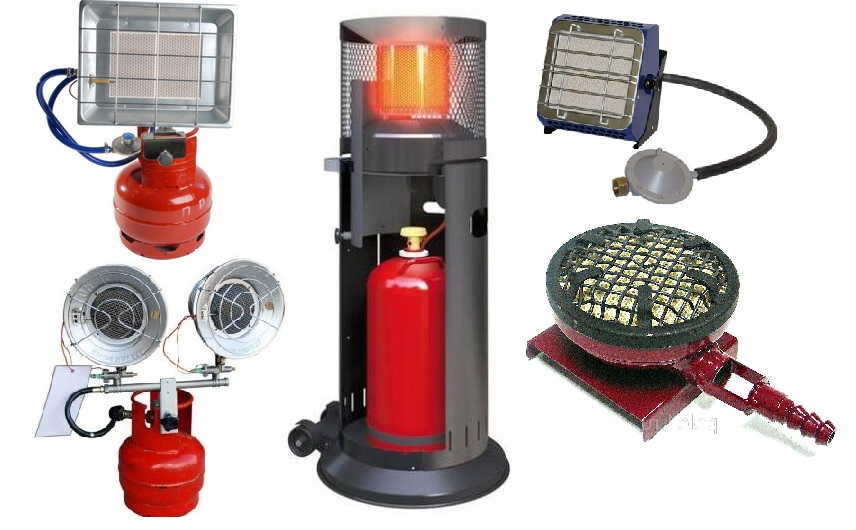
- How to choose a gas infrared ceramic heater
- How to choose an infrared heater for a summer residence
- How to choose an infrared gas heater for the garage
- Varieties of industrial gas IR emitters
- Light emitters
- Dark Emitters
- Gas: dark, light emitters
- How to make a gas heater for a garage with your own hands
- Popular models of industrial IR heaters
- Varieties
- Infrared
- Ceramic
- Catalytic
- Portable
- Features and principle of operation of a gas infrared heater
- How to choose a gas infrared heater (what you need to pay attention to when choosing)
- Peculiarities
- Conclusion
How to choose a gas infrared ceramic heater
Before you buy a gas infrared heater for a summer residence or at home, you need to familiarize yourself with a number of characteristics that determine the purpose of this device. Depending on the power, as well as design features, each of the options is most suitable for specific operating conditions.
The main guideline for choosing infrared gas heaters - this is their safety, so here you should exercise maximum caution and care.A mandatory requirement for the purchased model is a built-in automatic shutdown system, which is triggered when the product rolls over or is strongly tilted.
Today, such a security measure is considered mandatory.
In the choice, a serious role is played by where exactly the heater is planned to be placed. So, for residential premises, it is necessary to have a special sensor that will indicate the level of carbon dioxide in the room. Indeed, in the process of combustion, carbon dioxide is released, which can accumulate. In large quantities, it is unsafe for both health and human life.
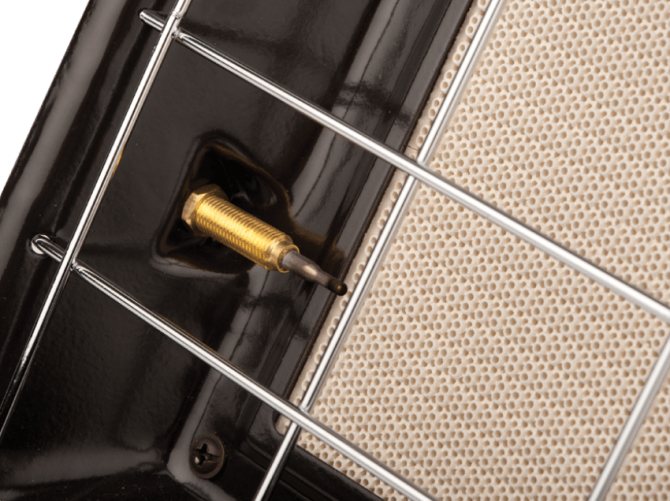
Ceramic heating element of a gas heater
In the presence of a special sensor, the level of carbon dioxide in the room is regulated as follows: the device regularly takes a sample, determining the current level. At the same time, he compares it with a given boundary. If the current level has reached the limit, the device switches off automatically.
How to choose an infrared heater for a summer residence
In order to buy a gas infrared ceramic heater, you need to focus on the mode in which it is planned to use it. Perhaps you will turn it on periodically when you come to the country for a few days. If long-term operation is planned, then the efficiency of the device will play a significant role, because its long-term use will entail certain costs.
When choosing an infrared heater for a summer residence, be sure to pay attention to the power of the device. There is a simple rule to be considered here: the more powerful the device, the less mobile it is.
And, accordingly, vice versa.A simple and lightweight device will never be able to produce the same power as a massive bulky heater.
The choice in this case is not affected by the total area of \u200b\u200bthe room. After all, such devices do not heat the entire room, so its size does not matter. Think in advance where you will install the heater, and what area it will need to heat.
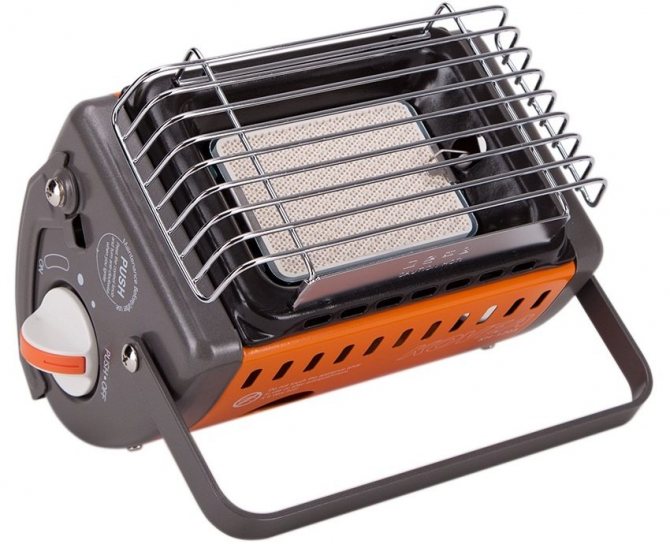
Portable gas heater Kovea Cupid Heater KH-1203
The appearance of the device will also play a big role, because everyone wants the heater to naturally fit into the environment and not create visual discomfort. Despite all its advantages, an infrared heater still cannot be considered a full-fledged heating device when it comes to permanent residence in the house. Its use is fully justified as an alternative for short periods of time, or as an additional source of heat.
How to choose an infrared gas heater for the garage
Buying a gas heater for a garage is one of the most difficult tasks. After all, initially this room is filled with a large amount of combustible substances, which, in combination with such equipment, create a fire hazard. Therefore, more stringent requirements are imposed on the safety of gas equipment.
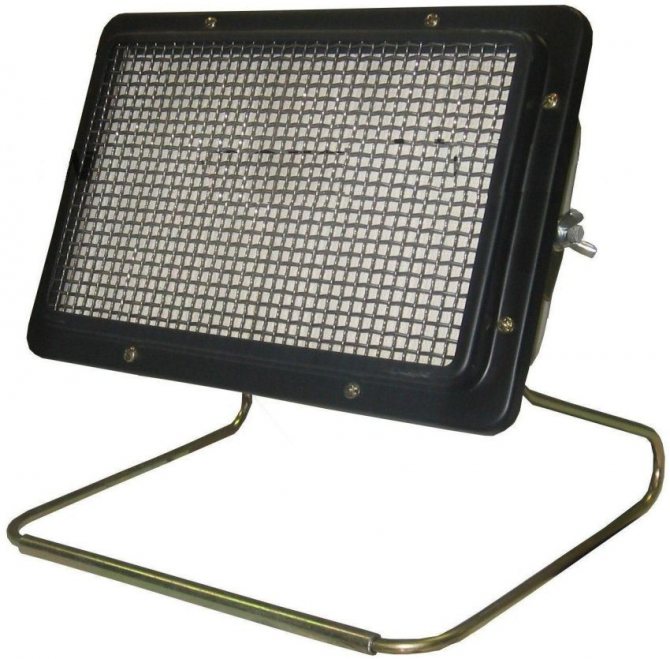
Gas heater is perfect as a source of heat for the garage
According to the type of construction, portable models are considered the most suitable for a garage, since, if necessary, you can change the direction of the heat flow. Optimum in a room of this type may be the use of a ceiling gas infrared heater.



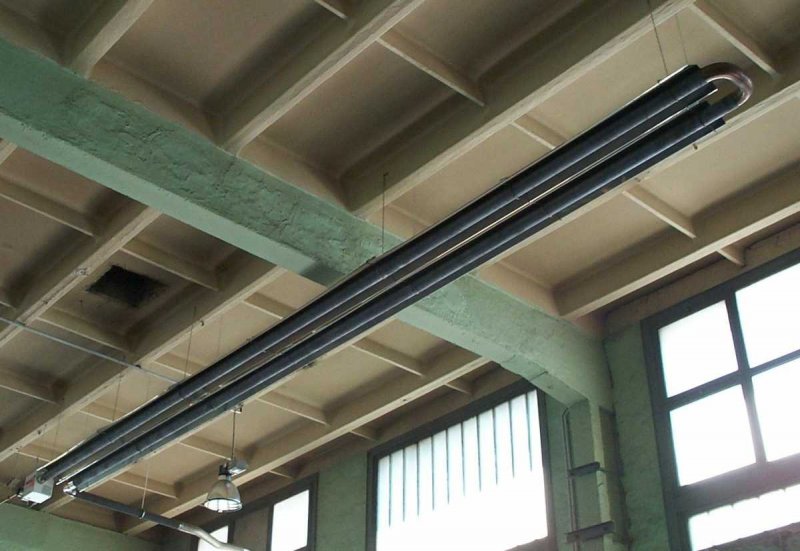
Varieties of industrial gas IR emitters
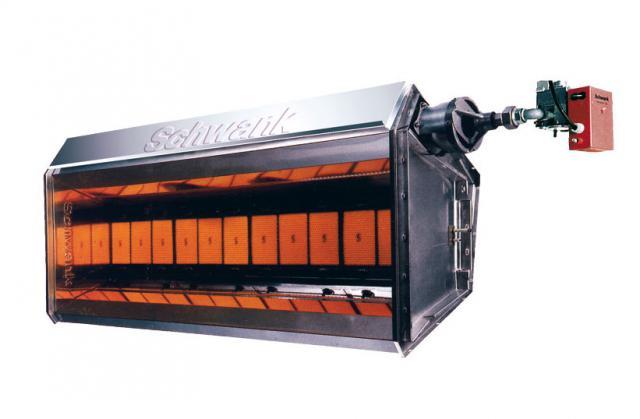
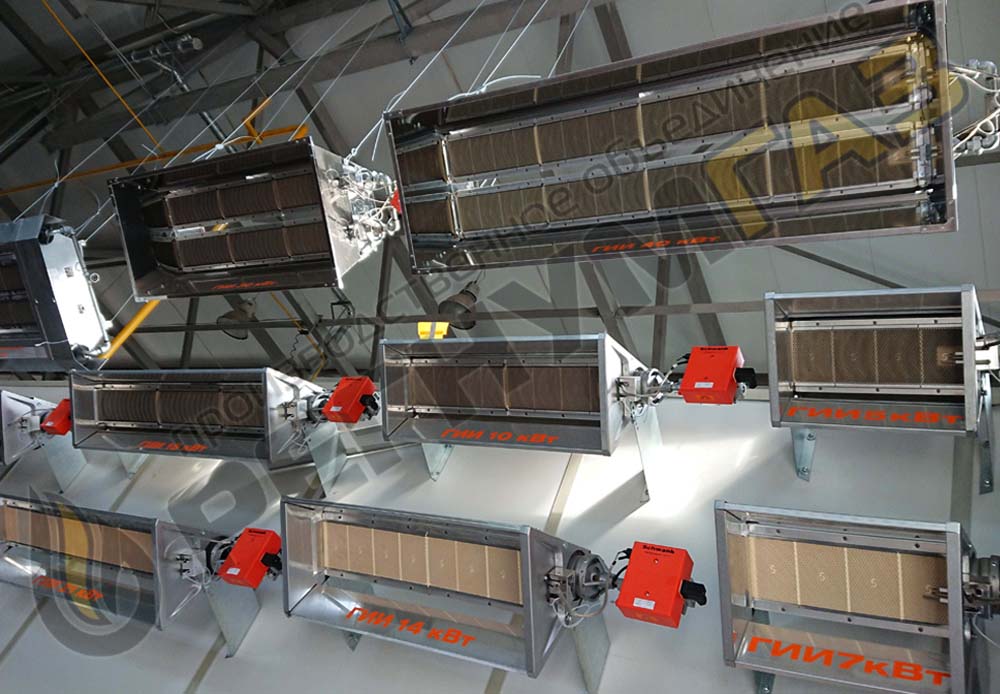
Light emitters
These heating systems are considered high-temperature and high-efficiency, since the most suitable ceiling height in the installation rooms should not be lower than 4 m. When calculating the power of the device, the ratio is used: 1 kW of equipment power = 20 m3 of the room.
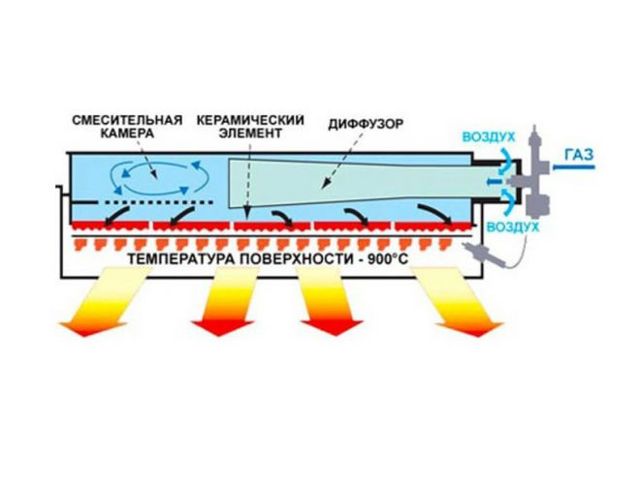
Ambient air is sucked in by the annular air intake due to the outgoing hot air and combustion products from the burner nozzle.
Such a heated mixture is sent to the pressure balance chamber, and then transported to the combustion chamber through the through holes. To eliminate combustion products, supply and exhaust ventilation or artificial exhaust is most often used.
Similar devices are used in forges, foundries and high machine shops. And also it is allowed to install devices in dusty rooms and rooms with high humidity. Often such heaters are installed in camp pavilions, tennis courts, etc.
Expert opinion
Afanasiev Mikhail Yurievich
Leading engineer of a company engaged in the production of energy-saving heating equipment.
IMPORTANT: Additional frame for the system gas infrared heater light radiation is not required, since they do not exert significant loads on the supporting structures.
Dark Emitters
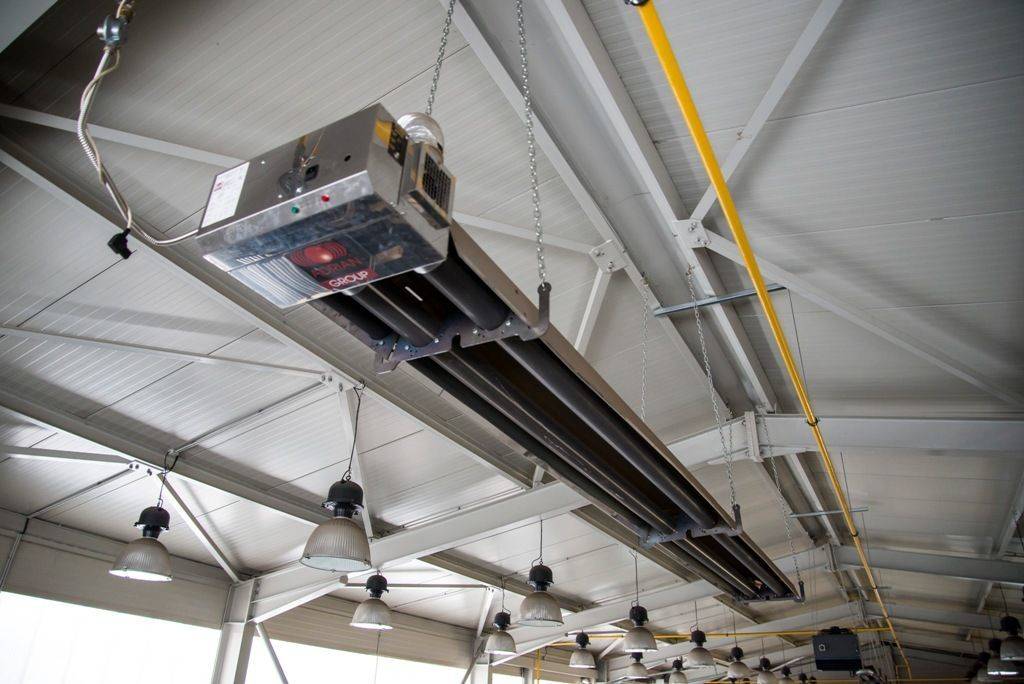
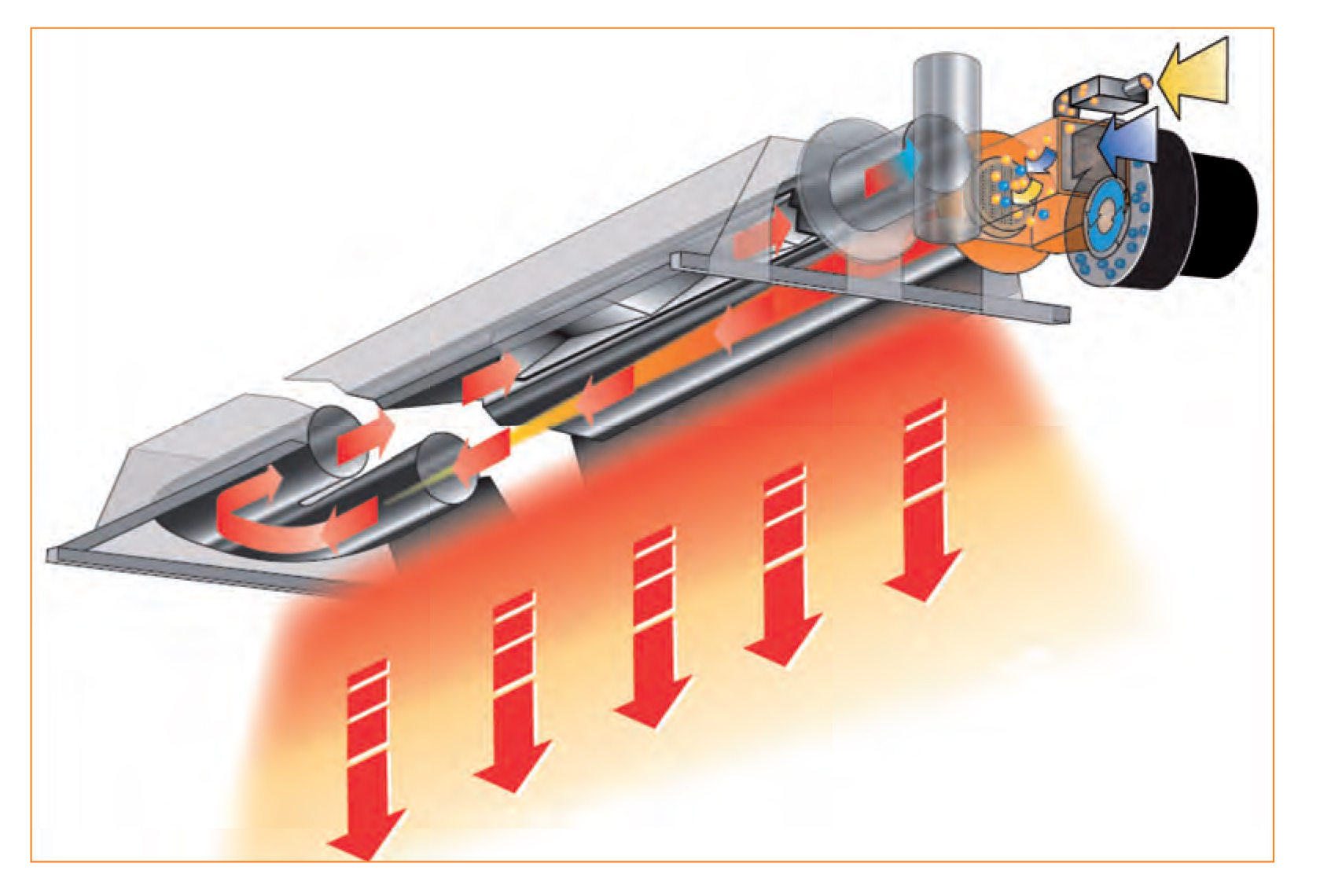
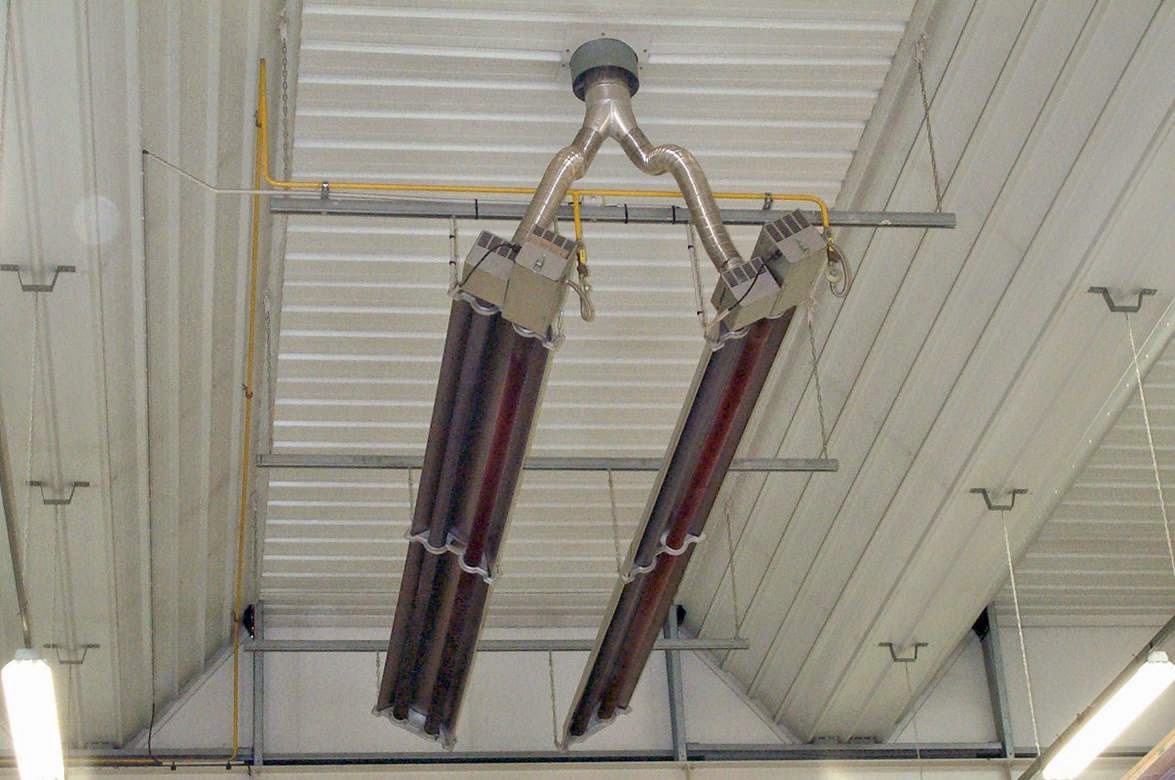
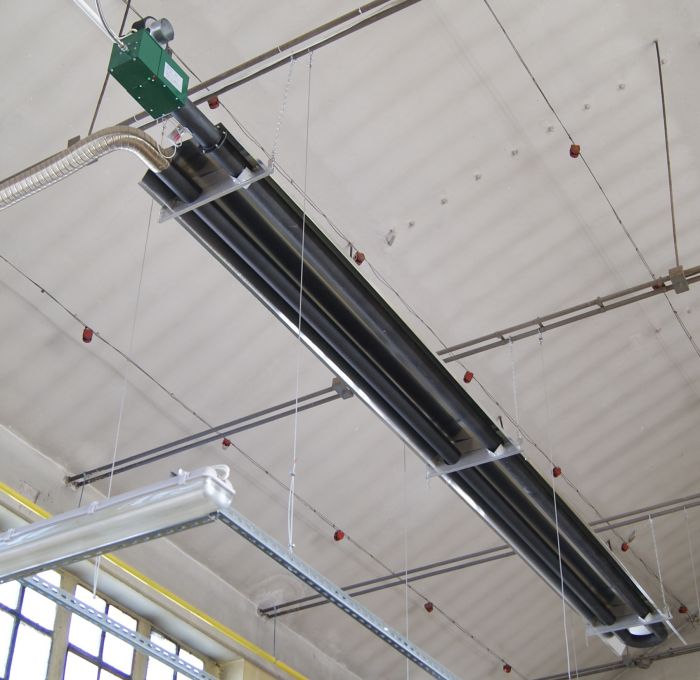
These devices got their name due to the method of low-temperature combustion of the gas mixture. If temperatures up to 1000 °C were reached in light systems, then in dark systems they do not exceed 450 °C. moreover, combustion occurs in a closed system with heating of the screen tube.
That, in turn, emits infrared waves in the range invisible to humans.Therefore, the heating element never turns red, yellow or white, as is observed in light types of heaters.
The design of the device includes the following components:
- gas outlet;
- radiating screen tube;
- reflector;
- gas stove.
Today you can find models with U-shaped or linear tubes. In the first case, due to the decomposition of the warm and cold emission spectra opposite each other, a uniform heating of the space is achieved.
In linear systems, the temperature will be higher than the end that is adjacent to the burner nozzle, so the radiation will slightly change temperature and intensity in certain areas. Such installations are used in rooms with a ceiling height of at least 3 m.
Expert opinion
Afanasiev Mikhail Yurievich
Leading engineer of a company engaged in the production of energy-saving heating equipment.
SAFETY MEASURES: The distance from the dark gas IR heater of explosive and combustible materials should not be less than 1.5 m.
This type of heater cannot be used in workshops and industrial warehouses with the processing and storage of flammable materials, offices and residential premises. Due to the larger size, complexity of installation and significant fuel consumption, such systems are mounted:
- in workshops where it was not possible to install light burners for some reason;
- in rooms where high temperature maintenance is not required;
- in narrow passages and corridors;
- in poorly ventilated large buildings located in isolation from the heating system.
Gas: dark, light emitters
Among gas equipment that emits infrared heat, heaters are divided into the following two types according to the intensity method:
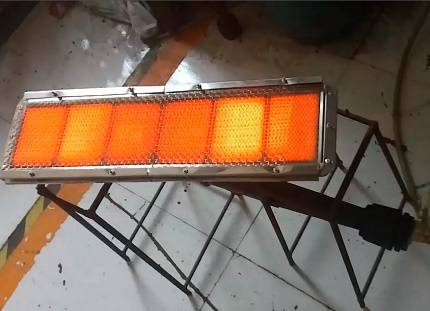
- Light emitters. The main feature is the bright reddish-orange color of the heating devices in the state of their incandescence. Variations of this class are able to glow their metal tubes (heating elements) to a bright intense color-light, while not overheating.
- Dark emitters. The main difference is the muted color of hot heating devices - metal tubes. They do not heat up to red, therefore it is conventionally customary to call them "dark" heaters.
Light infrared heaters are used to heat the space in a room with a floor-to-ceiling height of at least 4 meters. Their productivity is always higher than instances with a lower heating intensity. Such devices should be installed from a simple calculation: for every 20 cubic meters. m. it is required to supply one heater with a power of 1 kW. If we take into account large areas of premises, then for every 100 sq. m. space will need one device, the power of which is 5 kW.

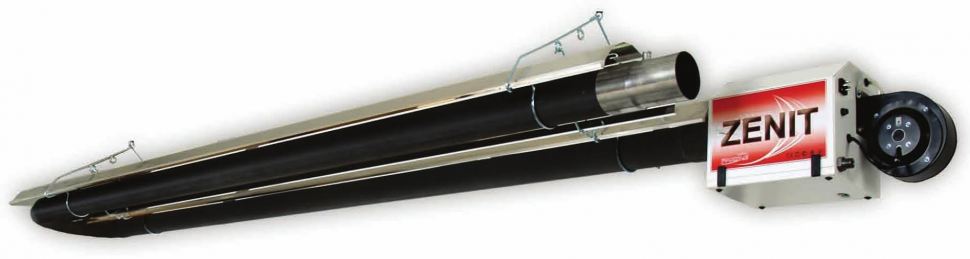
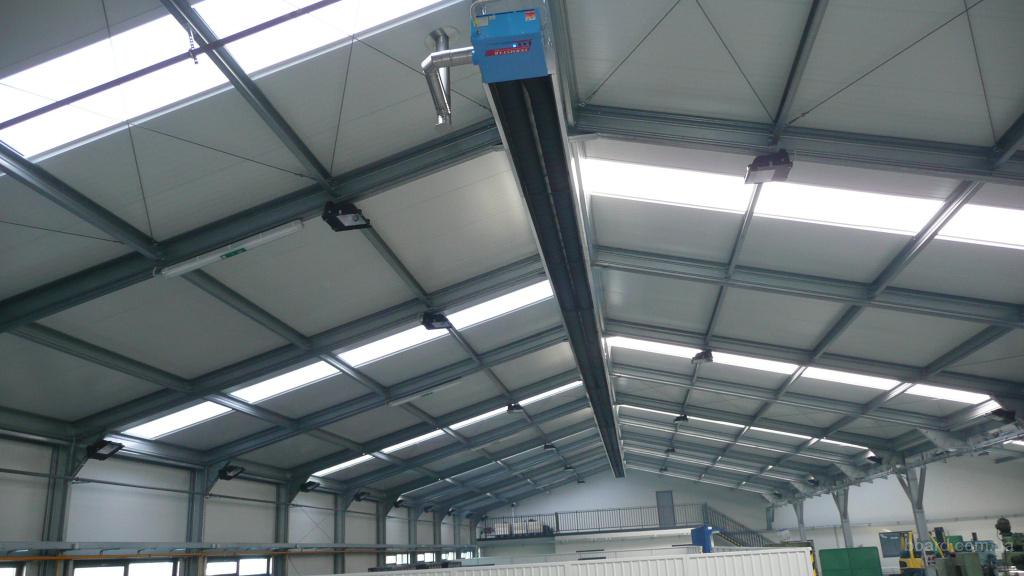

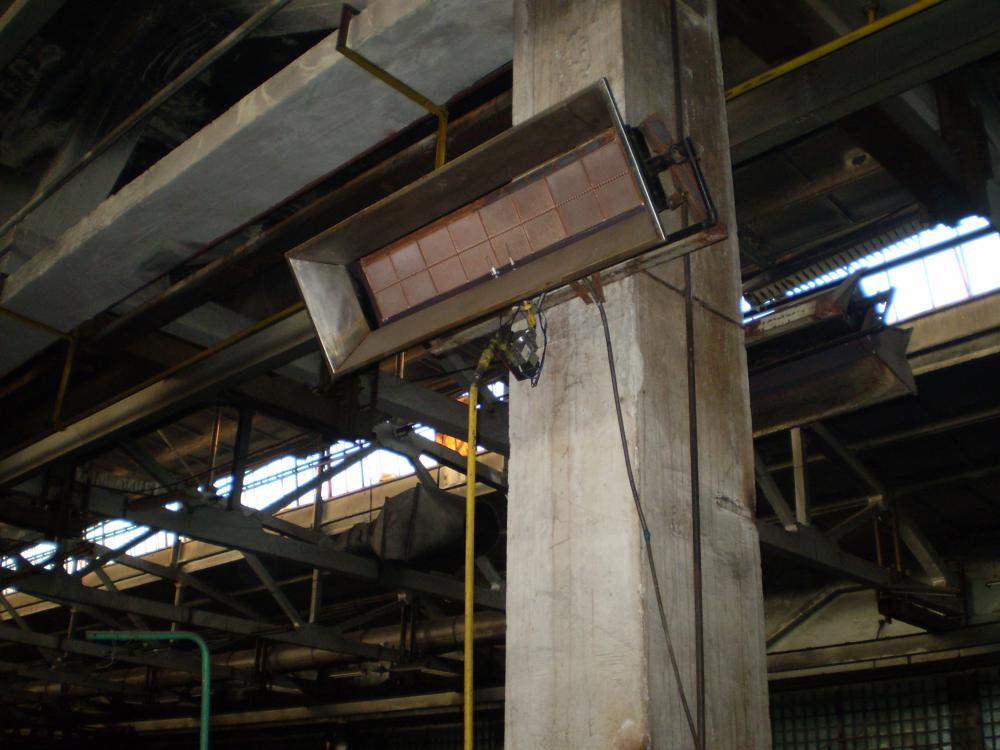


Dark ones are designed to heat the space in a room with an installation height of 3-3.5 m. The gas is burned in this case at temperatures from 350 to 400 degrees Celsius. These installations are much heavier in weight than light-type equipment. Therefore, this factor should always be taken into account during installation. To select this or that equipment, you need to look at the height of the ceilings in the room, the type of activity of the enterprise and the existing ventilation.
How to make a gas heater for a garage with your own hands
The price of a gas heater for a garage is not always acceptable, and in some cases you have to rely only on your own strength. Independent design of heaters has long been tested, and simple and understandable instructions have been compiled for craftsmen.
Homemade ceiling gas heater in the garage
Here are a few simple rules to keep in mind before you even get started:
The main requirement for both factory and home-made gas appliances is safety.
Give it as much attention as possible.
It is better to purchase ready-made (factory) elements that are responsible for supplying and shutting off gas, as they determine the safety of using the entire structure.
The simpler the mechanism of operation of the device, the better.
Pay attention to economy, otherwise the use of such a device may cost you dearly.
Use inexpensive, but high-quality components that will serve as a reliable basis.
In addition, you can not do without a special burner equipped with a valve
In order to make a high-quality heater with your own hands, you will need the following parts: a sheet of metal, scissors, rivets and a riveter for their installation, a fine metal mesh, a sieve and a gas cylinder. In addition, you can not do without a special burner equipped with a valve.
First of all, you need to attach a heater to the burner. To do this, a sieve attached to a metal sheet is circled with a marker.After that, parallel and perpendicular to each other, you need to draw rectangular ears. In this case, one of them should be 2 times longer than the rest. Then, using scissors for metal, you need to cut out the resulting pattern.
Kovea Isopropane Gas Cylinder
After that, the elements must be fastened together: the burner is attached with bolts to a metal circle that has been cut out. The ears are wrapped in opposite directions, and a strainer is attached to them, which will act as a diffuser. This is a ready-made element of a homemade heater.
Next, you can proceed to the fastening of the metal mesh. For this purpose, it is necessary to once again draw a circle with ears on a metal sheet and then cut it out. Next, you need to fix the mesh, which is attached to the ears of each of the circles, forming a mesh cylinder.
When all the elements are ready, you can connect them together and connect the finished product to a power source.
Street assembly steps ballu infrared heater BOGH-13
If you cannot afford to manufacture the device yourself, then the main thing you should focus on when choosing a gas infrared heater from a cylinder is customer reviews, as well as the technical specifications indicated by the manufacturer. Be sure to consider exactly where you plan to use it, as well as for what purpose. If you devote enough time to choosing the right model, then the purchased device will certainly meet all your expectations.
Popular models of industrial IR heaters
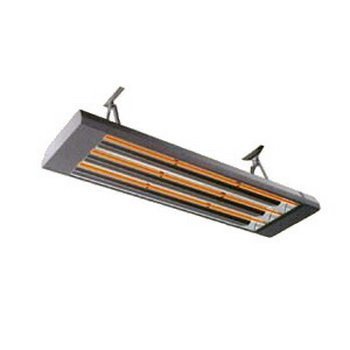
On the market of heating systems, you can find a huge number of different models of emitters operating on gas and electricity.Proven Russian manufacturers of thermal devices:
- IcoLine;
- Peony;
- EcoLine;
- Mr Heath;
- Infra.

According to users, Pion offers good mobile and stationary heating systems. Before buying, make sure that this is not a Chinese fake. The operating time of the Pion emitter of the latest models is much longer due to the improved quality of the aluminum reflector. The maximum heating area of one installation is 80-100 cubic meters. Among foreign manufacturers of IR heating systems for industry, the following can be distinguished:





- Helios;
- Hyundai;
- Zelion;
- Starproghetti.
Industrial IR automatic electrical systems are distinguished by practicality, high power, quality, long service life and safety, if you choose South Korean and European manufacturers: Siemens, ABB, Du Pont.
Varieties
There are mobile gas heaters for giving several varieties.
Infrared
It works on the principle of converting the heat released during the combustion of fuel into infrared radiation.
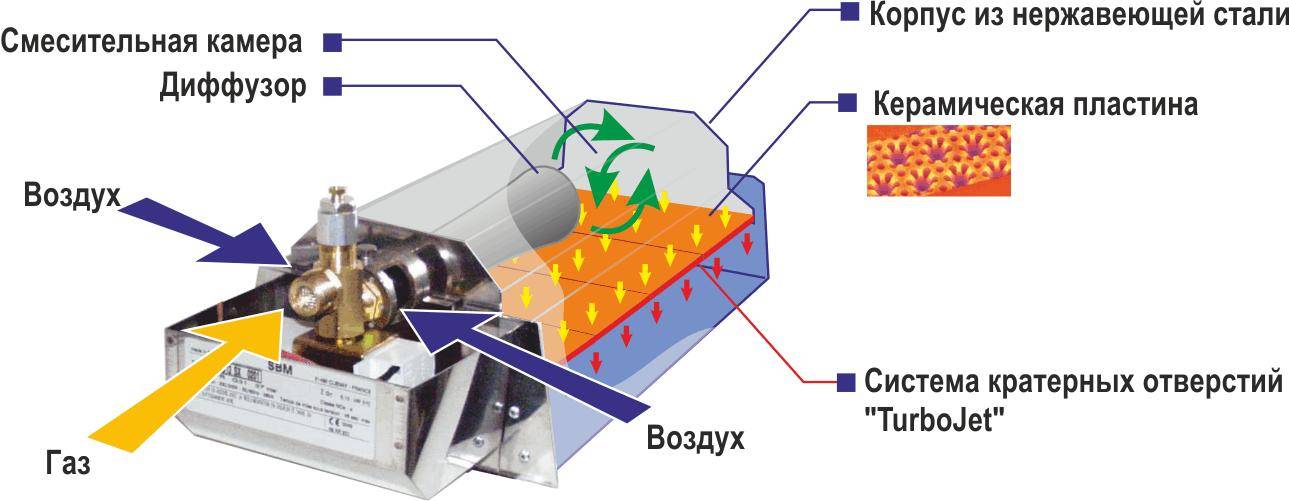
A burner, a valve, a combustion regulator and a heated panel are placed in a metal case. She is that emitter. The panel can be made of metal pipe, mesh, perforated sheet, ceramic, etc. When heated to 700-900 degrees, the panel emits infrared waves. They give off thermal energy not to the air, but to the surrounding objects. From them, the air gradually warms up. The infrared gas heater works on this principle.
This variant of direct heating, when combustion products are discharged inside rather than outside, is optimal for short-term use in well-ventilated areas.
If it is possible to install an indirect heating heater, it is better to buy it.
Infrared gas heater for giving with a cylinder.
Ceramic
According to the method of heat transfer, the gas ceramic heater belongs to the infrared type. The main element of the heater is a ceramic insert or panel. It serves to convert combustion energy into thermal radiation.
If it is possible to connect to a portable cylinder, the device will work autonomously. This is convenient, especially for owners of country houses located where there is no infrastructure yet, or it is turned off for the winter months.
To turn on the heater without automatic ignition, you need to bring the flame from a match or lighter to the top of the ceramic panel. It is strictly forbidden to kindle a flame near the nozzle.
Ceramic gas heater for giving with a cylinder.
Catalytic
One of the safest heating devices is a catalytic gas heater. The main difference from other types of similar devices is the flameless combustion of fuel and the release of heat during the oxidation reaction. Since the gas heat source works without fire, combustion products are not released into the room air.
The main element is a catalytic or catalyst plate made of fiberglass, with the addition of platinum. When fuel hits its surface, an oxidative reaction begins, during which thermal energy is released.
The consumer heats the house, but does not receive the negative side effects that occur during conventional combustion, such as burning oxygen in the air, saturation with carbon dioxide. A catalytic gas heater in this regard is much safer and more environmentally friendly. These are the main advantages of such a device, judging by the user reviews. It also has disadvantages, the main of which can be considered the cost. The catalytic plate develops its resource after 2500 hours of operation. It costs almost as much to replace it as to buy a new heating source.
It is more expedient to replace the unit that has exhausted its resource with a new one, rather than buying a plate for it.
Catalytic gas heater for giving with a cylinder.
Portable
Portable gas heaters for heating will be useful in field conditions, in buildings not equipped with any type of heating. In the back of the device is a small gas cylinder with a volume of 200 ml to 3 liters. The fuel consumption of such a heater is 100-200 g / h, the power is not more than 1.5 kW / h. A portable heat source works like infrared. With the help of piezo ignition, a flame appears in the burner, which heats the ceramic plate. Radiation from it provides the necessary heat.
Relatively inexpensive, cheap, light, convenient, designed for heating small rooms up to 15 m2, garages, tents.
Portable gas heater for giving with a cylinder.
Features and principle of operation of a gas infrared heater
Heating equipment warms in two ways - thermal (infrared) radiation and by heating the air.The first method is involved in gas infrared heaters, which are actively used to heat open areas and premises for various purposes. They do not heat the air, but the surrounding objects, creating warm and comfortable conditions for a long stay of people.

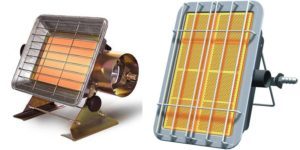
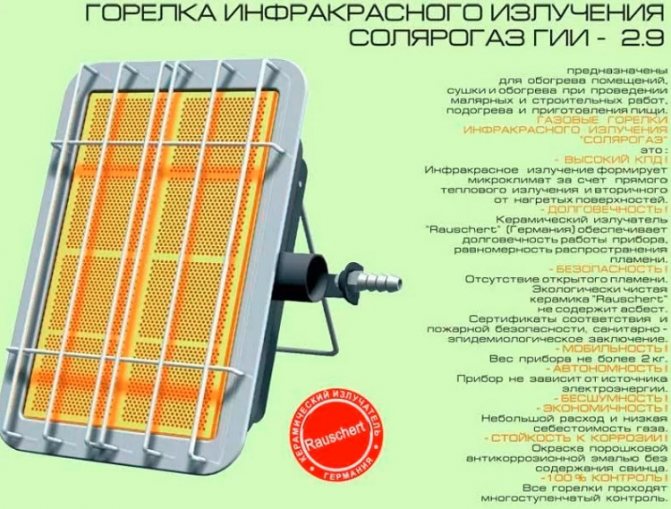


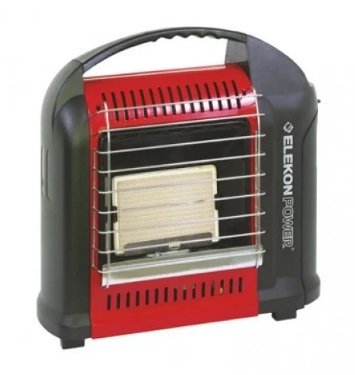


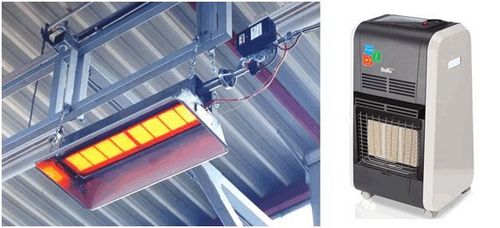
Gas infrared heaters are most often used for heating outdoor areas, but nothing prevents them from being used for space heating. If you like to arrange evening gatherings with tea in the open air or on the veranda, then this unusual equipment will be a pleasant gift for you. It will create a warm zone in which adults and children will be comfortable.
Gas-powered infrared heating devices will become indispensable for heating areas with swimming pools, industrial premises, summer verandas, open areas of street cafes, sports grounds and residential premises. The powerful infrared radiation generated by these devices will allow you to quickly warm up the surrounding objects and warm people, consuming a minimum amount of gas fuel.

The device and principle of operation of a gas infrared heater.
How are gas infrared heaters arranged? Inside them we will find:
- burners with ignition system;
- emitters - they generate heat;
- control circuits - they regulate the gas supply.
The task of a gas infrared heater is to generate infrared radiation. For this, ceramic and metal elements are used here, heated under the influence of an open flame. When heated, they become a source of thermal radiation that heats the surrounding objects.
To form a certain zone of influence, some models are provided with reflectors that ensure the directionality of infrared thermal radiation.
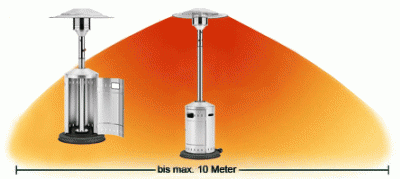
The device evenly heats the surrounding objects at a distance of several meters from it.
The infrared radiation that occurs during operation warms up the surrounding objects, which is why they begin to give off heat. It is felt even at a distance of several meters, allowing you to heat large spaces. To increase efficiency, some models use additional fans that increase the intensity of flame burning.
Due to their design and principle of operation, such models are used for heating restaurant terraces, open courtyard areas, summer verandas, as well as residential and industrial buildings.
As already mentioned, heat is generated by burning gas - it is stored in built-in or plug-in cylinders. One filling, depending on the power of the burner and the capacity of the cylinder, can last for 10-15 hours of continuous operation. Due to the fact that gas combustion is carried out in an open form, heaters are installed only in well-ventilated places.
If you plan to heat the premises with such a device, do not forget to open the vents - the combustion products (there are not very many of them) should be freely removed outside by a natural draft.
How to choose a gas infrared heater (what you need to pay attention to when choosing)
A modern gas heater is an efficient device that is successfully used for heating rooms of any type.In addition, open areas are also successfully heated.
Selection Tips:
- When planning the purchase of a gas heater, you need to make the right choice so that the device can cope with the tasks and the money is not just thrown away.
- The first thing that must be taken into account is the power of the chosen model. According to experts, 1 kW of power is able to heat an area of 10 m2.
- In order to effectively heat an open area, it is better to buy a device that looks like a tall lamp - these are the ones that provide a circular heating zone, which allows you to heat terraces, verandas, areas near pools, playgrounds, etc.
- In order to heat the utility room, a floor model is suitable.
- Catalytic models are suitable for all kinds of rooms. including residential ones, since their work is safer for others.
- For rooms of large areas and in the presence of a gas main in the house, it is worth taking a closer look at stationary gas convectors. These heaters look aesthetically pleasing and successfully replace standard heating radiators.
- The choice should also be made taking into account the time spent by people in the room. If their stay is periodic, and not constant, then catalytic models are quite suitable.
- With regular heating, especially if there are children, wall convectors are preferable. When mounting them, it is necessary to make a hole in the wall for a coaxial pipe, through which both air intake and exhaust gases are carried out. True, a project is needed to perform such an installation.
- In the garage, ceramic models are an excellent source of heat, they emit infrared radiation, which transfers heat to surrounding objects.
- When going camping, it would be the height of frivolity not to take a compact heater with you, which is also used for both heating and cooking. Such a heater should be compact, lightweight and productive - the tent keeps heat very poorly.
Peculiarities
A gas infrared heater is a heating device whose main function is to heat objects and heat areas using infrared rays.
The main indicator proving the energy efficiency of an IR heater from gas is the radiant efficiency. The indicator of such efficiency expresses the percentage of energy that is converted into heat radiation reaching the heating zone. New models of infrared heaters from gas can have heat transfer up to 80%.
These heating devices are very convenient: they do not require a power supply network or a gas network (gas supply in cylinders can always be available). Some models are equipped with a remote control.
Thanks to the direct transfer of heat using infrared radiation:
- Energy is used more economically (only for its intended purpose).
- This method of heating makes it possible to create a local thermal zone in a short period of time.
In addition, these devices will help to keep warm even outside the premises, for example, if you decide to relax in the company on the porch or in the gazebo.
The absolute advantage of an infrared gas heater in a simple design.
The gas burner is located in the metal case.There is also a burner adjustment device and a valve system, which are responsible for explosion and fire safety in case of malfunctions in the functioning of the gas device or overturning of the structure itself.

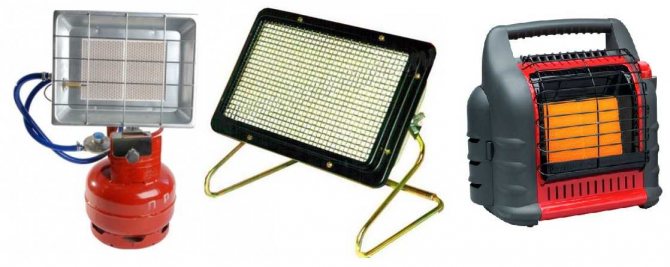

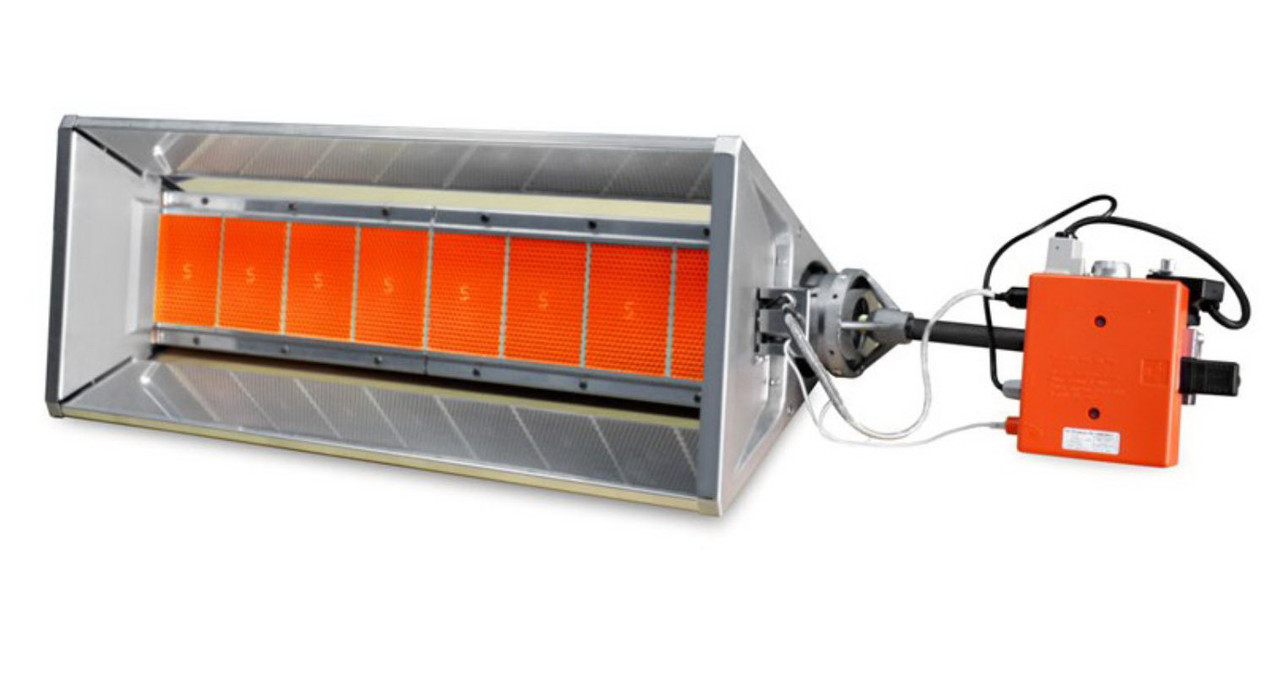
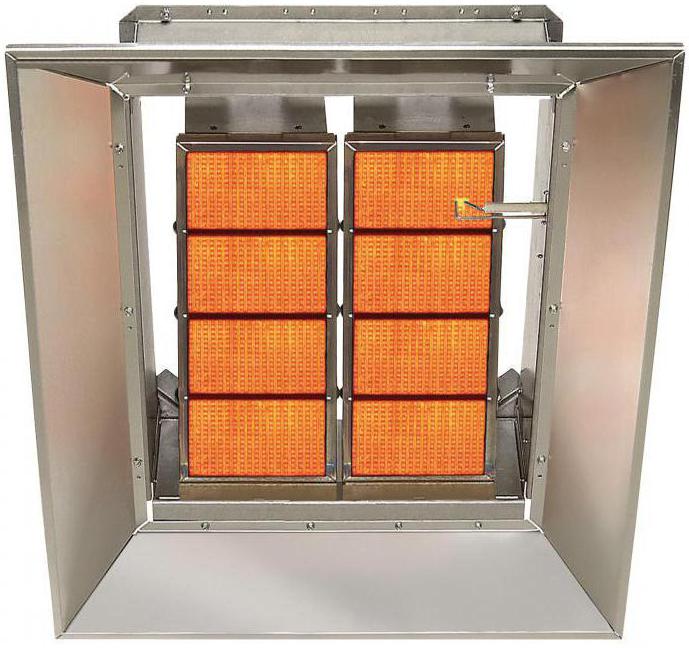

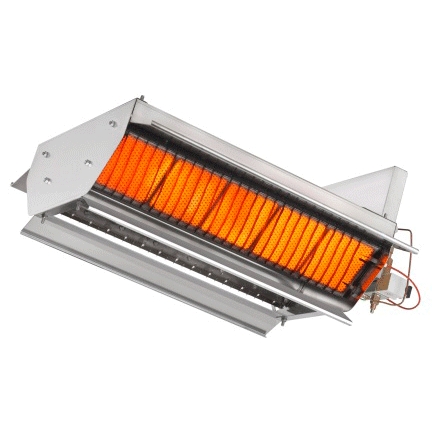

However, this is not all. Separately, a gas burner is not yet a heating device. Of course, you can warm up to her, as you would warm up with a gas stove. But most of the energy of the combustible gas will be spent on heating the air, which, according to physical laws, will rise up. In order for the burner to become a heater, IR emitters of various designs are used. These can be meshes, perforated sheets, metal pipes, and so on.
According to the design features of gas infrared heaters using the same principle of radiant heating, tubular gas infrared heaters can be distinguished. Their main constituents are:
- blast burner;
- metal pipes for radiation.
Conclusion
Electrical equipment is more costly in terms of money than gas equipment if main gas fuel is used. Dark units are heavier in weight and should be mounted on special brackets or suspension fixtures, while bright IR units are much lighter. Without preliminary calculations, it will be extremely difficult to arrange such a system so that it works optimally. It will be necessary to take into account the parameters of the room, the special conditions of production, the use of heaters, as well as their characteristics. With a small heating area for which the device is designed, you should simply install several of the same.