- Types of storm sewers
- Roof drainage elements
- Vertical drains
- Proper storm sewer care
- Stormwater repair and cleaning
- Storm sewer treatment devices
- Laying rain sewer installation features
- Prevention of clogging of storm sewers
- surface drainage
- What it is
- What are the functions of drainage systems
- Kinds
- The device of external drainage systems of a private house
- The structure of the drainage system
- Storm sewer elements
- Typology of storm sewers
- Elements of the drainage structure
Types of storm sewers
The design of rainwater drainage requires
developer of knowledge of ways to collect and transport wastewater. There are different design options
storm water drainage system. According to the method of transportation:
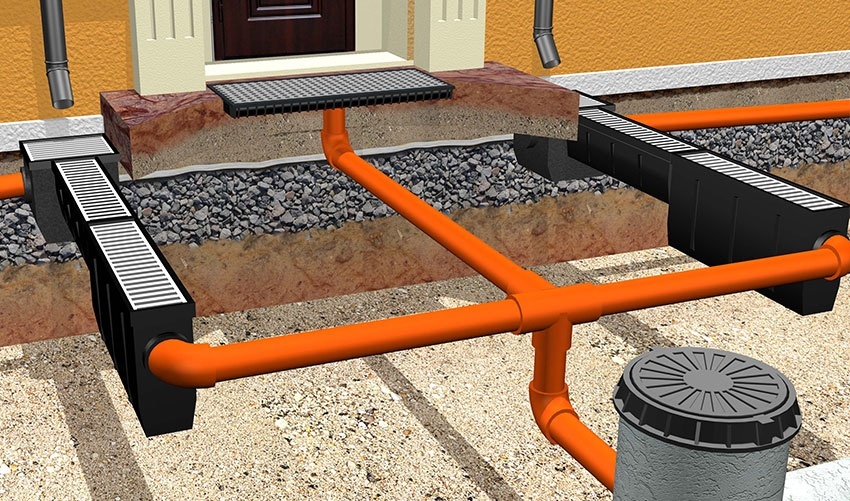
- closed channels. Water enters the receiving wells, from where it passes through an underground pipe system to a treatment plant, or to a discharge point. The most difficult option, requiring an accurate calculation of the pipe section, determining the number of drains, etc.;
- open lines. Drains move along an above-ground system of trays or gutters. The option is convenient for ease of maintenance and cleaning of channels.Often used in urban areas, where rainwater contains a large amount of debris and sand;
- mixed. They consist of open and closed areas. This option is most common, as it allows you to save on earthworks.
How to collect water:
- point. This is a system of receiving wells connected by pipes. It collects runoff from lowlands, areas under drainpipes, etc.;
- linear. They consist of extended receiving troughs. This is a good way to collect moisture from large areas, paved parking lots and other areas.

The choice of the appropriate option is
important criteria:
- configuration and layout of the site;
- the state of its surface;
- the way it is used.
It must be taken into account that
efficient collection of effluents will be required in any case. Correctly composed storm sewer scheme
provides the most complete removal of rainwater. Otherwise, the water will
flock to lowlands, penetrate cellars, destroy the foundations of buildings and
structures.
Roof drainage elements
Storm water the system consists of such elements:
- Gutter. This is the main part of the structure, which is fixed directly under the slope of the roofing material and receives water flows. It is installed along the perimeter of the structure at a slight slope.
- Funnel. With its help, water is directed to the drain pipe. To prevent the ingress of large debris or leaves, it is better to equip the funnel in its upper part with a protective mesh.
- Elements for draining liquid into the sewer.
- Internal and external corners. Are applied in a difficult design.
- Couplings. They serve to connect the gutters if the structure is long.
- Knee.The element is installed at the bottom of the drain and drains the liquid further from the structure.
- Brackets and clamps. These are connecting elements for pipes and fixing gutters.
- Stub. It is installed to restrict the flow of water.
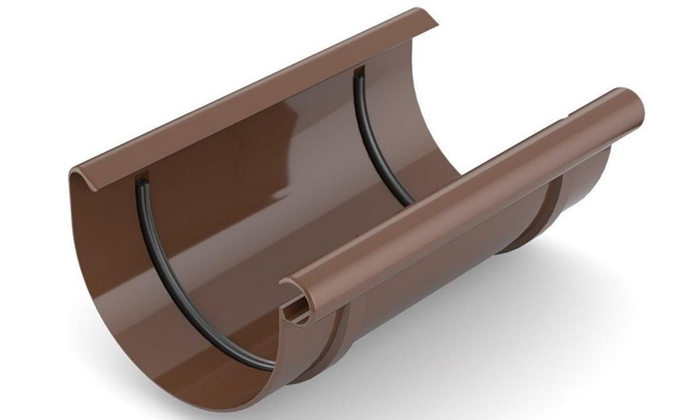
You can buy both a standard system and order the manufacture of an individual project.
Vertical drains
Such structures are represented by a well in which pumping equipment is located (wells are pumped out with the help of pumps). As a rule, such drainages are operated in the agricultural industry, and they are also actively used for drainage of land during road construction.
When laying this system, wells and trays are used, which, as a rule, are located on a waterproof layer. In addition, such a system is necessarily equipped with deep pumping elements. Such a drainage system is considered the most effective. And if the land on the territory of a particular site has a high coefficient of water resistance, then such a structure will be not only effective, but also quite economical.
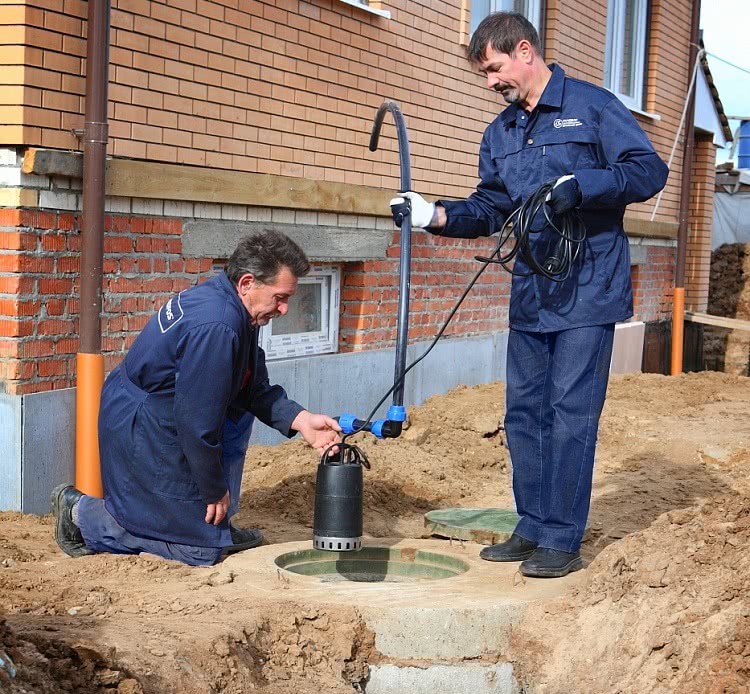 For a vertical drainage system, suction pump water from wells
The depth of laying vertical drains can be different, since everything in this case depends on the level at which groundwater is located. It can be both 20 and 150 meters, depending on the characteristics of the soil on which the site is located.
Such borehole drainages can operate in various modes (the mode is selected based on the time of year). Do not forget that such systems require periodic preventive maintenance. filter inspections and cleaningswhich consists of sand and gravel.
Proper storm sewer care
Storm sewers designed to collect and drain rainwater from the site also need maintenance.
Stormwater repair and cleaning
A signal that the system is failing will be a deterioration in its throughput or a complete obstruction of the structure. When such symptoms appear, the storm drain is opened and inspected. After detection of defective segments, they are replaced with serviceable ones. Then the system is tested. If everything is fine, they fall asleep with soil. It should be borne in mind that all work must be carried out quickly, otherwise there is a risk of flooding of the territory. This is especially true for areas where the function of storm sewers includes water purification.
To set up the system commonly used steel pipe diameter 100 mm. Proper installation of a storm drain also implies the presence of a water seal with a drain valve for water discharge. Metal parts corrode over time. During the repair, defective areas are replaced with plastic parts of the same diameter. Steel should leave only the outlet of the pipe, which is located directly after the shutter. This will make it possible to increase the mechanical strength of the system. Periodic cleaning of the storm drain is carried out in the same way as cleaning the drainage system.
To protect storm sewers, filter elements are required to trap large contaminants.
Storm sewer treatment devices
To reduce the number of system cleanings, special elements are used that are installed directly into the structure. The simplest device is a filter that traps large debris.For the most effective wastewater treatment, the following equipment is used:



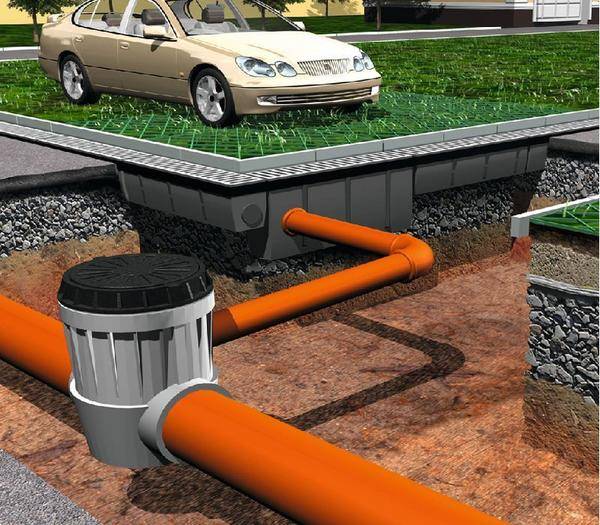


- absorption blocks;
- sand traps;
- ultraviolet disinfection stations;
- filters catching oil products;
- settling tanks;
- separators.
When choosing cleaning elements for storm water, one must proceed from the existing conditions. For ordinary private houses, a sand trap will be enough. Everything else may be needed only for industrial premises. For example, if cars are being repaired in a storm sewer area, it would be desirable to install a filter that captures oil products.
For guard private storm sewer at home there are quite enough filters that trap large debris and sand traps
Regular maintenance of the drainage system and storm sewers is the key to their long and trouble-free functioning. You should not save on cleaning procedures and neglect the simple rules of proper operation, the failure of the system and the need for its complete replacement will become a very costly undertaking. A prudent owner understands that regular cleaning of the system, carried out independently or with the involvement of specialists, keeps the system in working order and extends its life.
Laying rain sewer installation features
As a rule, the storm sewer on the site is mounted exactly according to the same principle as the sewer in the house, and the differences between them are observed only in materials and assembly nuances. The most important difference lies in the slope, which in this case is 3-5 mm per 1 m of the gutter or pipe - it is this slope that allows the water flow to safely carry away all the garbage with it and not deposit it on the pipes.In addition to this nuance, there are a lot of other points related to the direct installation of rain sewers.
-
Instead of plumbing fixtures, water inlets are used in this system - as mentioned above, they are mounted either in places where water is likely to accumulate, or directly under downpipes.
- The discharge point in this system is not the central city sewer, but a lowland, a river, a beam or just a drain pit - it should be noted that a pit is made separately for rain sewers.
- All water intakes are combined by means of inspection or revision wells into a single line, through which water goes to the discharge point. A well is a tee through which, among other things, you can always clean the drainage pipes.
- Polypropylene pipes are placed on a sand cushion, the thickness of which should be at least 5-10 cm. It is with this cushion and the bottom of the trench that the slope of the pipes is formed.
- The initial backfilling of pipelines is also carried out with the help of sand - you should not throw stones or soil with debris directly onto the pipes. During operation, soil movements occur, and these stones will very quickly disable the rain sewer system.
-
A filter funnel is mounted under the downpipe (in front of the storm water inlet), the task of which is to trap large debris and prevent it from penetrating into the system of pipes and gutters.
In principle, there is nothing complicated here, but for such a system, or rather for specialized material, you will have to pay a lot of money - an open rain sewer system is much cheaper to manufacture on your own.You will also have to buy material for it, but here there is one option - it is made of concrete, and no one will stop you from buying molds for them instead of ready-made trays and casting gutters with your own hands. This is a simple process that almost every man is able to handle.
The only thing I will add at the end of the topic is to remind you that if you are interested in a really good rain sewer that does not spoil the interior of the site with the appearance of its gutters, then it is better to choose closed underground installation system. Yes, it is more difficult to manufacture, but it does not hold advantages.
Prevention of clogging of storm sewers
In the photo, a sewage treatment system for storm sewers
Timely maintenance of storm sewers ensures a long service life. It is necessary to constantly monitor the state and conditions of the functioning of the structure.
Storm sewer maintenance rules:
- During rains manholes should be covered with manholes.
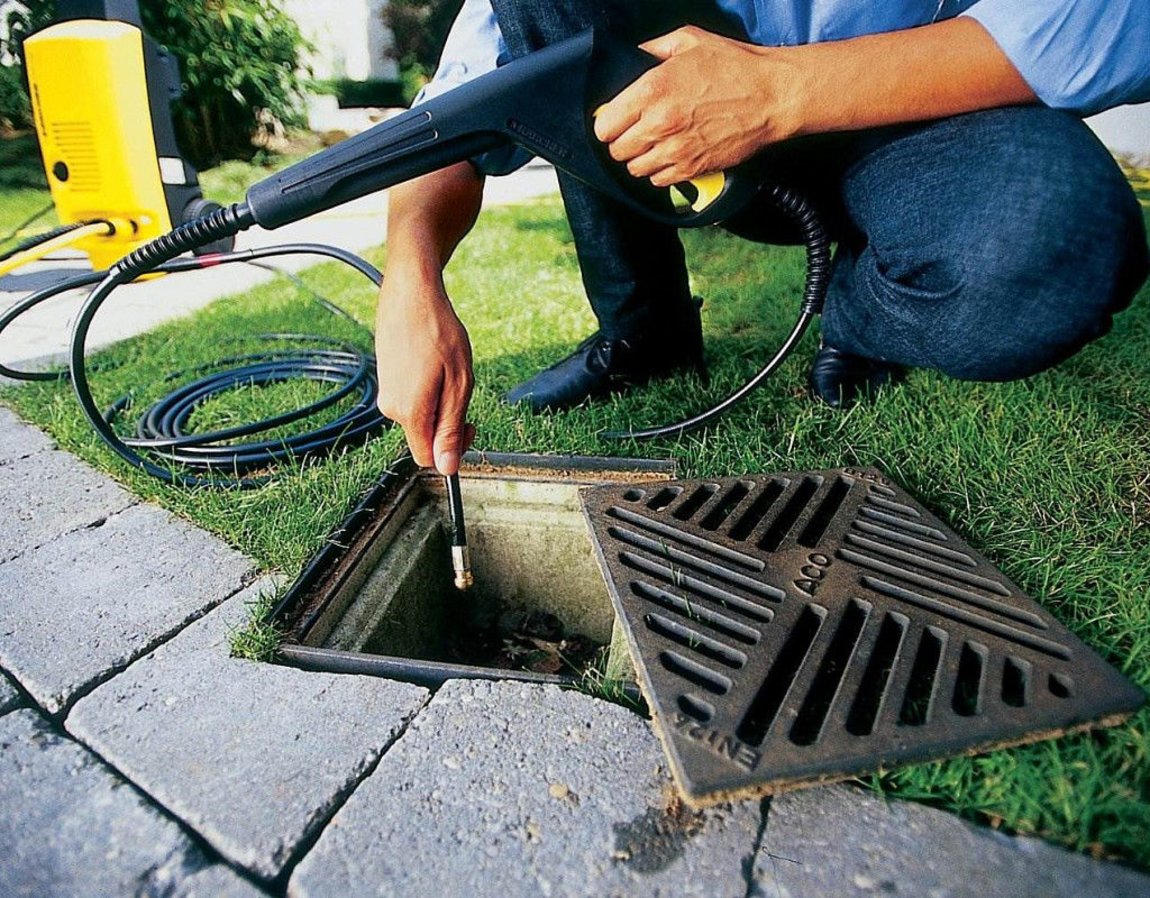
- Be sure to inspect your storm drains twice a year. In the spring, when the ice has not yet melted, check the cleanliness of the pipeline. In this way, you will ensure the free flow of water during a flood. In autumn, remove large debris from the channels that accumulates throughout the season. If a large amount of sand is found, remove it with pressurized water.
- Sometimes an open system has to be cleaned more often: after construction work on the site and in the house; if there are tall trees near the building; after heavy rains.
- Once every 10-15 years, it is recommended to overhaul storm sewers. At this time, the layers on the walls are removed and the elements of the highway are repaired.For cleaning pipes, a pneumatic device with a shaft and nozzles is used. The system is flushed with pressurized water, which is supplied from both sides of the route.
To avoid clogging of the structure, it is necessary to install the maximum number of elements to retain debris and filter water. They are selected depending on the operating conditions of the storm drain. These include:
- Sand traps. Devices are installed in places where water accumulates: at the beginning of the sewer route; near sidewalks and platforms; under vertical roof risers; after rainwater. The interior of the device is divided into many small chambers by partitions. After moving through the sections, the water loses speed, heavy particles fall to the bottom of the tank and remain there. For the convenience of removing debris, the inside of the tank is made removable.
- filter baskets. They prevent foreign objects from entering the storm water inlets.
- Centrifuges and grease filters for separating oil from water. Without such devices, oil products harden and clog the highway. Devices are installed near garages and workshops where cars are repaired.
- Lattices and grids with small cells. Installed on trays that collect water from the surface of the site. They hold up leaves, branches, etc.
- Gasoline collection devices. They are also able to collect kerosene and other petroleum products. Installed near the garage.
- absorption wells. They are built into the highways for the accumulation of garbage coming with water.
- Sumps and separators. Tanks in which water settles, and dirt settles to the bottom. After them, rainwater can be sent to filtration fields for disposal in the ground.
- Devices for disinfection. UV treatment stations are designed to destroy harmful microorganisms in the system.
- Manholes. They are mounted in places of sharp turns of the highway. At this point, the flow loses speed, debris settles to the bottom and eventually blocks the pipe. Manholes are built large enough to go down to the pipes and remove dirt from them. Through the collectors, you can monitor the condition of underground sewerage sections.
Most products are designed for industrial use, but if necessary, they are installed in the private sector, for example, if you need to build one storm main for several houses. The presence of such products allows you to clean the line, supplying water simultaneously from both sides of the pipe.
Read more about designing a sewerage scheme
surface drainage
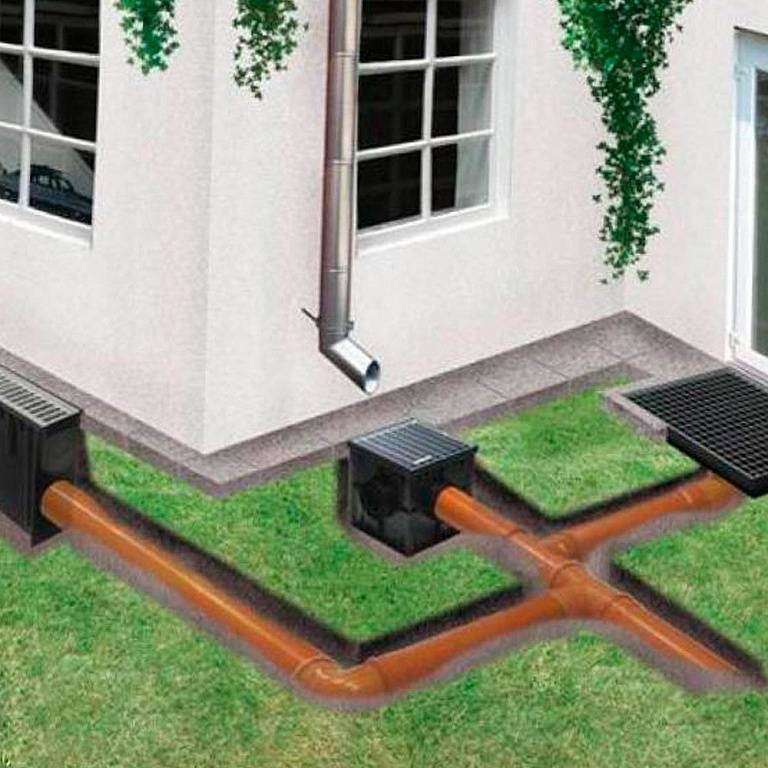
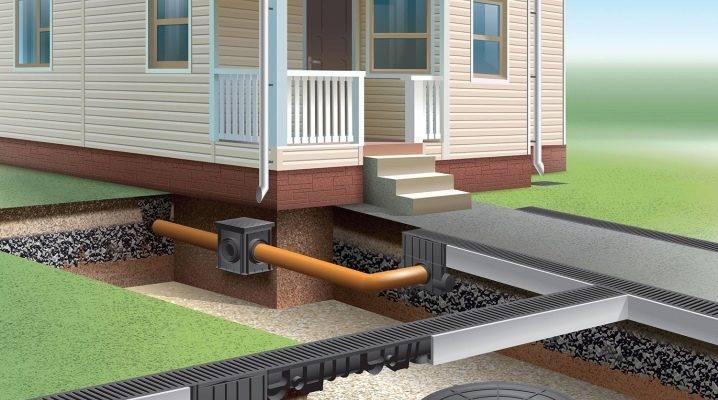
Surface drainage is a network of drainage channels and tanks - sand traps. Through a system of vertical and horizontal drainage systems, rainwater flows from the surface storm drain into the storm sewer collectors, and then enters the treatment plant. Drainage channels are most often constructed from prefabricated trays, which are covered with drainage grates. But sometimes drainage channels are concreted on the spot using formwork. Trays are manufactured industrially from concrete, plastic, polymer concrete and other materials. Noteworthy are the products produced from composite materials, including trays containing mineral components (crumb) “poured” into a polymer form.
According to experts, the main advantage of composite trays is that they are strong enough, despite their relatively low weight. Often, in areas lined with paving slabs (on streets, in gardens, squares, in private estates), drainage gutters made of the same material are used. Experts believe that the main criterion when choosing trays (when it comes to building a private house) is often the distance. That is, the shoulder of transportation from the place of purchase of building materials to the building under construction.
If a house is being built nearby, the owners often prefer to pave the surface drainage with concrete trays. But from afar it is easier to bring relatively light and well-packed products. Although, of course, the material from which the trays are made must be provided for by the project. As well as the cross section of the drainage system, the number and volume of sand traps, the type of drainage grate and a number of other elements of the system. In urban planning, other approaches are usually used. On the roadway, and even more so on major highways, high-strength trays made of concrete or reinforced concrete are installed. From above they are covered with cast-iron gratings with a special fastening.
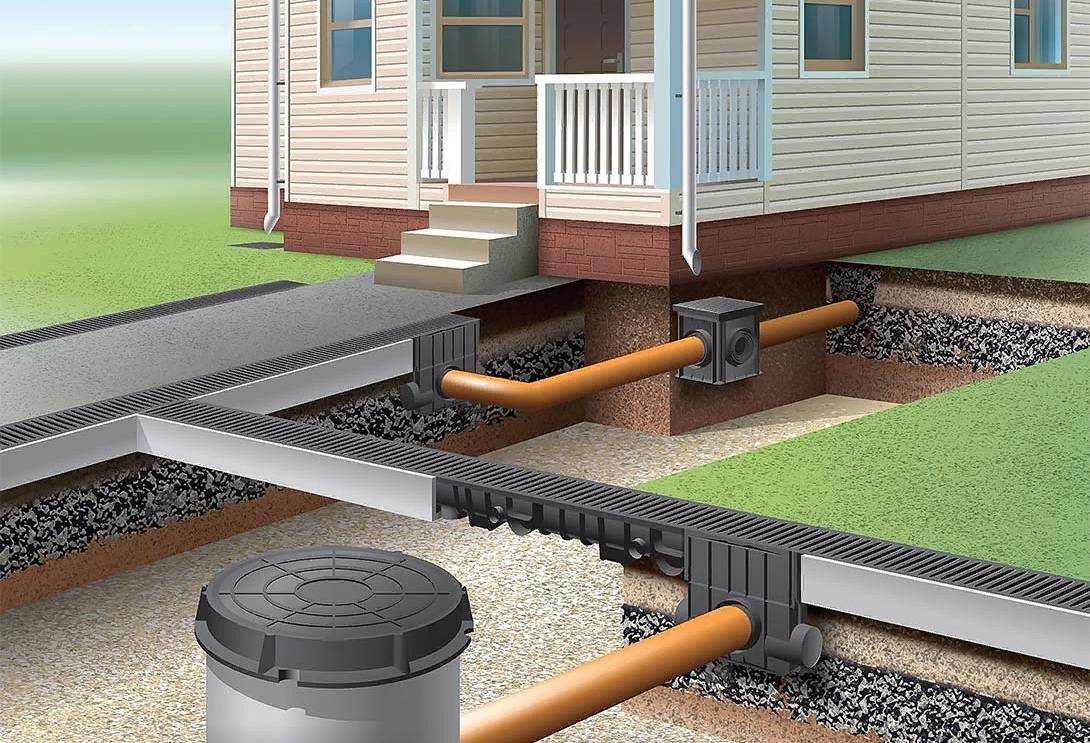




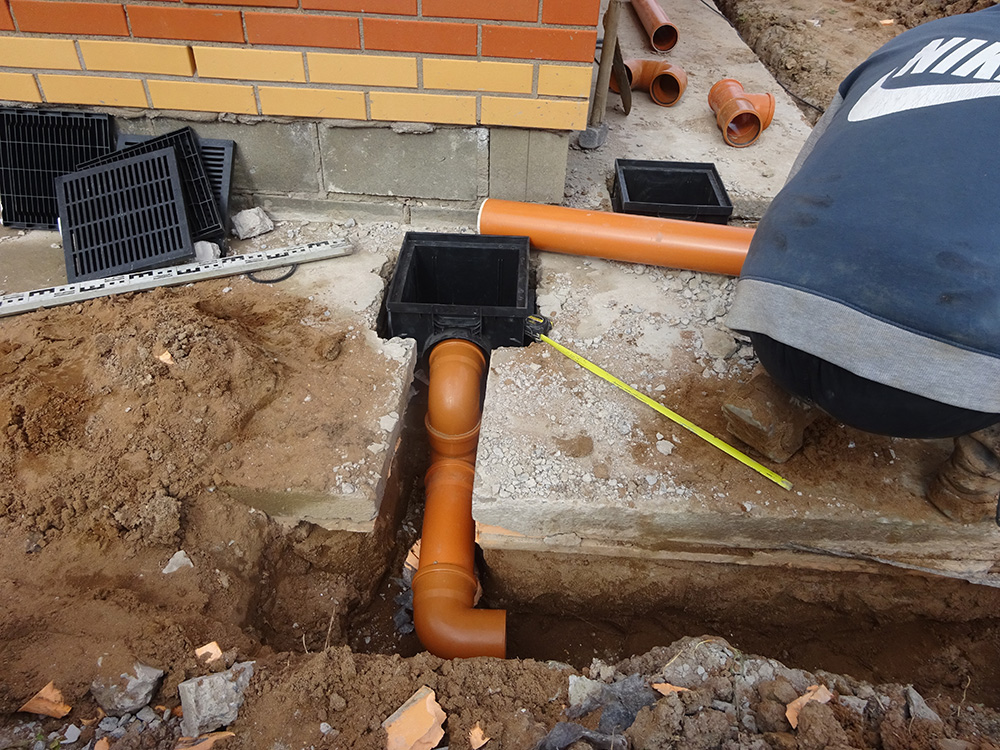


Accordingly, the more durable materials are used to lay the drainage channel, the more powerful the grate should be. For a drainage system that does not experience significant external load, plastic, steel (galvanized or stainless steel), bimetallic or copper gratings can be used. The latter, however, are quite expensive. Lattices come in various shapes, including cellular.They not only protect pedestrians and vehicle wheels from accidentally falling into the drainage tray, but also prevent debris from entering the storm sewer.
Thus, it is advisable to choose the "step width" of the grid and the size of the cells based on the size of potential "weeds". Among them are fallen leaves of trees, which easily fall into trays covered with large bars. Sand traps are shaped like heavily recessed trays. They are also made of concrete, plastic or other "tray" materials. As a rule, the last channel at the end of the drainage line is connected to the sand trap. Due to the special recessed shape of the sand trap, the speed of rainwater flow is reduced. Substances in rainwater (mainly sand and small pebbles, which are abundantly sprinkled on sidewalks in winter on ice) settle to the bottom of the sand trap, and rainwater flows into the storm sewer.
According to experts, for the stable operation of the storm drain, the sand trap must be cleaned several times per season. Silt, sand, dirt, can be scooped out "manually" by removing the protective grate. At the same time, it is advisable to use plastic sand traps equipped with removable waste baskets in areas “not loaded” with heavy transport. Emptying such containers is much more convenient.
Views: 3439
Back to section "Storm water treatment plant"12 August 2013
What it is
Drainage sewerage is a complex of connected drains and channels, which are often called trenches. Pipes and channels are placed around the perimeter of a private area to remove excess moisture outside the private house.It is recommended that the system be installed by a qualified technician. After all, only a professional in this field is able to determine the required distance between the pipes, since it differs for different soils.
With clay soil, the system is installed with a smaller distance, and with a large one on sandy soil. This is primarily due to the speed with which the soil absorbs water. The better the soil passes the liquid, the smaller the distance between the pipes becomes. Excess liquid is driven through the pipes and merges into the general sewer system. In the absence of local sewage, the owners of the house dig wells, which serve as a place to drain the liquid.
What are the functions of drainage systems
There is no life without water, but if there is an excessive amount of it, this very life becomes much more complicated. Water stagnation has a detrimental effect on the fertile layer, and any structures that come into contact with flooded soil fail much faster. And we are talking not only about paths and other surfaces on which puddles stand for months, but also about foundations.
Maria Sukhareva Uponor Specialist
It is difficult to overestimate the importance of protecting the foundation of the house and adjacent areas from the negative effects of moisture, which affects both the characteristics of the building and the residents. The drainage system, arranged in the foundation area, not only collects and drains water, but also prevents the groundwater level from rising
Even the capillary rise of moisture is fraught with dampening of the foundation and the appearance of mold, while freezing of wet soil under the building spot can lead to deformation of the base.Not to mention the fact that ice crystals “tear” the most durable materials without any problems, and in the spring, instead of a monolith, it is quite possible to find its cracked likeness. The drainage system promptly removes all types of water from the foundation and basement, thereby draining them and providing the supporting structures with optimal operation.
sartreekMember
The soil is clayey, my water is quite high - 30-40 cm, I want to make some kind of drainage around the house with a drain into the well, followed by pumping. High water does not interfere with life at all, but in winter the foundation is a pity.
According to statistics, from the roof of a medium-sized country house, from 50 to 150 m³ of runoff is collected during the year, including melt and rain water. Draining such a volume of water into a site, even with permeable soil, can cause stagnation, not to mention clay soils. To prevent this, there is a storm sewer.
Maria Sukhareva
Storm sewage is designed to collect, filter and drain rain and melt water, as well as surface runoff during snowmelt or heavy rainfall. Thus, the flooding of buildings and the formation of puddles in the warm season and ice formation in the cold season are prevented.
Drainage and storm sewers are different systems and should be distinguished.
Storyteller14Participant
Organization advice needed drainage system around home and drainage from the roof. My house is located on the banks of the former river, now it is not flowing, the groundwater level is very high, in the spring in the basement, until waterproofing was done, water appeared. This summer I decided to make drainage and combined it with a storm drain. Drainage pipes (corrugated pipe 110 mm, perforated and in geotextiles) led into the lake.Now I think that I combined it in vain: during heavy rain it is not visible that water flows out of the drainage pipes, it simply soaks into the ground. Tell me please, could do that Or is it better not to run a storm drain into the drain?


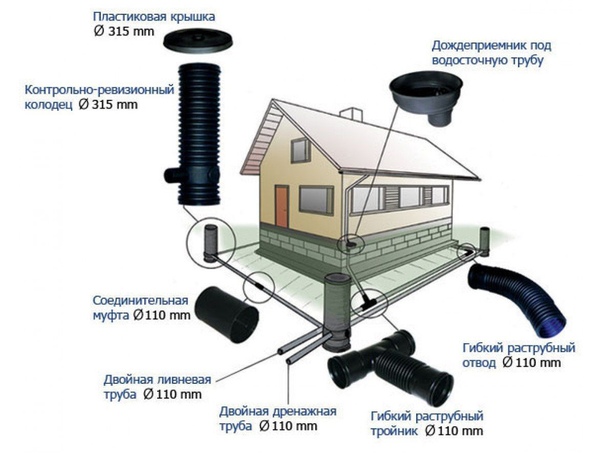


Maria Sukhareva
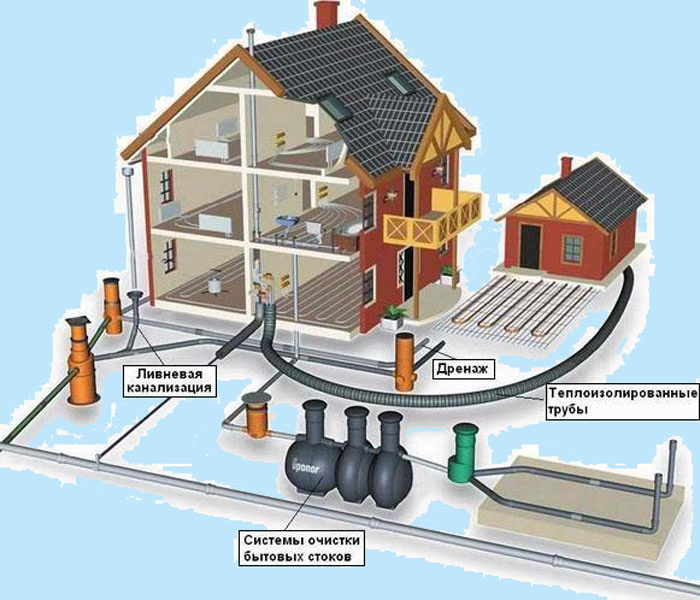
A deep drainage system and a storm sewer system perform related, yet different tasks. Drainage collects the water contained in the soil and removes it from the foundation of the house. If necessary, drainage also prevents the rise of groundwater to the level of the lower base of the building. A storm drain drains rainwater from the roof of a building to avoid deep puddles in the yard that can increase the dampness of foundations and basements.
Rain water is not recommended to be discharged into the drainage system. If this happens, then during heavy rainfall, the drainage pipes overflow with water, which puts pressure on the foundation structures. Thus, the drainage system acquires the opposite effect, which is what happens in this case. The shape of the drain pipe or the location of the holes also does not improve the ability of the drainage system to protect itself from excess rainwater.
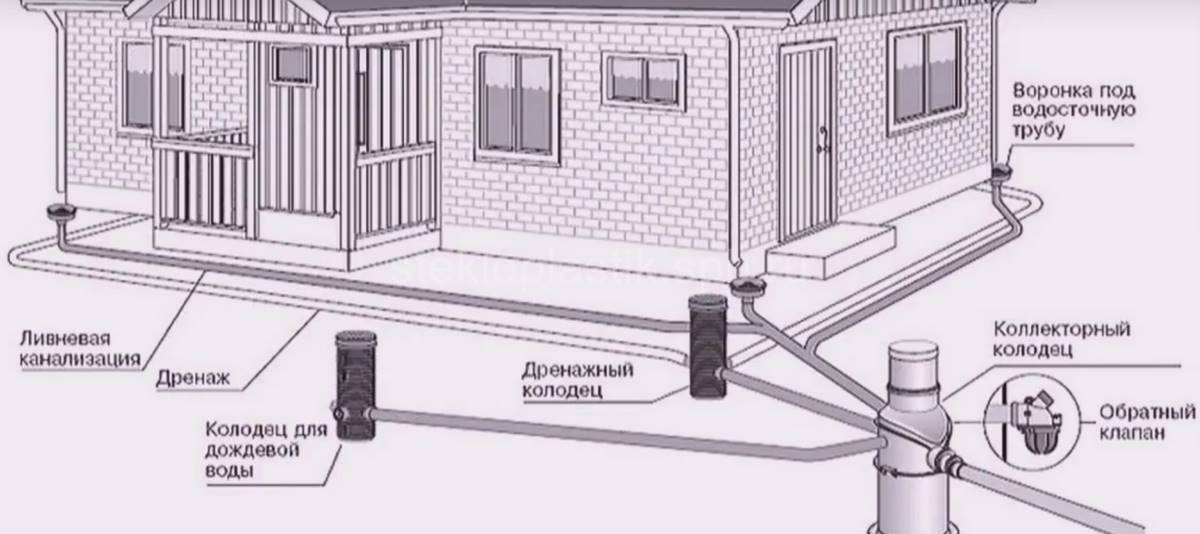
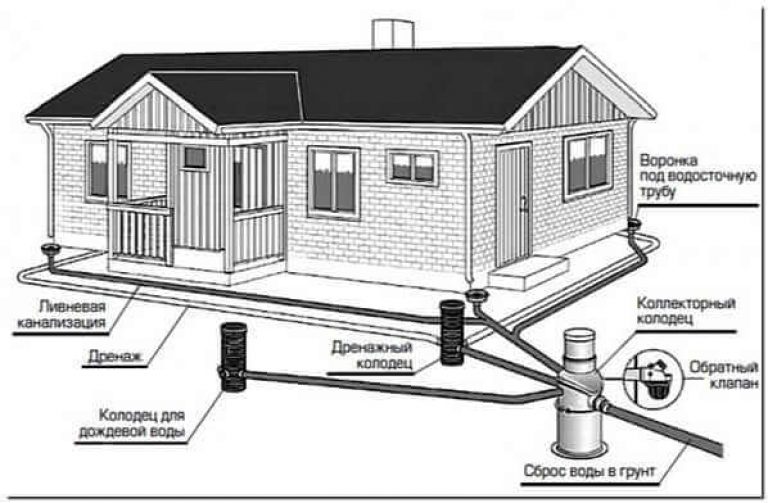
Water from the drainage and storm sewer system is collected in the main drain well. At the point of connection of the drainage pipe inside the well, it is recommended check valve installation, which, even in the event of a flood, will not allow the reverse flow of water through the drainage system to the foundation of the building.
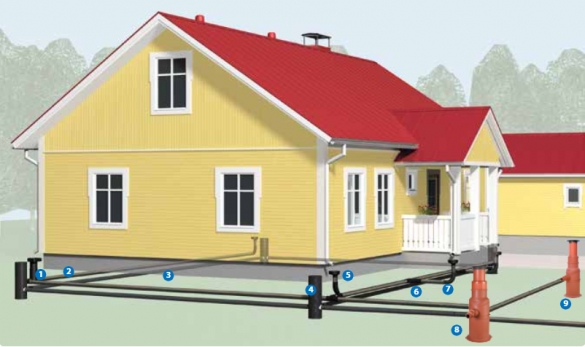
- Rain inlet.
- Storm sewer pipe.
- Drain pipe.
- Drainage well.
- Rain funnel.
- Flexible socket tee.
- Flexible socket outlet.
- Manifold well (solid cast iron cover and ball check valve).
- Collector well (lattice cast-iron cover).
Kinds
Surface drainage is designed to protect the site from excess rain and melt water. Such a system is especially popular with homeowners who are responsible for the arrangement of private territory and the protection of buildings. Installation of an open drainage system prevents subsidence and destruction of the foundations of buildings, asphalt pavements and paved paths, protects tree roots from excess moisture.
Surface drainage is represented by two types:
- linear;
- point.
A linear drainage system is a recessed gutters stretched across the territory of the site, mounted from plastic or made of concrete. Such a system is installed in areas occupying large areas.
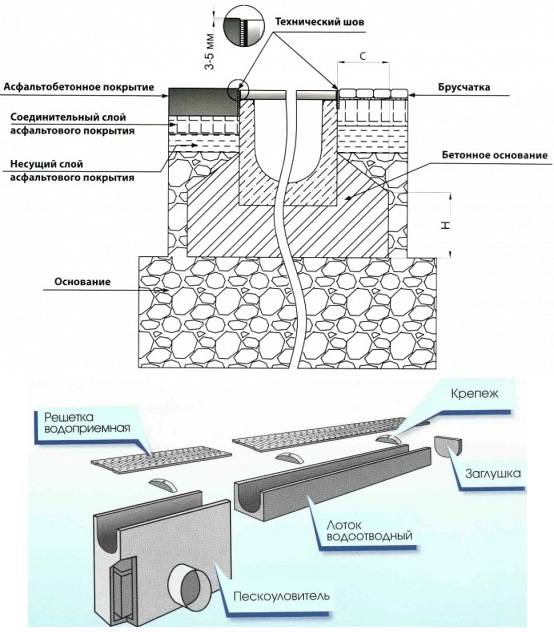
Design and installation scheme of linear drainage systems
Point drainage is a system of storm water inlets connected to storm sewers. Also included in this system are sand receivers designed to prevent clogging of the sewer. The guys from the Prochistka-MSK company know a lot about sewer blockages.
It makes no sense to compare these two types of drainage, each of them complements each other. Experts, for more practical and high-quality water drainage, recommend combining these two types. In this case, the drainage will be as efficient as possible.
Construction and point drainage scheme
The device of external drainage systems of a private house
Each of the considered systems has its own set of elements and can be made of various materials.Their only main pipes and wells (inspection, drainage, rotary) are identical.
The structure of the drainage system
Drainage refers to a closed type of sewer systems, it is completely underground. On the surface of the entire structure, only the covers of the wells are visible.
Underground drainage sewage is done in areas:
- with a high-lying aquifer;
- with clay and loam soil;
- with a high probability of floods;
- in a flooded valley.
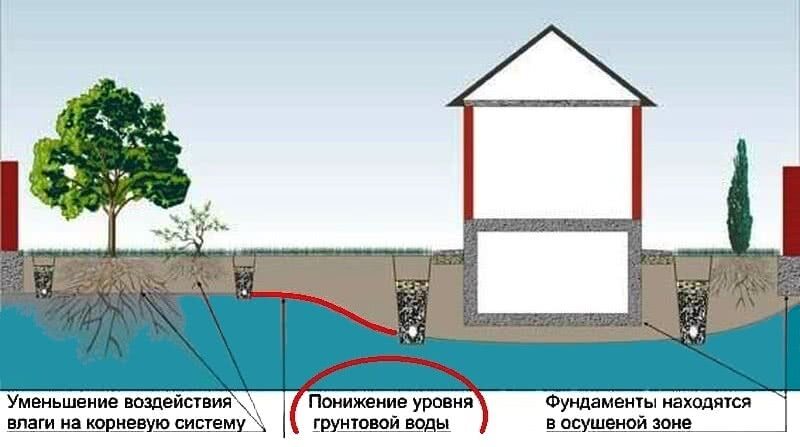 Drainage reduces the impact of moisture on the roots of trees and lowers the GWL
The drainage system includes:
- Drains (perforated pipes in geotextiles).
- Sand traps.
- Drainage lines.
- Inspection, differential and storage wells.
Perforated pipes collect excess moisture from the soil, sand traps purify water from sludge, and main pipelines transport it to the water collectors. Wells of various designs help control this process and clean the system.

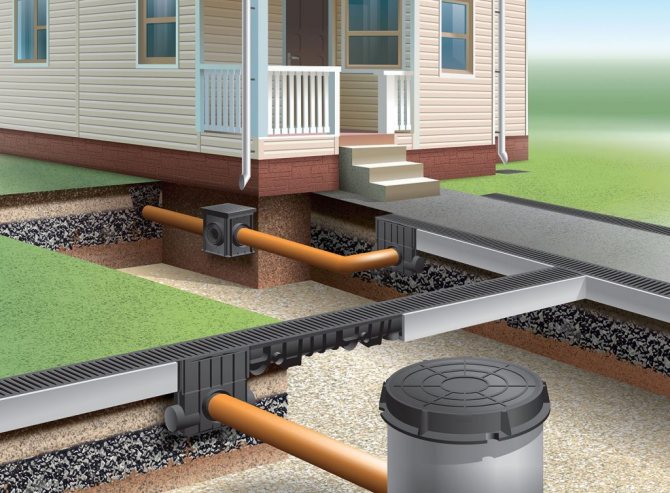
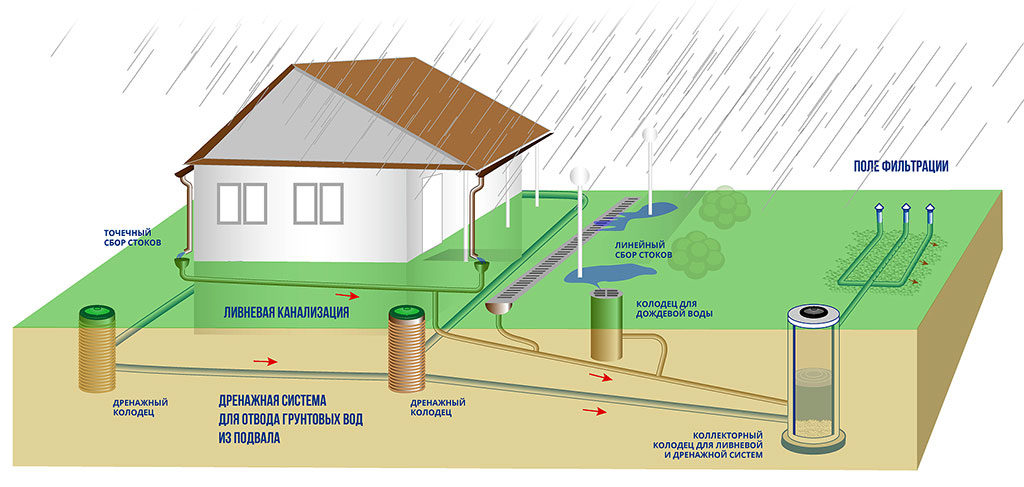


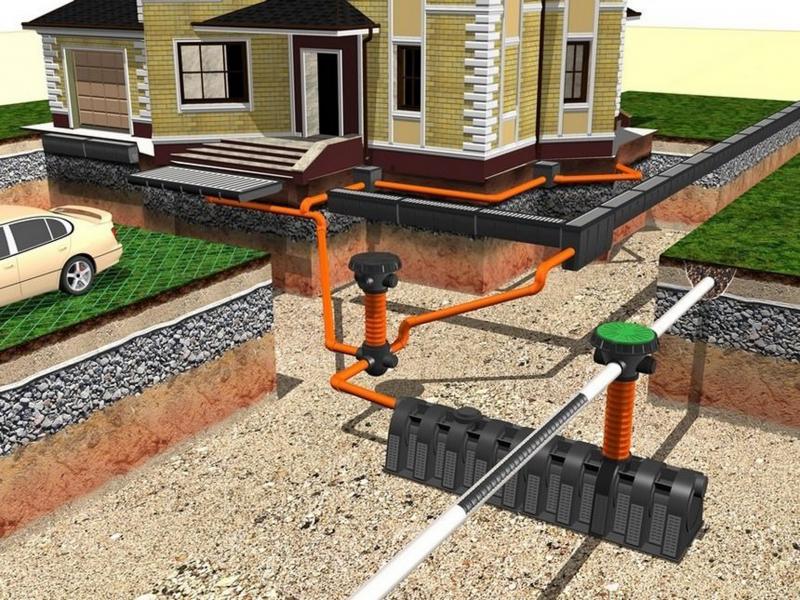
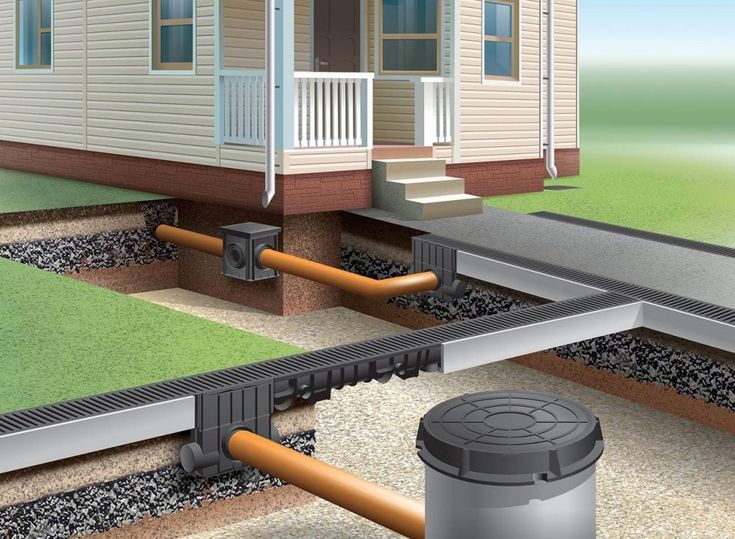


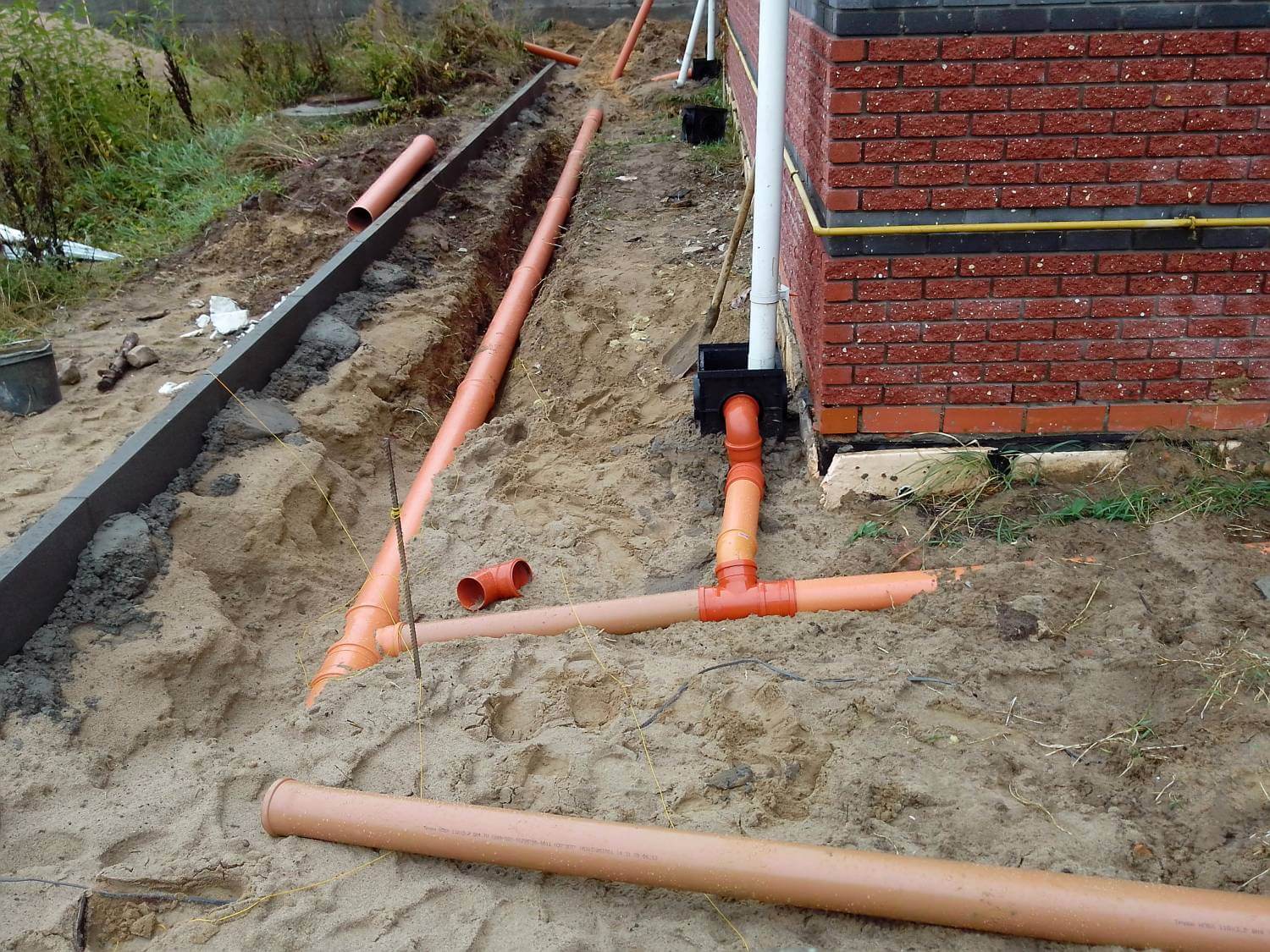
All collected effluents fall into a common storage. Already from it, they are pumped out into the centralized system of the village storm water or into a nearby reservoir. Either the water in it is used for watering beds or technical needs.
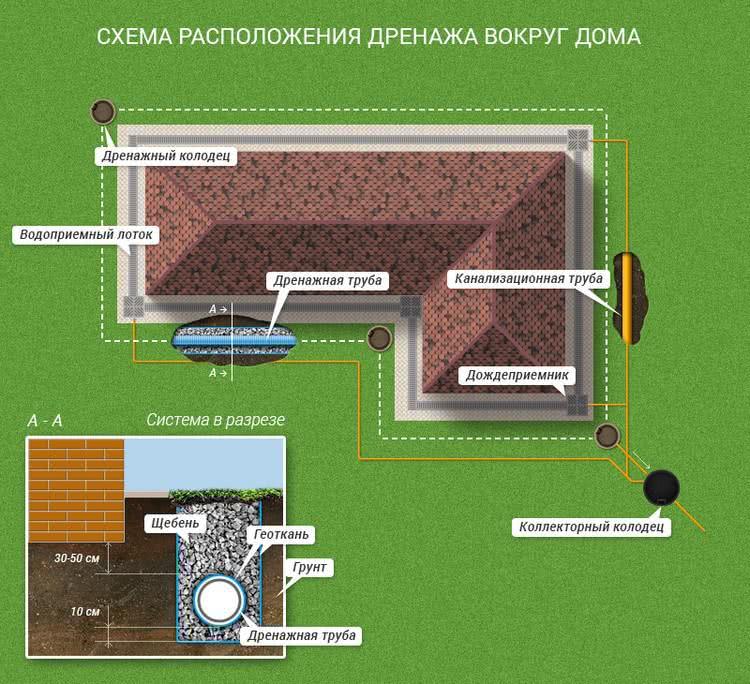 Drainage scheme around the house
Drains can be made from:
- plastic;
- asbestos cement;
- ceramics.
Asbestos-cement pipes are cheap, but inferior to analogues in terms of durability. Ceramic will last decades, but cost a lot of money. More popular are plastic pipelines made of PVC, polypropylene and polyethylene. At the same time, polyethylene products are the most resistant to frost and do not crack during sudden changes in temperature.
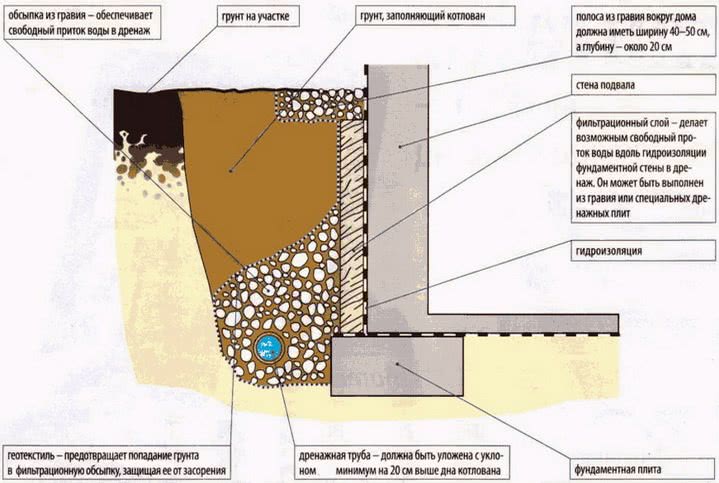 Scheme of laying drains along the foundation
Pipes are purchased with perforation or perforate the walls of the pipes on their own. According to the stiffness class, drains are selected with the marking SN 2-4 for laying depths up to 3 meters, and SN 6 and above - with a depth of 5 meters.
Storm sewer elements
An integral part of the storm drain is a drainage system, the elements of which are mounted on the roof and along the walls of a private house. They collect water from the roof and redirect it to an above ground storm drain so that it does not damage the façade and foundation.
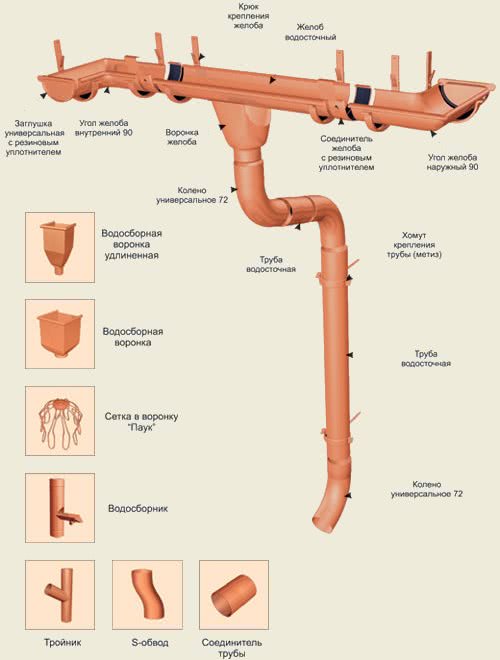 Design drainage system from plastic
The drainage system includes:
- drainage gutters along the edge of the roof slope;
- funnels and vertical pipes-weirs;
- plugs, clamps and seals;
- connectors and contours;
- tees and swivel elbows.
A modern drainage system is a constructor, the details of which must be assembled in a certain sequence in accordance with the project. Its elements can be made of galvanized, copper, ceramic or plastic. The choice largely depends on the architecture of the house and the type of roofing material.
Often, drains are supplemented with protective nets on funnels and gutters, droppers and an anti-icing cable. These devices are optional, but improve the performance of the entire system.
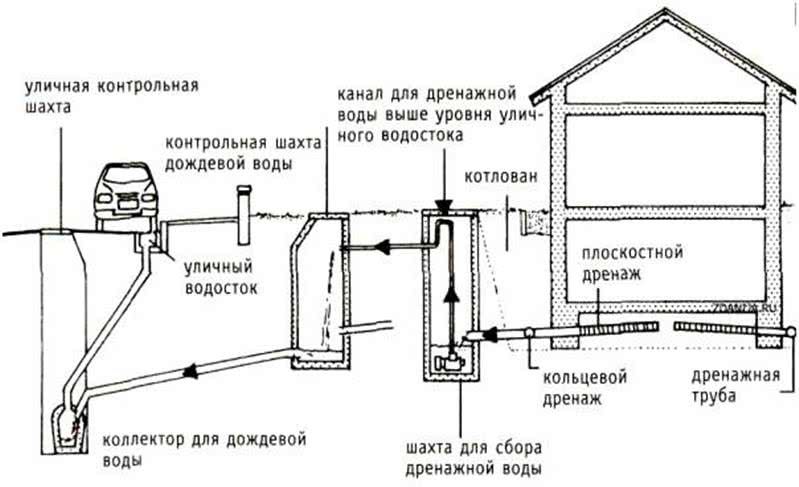 Scheme of drainage and storm water with catchment wells
Pipes are cleaned with a pump and large volumes of water. A hose with a special nozzle is lowered into the well. A powerful pressure of water easily washes away all deposits from the walls of pipelines and drains.
Gradually, all the limescale and sludge end up in the well, from which they are pumped out by a drainage pump or a vacuum sludge pump.In most cases, flushing is enough in excess, but occasionally you have to resort to mechanical cleaning of the system using scrapers and a plumbing cable with a hook at the end.
Typology of storm sewers
In order to find out how to make a storm sewer with your own hands, you need to familiarize yourself with its types:
- Aboveground type. The main feature of such storm drains is that the gutters that perform the drainage function are located in the coating. With their help, water enters a specially designated place or flows into a garden or garden on the site.
- underground type. All components of this sewer type of construction are located below ground level. The design organically fits into the exterior of the yard. However, for its installation, it is necessary to perform a huge amount of land work, accompanied by large financial costs. You can equip this system at home with your own hands when remodeling your site or building a new cottage. In turn, they are divided into two types:
- non-freezing;
- freezing.
Non-freezing storm drain should be laid below the depth of soils subject to freezing. Each region has its own level, which on average is from 1.5 to 1.7 meters. As for the freezing structure, its average depth is less than a meter, however, this storm sewer in the country can function unstably in the winter and spring seasons.
- Mixed type. The name speaks for itself. Part of the structure is made from above, and the other part is made in the ground. This option combines a huge number of advantages:
- a small amount of necessary building materials;
- relatively small financial costs;
- aesthetic appearance.
However, almost always, you have to produce an individual project. This is due to the fact that each site has a number of features:
- layout;
- soil moisture absorption;
- development;
- terrain relief.
Elements of the drainage structure
What is a drainage system? This is a network consisting of various components, the main purpose of which is the removal and collection of capillary water contained in the pores of non-cohesive soils and cracks in cohesive rocks.
The main underground elements are drainage pipes. They should not be confused with water supply and sewerage systems, since only waters that are in the upper soil layers move through them. And the collection and drainage of rain and melt water is handled by storm sewers.

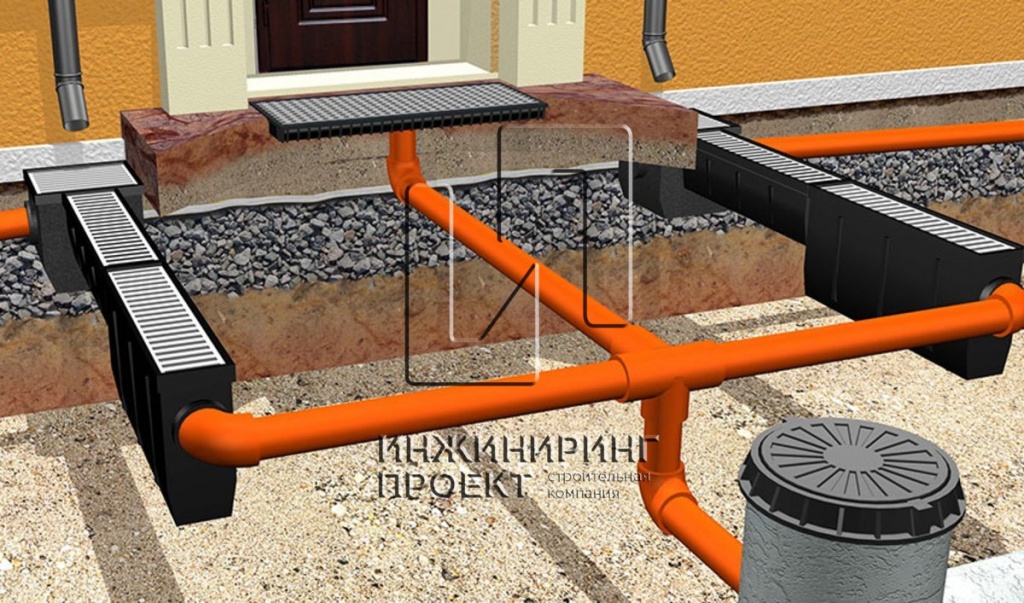




More elastic corrugated models are popular. The diameter of the pipes depends on the volume of the discharged liquid, the standard cross-sectional dimensions are: 50 mm, 63 mm, 90 mm, 110 mm, 125 mm, 160 mm, 200 mm. For central highways, products of a larger diameter are selected, for branches - a smaller one. Reinforced pipes consist of 2 layers.
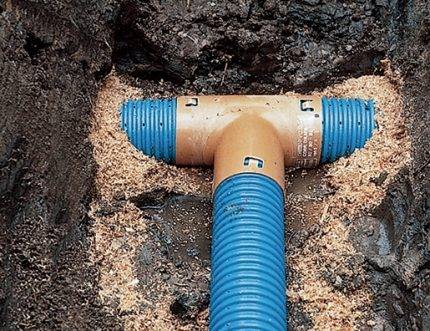
The modern type of drainage pipes are products made of durable and heavy-duty modified plastic (for example, HDPE). The walls of the pipes are covered with filter holes or cuts, some top views are covered with geotextile
At the junction of several hoses or in areas where pipes turn at a large angle, install technical (revision) wells from a similar material. These are wide sections of corrugated pipes or specially manufactured factory models.
The drainage system may also include storage wells, which are installed at the lowest points of the site for efficiency.Accumulators suit if it is not possible to dump the discharged water into a nearby reservoir. All drainage lines lead to wells. They transport water, which is often used for irrigation or household needs.
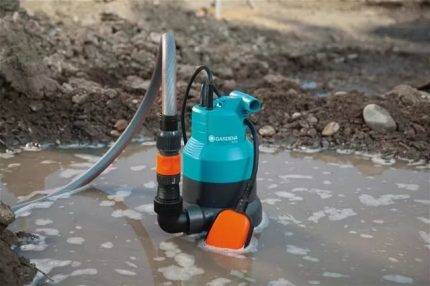
If the terrain does not allow a gravity system, drainage pumps are used. Various models (usually submersible type) are used to pump water through pipes in the right direction, differ in design features and power
In addition to the main elements of the system, fittings for connecting pipes, geotextiles and building material for arranging trenches and wells (sand, gravel or crushed stone, concrete rings, bricks) will be required.