- No. 4. Electric garage heating
- Top 10 popular heating appliances for sale
- Basic schemes and how water heating works in the garage
- Important nuances:
- No. 1. Water heating system
- Heating with electricity
- Shopping list
- step by step plan
- How to reduce heat loss and not go broke?
- How to make cheap and fast garage heating with your own hands
- Choosing the most economical heating method
- Electricity
- Water heating
- Gas
- solid fuel
- Liquid fuel
- air heating
- What to Consider When Choosing a Garage Heating System
- fire safety requirements
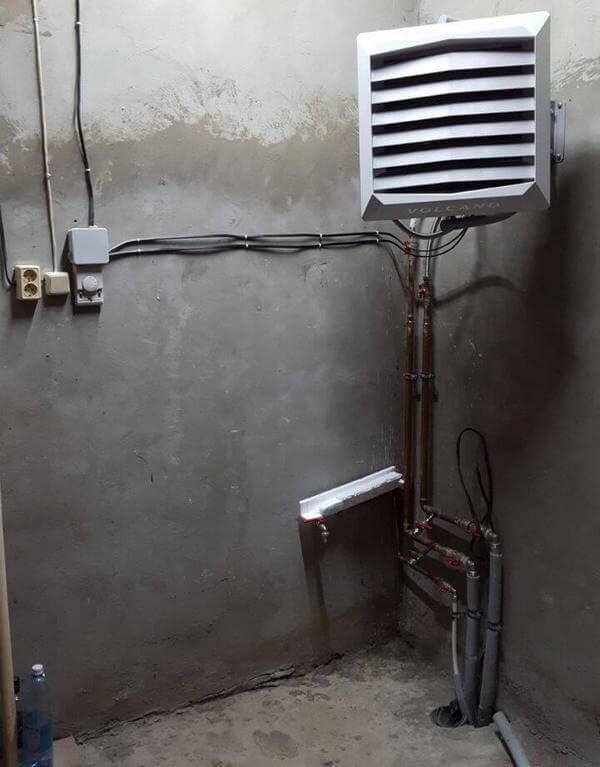
No. 4. Electric garage heating
Electric heating is the easiest to organize, but you have to pay dearly for such convenience.
Advantages:
- simplicity and high speed of arrangement. It is enough to buy a heater and plug it into an outlet;
- a large selection of heating devices;
- lack of combustion products, so a chimney is not needed;
- high level of security;
- high heating rate;
- ease of temperature adjustment.
There are also disadvantages:
- long-term heating with electricity will cost a pretty penny;
- not suitable for regions with power outages;
- rapid cooling of the room after turning off the heating;
- low durability of the equipment.
Most often, the following electric heaters are used to heat the garage:
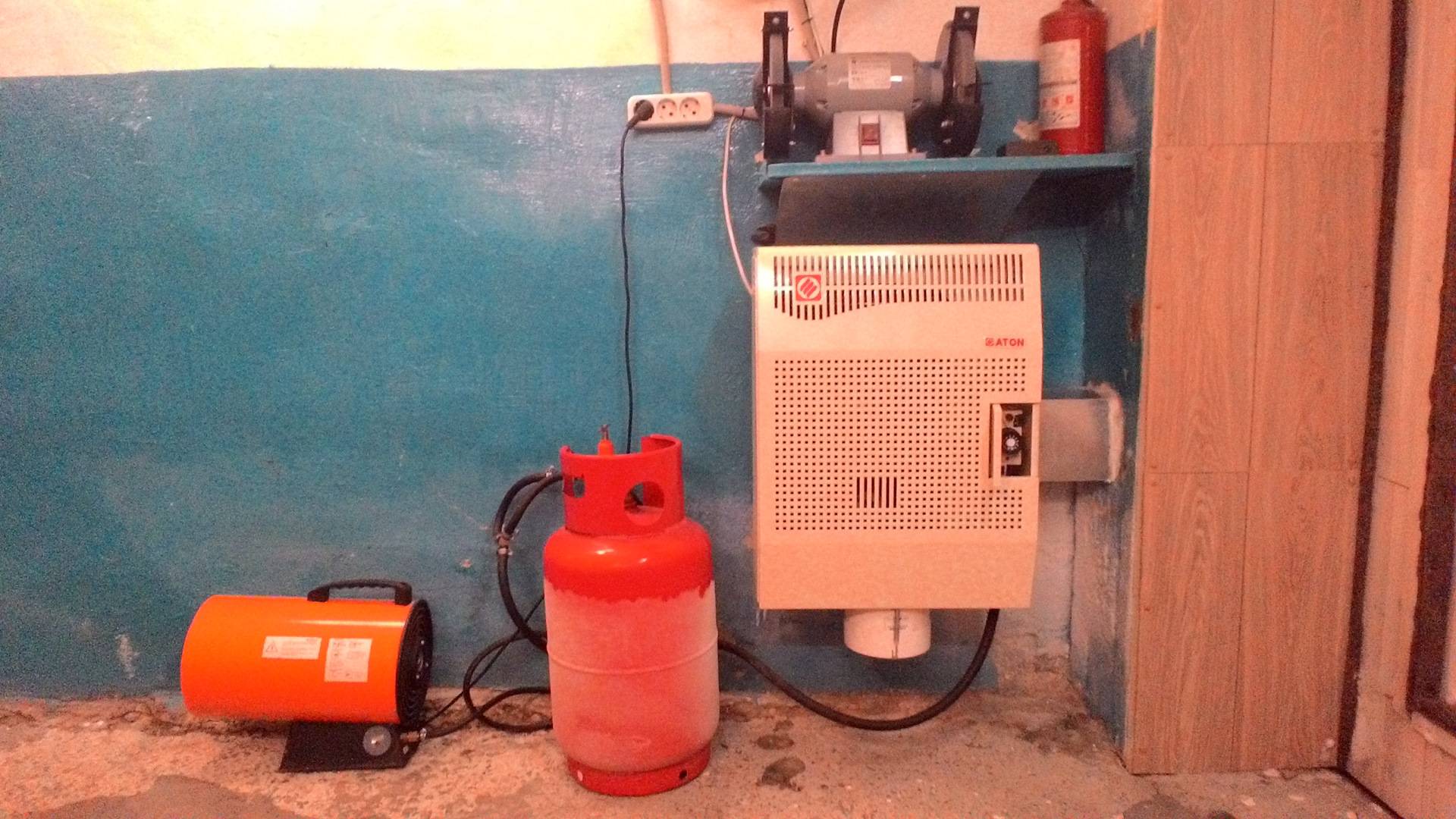
- heat guns are a more powerful analogue of a household fan heater. Cold air passes through the heating element, heats up and is blown into the room with the help of a fan. You can put the heat gun anywhere, it is mobile and allows you to adjust the degree of heating. There are very powerful models that need to be connected to a 380 V network. The gun is capable of raising dust into the air, this is especially noticeable in small garages, so you will have to keep the room clean;
- the fan heater is inferior in terms of power to the heat gun, it is the cheapest, it dries the air. For them, as well as for guns, a fairly high noise level is characteristic. Ceramic fan heaters are more durable, economical and comfortable in terms of operation than spiral counterparts;
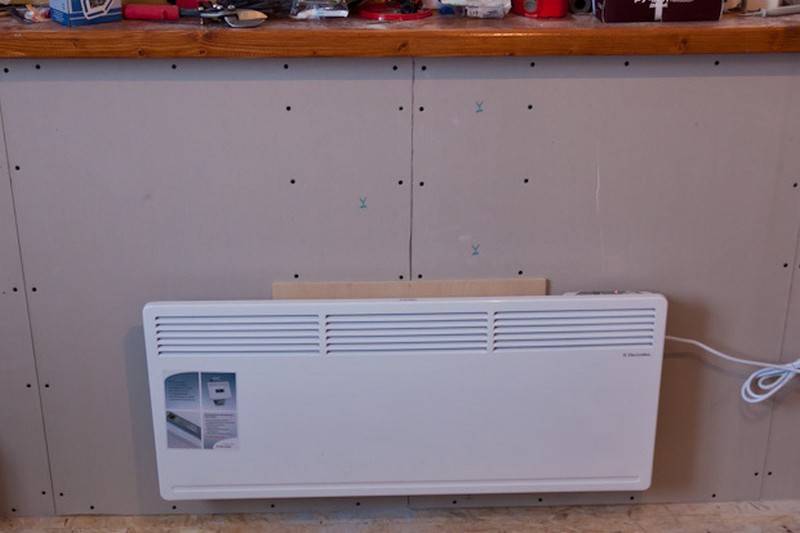
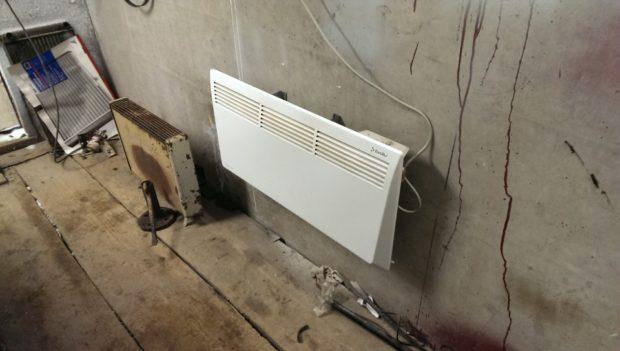
- a convector is a heating element in a housing with holes. The room is warmed up due to the heat transfer of the body and the exit of warm air through the holes. Many models are equipped with wheels for easier movement. The convector heats up the room more slowly than a heat gun, but after turning off the case cools down for a long time. Another disadvantage is the higher price;
- an oil heater is more complicated than a convector. Here, the heating element first heats the oil, then the oil heats the body, and the body already heats the air. The room heats up for a long time, so this is not the best option for a garage;
- Infrared heaters heat surfaces and objects, which then heat the air. The person becomes warm immediately. By the same principle, the sun warms the planet. Such devices consume a minimum of electricity, but during operation they heat up significantly - be careful if the garage is small.It is better not to direct the beams at the car;
- Inverter split systems are a fairly economical way to generate heat, but the equipment itself is very expensive. The system can operate at temperatures not lower than -20C.
Electric heaters are suitable for temporary garage heating: they planned to do some work, turned on the heater, did everything and turned it off. It won’t hit your wallet, and you won’t have to bother with kindling and a chimney. If the garage is a workshop where you spend time regularly, then this heating method is not for you.
Top 10 popular heating appliances for sale
If the garage is used for its intended purpose, that is, your iron horse is standing in it, it is convenient to choose an inexpensive and practical ceiling-type infrared heater. Here are the most popular models according to Yandex Market:
 Timberk TCH A1B 1000, price 4170 rubles
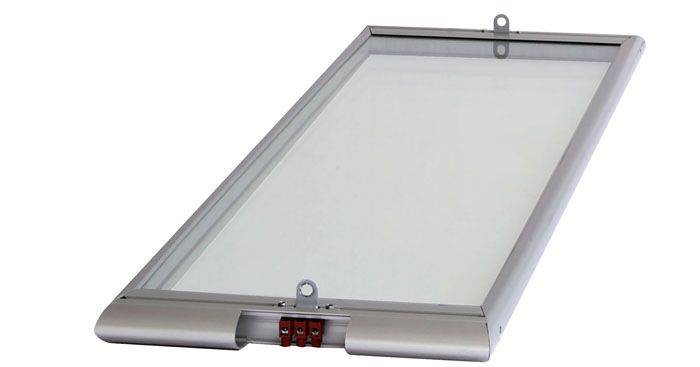
 Almac IK16, price 3771 rubles
 Peony ThermoGlass P-10, price 6950 rubles
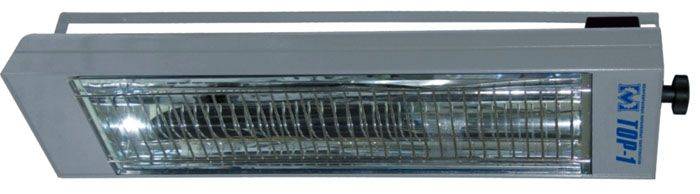 Makar TOR-1, price 5500 rubles
The next category is mobile gas heaters. Network buyers have made their choice in favor of the following devices:
 Gas oven Ballu BIGH-55, price 5490 rubles
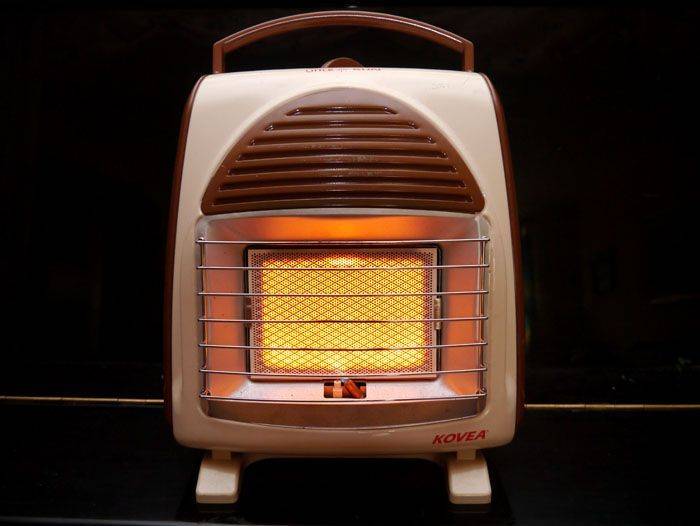 Gas oven KOVEALittleSun (KH-0203), price 6110 rubles
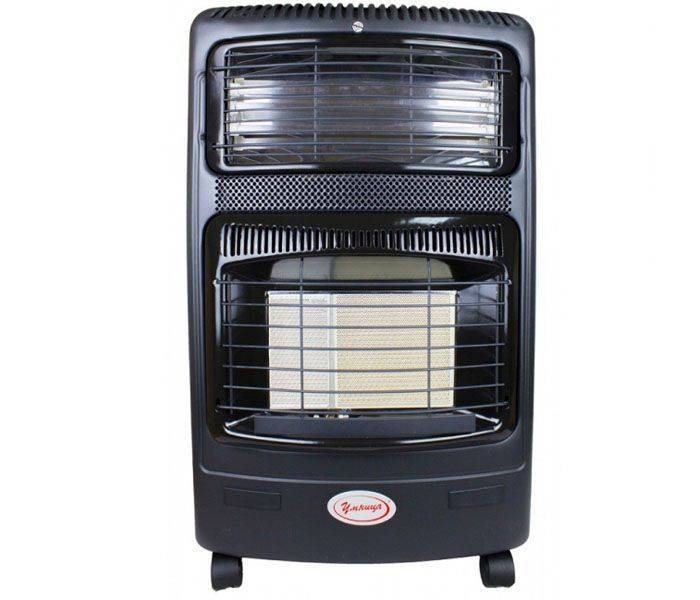 Gas oven Umnitsa OEG-2, price 7684 rubles
Solid fuel boilers from domestic manufacturers are distinguished by a pleasant design and flawless operation. Among the best models are:
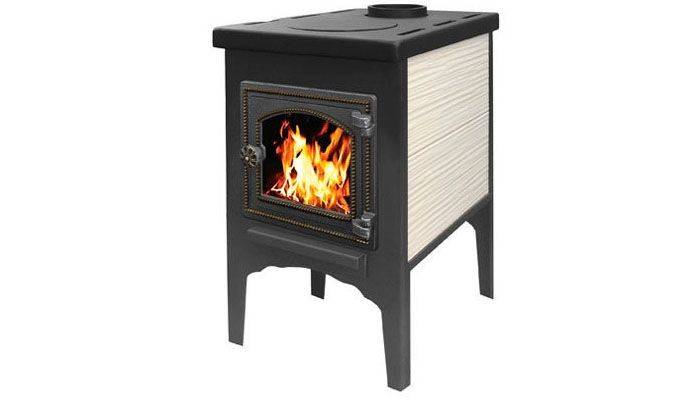 Potbelly stove Vesuvius B5, price 7980 rubles
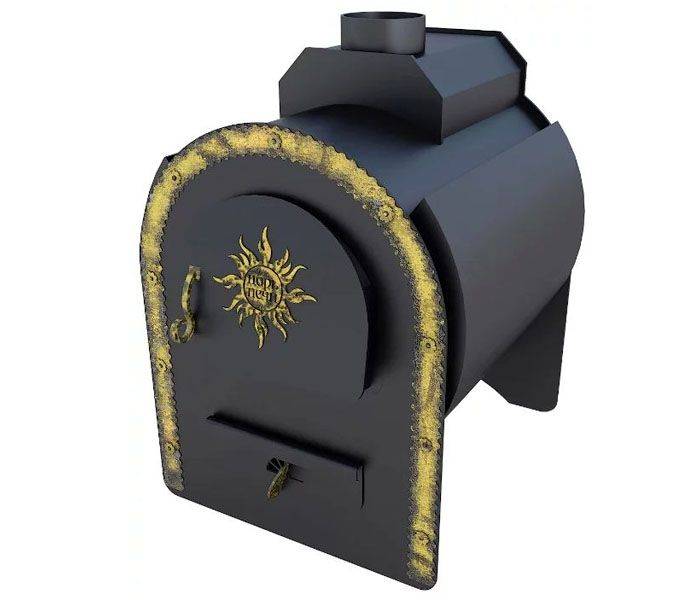 Heating stove King of the stove, price 6500 rubles
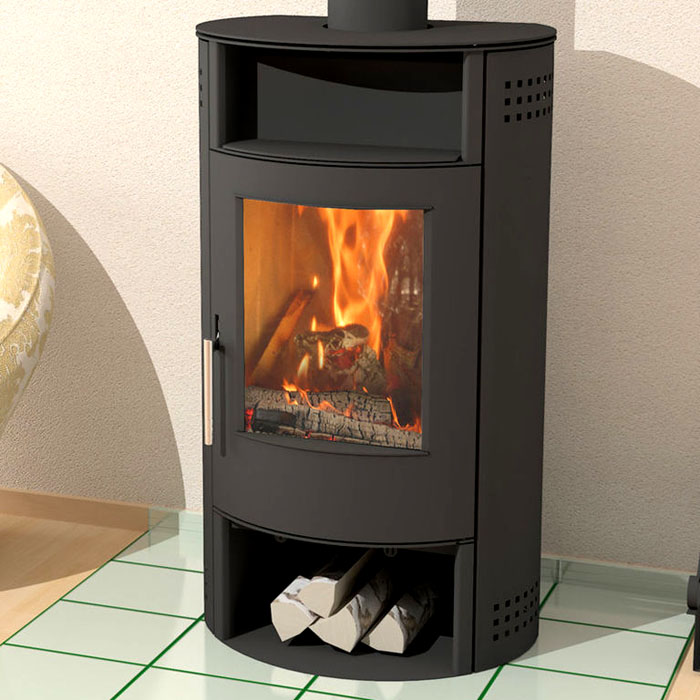 META Baikal 8, price 30650 rubles
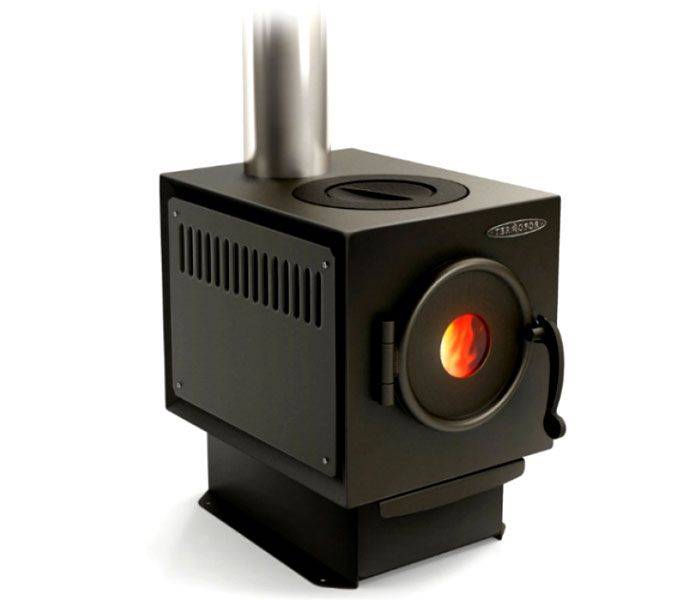 TERMOFOR Cinderella 2016, price 6330 rubles
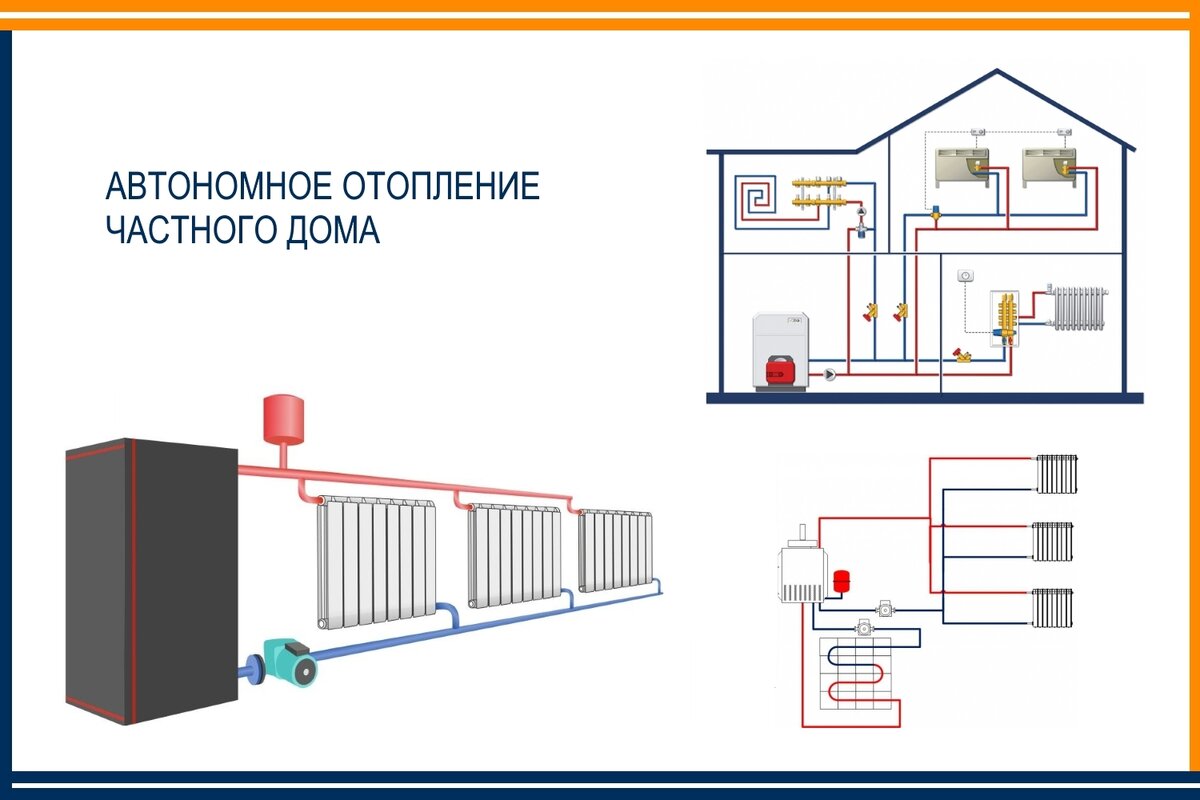
Basic schemes and how water heating works in the garage
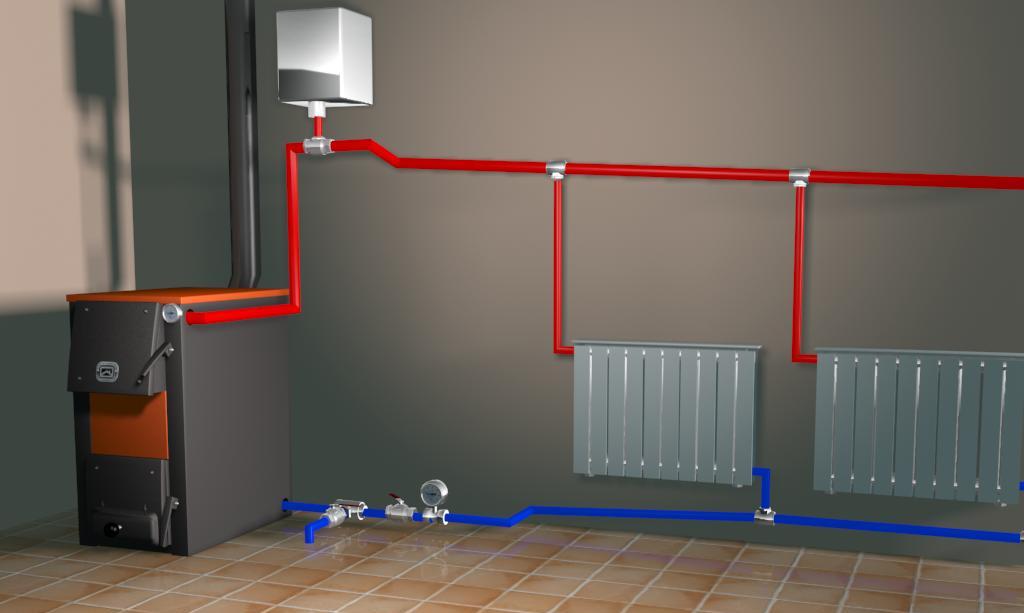
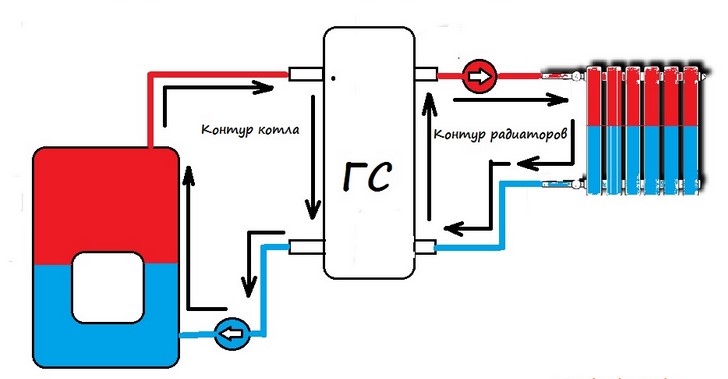
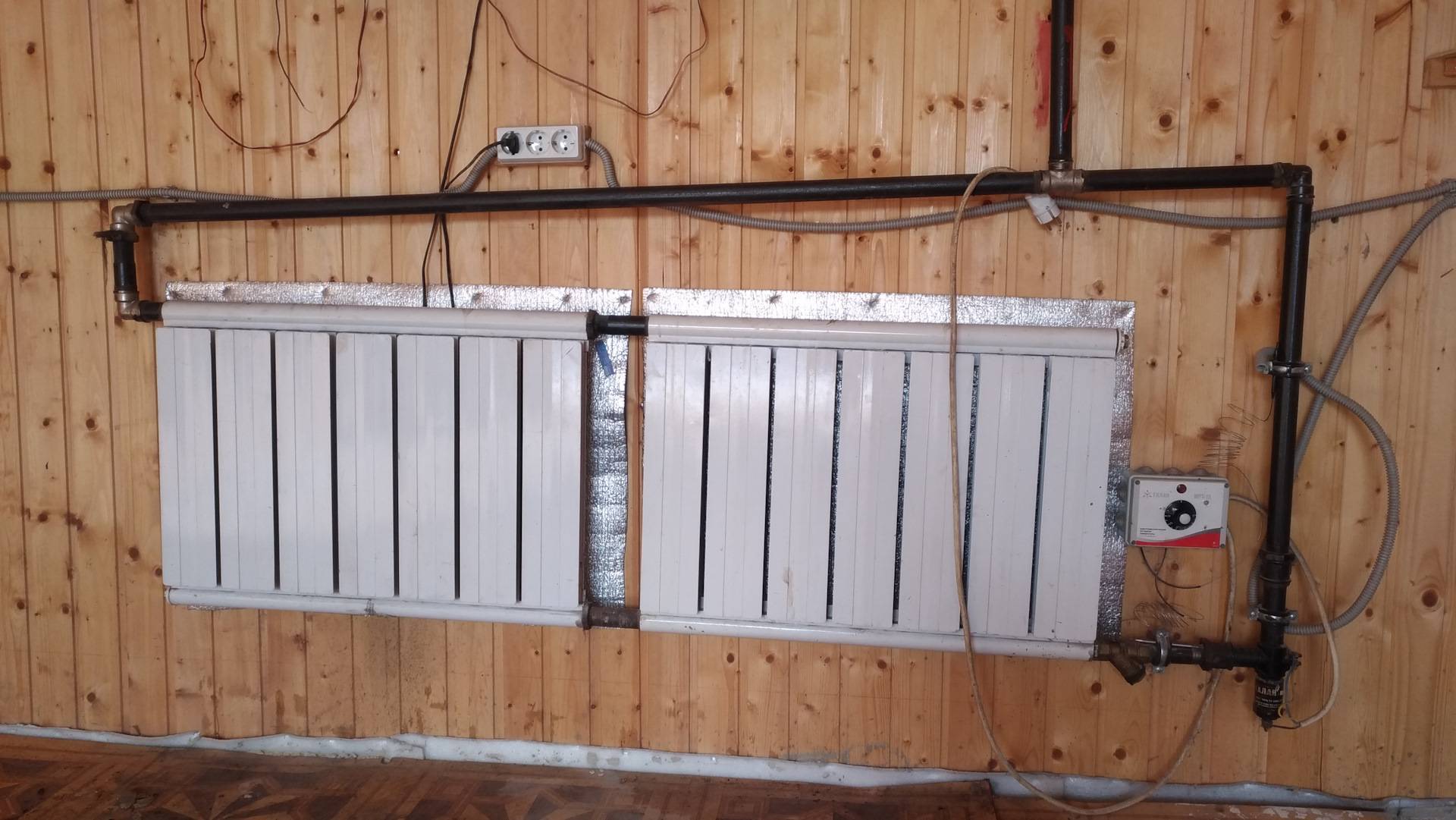
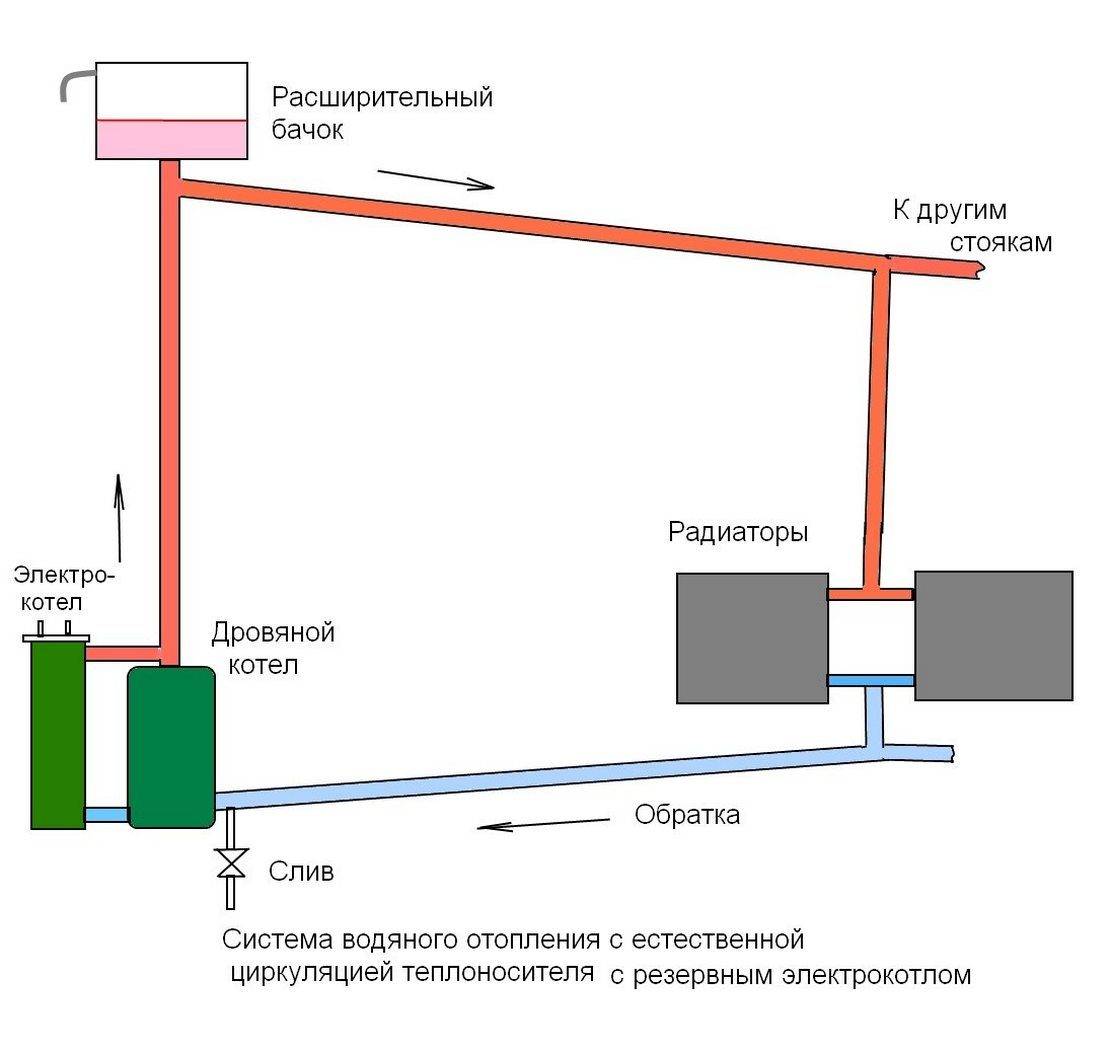
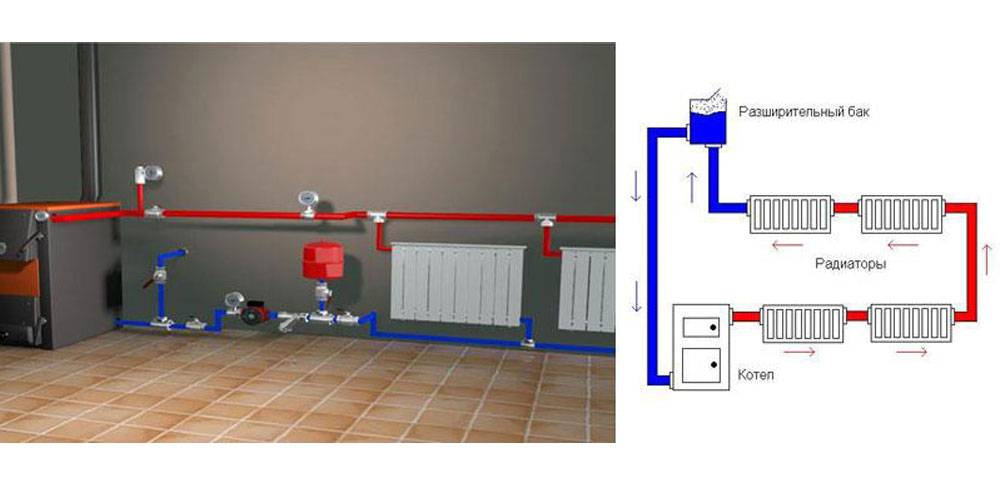
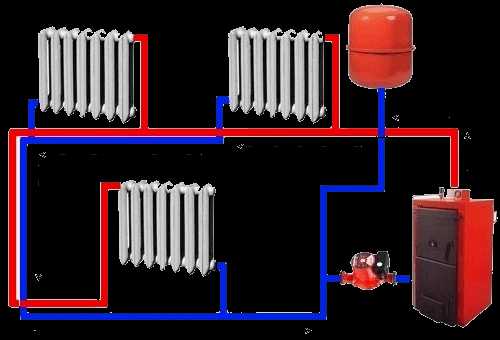
This heating system is simple and reliable, and also provides good efficiency. The principle of operation will be roughly as follows.A boiler operating on a different type of fuel heats a tank of water. Through a closed system of pipes and storage tanks, hot water circulates inside the system, giving off heat to the outside. At the last stage, already somewhat chilled water returns to the boiler, where it is reheated. Proper piping and selection of the necessary boiler parameters are the main points in creating such a system.
Important nuances:
The system necessarily needs a small circulation pump, which will provide water flow. Partially this goal will be served by a slight slope in the piping, but equipping with a pump will be much more efficient.
The effectiveness of the system also depends on the choice of material for the system. Traditional metal pipes and radiators have been replaced by modern counterparts. They heat up much faster, but also cool down quickly. The heating of the metal occurs many times slower, but the heat transfer will stretch for a long time.
If the garage is attached to a residential building, it will be easier and cheaper to connect it to an existing heating system. To save money, you can use fewer radiators, but this option will be the best.
A nearby building can also be heated by piping away from the house, but in this case, careful thermal insulation in the external environment must be carried out to avoid the risk of freezing of the system.
The location of radiators has its own laws. This should be a minimum distance to the floor - 15 cm, as well as 2 - 4 cm from the walls.
To eliminate the possibility of freezing of an unused system during severe frost, the water in the pipes can be replaced with a special antifreeze.
Water heating in the garage will be a waste of time and money if you do not provide decent insulation for the building.
Particular attention should be paid to a high-quality floor screed, from which heat loss most often occurs. Also, without fail, the garage is equipped with a working ventilation.
The principle of serial connection of consumers is most often used. This is much easier to do by hand, but does not "work" as efficiently as a parallel piping scheme.
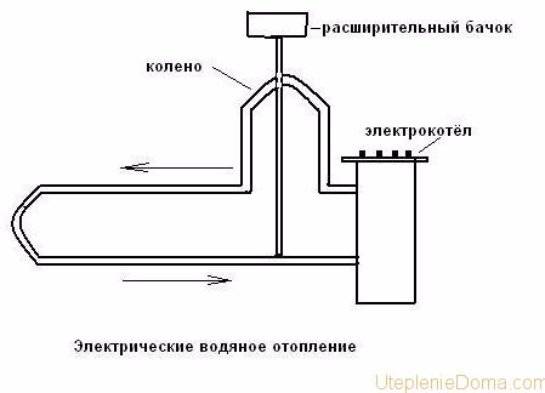
Expansion tank can be made by hand
A sufficiently large metal or plastic container is suitable for this. If necessary, this will help to seamlessly add water to the system and avoid overheating of the boiler.
This is much easier to do by hand, but does not "work" as efficiently as a parallel piping scheme.
The expansion tank can be made by hand. A sufficiently large metal or plastic container is suitable for this. If necessary, this will help to seamlessly add water to the system and avoid overheating of the boiler.


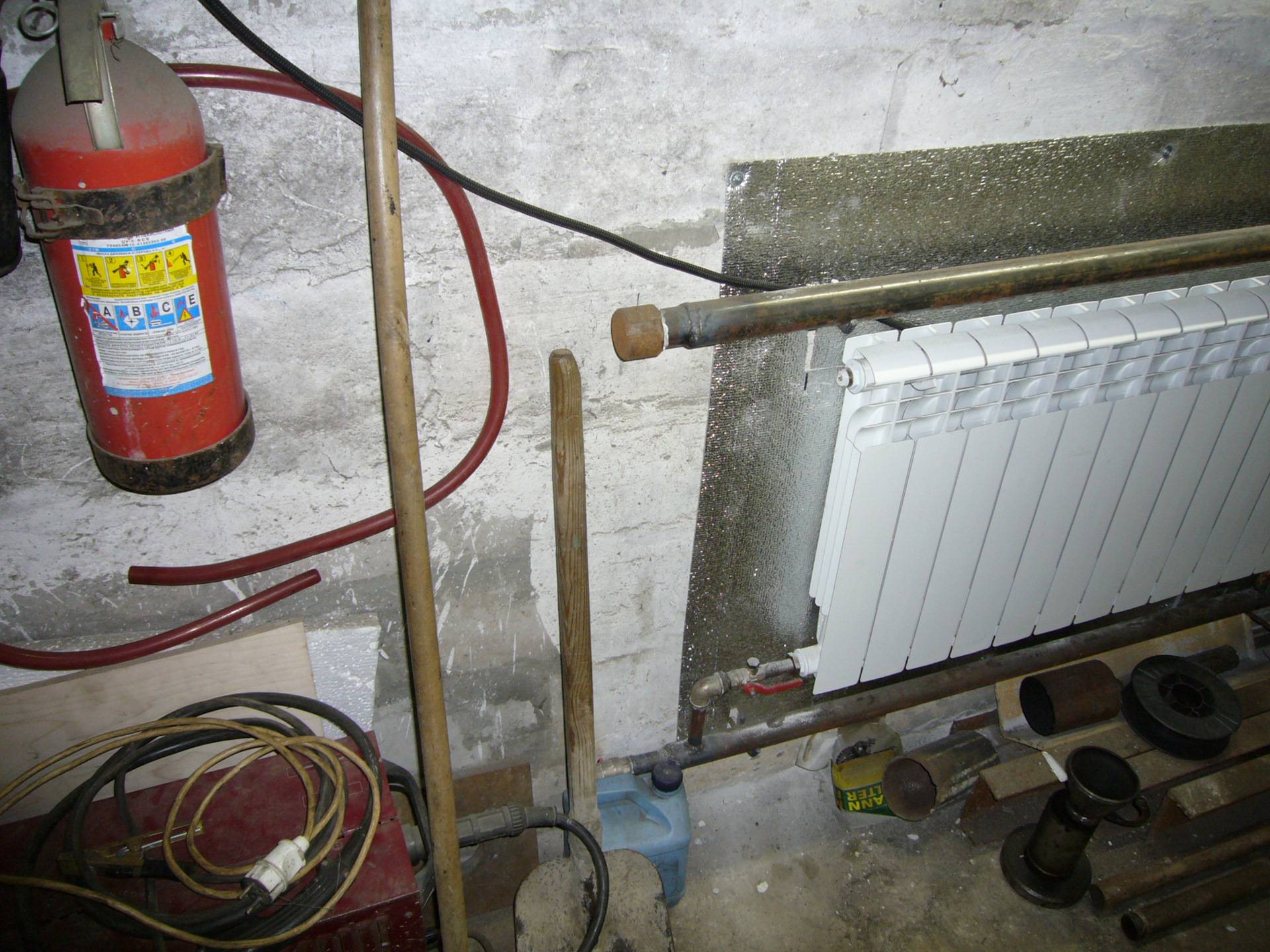
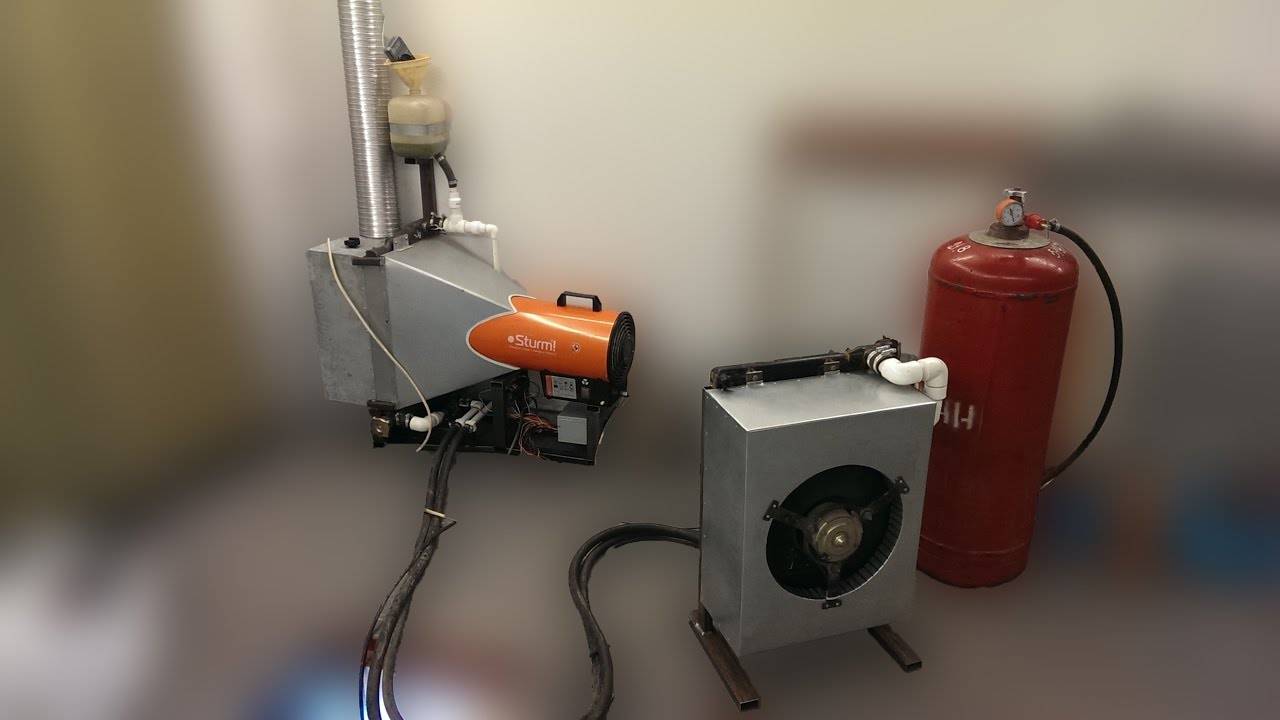

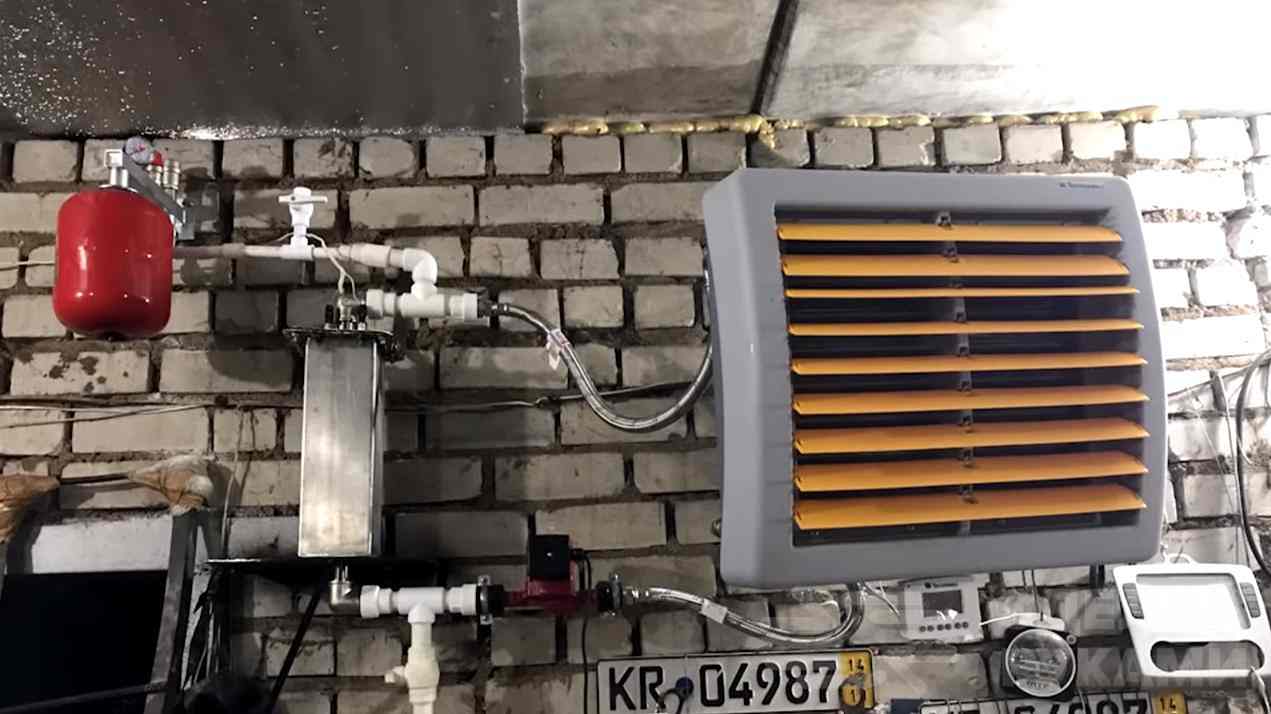
Schemes for a garage water heating system are diverse and easy to find in the public domain on the Internet. Further installation, as well as a list of necessary tools, will depend on the type of materials used. Before installation, it is also necessary to analyze the additional energy costs, which increase in proportion to the size of the garage. For a car, this issue is not fundamental, because sufficiently dry and ventilated air will help to avoid body corrosion. The issue of space heating is relevant when performing long-term work or if the garage is combined with a workshop or other outbuildings.
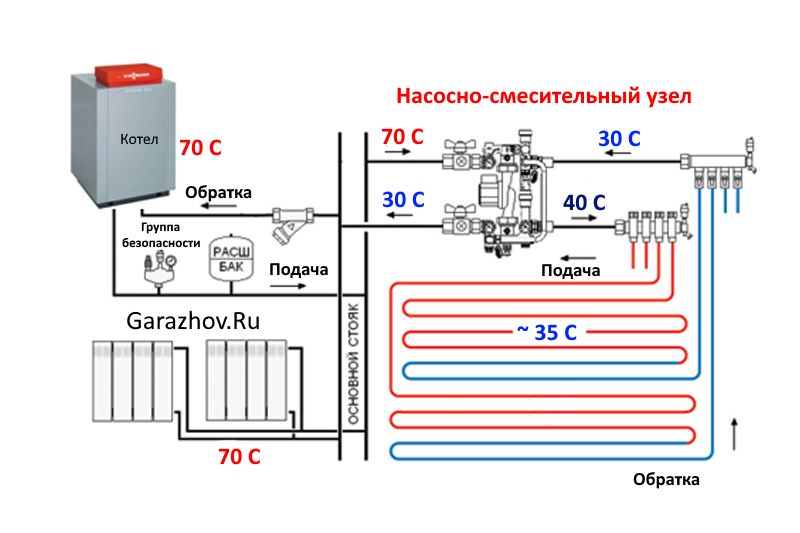
Here are some of the most classic examples, and an example with underfloor heating.

———————————————————————————————————-

———————————————————————————————————-
No. 1. Water heating system
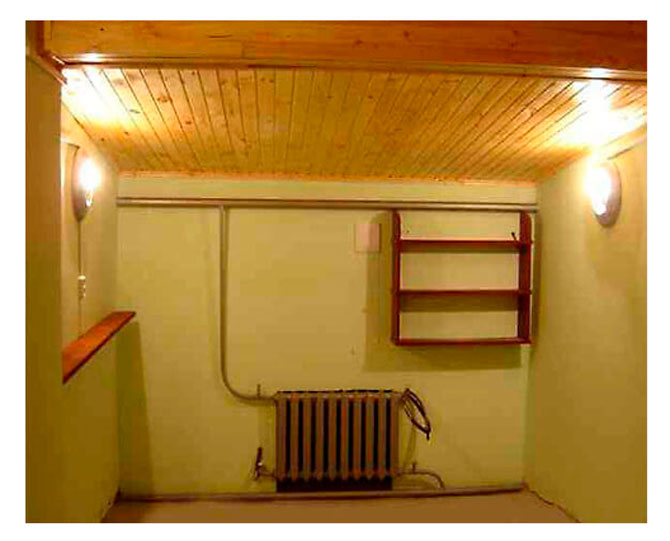
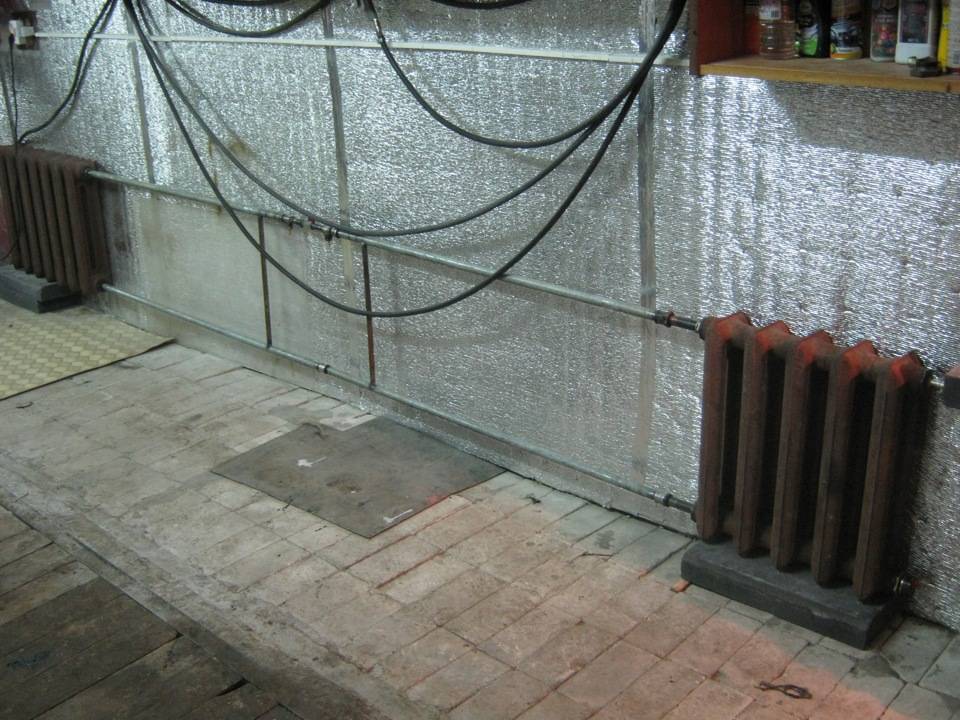
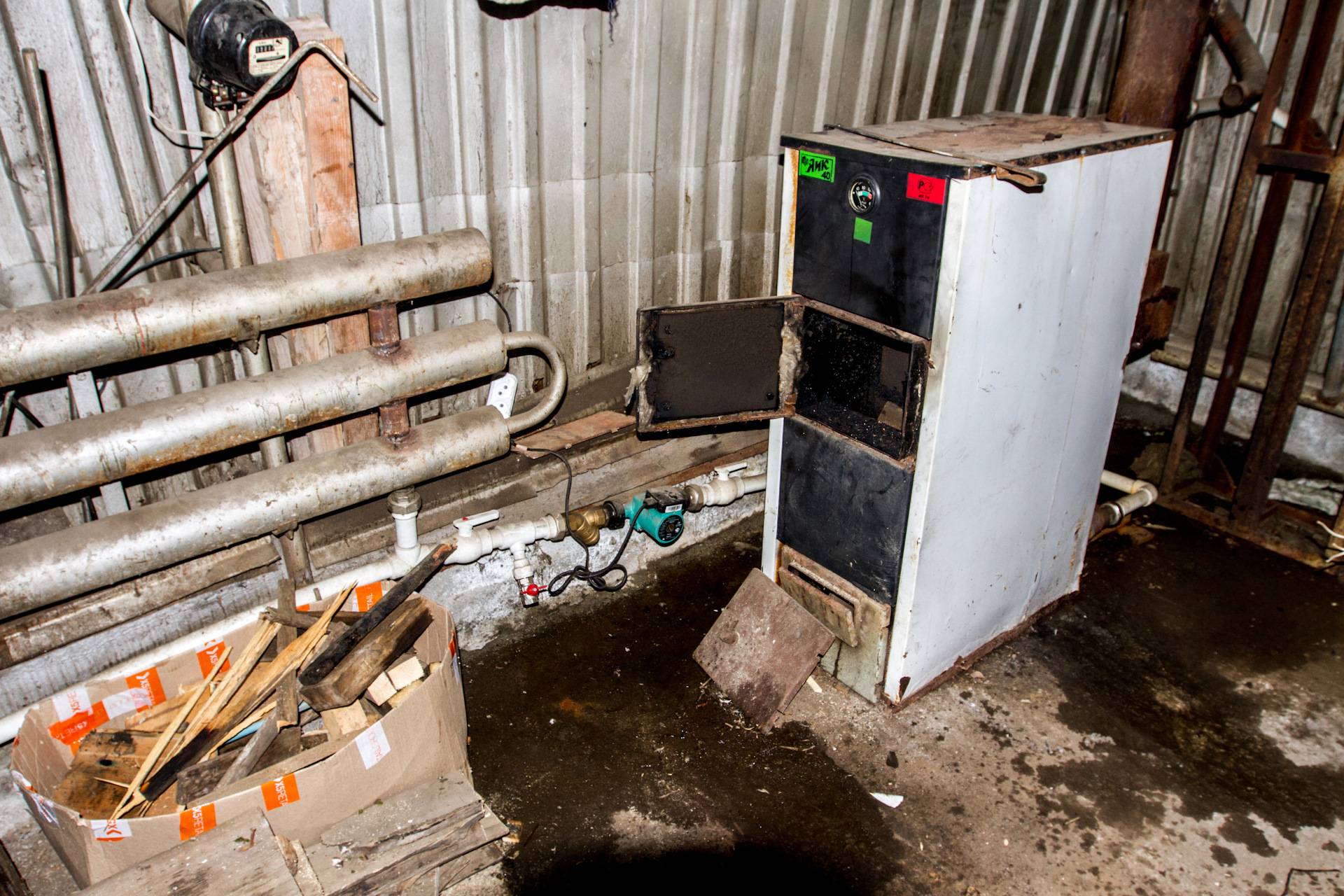
The water heating system is organized in the garage by analogy with residential premises. The coolant is heated in the boiler, and then it passes through pipes and radiators, evenly heating the entire garage. After the heat supply is stopped, the pipes remain heated for another couple of hours. This is the main advantage of this system.
The main disadvantage is the complexity of the organization. In addition, the water in the heating circuit may freeze, so if the system is not used in the coming days, it is better to drain the water. On the other hand, frequent water changes lead to rapid corrosion of pipes and radiators. To avoid this problem, it is better to use metal-plastic equipment. It is better not to use ordinary water in the heating system - it is replaced with antifreeze, a non-freezing coolant.
The complexity of the arrangement turns into another drawback - a high price. The most economical way to heat a garage is to connect its circuit to a domestic boiler. The cost of general heating will increase, but it will still be cheaper than organizing an independent heating system.
If it is not possible to connect to the home system, a separate boiler will have to be installed. It can run on different fuels. The following types of boilers are used in the garage heating system:
- an electric boiler is the easiest to install, as safe as possible, but expensive in terms of operation.Even if you are not afraid of electricity bills, you should not use such boilers in areas with frequent power outages, power surges, as well as in regions with severe windy winters, because the wires can break, which will eventually lead to freezing of water in the system. If you do not have time to drain the water in time, then the pipes may burst;
- gas boilers are extremely rarely used in garages, since not everywhere there is access to a gas pipeline. If the gas pipeline passes nearby, then you are very lucky - gas heating will be inexpensive, and in terms of operation, such systems are quite simple. The main thing, only, to follow the safety precautions;
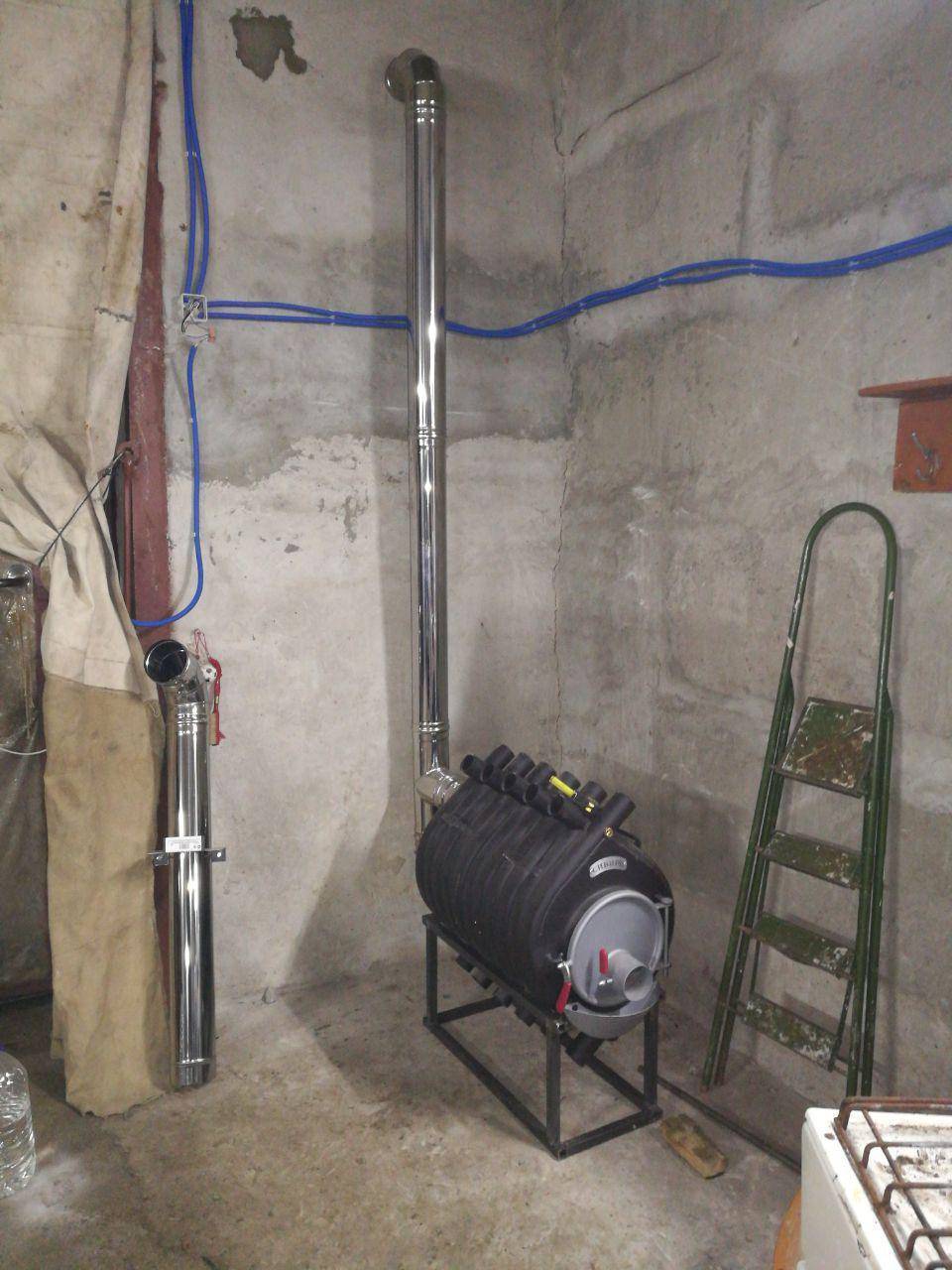
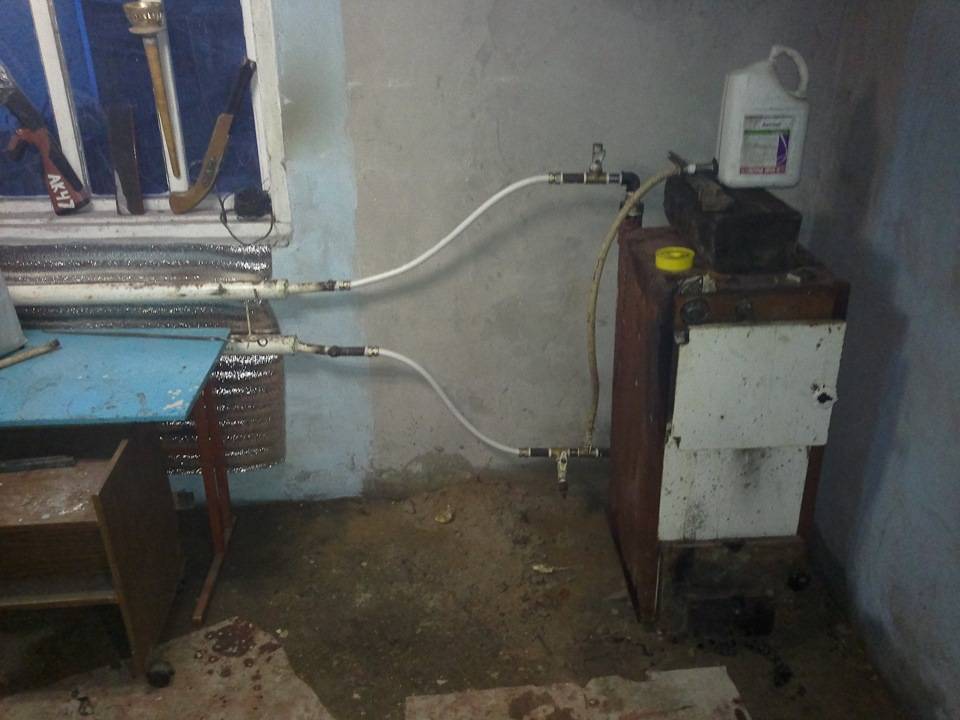
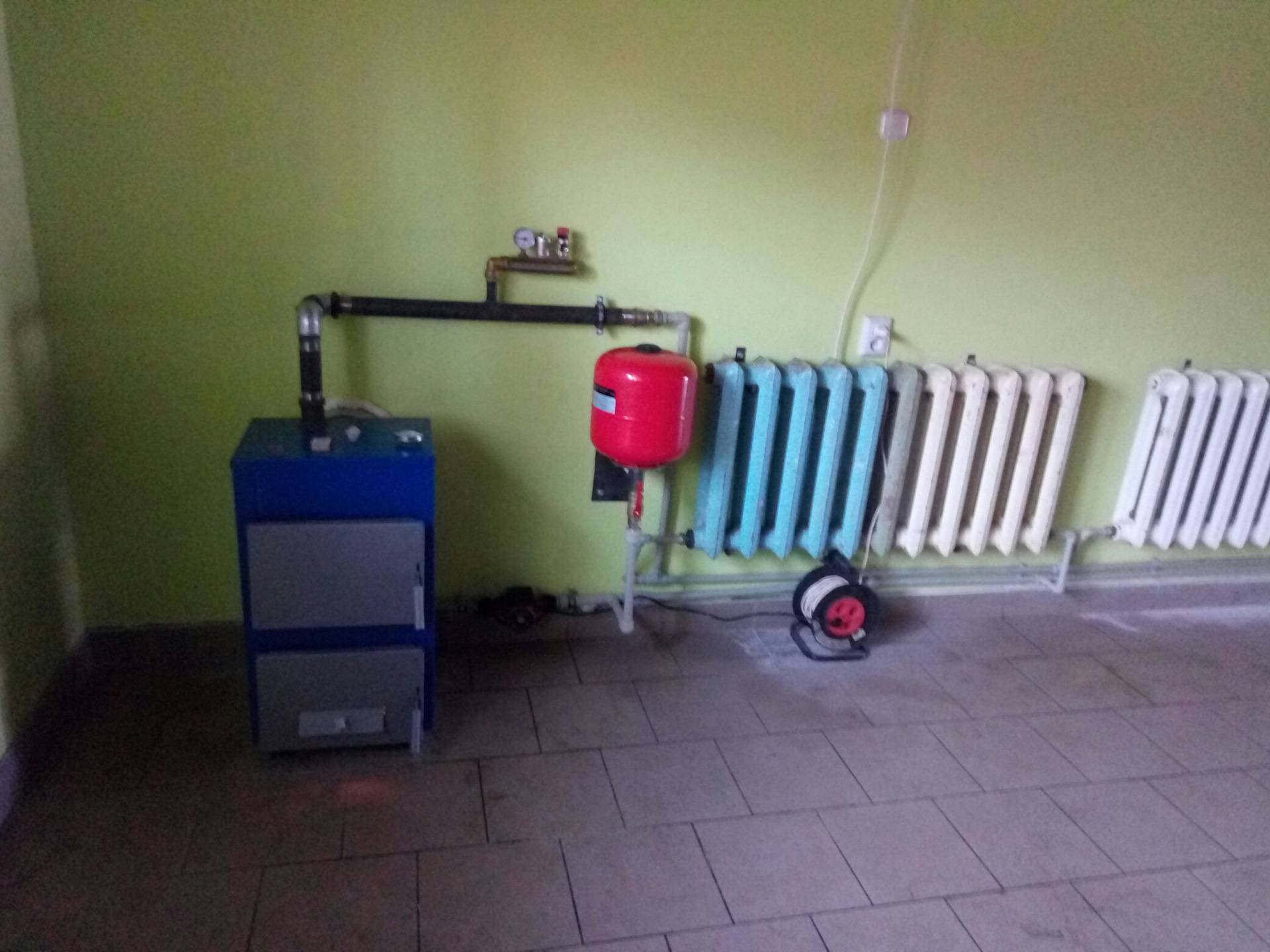
- boilers for liquid and solid fuels. You can choose a stove for wood, coal, diesel or waste oil - it all depends on which resource is more available in your case. Solid fuel boilers require constant monitoring and frequent loading of fuel. Pyrolysis and pellet units are more convenient in this regard, but they are not cheap, the most economical option is a potbelly stove, which can also be used in a water heating system.
For all boilers, except electric, you will have to organize a chimney. In addition to the boiler, radiators, heating pipes and chimney pipes, you will need a circulation pump and an expansion tank. All this costs money, so using a water heating system only makes sense in large garages. Often such heating is done at service stations and in commercial auto repair shops. If the garage is small, then it makes no sense to organize such a complex water heating system - this is an option for more or less spacious rooms where constant heating is required.
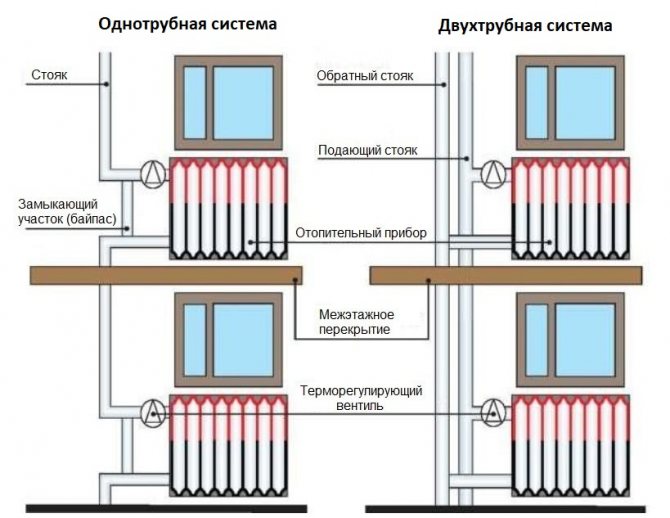
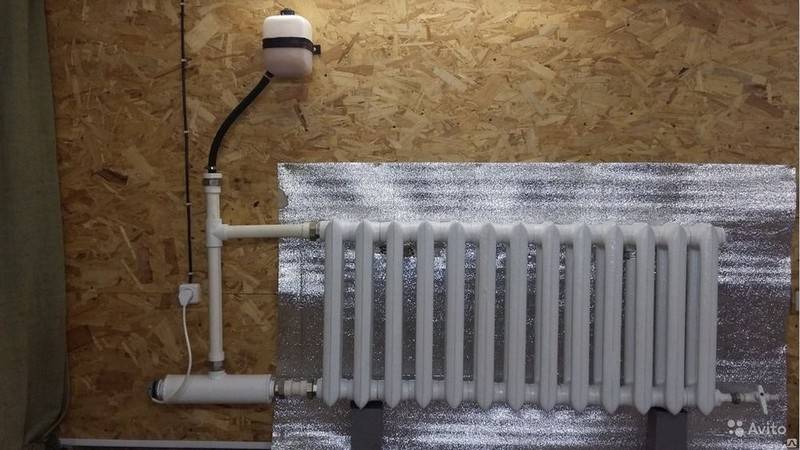
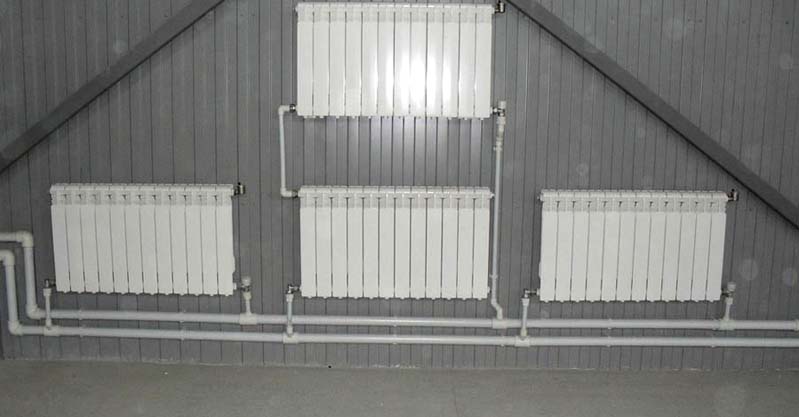
The principle of operation of a water heating system is quite simple.The coolant heats up, passes through the pipes, gives off heat and returns to the boiler. The system can be one- or two-pipe. A single pipe system is much easier to organize and cheaper, it is best suited for a small private garage. In this case, the heated coolant sequentially enters the radiators, i.e. in the first radiator, the temperature will be higher than in the last one, where the antifreeze reaches already cooled down. A two-pipe system allows for more uniform heating, but much more materials will be needed.
Even if the garage is not attached to the house, but is located nearby, you can try to connect it to the home heating system, but there are limitations. The distance from the garage to the house should not be more than 20 m, and the pipes must be insulated with high quality.
If antifreeze is used as a coolant (a liquid that does not freeze even at -45C), then you need to work with it carefully, because it is a toxic substance that becomes even more dangerous when heated. Antifreeze is not recommended for use in two-pipe systems
The coolant is replaced every 5 years.
Heating with electricity
Shopping list
To create a highly efficient garage heating with electricity, you will need to purchase:
- electric boiler;
- radiators;
- plastic pipes;
- waterproofing material.
Let's take a closer look at how to use an electric heater according to the "hand-made warm floor" system. It is not difficult to make a heater of such a plan if you follow the recommendations of specialists.



step by step plan
Heating the garage with electricity using the "warm floor" system must be organized as follows:
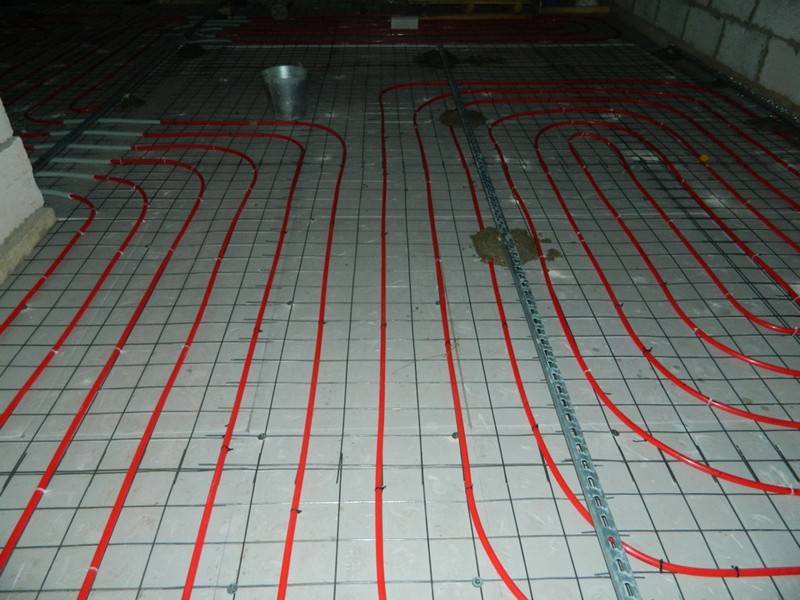
- the base will need to be waterproofed with a special roll material;
- pipes with a heat carrier made of metal-plastic are installed directly in a concrete screed for uniform heating of the entire room;
- further, the pipes embedded in concrete are connected to an electric radiator, a power source;
- if necessary, turn on the system, plug the wire from the radiator into a socket.
How to reduce heat loss and not go broke?
No heating system will be profitable and efficient if you do not take care of reducing heat loss. Heaters will waste a huge amount of energy. This is expensive and impractical, so you will have to insulate the gates, walls, floor and roof.
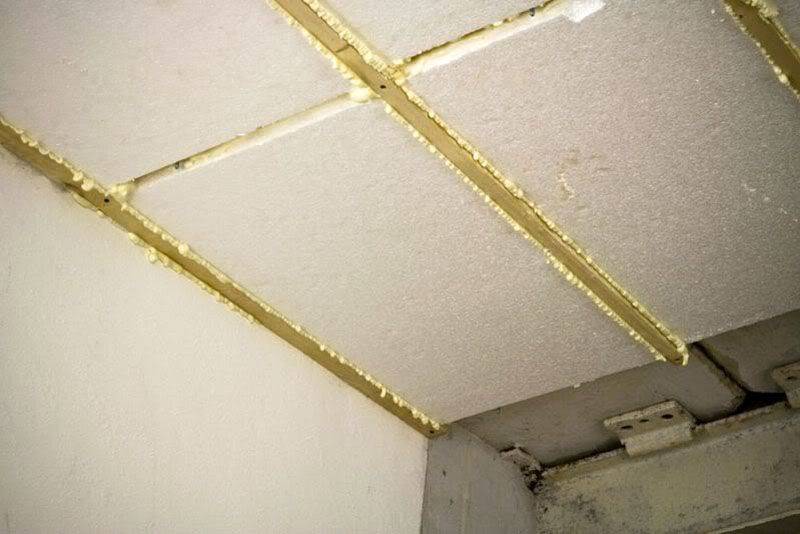
You can use expanded clay, polystyrene concrete, foil insulation, but the cheapest and most versatile option is foam. It is suitable for insulation of all structural elements. It can also be used for thermal insulation of the floor, provided that a floating screed is made: the foam does not tolerate mechanical stress, so it is poured with cement.
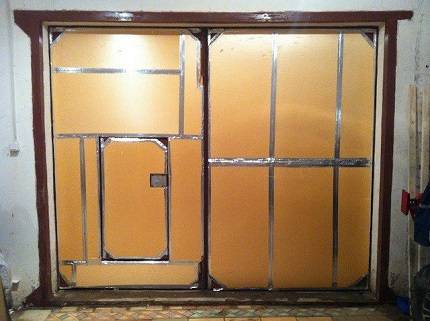
Styrofoam is ideal for sheathing garage doors. The insulation is mounted on a special crate, and on top it is covered with outer cladding - MDF boards, chipboard or plywood
Styrofoam sheathed ceiling, walls and garage doors. There are two options - external or external wall decoration. Both are equally effective and allow you to achieve excellent thermal insulation of the building. You should choose based on the convenience of the owner of the garage.
This is interesting: Electric stoves for saunas and baths
How to make cheap and fast garage heating with your own hands
We will give several options for heaters for the garage, which you can do yourself:
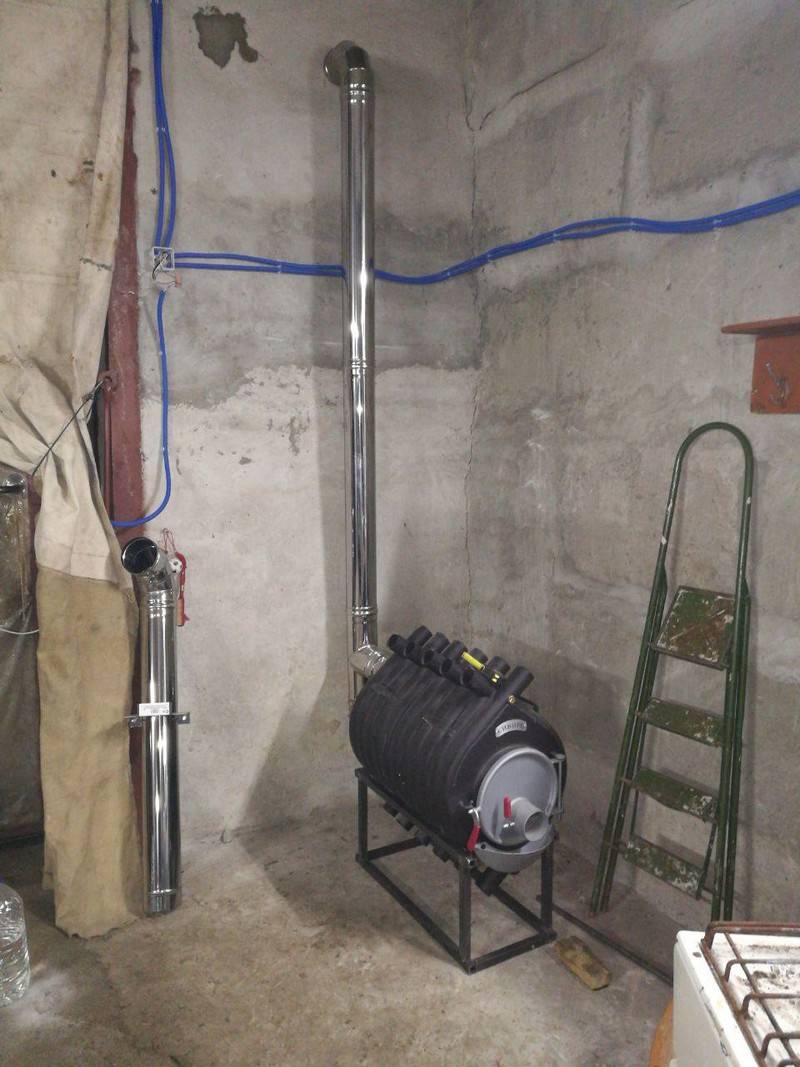
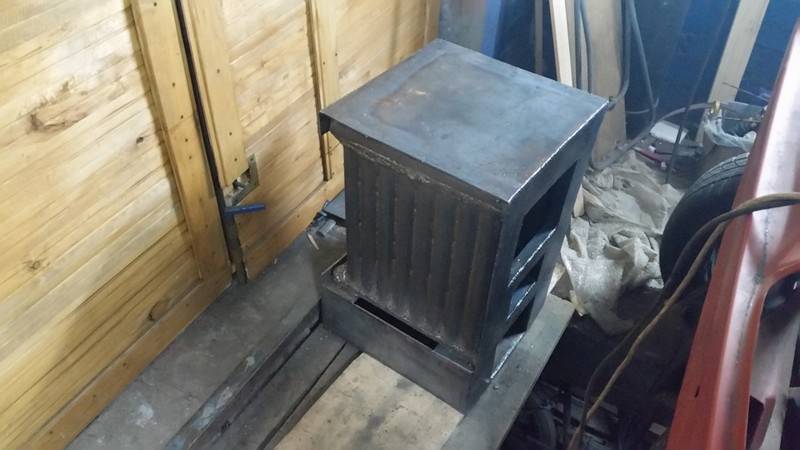
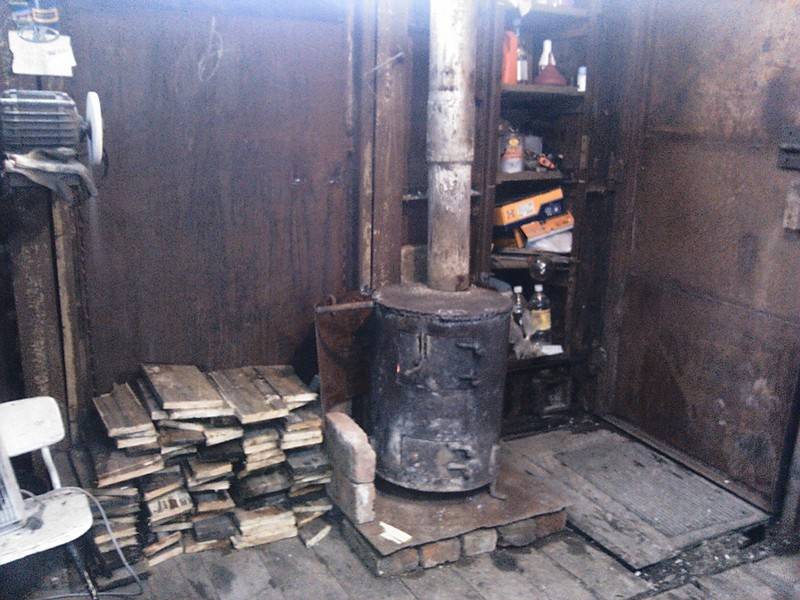
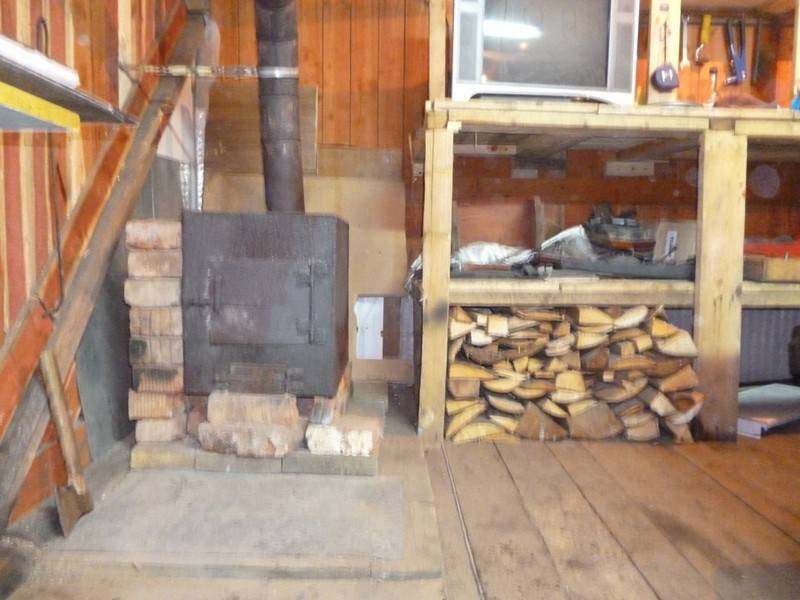
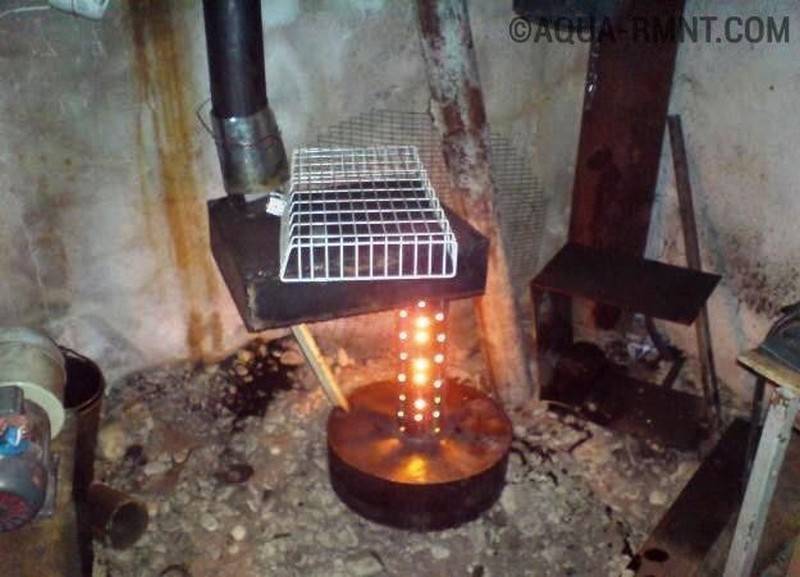
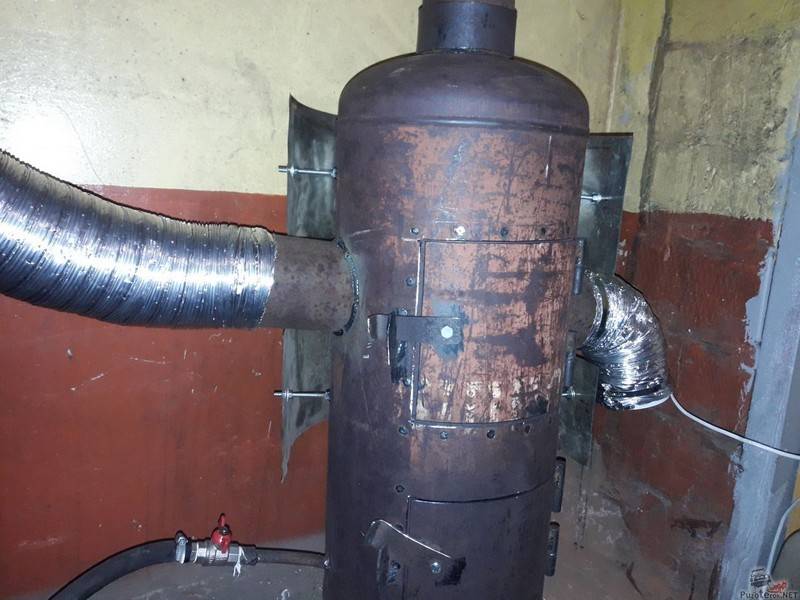
The simplest of them is a potbelly stove, which is usually heated with firewood. It can be an oven of any configuration, made from any ready-made container. For example, from a 200-liter barrel, which is cut in half across. The oven is made from the half. Although you can place the barrel horizontally without cutting it. The main thing is to make a pipe for the chimney, a firebox where a partition is inserted from a grate welded from reinforcement, and a door to close the combustion chamber. As practice shows, it is not a problem to make such a heating device in three to four hours.
Wood stove from a 200 liter barrel
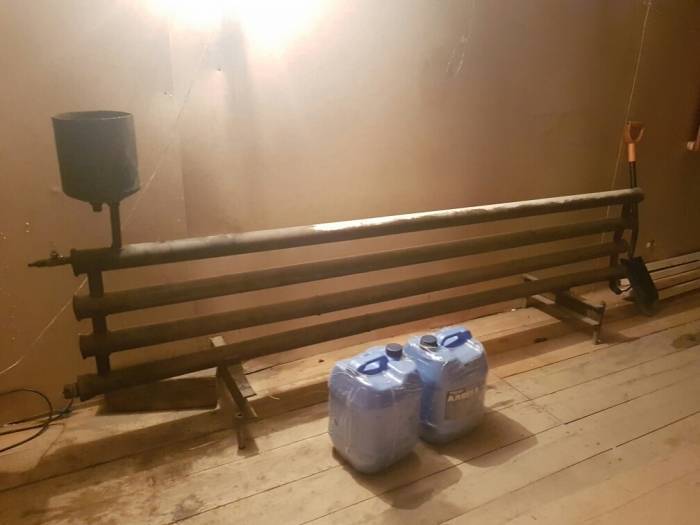
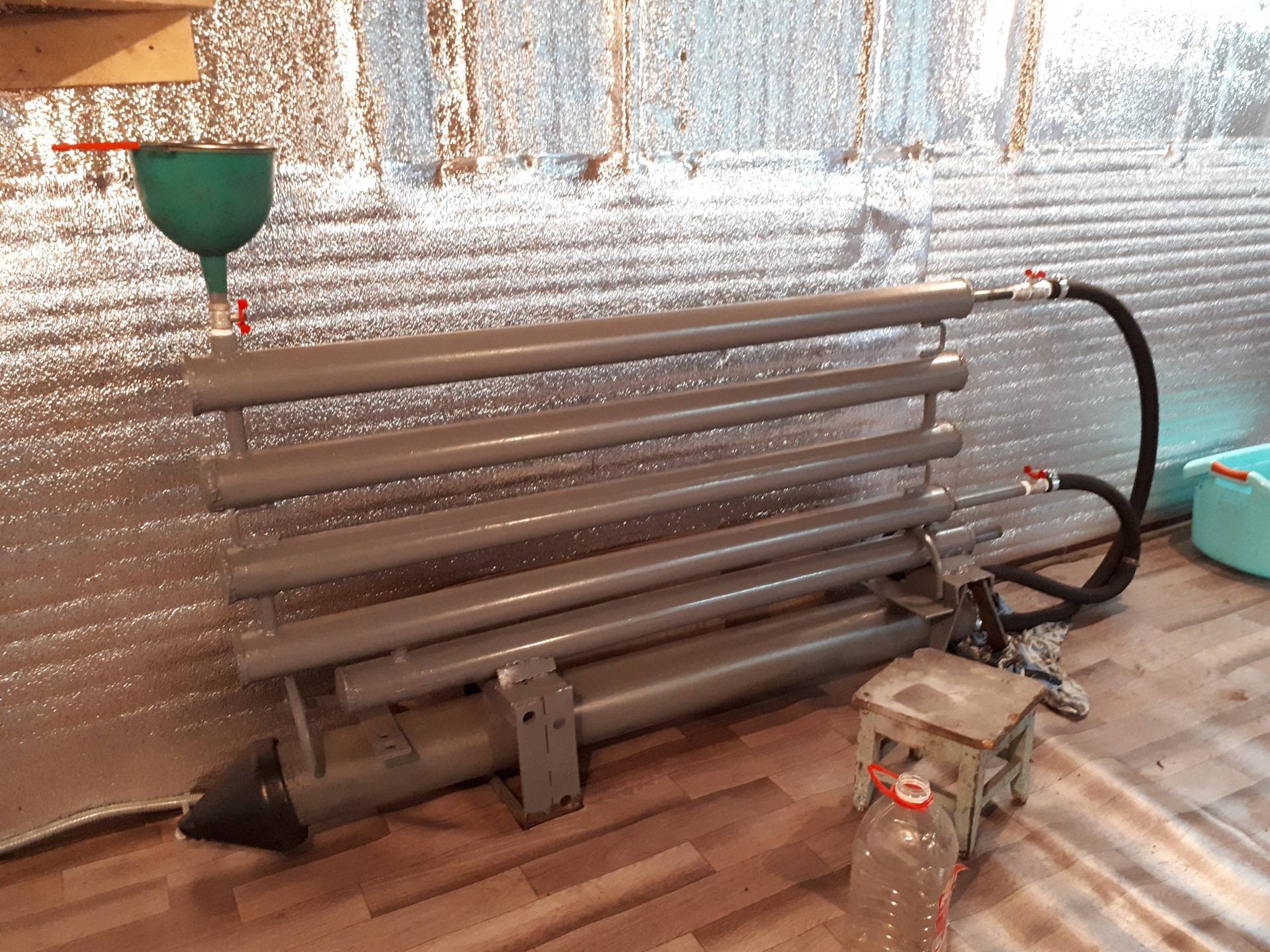
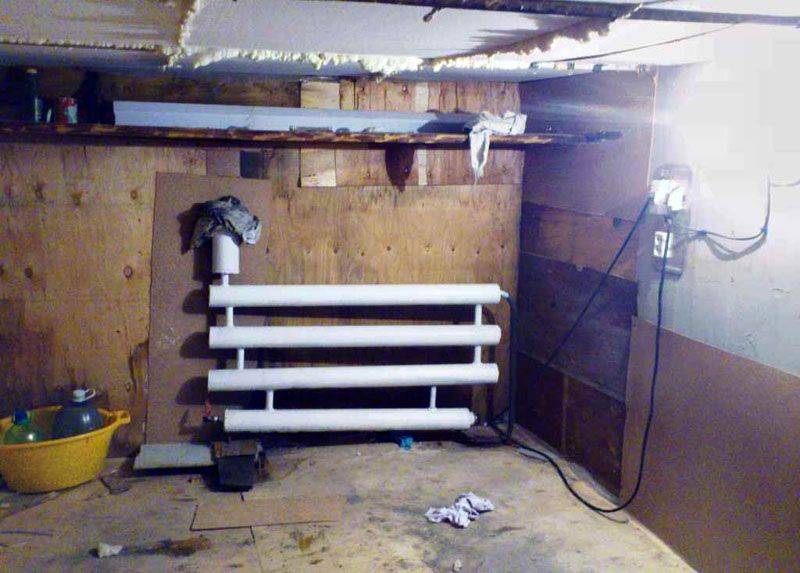
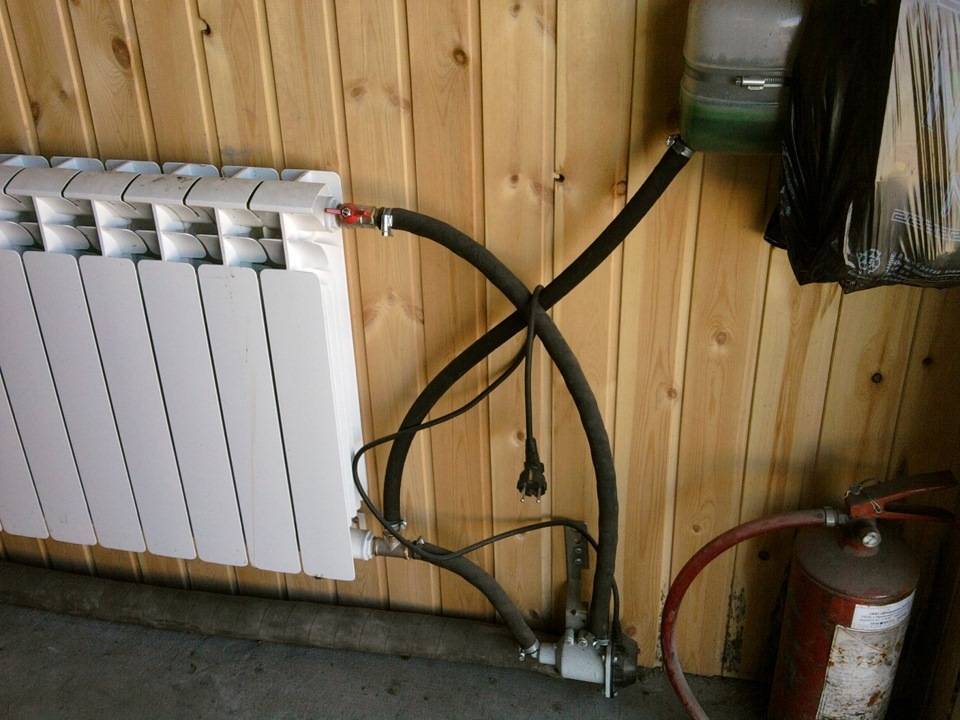
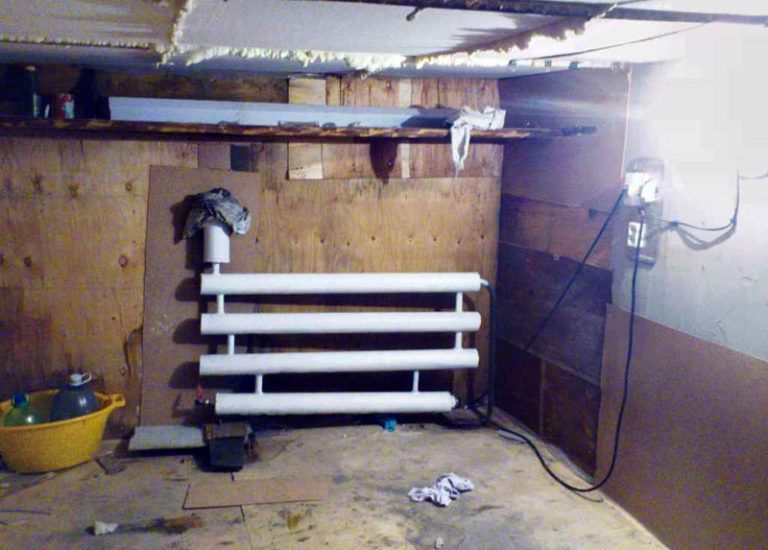
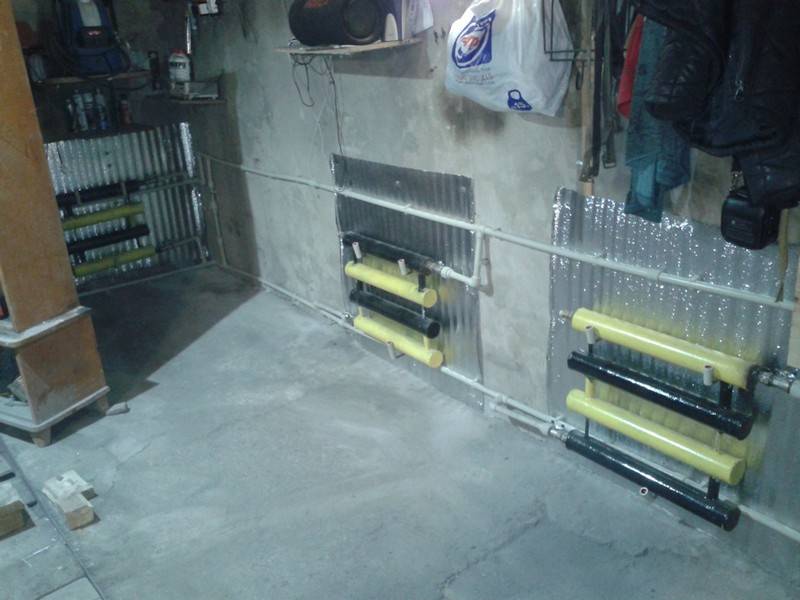
Good choice for electricity. But this is a water heating system. To do this, it is necessary to weld a heating register from several pipes. The more pipes in the structure, the larger their diameter, the higher the heat transfer of the device. An ordinary household boiler with a power of 1-1.5 kW is welded into the lower pipe from the end. And a vertically mounted small expansion tank of an open type is welded into the upper pipe from the end. Through it, water or antifreeze will be poured into the system. The last one is better. The register is filled with coolant, the boiler is plugged into a socket. Literally in half an hour, the heater will be already hot and will begin to heat the garage.
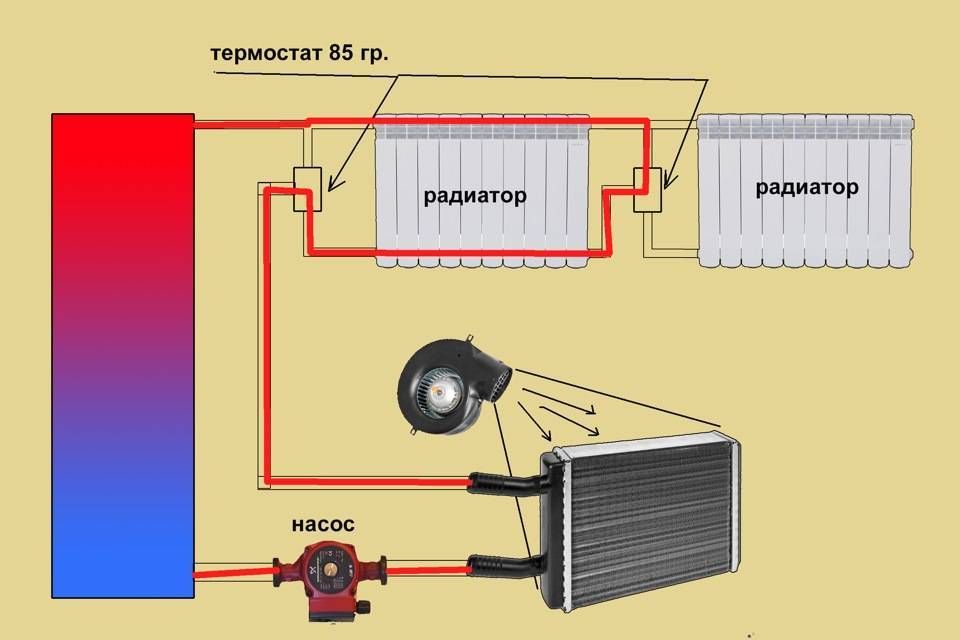
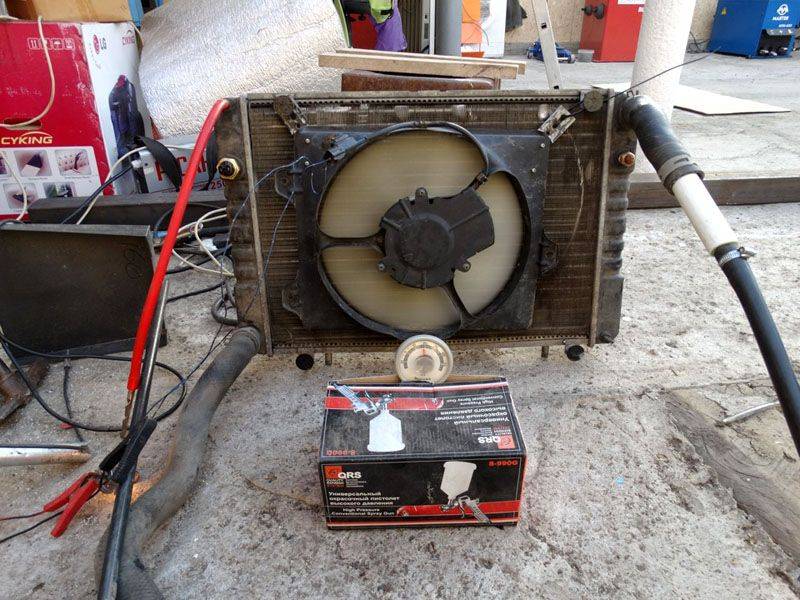
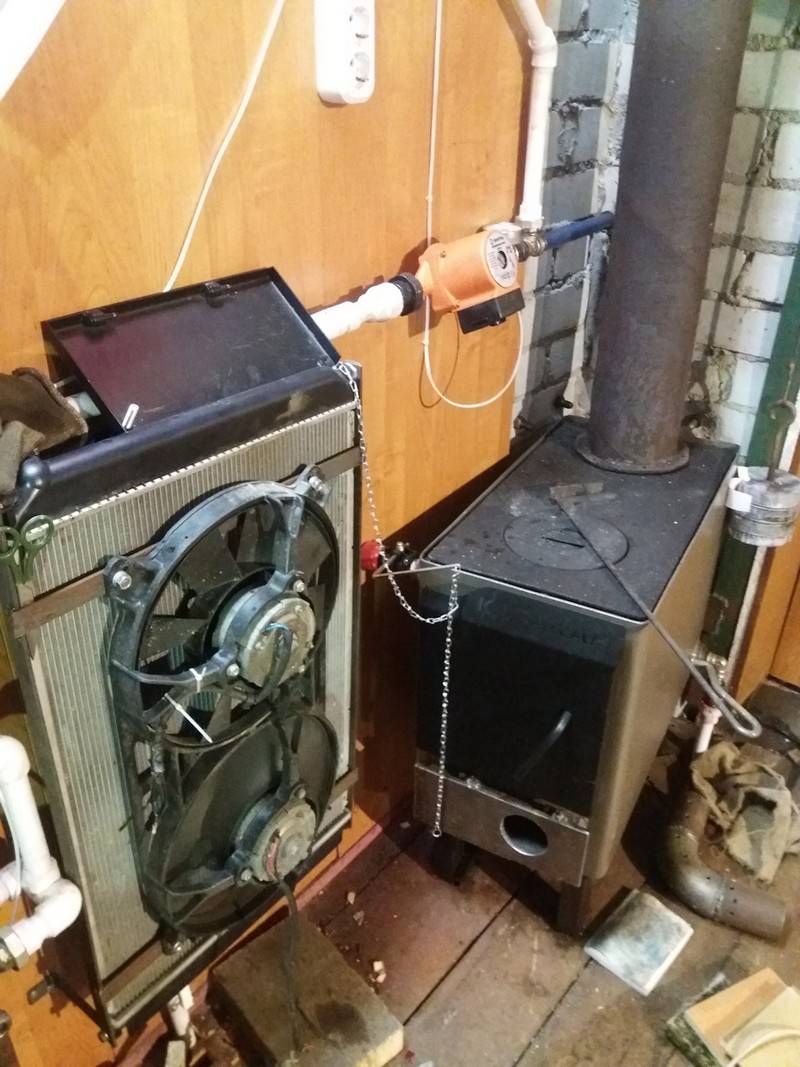
Another option with air heating elements. To do this, you will have to use a potbelly stove with a water circuit. Only instead of a full-fledged heating system, a conventional radiator from a car is used along with a fan. The radiator is hung on the wall so that a fan fits behind it. The latter is connected to the mains through a step-down transformer. The radiator is connected to the coil with hoses or plastic pipes.The connection should be made as follows: the upper pipes of the coil and the radiator are connected by one hose - this is the coolant supply circuit, the lower ones form a return circuit between themselves. The effectiveness of this method of garage heating lies in the fact that a small-sized boiler is required for assembly, which can quickly heat the coolant. The fan effectively removes heat, lowering the temperature of the water to the maximum. That is, the ring system works according to all heat engineering laws. By the way, you can replace the potbelly stove with a boiler.
Choosing the most economical heating method
A man who owns a car and a garage (and a woman too) usually has no reason to blame the lack of items in the cost estimate: parts are expensive, gas also does not fall down, and if the premises are rented, then rates tend to creep up over time. In this regard, the main criterion for organizing heating is efficiency. This is what we take as a basis when considering all the advantages and disadvantages of the methods discussed below.
Electricity
One of the most popular options. The secret of being in demand is simplicity - special devices powered by electrical wiring are used to heat the room:
- heat gun;
- convector;
- fan heater.
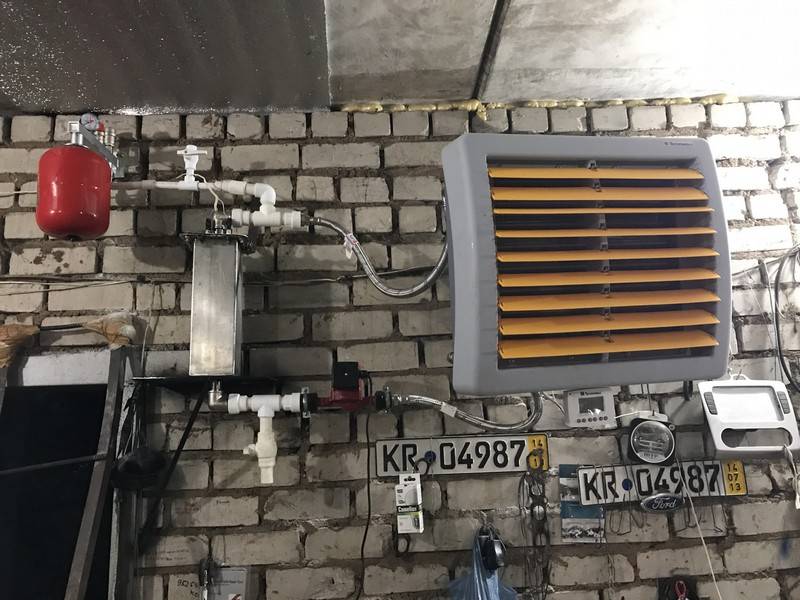
They can either be fixed in place or move around the entire perimeter for a point distribution of heat. However, the process consumes a large amount of electricity, which can eventually hit the wallet. Our verdict - this method can only be considered as a temporary solution in case of severe frosts.




There is also the option of installing a warm floor, but it requires a deep study of the project due to the specifics of the use of the premises and is fraught with considerable costs during implementation.
- safety;
- elementary installation;
- mobility;
- temperature can be adjusted.
- a burning smell may appear;
- some appliances are very noisy;
- with frequent use, a large consumption of electricity is observed.
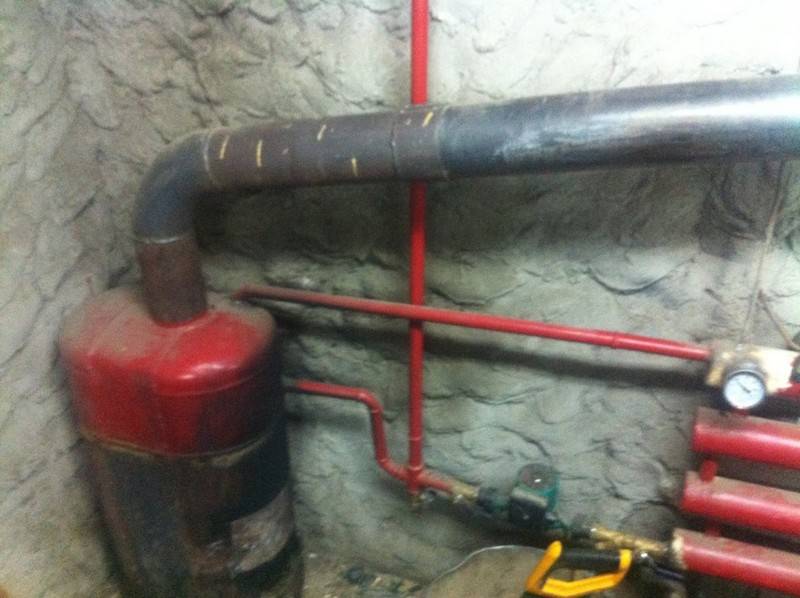
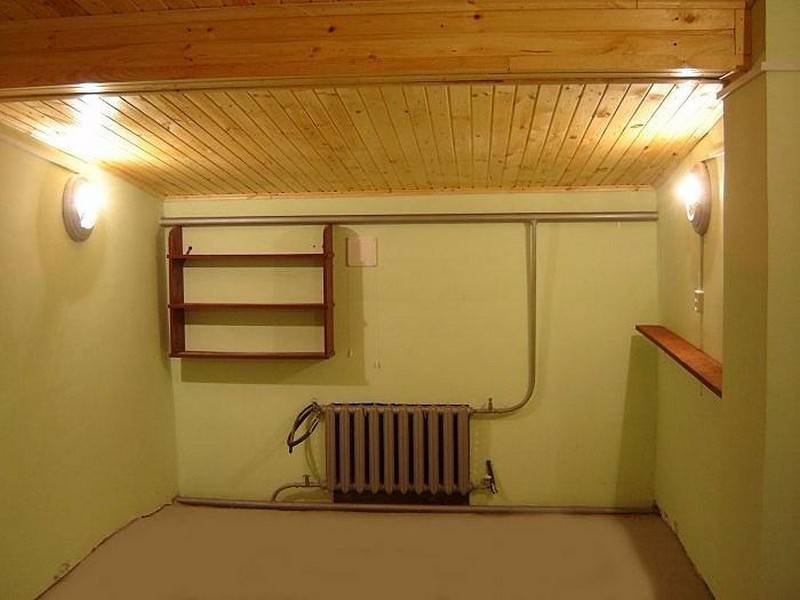
Water heating
It is very good if the garage is located near the house - in this case there is no need to connect a separate boiler. Only one radiator will be enough, and the number of sections will depend on the total area of \u200b\u200bthe room.
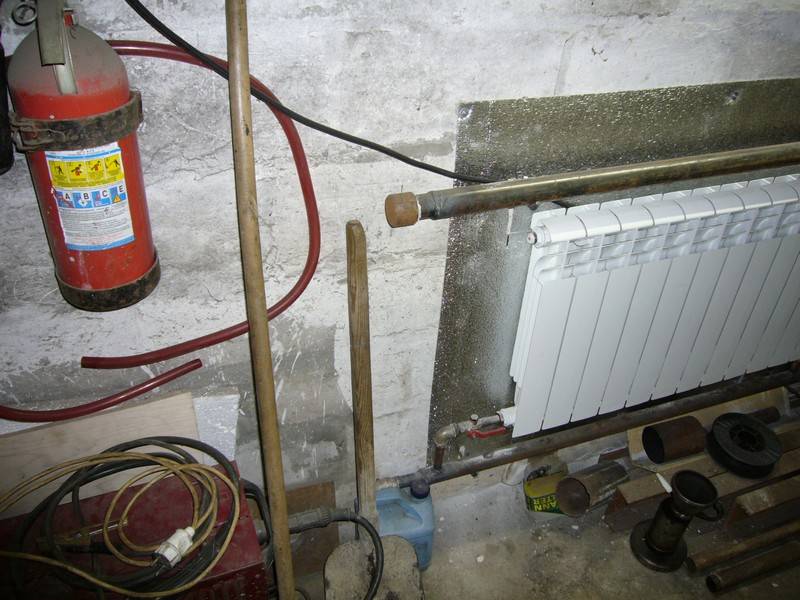
However, most often you still have to resort to placing a separate boiler. It is best to choose a single-pipe system: this greatly simplifies installation and reduces costs. But if the garage is large, then such heating will not be enough for a full warm-up - you will have to install a two-circuit system.
perfect heating of even a very large room;
- the need for constant operation of the system to avoid rupture of pipes during the frosty period;
- complex and lengthy installation;
- high cost of accessories.
Gas
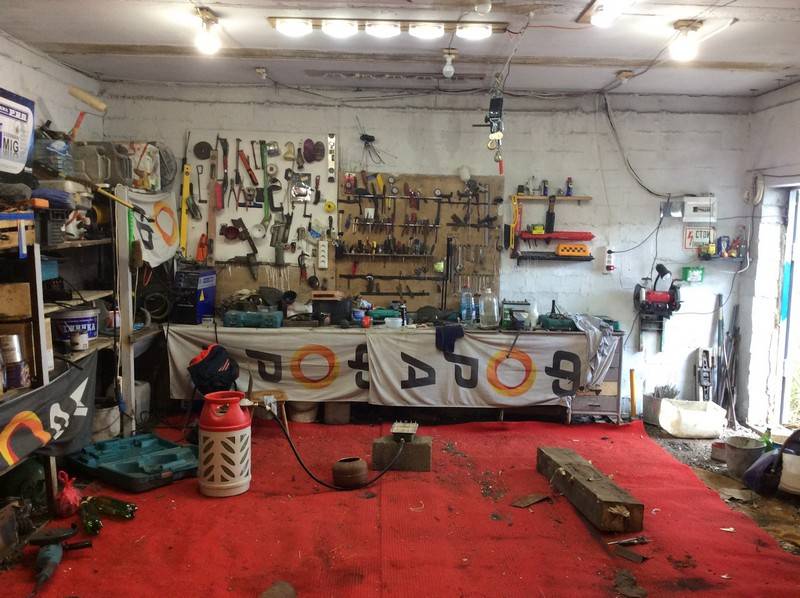
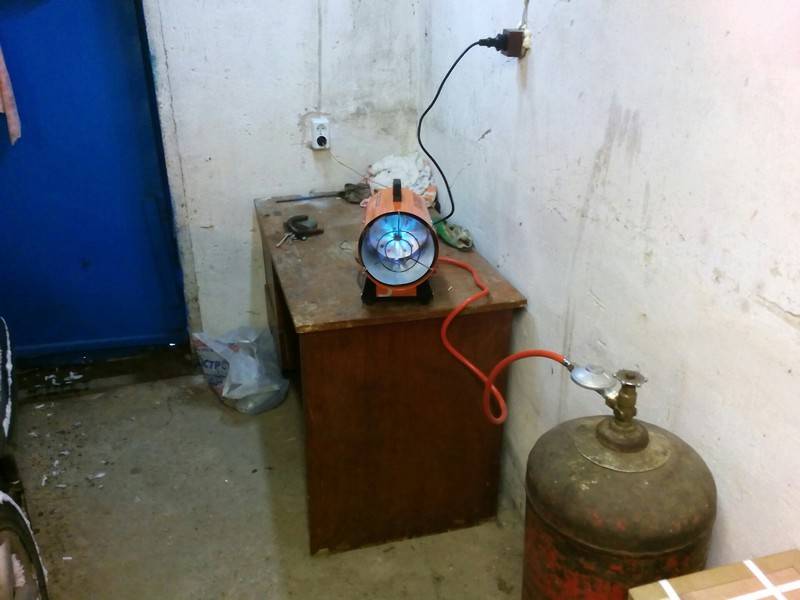
Probably the cheapest and prettiest option. If not for one "but" - to activate it, you will have to beat a lot of thresholds in the appropriate authorities. Without the permission of the gas workers, you will not be able to do anything, and coordination, as a rule, takes a lot of time.
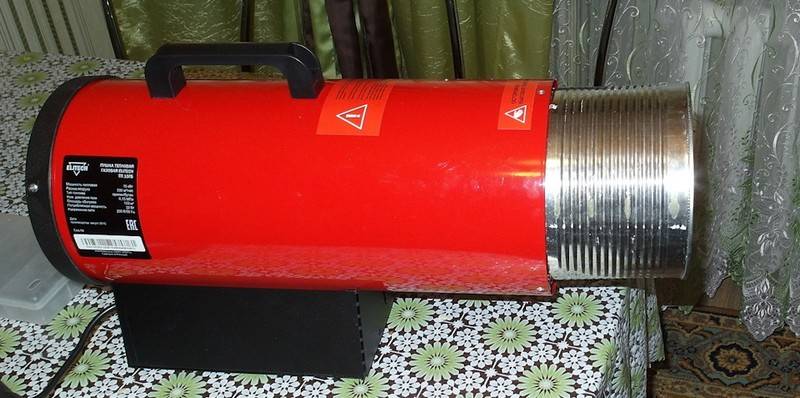
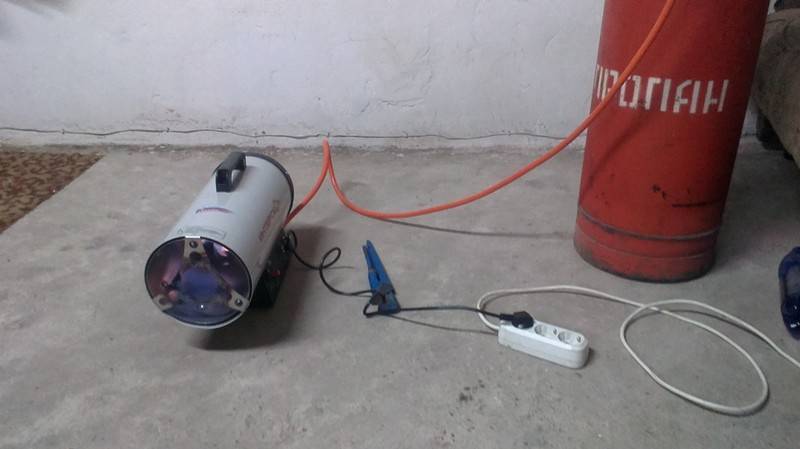
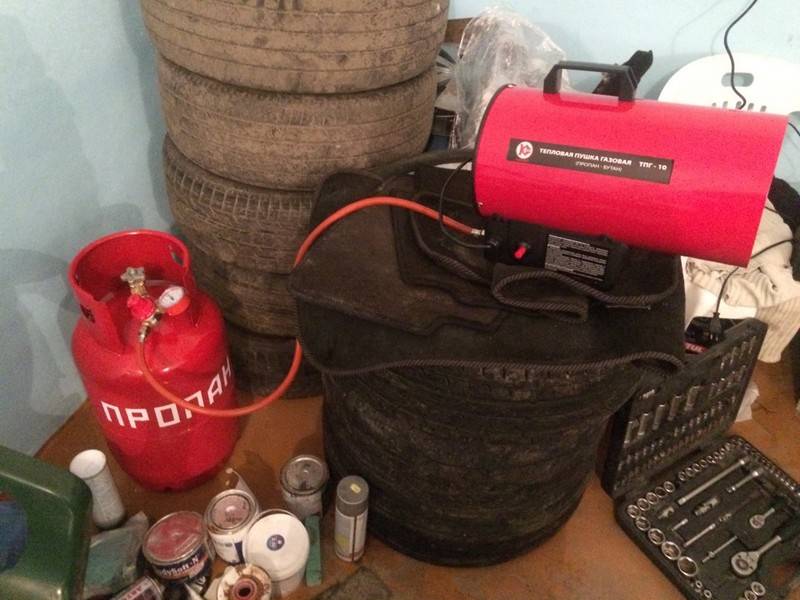
If, nevertheless, gas heating of the garage is your choice, then you have no desire to expect mercy from the services, then you can use mobile gas guns and convectors.With their help, you can warm up even the largest room with high quality.
- cheapness;
- convenience.
- permission of services and professional installation is required;
- complex safety precautions for the operation of gas cylinders and boilers;
- high costs for the arrangement of the system;
- explosiveness.
solid fuel
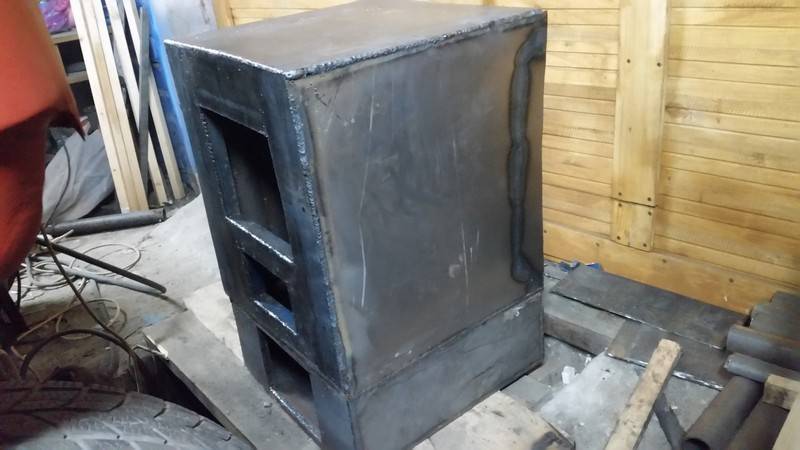
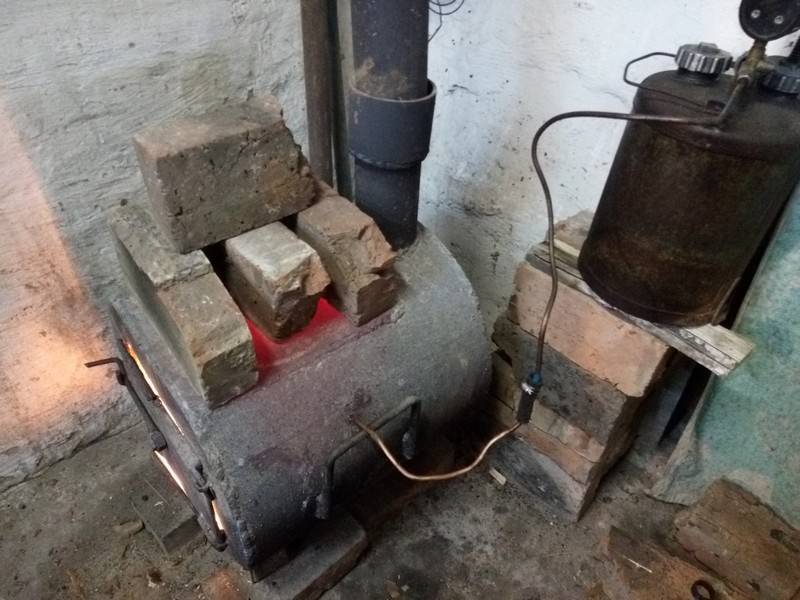
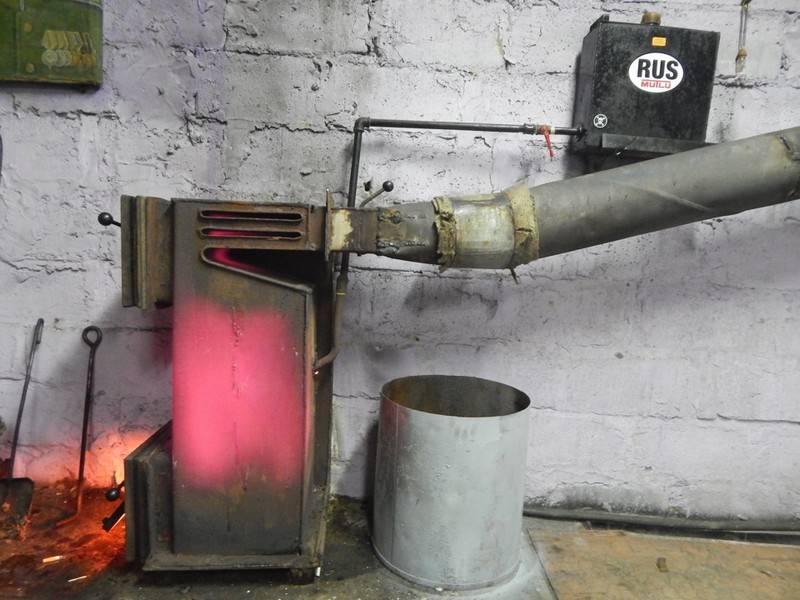
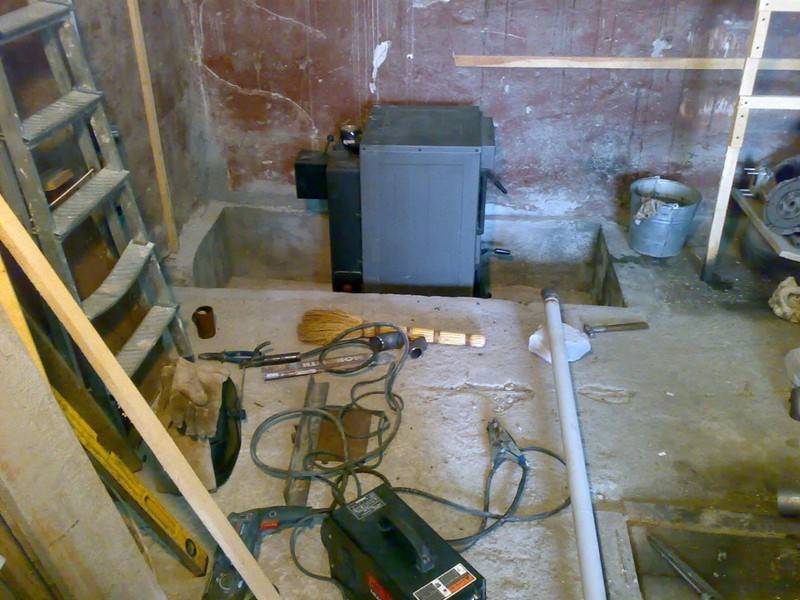
No matter how rapidly modern technology develops, many car owners still heat their garages with solid fuel boilers. Simply put, they use the good old potbelly stove. Or a ready-made boiler from those that are on sale - the choice is huge. True, do not forget to overlay the oven with bricks - this way you will significantly increase heat transfer.
- unaesthetic appearance;
- independence from communications;
- cheap and cheerful.
- often this method of heating does not meet fire safety standards when implemented;
- you need to build a chimney, which hits the budget hard;
- difficult care - regular cleaning is necessary.
Liquid fuel
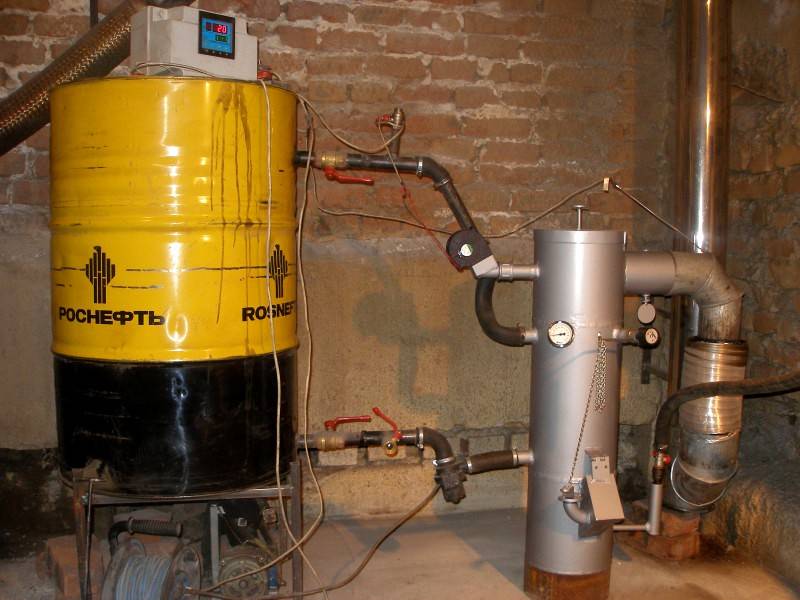
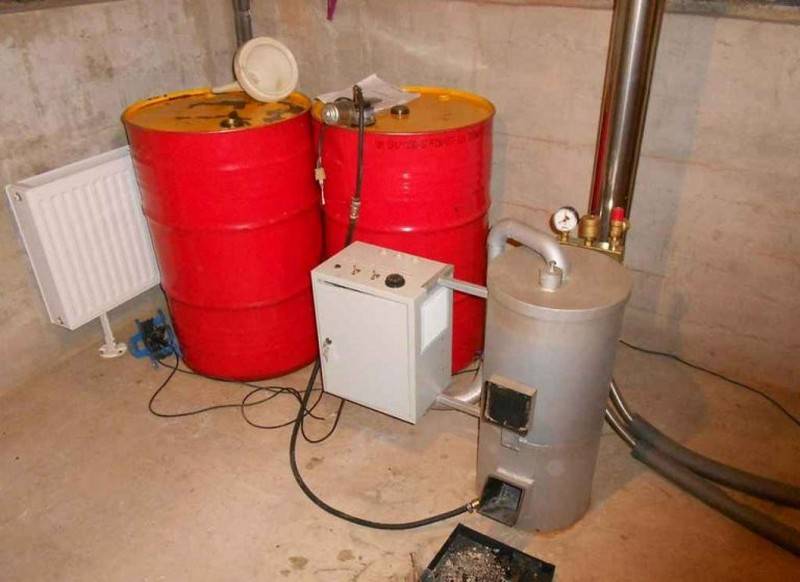
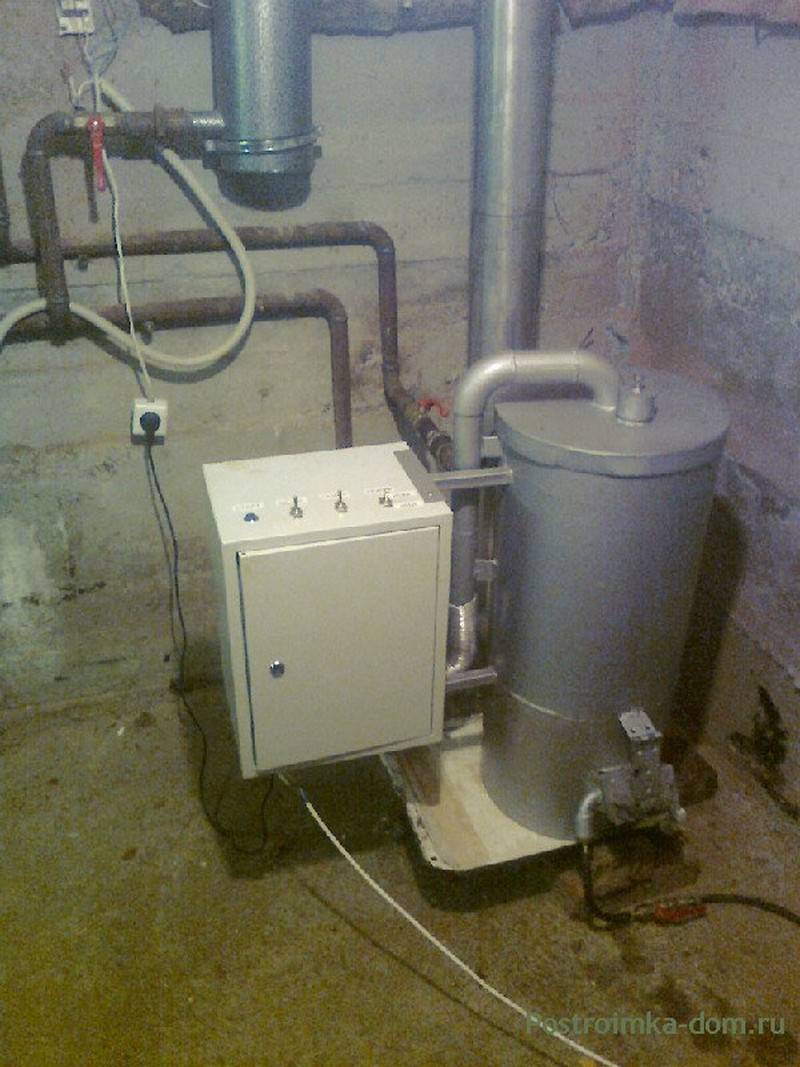
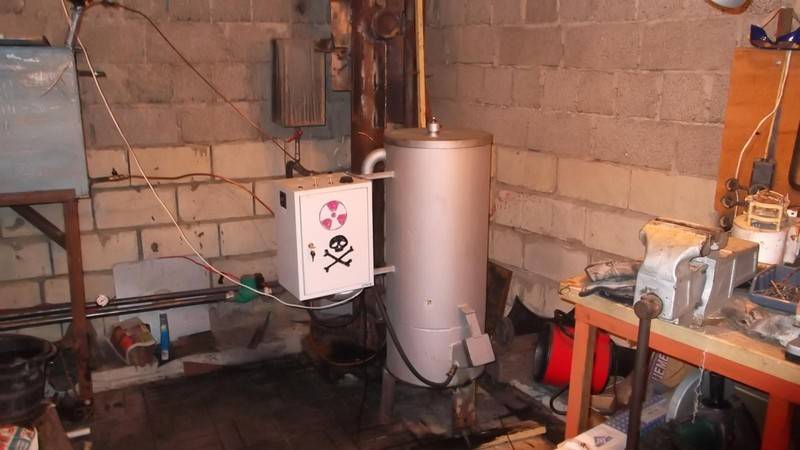
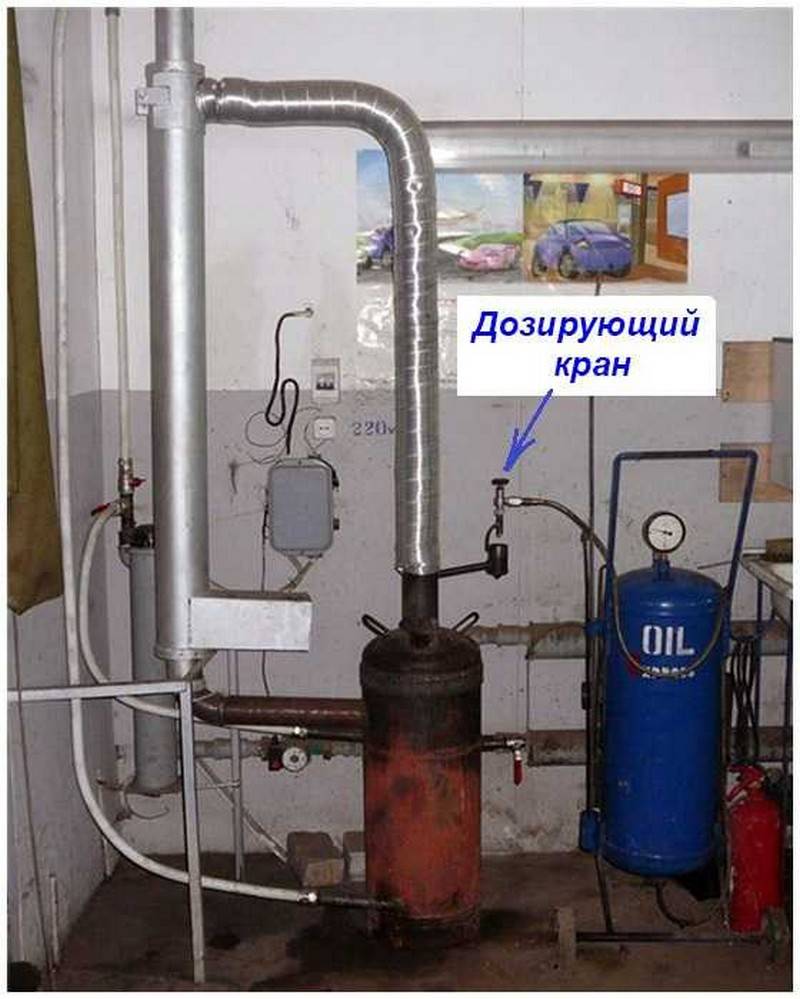
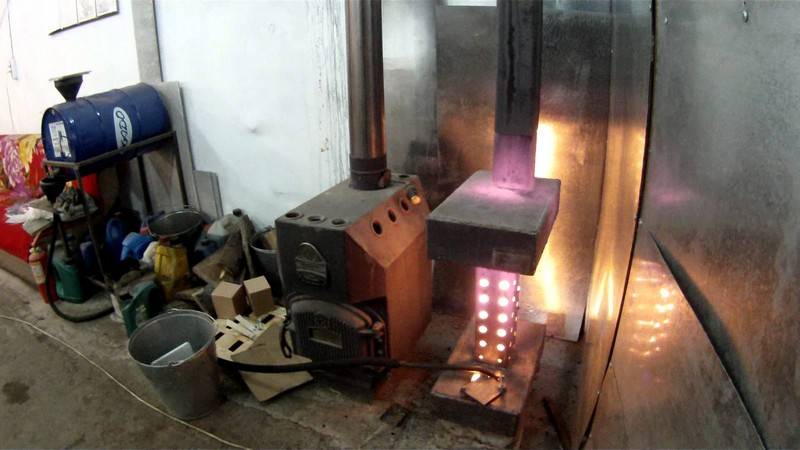
Those working on diesel fuel, diesel fuel and mining stoves can be found ready-made in specialized stores, but you can also assemble it yourself if you have an old used gas cylinder and sheets of heat-resistant steel.
- flawless economy;
- easy do-it-yourself installation;
- available and inexpensive fuel.
- such a furnace cannot be called fireproof;
- you need to clean the oven regularly, as a lot of soot appears;
- again, you need a chimney;
- prolonged warm-up.
air heating
It is used very rarely due to the complex organization of the system itself. It also requires a heat generator or a gun to work.




What to Consider When Choosing a Garage Heating System
So, if the decision to heat the garage is made, then you should not rush to the store to buy one or another type of heating equipment. It will not make any sense if you do not take into account some points regarding the premises itself.
First of all, you need to deal with the insulation of the building. If this is a metal structure, then it will have to be bricked on the outside or laid with insulation from the inside, sheathed with plywood or OSB boards on top. The first option is better. At the same time, it is necessary to insulate not only the walls, but also the roof, and, if possible, the floors. Although there will be problems with the latter in the operated garage. Secondly, it is necessary to eliminate all possible leaks, especially for gates and windows. Because not only will cold air pass through them, but warm air will also evaporate.
The second thing you need to pay attention to when starting to think about heating is ventilation. Many will say that heat will go outside through it, and they will be right. But do not forget that various lubricants are stored inside the garage, sometimes fuel, which emit vapors dangerous to humans into the room, and they must be disposed of without fail
In addition, if a garage boiler is installed that runs on solid fuel or mining, then no matter how high-quality it is, no matter how well the chimney works, carbon monoxide gases in a small amount will still penetrate into the room where they begin to accumulate. And that's bad
But do not forget that various lubricants are stored inside the garage, sometimes fuel, which emit vapors dangerous to humans into the room, and they must be disposed of without fail.In addition, if a garage boiler is installed that runs on solid fuel or mining, then no matter how high-quality it is, no matter how well the chimney works, carbon monoxide gases in a small amount will still penetrate into the room where they begin to accumulate. And this is already bad.
Comment
Sergei Kharitonov
Leading Engineer for Heating, Ventilation and Air Conditioning LLC "GK Spetsstroy"
Ask a Question
“I will add that the ventilation function will include a decrease in humidity. A car in winter or in rainy weather will bring water and snow with it, which will create high humidity inside the garage. It will make your car rust faster. So ventilation from all sides is a necessary engineering network.”
fire safety requirements
The car itself is already an object of increased fire danger. Therefore, when the question is raised, how to heat a garage, it is necessary to strictly adhere to fire safety rules. Namely:
- You can’t store more than 20 liters of fuel in the garage, and 5 liters of oil. Their storage should be organized in a special container with a well-closed lid. The canisters themselves should be stored in a metal cabinet.
- You can not litter the room with old things, because they are the sources of maintaining the fire.

- You can not refuel the car inside the garage, this is done only on the street.
- The same goes for oil changes.
- It is forbidden to turn the building into a car wash for cleaning parts and components of the car in gasoline.
- Used rags should be thrown away immediately.
- Clothes are stored in a closet or other room.
- No hot work in the garage.
- Torches, fires, blowtorches or gas burners must not be lit in it.
- Smoking is also strictly prohibited here.
- Do not use homemade electrical appliances for heating.
- There must be a fire extinguisher in the garage, it must be located on the inner plane of the gate leaves. Next to the building, you need to organize a box of sand, a barrel of water and a few tools: shovels, buckets and an axe.
As you can see, the question of how to heat a garage in winter with your own hands is not only the task of choosing a heating technology and a heater. This is a whole range of requirements from firefighters. Although it is these rules that relate to being safe in the garage. So do not argue with fire safety representatives if they require you to strictly adhere to these standards.