
- Features of adjusting different types of lamps
- Dimmable LED lamps - what is it
- What dimmer is needed for conventional LED bulbs
- Is it possible to dim the brightness of 12V LED lamps
- The best pushbutton and touch dimmers
- Legrand Etika 672218
- Legrand Valena Allure 722762
- Delumo
- Touch remote control dimmer LIVOLO
- How to solve the problem of flickering LED lights
- Compatibility of LED lamps with dimmers
- Rules for choosing the best option
- Types of dimmers
- Control method
- Method of installation and location
- For wall mounting
- For flush mounting next to the tape
- Additional functions
- Features of the dimmable led lamp and its differences from the usual
- How to distinguish a dimmable light bulb from a regular one?
- Adjustable LED lights
- Purpose of the dimmer
- Dimmer classification for LED lamps
- Place and method of installation
- According to the principle of management
- Mechanics
- Sensor
- "Remote"
- We assemble a dimmer with our own hands
- Circuit on triacs:
- Dimmer on the N555 chip
- Dimmer on thyristors and dinistors
- Dimmer for LED strip
Features of adjusting different types of lamps
Different types of lamps require different control schemes for their operation. Yes, for incandescent and halogen lamps analogues, designed for an operating voltage of 220 volts, only the option of changing the supplied voltage is possible. This leads to a change in the intensity of the glow of the light source. For devices with an operating voltage of 12 Volts DC, the change in the luminous flux is carried out by means of a PWM REGULATOR, which is capable of smoothly changing the output operating voltage without increasing or decreasing its amplitude.
Dimmable LED lamps - what is it
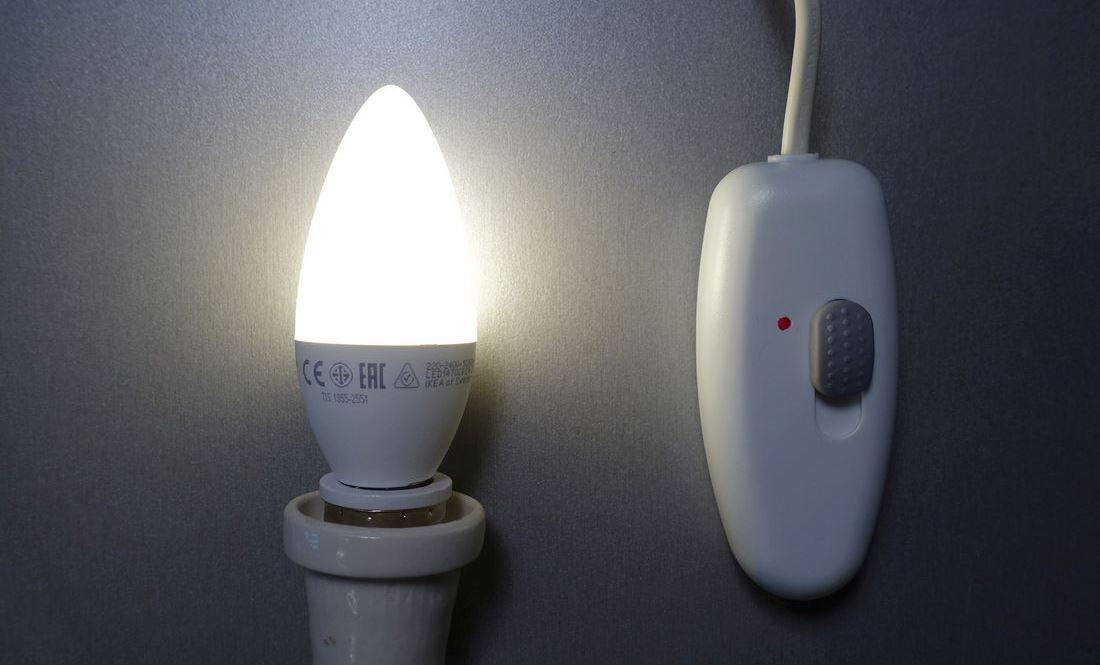
LED lamps equipped with a device that allows you to smoothly adjust their glow are called dimmable LED lamps.
Note! LED light sources, equipped with dimming devices, outwardly in no way do not differ from analogues that are not equipped with such devices. The presence of the possibility of dimming the lamp is indicated in its marking with the designation dimmable.
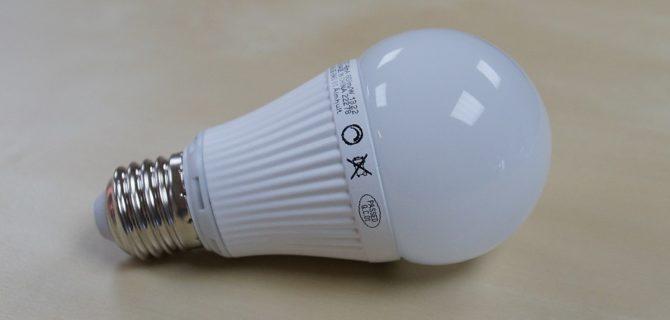
Lamps that do not have a dimmer in their design work only in two modes: on and off. And in the presence of a dimming device, they are able to adjust the intensity of the glow in accordance with the specified values (usually from 10 to 100%).
What dimmer is needed for conventional LED bulbs
When choosing a regulator for led light sources, the following indicators will become the criteria:
- technical characteristics - electric power and operating voltage;
- type of device (its purpose) - for incandescent lamps, halogen or LED lamps;
- design - determines the type of execution, method of adjustment and location.

When choosing a specific model, it must be remembered that non-compliance with the above criteria can lead to the following negative consequences:
- overheating of the device if the power of the light sources connected to it is exceeded;
- the inability to perform the required settings or save them in the device's memory adversely affects the functionality of the regulator;
- the design of the dimmer does not allow it to be placed in the selected installation location due to the peculiarities of the fastening elements provided for by a particular model.
Is it possible to dim the brightness of 12V LED lamps
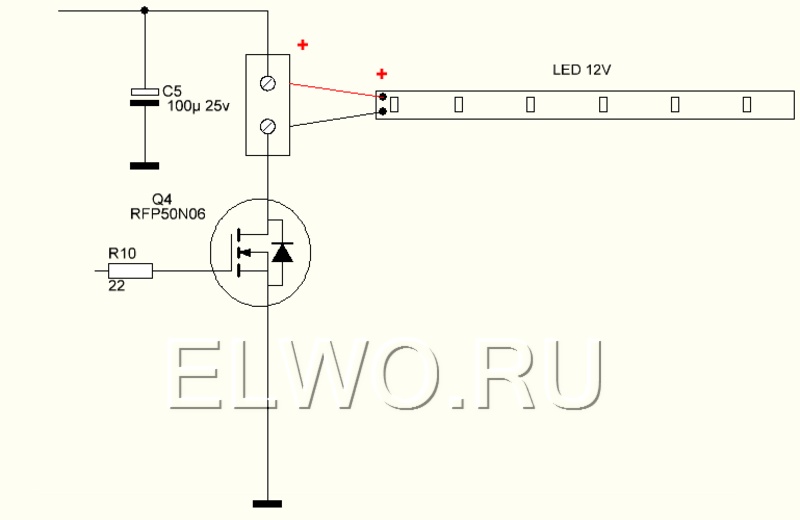
For backlighting and artificial lighting, LED strips are widely used, in which light sources operate at a voltage of 12 volts.
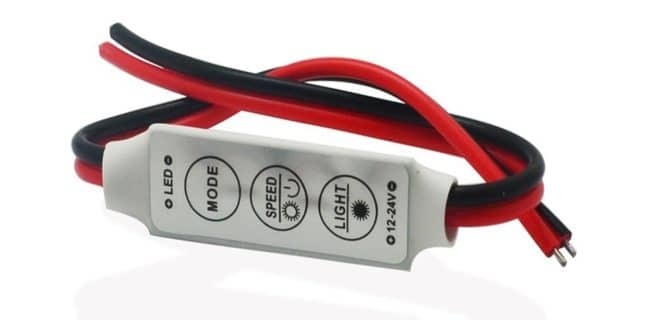
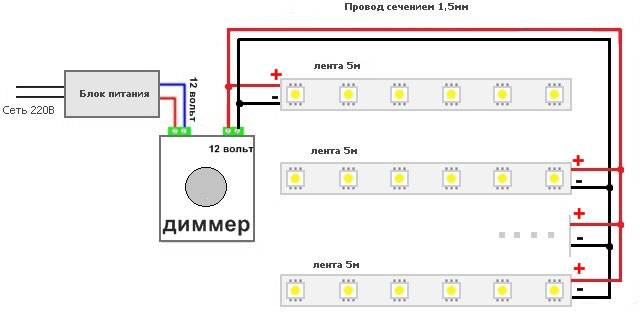
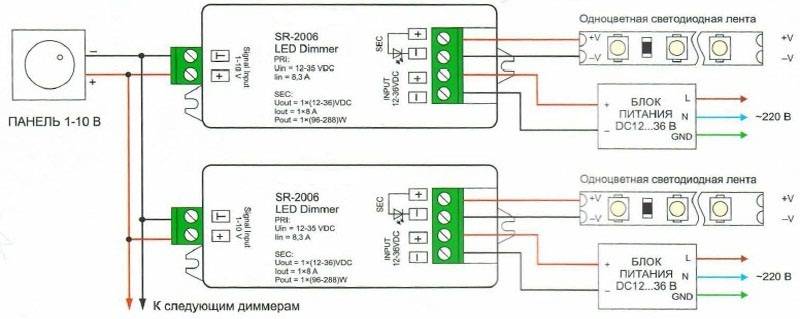
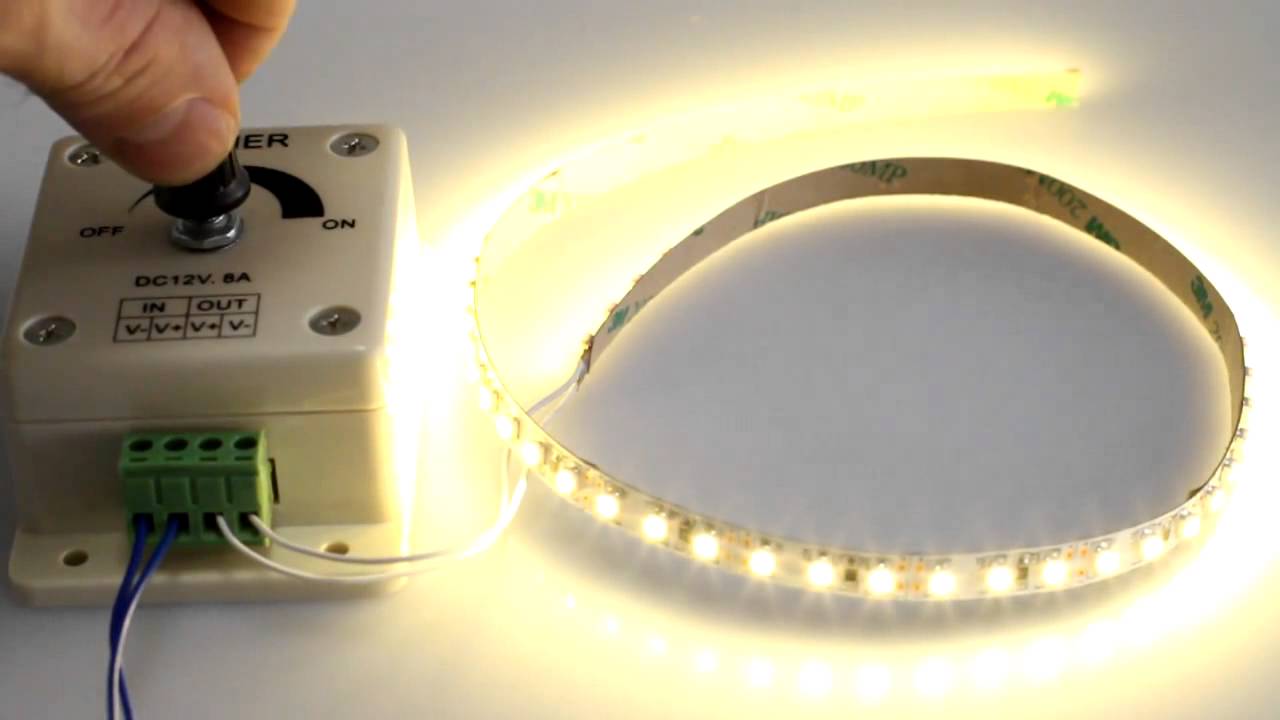
To control the operation of such a device, a dimmer for an LED strip is used, which is included in the power supply circuit of the light source and can control its operation both in a given mode and at remote control management.
A dimmer for an LED strip of the same glow color has one control channel, which involves changing only the brightness of the glow. For tri-color tapes (RGB-glow), the devices are equipped with three control channels, which also allow you to adjust the rate of change of all colors.
The best pushbutton and touch dimmers
Legrand Etika 672218
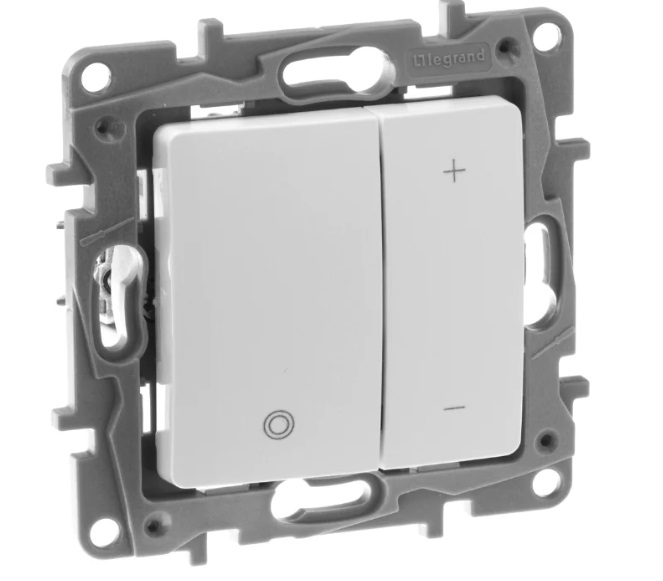
With this product, you can turn on and off the light in the room, as well as adjust the brightness of the lighting. It is suitable for lamps with a total power of up to 400 watts. The Legrand Etika 672218 mechanism consists of two buttons. The left button is designed to turn the lighting on and off, and the second to adjust the level of illumination in the room. Under the keys of the device there is an LED that lights up in red in capacitive mode of operation, and green in inductive mode. One of these modes can be forced. Also in this model, you can set automatic memory, which, when turned on, will give out the brightness used before.This feature can be disabled if necessary.
The power and adjustment buttons are made of ABS plastic, which will not change its color under the influence of sunlight. The mechanism of the product is made of polycarbonate. "Legrand Etika 672218" has IP20 protection.
The average cost is 3000 rubles.
Legrand Etika 672218
Advantages:
- Available in two color options;
- There is a memory function;
- Easy installation;
- Reliable manufacturer.
Flaws:
Not found.
Legrand Valena Allure 722762

A feature of this model is that it is suitable for any type of lighting fixtures. A maximum of 10 lamps can be connected. The lighting will turn on gradually, 2 seconds after turning on, the brightness will be set to the one that was adjusted when the product was last used. "Legrand Valena Allure" has three modes of operation: normal dimming mode, night mode, when the brightness will gradually decrease and turn off completely after 60 minutes, as well as the set brightness mode (0%, 33%, 60% and 100%). It is also worth noting that this model has built-in protection against overloads and short circuits. You can control this model remotely, as well as using the buttons.
The average cost is 4500 rubles.
Legrand Valena Allure 722762
Advantages:
- Suitable for all types of lamps;
- 3 operating modes;
- Overload protection.
Flaws:
There is no indicator light.
Delumo
This model has touch control, as well as a wide variety of color panels. Thanks to this, the product will easily fit into any interior and will complement it harmoniously. You can connect one lamp or a group consisting of several lamps to this device.In this case, the change of all parameters will occur simultaneously for the entire group. With the help of "Delumo" you can turn the light on and off, adjust its brightness, and there is also a soft start function. It is also worth noting that the device will automatically turn off 10 hours after it is turned on.


This model does not require wall mounting. "Delumo" has a battery that will last for several years of active use. And its functioning carried out at the expense installation of a radio dimmer in the network, which will control all the signals supplied.
The average cost is 2100 rubles.
Delumo dimmer
Advantages:
- It is possible to control several light sources;
- The front panel is made of glass and has more than 20 color options;
- Smooth start;
- Suitable for any type of lamp.
Flaws:
No.
Touch remote control dimmer LIVOLO
The LIVOLO dimmer has a touch panel made of glass. Available in 4 color options that will fit into any style of interior. With "LIVOLO" you can easily replace a conventional switch. In addition, you will have the advantage of smoothly turning on and off the light, which will be especially useful in Night time, and it is also possible to adjust the brightness of the lighting, which will extend the life of your lamps. Adjusting the parameters is fast and does not require much effort, since the sensors of this model immediately respond to any actions. Also, "LIVOLO" can be controlled using the remote control, which will save you from making unnecessary movements.
"LIVOLO" has a degree of protection IP20.And the maximum load per device is 500 watts.
The average cost is 2000 rubles.
Touch remote control dimmer LIVOLO
Advantages:
- Remote control possible;
- 4 color options;
- Smooth turn on.
Flaws:
Not often found in stores.
How to solve the problem of flickering LED lights
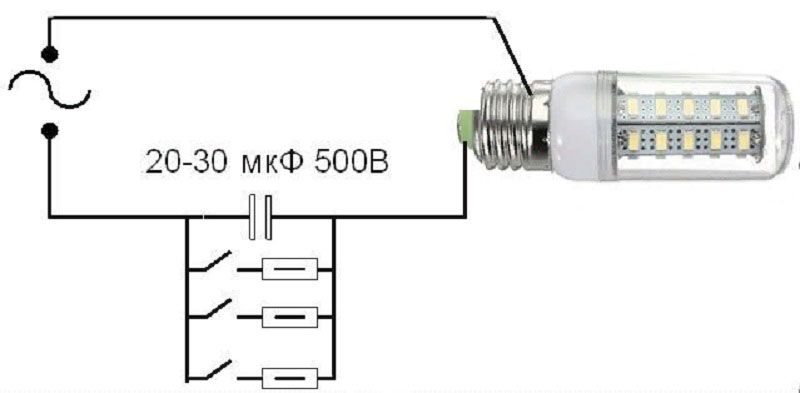
The easiest and most effective way to return the lamp to a stable state is to replace the switch with a new one without an indicator. If desired, you can turn off the neon or LED backlight by biting the power wire. If you do not understand which wire to disconnect, it is better not to do this.
Some craftsmen add an incandescent lamp to the lighting fixture circuit, which will take over the current that goes to charge the capacitor, excluding the start of the LED. However, there are two drawbacks: the power consumption of the device will increase, and it is not easy to install an additional lamp in a standard lamp. But in general, the idea is good.
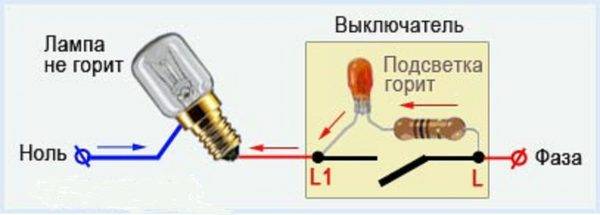
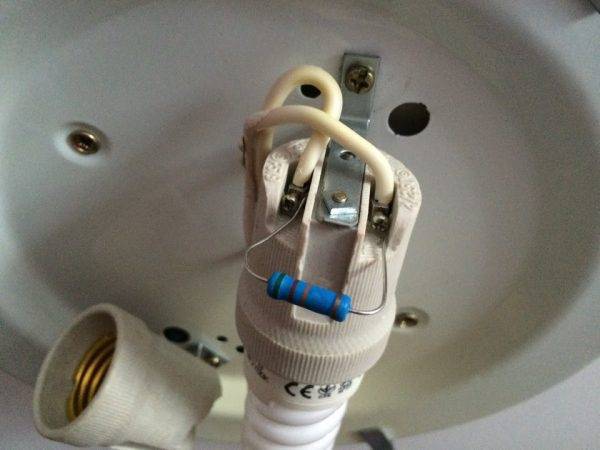
People who are versed in the subject are advised to connect a small resistor to the power supply circuit of the lamp, which takes voltage well. The power of the resistor should be 2 watts. It is better to connect a 50 kΩ resistor in the area of \u200b\u200bthe cartridge or junction box, connecting the contacts with a terminal block and insulating with heat shrink tubing. Do not forget to first turn off the power supply. Do not use a resistor value greater than the recommended value in order to avoid unnecessary energy consumption.
There is another way to get rid of flickering lamps. It is necessary to connect the switch indicator to the mains with a separate wire.The operation is simple, but requires additional wire connections, which not every owner of the premises can do on their own.
Choosing way to solve the problemwe advise you to stop on turning off the backlight mains or on the last version with the installation of a current-limiting resistor, which costs a few rubles and is easily hidden in the lamp. A minimum of consumables and a little skill, and your energy-saving lamp will work just fine.
Remember that the weak glow of the LED device does not mean its malfunction. Energy-saving lamps need to be bought a little more than the denomination that is required. changing 60 W incandescent lamp, purchase an 8W LED lamp.
Compatibility of LED lamps with dimmers
There are no universal regulators, for each type of light source a certain type of dimmer is selected.
Diode lighting sources can be adjustable and unregulated. Light source manufacturers may produce products that work with a particular type of dimmer. To determine compatibility, you can use the tables that are available from sellers.
It is necessary to choose regulators taking into account the technical parameters of the bulbs:
- If the light source is unregulated, then installing a lamp with a dimmer is not allowed. The result may be poor-quality work and breakdown of the regulator itself. Such situations do not apply to warranty service.
- Adjustable light sources work can work with standard dimmers that function as a phase cut. It should be taken into account that the level of light dimming will be affected by the number of diode elements installed on the switch.Most dimmers need a minimum load level of 20-45 watts to work properly. To achieve this level of power, you need one incandescent bulb. But for installation in a network with a power of 220 volts, 2-3 diode lamps are required.
- If a single diode light source will be used, it is recommended to give preference to a low voltage dimmer. Such a device is used to change the parameter of a low-voltage LED light having a magnetic transformer device.
Rules for choosing the best option
Customers can purchase two types of LED strips, the so-called monochrome, that is, one color, or three-color RGB. In the latter case, all colors can be connected separately, mixed, and various effects can be obtained.
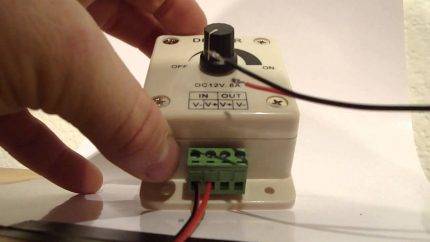 Dimmers can be of various sizes, power, which allows the interested person to choose the right product for any LED strip
And the future owner should be aware that in order to control the multi-color tape, you will need to purchase a special RGB controller. Since the capabilities of the regulator for the full control of such a light source are not enough.
In addition, you need to carefully consider the technical parameters of the device. Since the power of any control device must exceed that of the LED strip itself, this feature must be taken into account even before purchase.
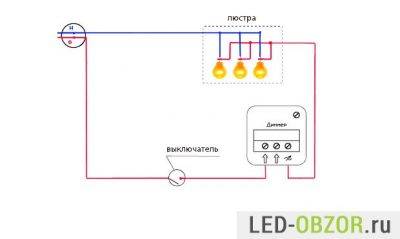


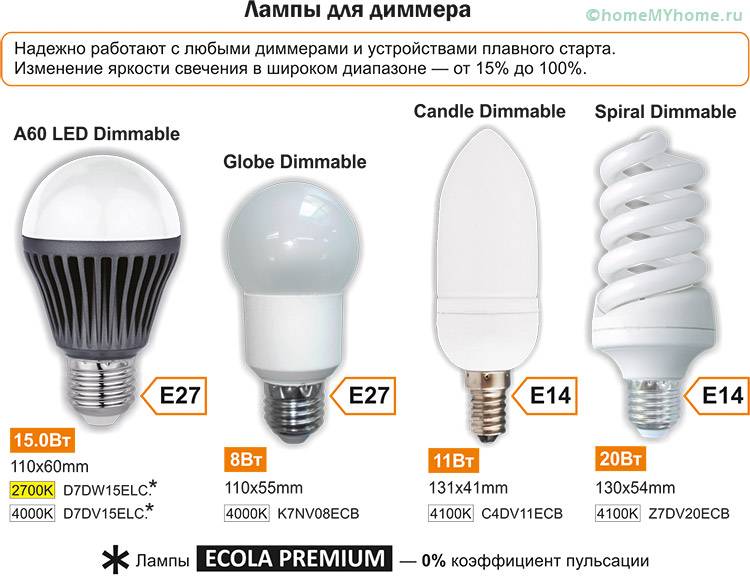
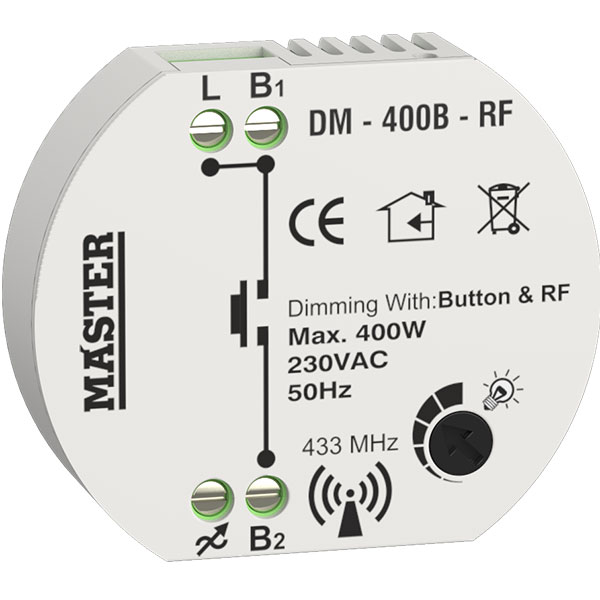
Moreover, the options can be as follows:
- If the owner of the premises does not plan to further increase the length of the LED strip, and, consequently, its power, then this characteristic of the dimmer should be 20-30% higher and this is at least, and best of all, half.That will help to extend the life of the regulator, eliminating the possibility of rapid wear and subsequent breakdown.
- If you plan to increase the power of the LED strip, then the device must be purchased with this in mind. Or later again you will have to spend money on acquiring a new regulator. Moreover, the power reserve should be calculated taking into account the prescribed 20-50% for the reserve.
When a potential buyer incorrectly calculates the power, the device will not be able to perform its functions, so it simply will not turn on. And this is with the most favorable outcome, since it often happens that an overload leads to an instant failure.
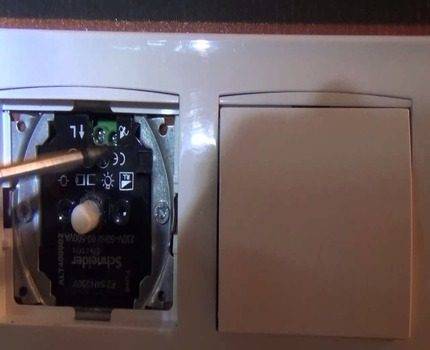
Installation of any type of regulator is simple, so in some cases the user will be able to perform this procedure on his own
In addition, it is important to determine the type of control. Any of them (mechanical, electronic, remote) is reliable and will allow a person to effectively manipulate the brightness of the LED strip
Therefore, everything will depend on how much a person is willing to pay. If he decides to save money, then the most affordable model with mechanical type of control.
When the future user has more funds at his disposal, then a device with an attached remote control should be preferred. Since it increases comfort, which is a significant advantage.
In addition, when choosing, you should not save on the quality of the dimmer, it should only be from a well-known manufacturer. Which are the companies Osram, Gauss, Philips, and a number of others.
If, nevertheless, there is a desire to reduce costs and purchase a Chinese product, then it is worth remembering that such a purchase can result in a headache, loss of some efficiency and a number of other health problems. Other features when choosing are not so important and it all depends on personal preferences.
Those who wish to assemble a dimmer with their own hands on our website will receive a detailed guide. We recommend that you read a very useful article.
Types of dimmers
Ribbons, as you know, are monochrome and multicolor. The most common options for multi-color ribbons are RGB (red, green blue) and RGB + W (red, green blue, white). The difference between ordinary RGB and RGB + W is that in the first case, the tape uses separate LEDs of various colors, located singly or in groups, but alternately: R-G-B-R-G ...
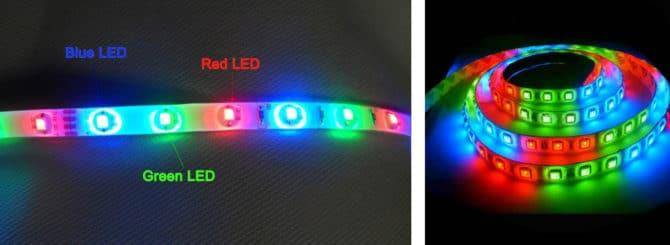
RGB strip assembled from LEDs of different colors
The RGB + W strip uses four-color LEDs, consisting of several crystals located in one device. By activating certain crystals, you can achieve the appearance of many additional colors, including white. You can also highlight three-color three-crystal RGB 5050 LEDs, which also work on the principle of color mixing.
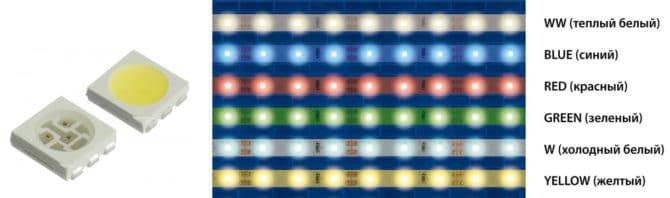
For multi-color versions of tapes, of course, special types of dimmers are needed that can independently control three channels.
Additionally, dimmers for LED strips are distinguished by:
- management method;
- installation method and location;
- additional features.
Control method
According to the method of controlling the LED strip, dimmers can be divided into the following four groups:
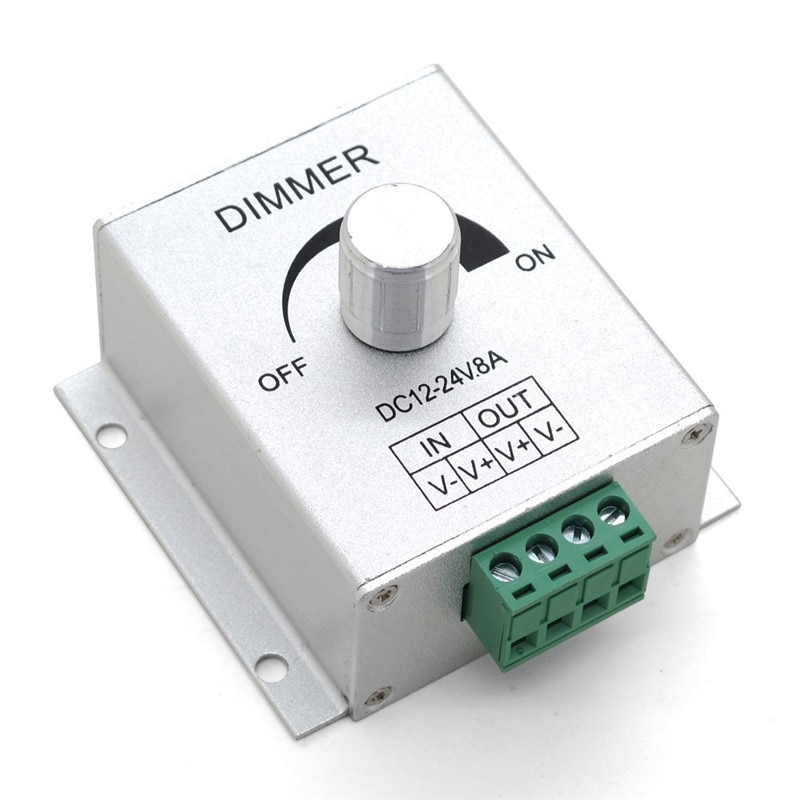
rotary.Adjusting the brightness of the tape in such dimmers is done using a conventional rotary knob. In this case, switching on / off can be done either by turning the knob or by pressing it;
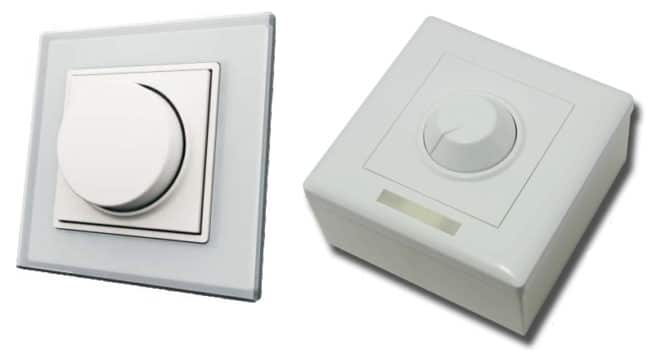
Buy
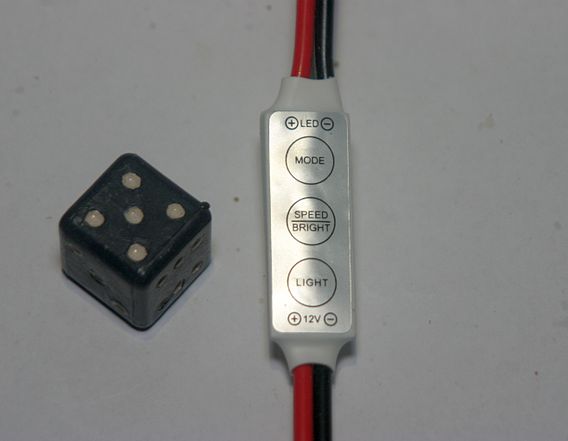
push-button. In such devices, the brightness of the lighting is adjusted using ordinary keys, as on a switch, or mechanical buttons;
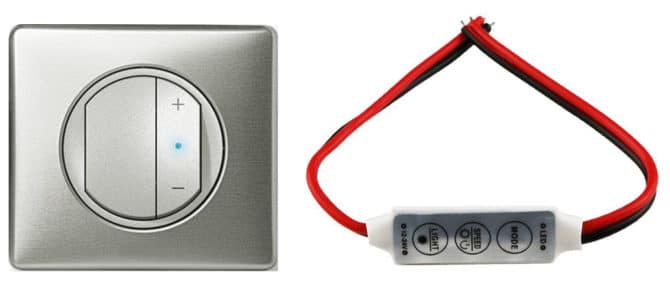
Wall and mini dimmers with mechanical button control
Buy
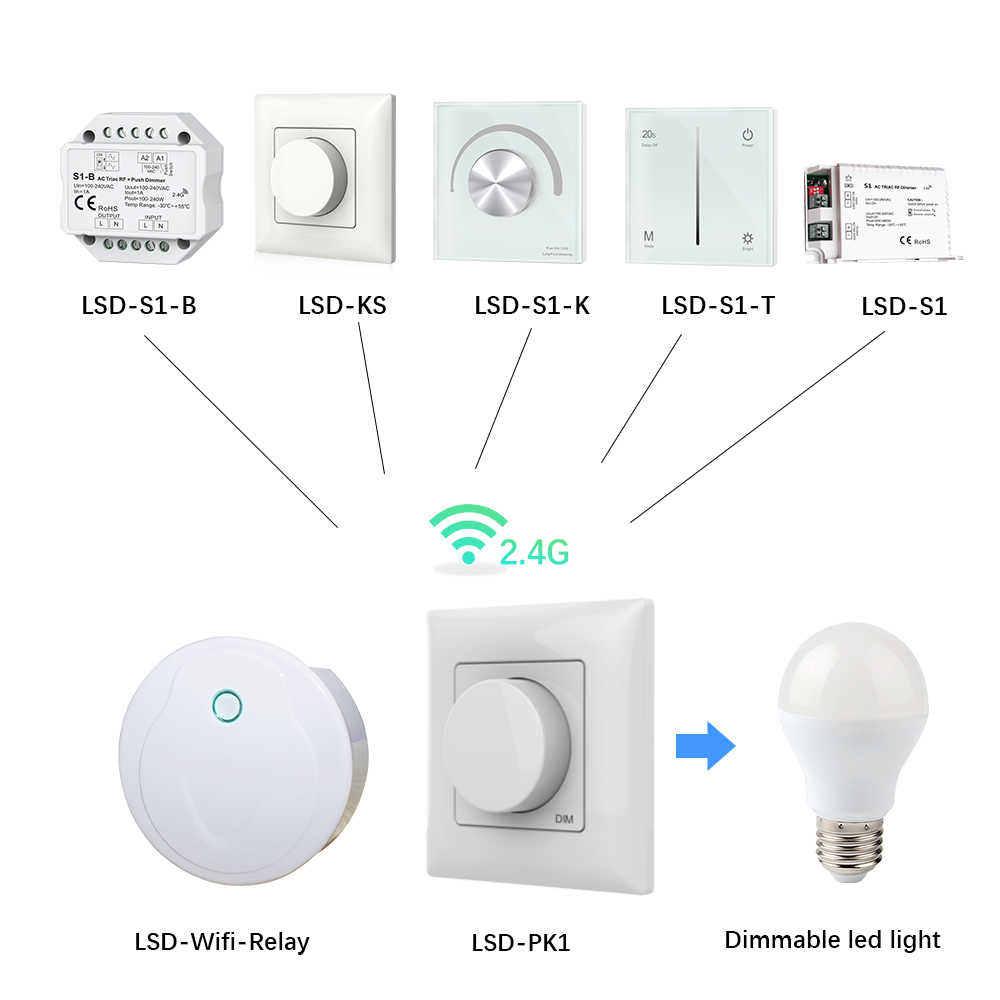
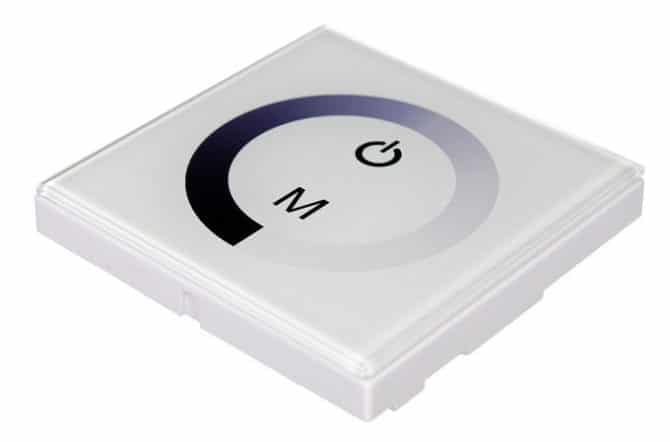
sensory. The device is controlled by touch buttons. You do not need to press them, just touch them enough;



Buy
remote controlled. Setting the required level of illumination for this category of regulators is carried out remotely using a wireless IR or radio remote control. Some of these devices have built-in Wi-Fi or a microphone. The first can be controlled from a mobile device, the second - by voice.
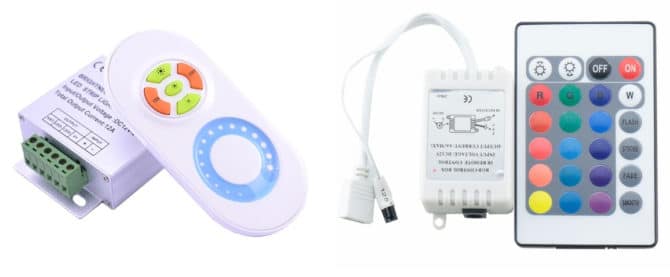
Single color and RGB dimmers with remote control
Method of installation and location
The dimmers for tapes produced today have a different design. Depending on the tasks and design ideas, you can choose the design that suits you best.
For wall mounting
Usually (but not necessarily) such devices have the form and dimensions of a conventional switch. They are recessed into the wall or have an overhead design. A very convenient option for organizing lighting or lighting living rooms.
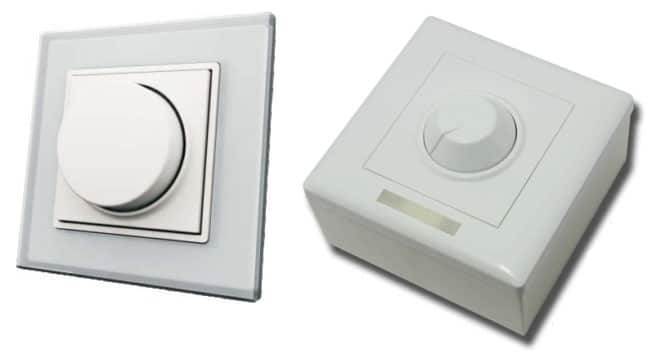
For flush mounting next to the tape
Sometimes it is inconvenient to use a wall structure or it is problematic to install it (for example, you don’t want to make repeated repairs). In this case, the dimmer can be placed near the tape or in any convenient place. For example, hide behind interior elements or in the inter-ceiling space.This is where concealed mounting comes in handy. You will have to control such a device remotely: using a wired or wireless remote control.
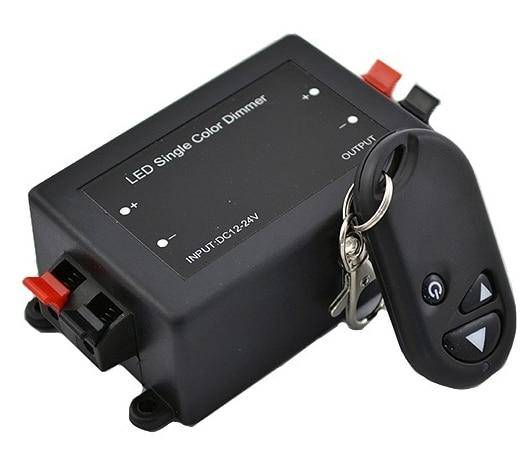
This dimmer has a remote control, so it can be placed anywhere.
Additional functions
Modern dimmers, in addition to their main task of adjusting the brightness, can perform a huge number of additional functions. With the advent of microcontrollers, this has ceased to be an expensive pleasure. Typically, such dimmers are called LED strip controllers, since it is already difficult to call them dimmers.
The most interesting of the functions performed by controllers are:
- Switching on by timer (imitation of the presence of the owner).
- Creation of lighting effects (running light, periodic fading, color change, etc.).
- Light music mode (uses the built-in microphone).
- Integration into a smart home or connection to a PC via a wired interface.
- Inputs for connecting external sensors (alarm, light, etc.).
- Possibility of independent programming.
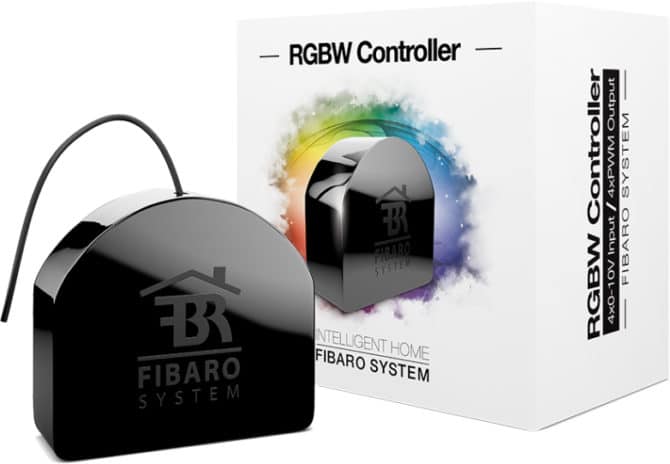
This controller for LED strips can no longer be called a dimmer: it performs several dozen additional functions, can be programmed and integrated into a smart home
Features of the dimmable led lamp and its differences from the usual
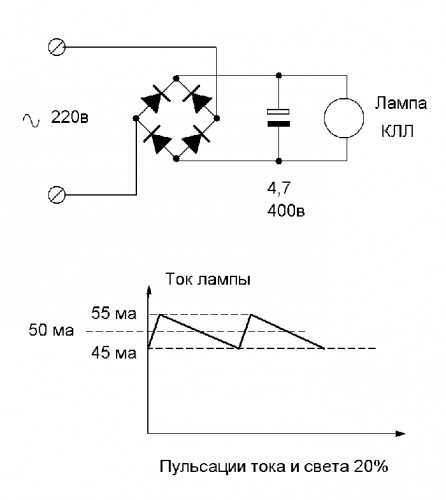
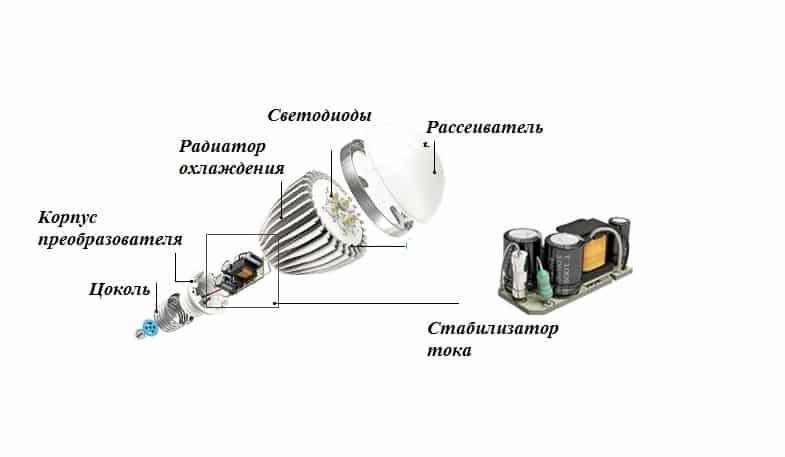
Let's return to the problem with adjusting the brightness of a conventional LED lamp. Why is this happening? The fact is that a semiconductor device, which is an LED, requires a constant supply voltage for operation, and an alternating voltage in the lighting network. In addition, the current passing through the diode must be strictly specified value. Otherwise, the device will fail.
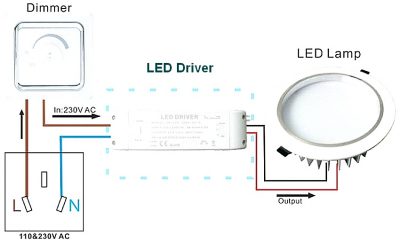
A dimmer built into an LED light bulb or fixture just solves these problems. It converts the AC voltage to DC and lowers it to the required value. Additionally, it sets the required current through the diode and maintains it at a given level - it stabilizes.
What happens when you try to dim such a bulb with a dimmer? You turn the knob, and the operating voltage on the load changes. But in led lamp driver 220V has clear instructions - to keep the voltage and current at a given level. He does his job while he can. You twist - nothing changes. But if the input voltage is too low, the device gives up: it turns off the diodes (branded products) or starts to behave unpredictably (budget option). That is why an ordinary led lamp, switched on through a dimmer, behaves, to put it mildly, inadequately: it simply does not understand what is happening.
The designers solved the problem of dimming LED lamps by changing the driver circuit. Now he monitors the voltage supplied to the light bulb. If a change is detected, it automatically changes the current through the LED. Less voltage means less current. More voltage - more current, but only if it does not exceed the maximum allowable. As a result, it became possible to adjust the brightness, but the protection of the diodes from overload was preserved. Such modified lighting fixtures were called dimmable lamps.
So, LED bulbs, the design of which provides for a dimming mode, can be used with dimmers. But with what? AC dimmers operating on the half-wave cutoff principle are of two types.
- Front edge cut.
- Rear edge cut.
What does this mean? The first type supplies only the remainder of the AC half-wave to the load, cutting off its front end. The second gives a half-wave from the very beginning, but cuts off the remainder at the right moment. It looks something like this:
The former are more common due to the simplicity of the circuit design and lower price. The latter are slightly more expensive, but create less interference that can interfere with audio equipment. What types of dimmers can dimmable bulbs work with? Both with those and others, but the second option (cutting the trailing edge) is preferable, since the voltage on the illuminator increases gradually, and not abruptly. This mode is more “understandable” by dimmable light bulb drivers.
If you already have a dimmer with a cutting edge, but you decide to replace the incandescent bulbs with diode ones, then feel free to change it. Everything will work fine, but on the condition that dimmable led bulbs and quality.
How to distinguish a dimmable light bulb from a regular one?
Dimmable lamps, which are produced today, in appearance are no different from ordinary ones. All the differences, as you understand, are inside, in the power driver circuit. To find out what type of device you are holding in your hands, you must carefully study the packaging or accompanying documentation, if any. The packaging of a dimmable light bulb must have the appropriate inscription "dimmable", "dimmable" or something similar. Often, instead of an inscription, icons are used depicting a rotary dimmer knob.
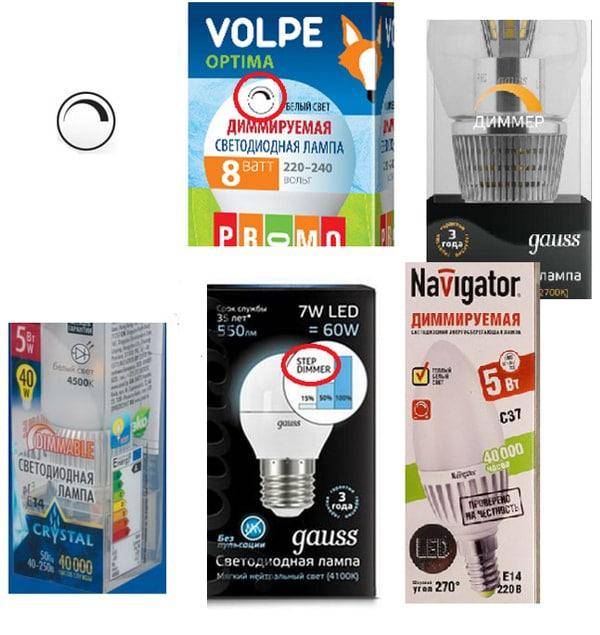
Adjustable LED lights
Let's leave the light bulbs for a while and talk about LED lamps, which are no less popular.How are things going with the ability to adjust the brightness of them? There are many more options than LED bulbs. Depending on the task at hand, you can choose one of the following:
- Luminaire with built-in dimmable driver.
- A luminaire with an external dimmable driver (usually these are spotlights).
- A luminaire with a dimmer built into the driver - here you don’t even need to buy a dimmer separately.
- Dimmable driver for LED lights.
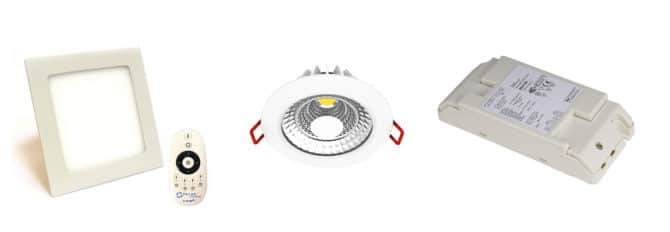
Purpose of the dimmer
The task of the dimmer is to provide a change in the brightness of the glow of lighting devices. Adjustable light switches allow you to achieve any intensity of lighting: from subdued light to extremely bright. The use of dimmers makes double or triple switches unnecessary, there is no need to buy expensive lighting fixtures with voltage controllers.


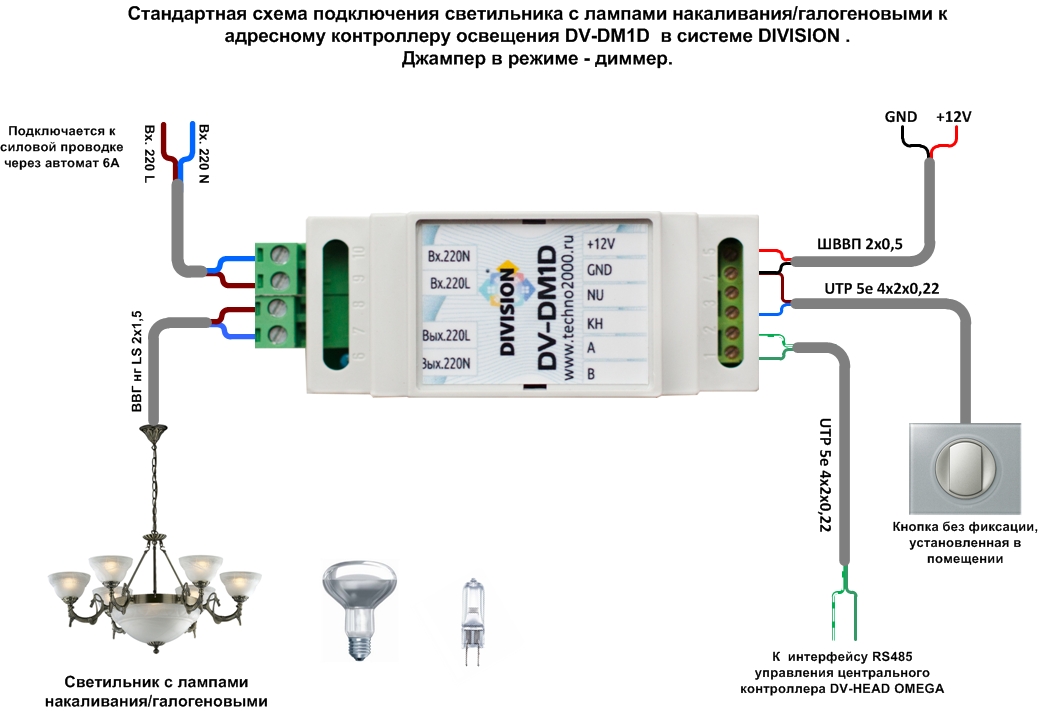
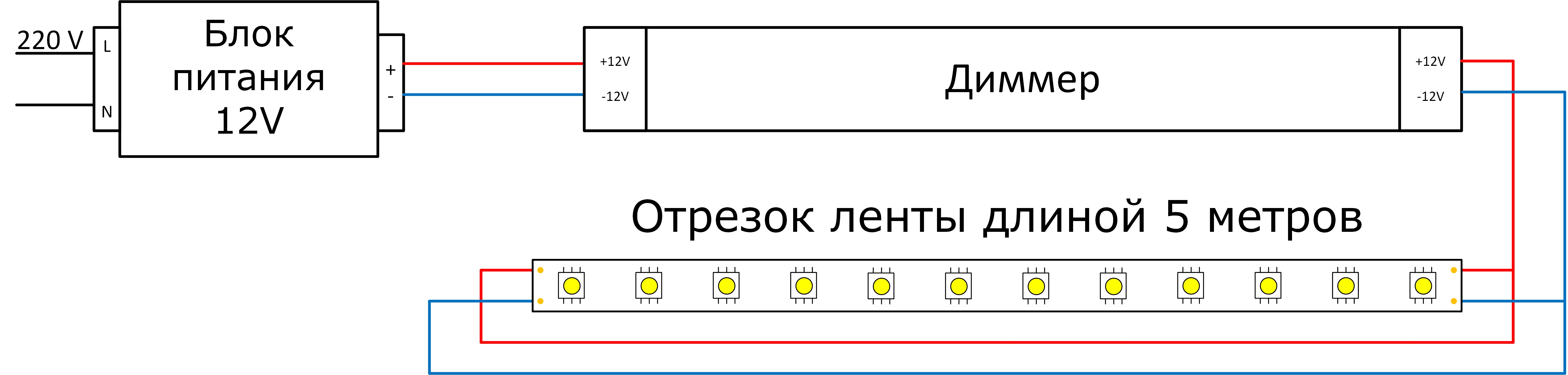

Note! To control light intensity energy-saving light bulbs will need a special device - an electronic starter. The advantages of dimmers include the following characteristics:
The advantages of dimmers include the following characteristics:
- light brightness control;
- setting the brightness change time;
- control from the remote control;
- long service life;
- programmed artistic flicker, creating backlit paintings;
- energy efficiency (some models).
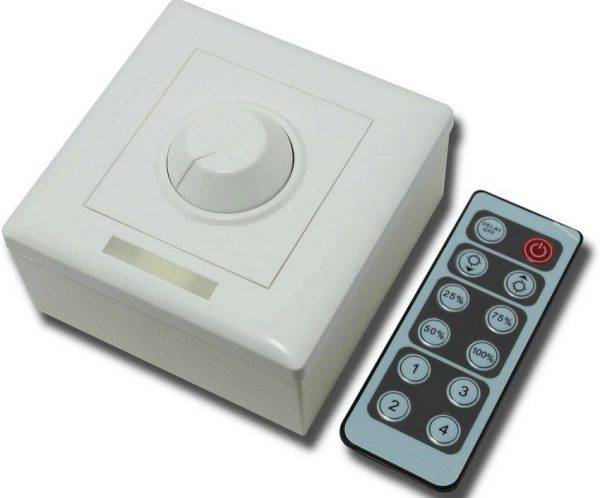
Disadvantages of dimmers:
- excessive consumption of electricity in some cases;
- the creation of radio interference that interferes with the operation of electrical household appliances;
- small loads cause dimmers to malfunction;
- the operation of dimmers often results in unwanted flickering of the light.
Dimmer classification for LED lamps
When buying dimmers, you need to consider that variators for energy-saving, LED and conventional lamps incandescents have certain differences and classification. Dimmers are divided according to design features, method and place of installation, control principle and other characteristics.
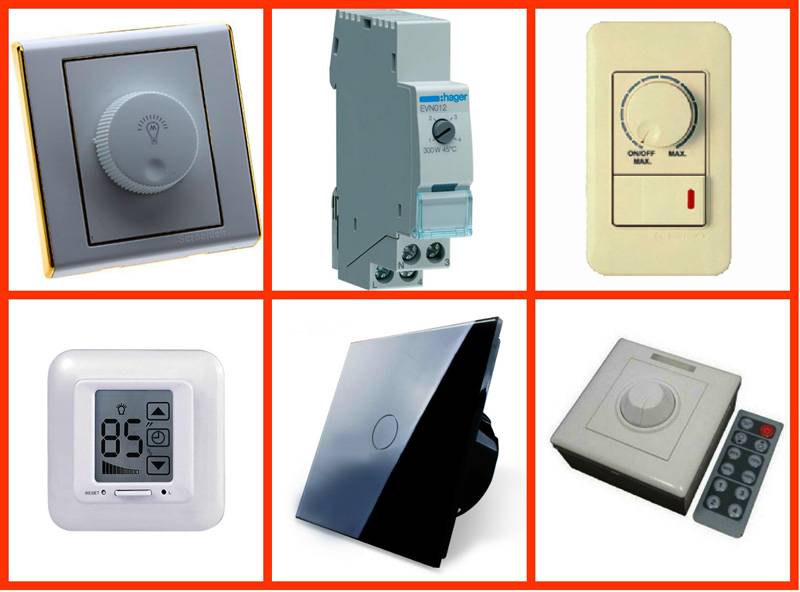 A variety of dimmers makes it easy to choose the right device
Place and method of installation
According to the place of installation, dimmers are divided into remote, modular and wall-mounted.
- Modular. This type of dimmer is mounted on a DIN rail in a distribution board together with an RCD. Such variators can be easily installed or replaced at any time, but for this device it is necessary to provide for the laying of a separate wire during repair or construction. Modular dimmers are perfect for home improvement according to the "smart home" system.
- Remote. These are small devices 20÷30 mm long and having three control sensors. Since they provide for remote control, such dimmers can be mounted next to the lamp or directly in the lighting fixture itself. The dimmer can be installed simultaneously with the chandelier and does not require chasing the walls or ceiling. An ideal option if it is decided to install variators for lighting, and the repair has already been done.
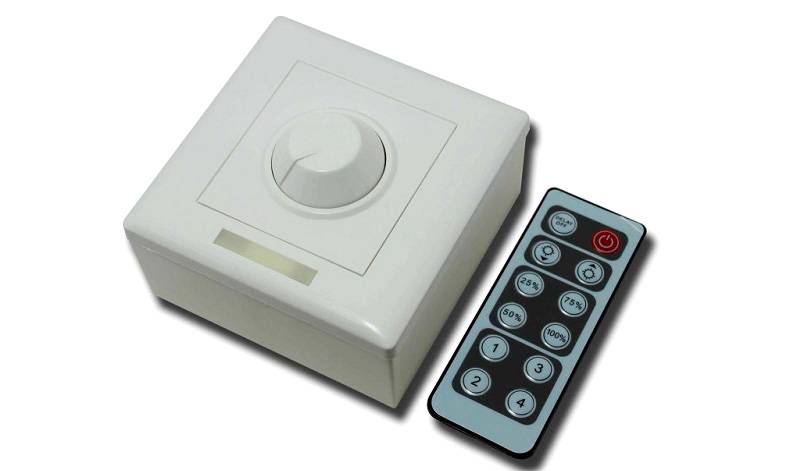 Remote control of the dimmer is quite convenient
Wall. Such dimmers are mounted in the same way as sockets and switches directly in the room where the dimmable LED lamps are located.Installation of such a dimmer must be carried out before repair and topcoating, since wall chiselling required for installation or ceiling.
According to the principle of management
If we talk about the principle of controlling the dimmer and, then they, in turn, are divided into mechanical, sensory and remote.
Mechanics
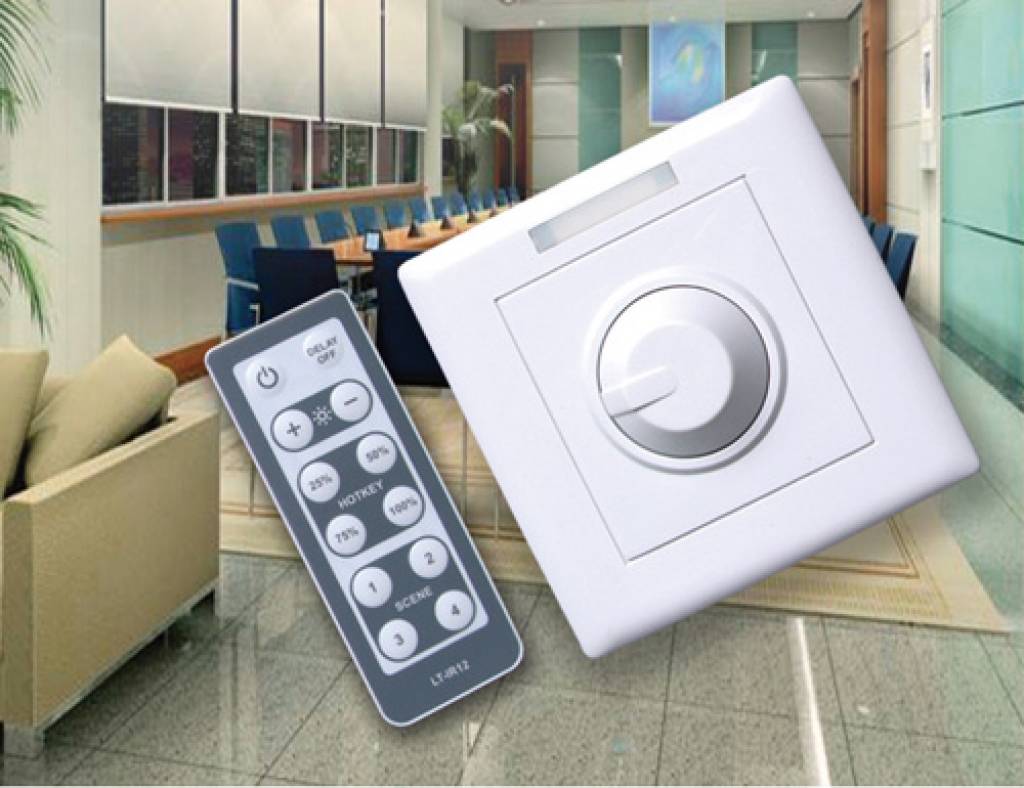
Mechanically controlled lighting variators are the earliest and simplest devices for adjusting the intensity of the luminous flux of lamps. On the body of the dimmer there is a rotating round knob, through which the variable resistor is controlled and, accordingly, the lamps are turned on and off.
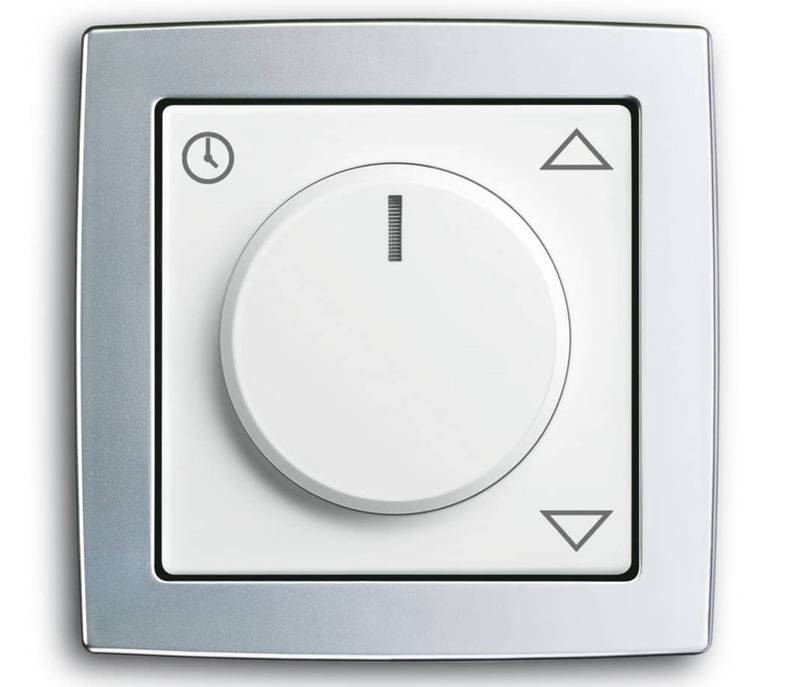 Good old and trouble-free mechanical dimmer
Among mechanical dimmers there are push-button and keyboard models. Such devices are same as normal switches have a button to turn off the lighting fixture from the mains.
Sensor
Touch control dimmers have a more solid and modern look. To dim LED lamps, you just need to lightly touch the touch screen. However, these dimmers are more expensive than their mechanical counterparts.
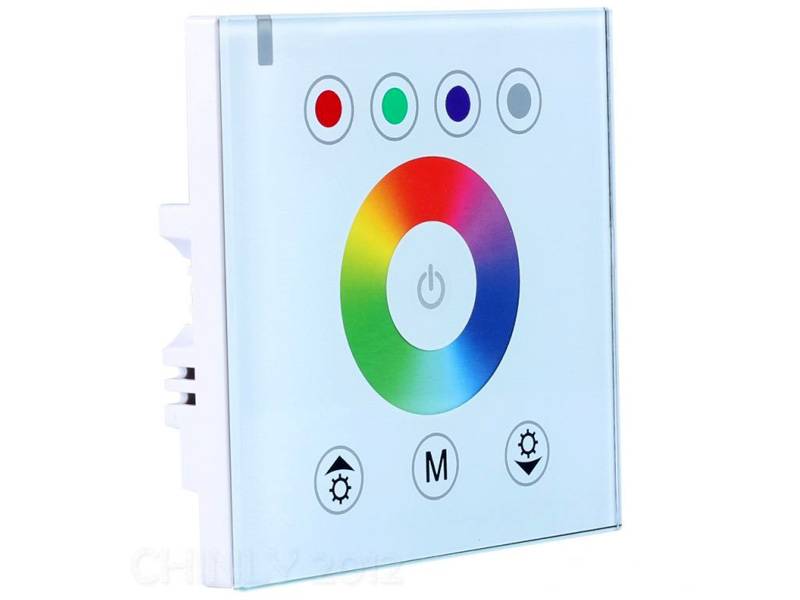 Such a touch dimmer will not leave anyone indifferent
"Remote"
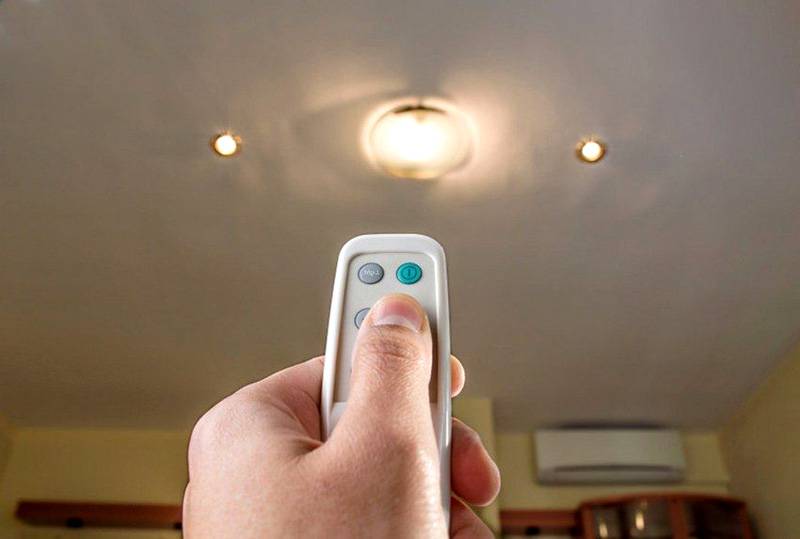 Technology enhances comfort
Regulators remote control lighting are equipped with a remote control with which the optimal level of luminous intensity of the lamps is adjusted via a radio channel or via an infrared port. Radio control is possible even from the street, while the remote control with an infrared port can only perform settings when pointing it directly at the dimmer.
 Dimmer with radio remote control
There are also models of dimmers that allow you to control lighting via Wi-Fi, and they are mainly used in smart home systems.
One of the varieties of dimmers are acoustic dimmers that respond to claps or voice commands.
We assemble a dimmer with our own hands
Circuit on triacs:
In this circuit, the master oscillator is built on two triacs, a triac VS1 and a diac VS2. After turning on the circuit, the capacitors begin to charge through the resistor chain. When the voltage on the capacitor reaches the opening voltage of the triac, current begins to flow through them, and the capacitor is discharged.
The lower the resistance of the resistor, the faster the capacitor charges, the lower the duty cycle
Changing the resistance of the variable resistor controls the depth of gating over a wide range. Such a scheme can be used only for LEDs, but also for any network load.
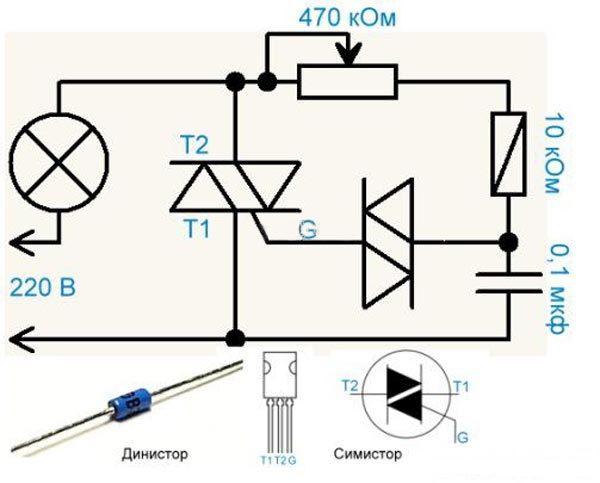

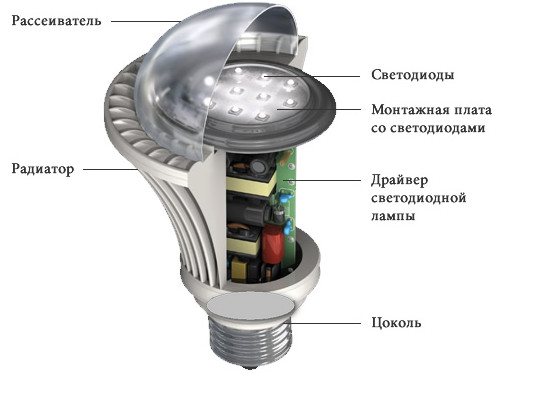


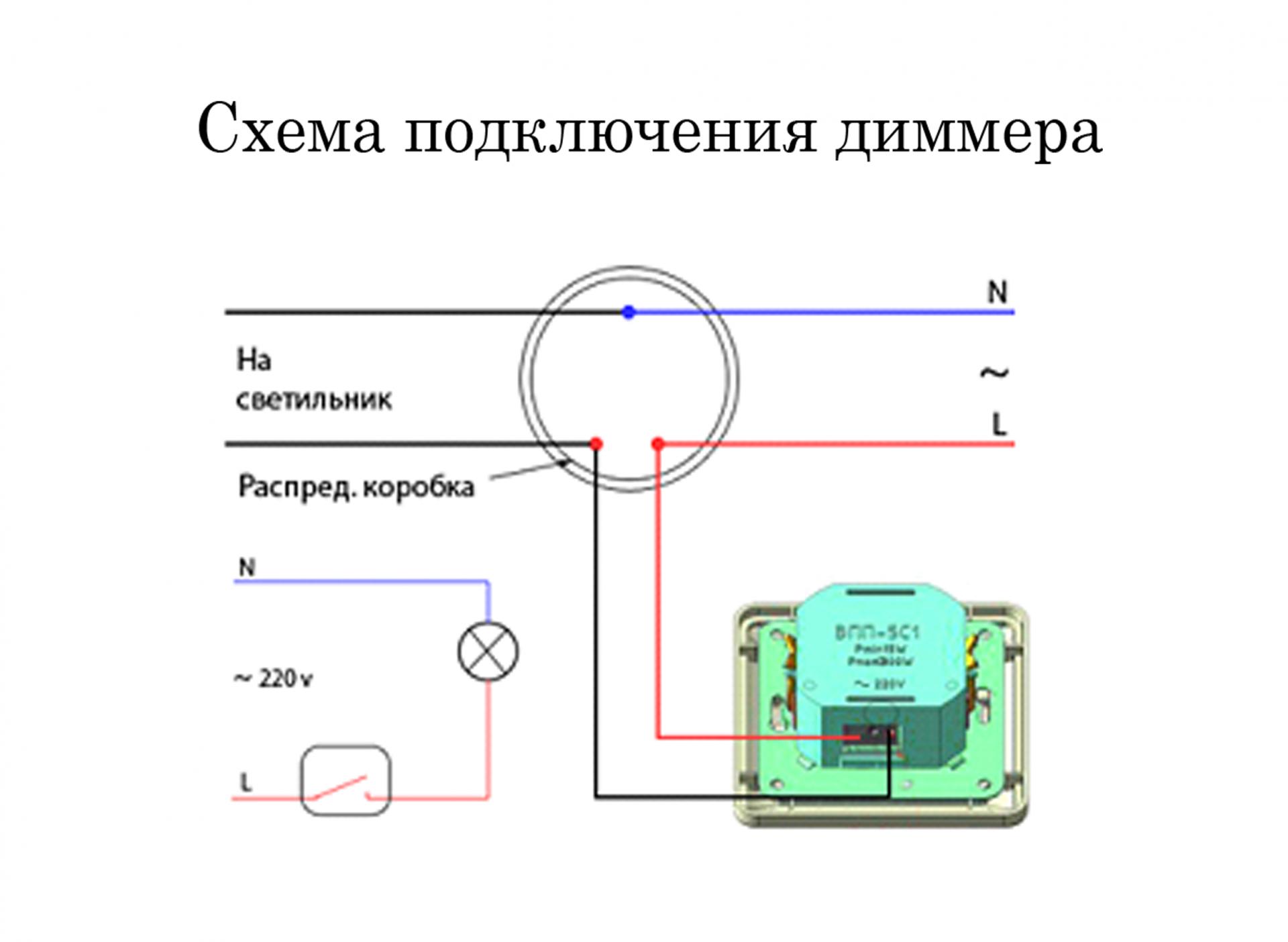
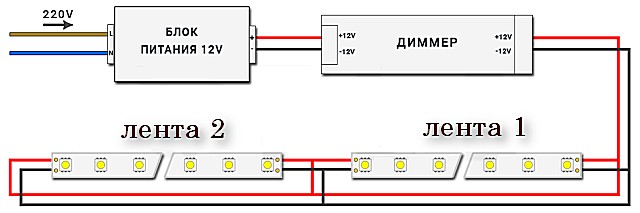


AC connection diagram:
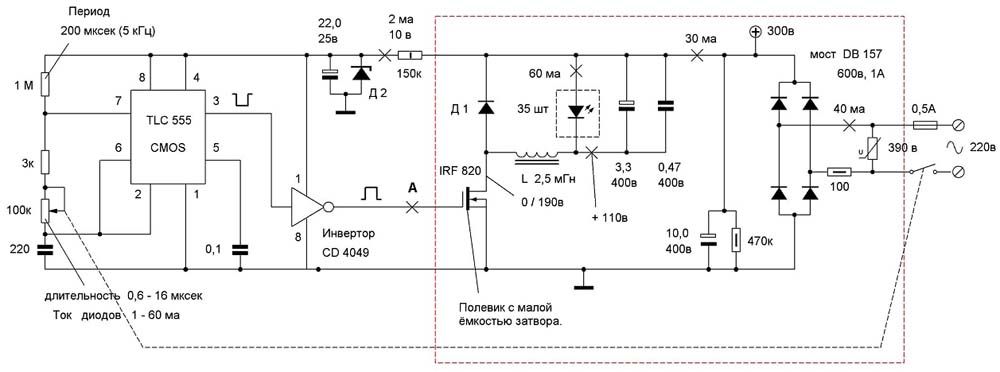
Dimmer on the N555 chip
The N555 chip is an analog-to-digital timer. Its most important advantage is the ability to work in a wide range of supply voltage. Ordinary microcircuits with TTL logic operate from 5V, and their logical unit is 2.4V. CMOS series are higher voltage.
But the generator circuit with the ability to change the duty cycle turns out to be quite cumbersome. Also, for microcircuits with standard logic, increasing the frequency reduces the voltage of the output signal, which makes it impossible to switch powerful field-effect transistors and is only suitable for loads of small power. The timer on the N555 chip is ideal for PWM controllers, since it simultaneously allows you to adjust both the frequency and the duty cycle of the pulses
Output voltage is about 70% of the supply voltage, due to which it can even be controlled by Mosfets field-effect transistors with a current of up to 9A
The timer on the N555 chip is ideal for PWM controllers, since it simultaneously allows you to adjust both the frequency and the duty cycle of the pulses. The output voltage is about 70% of the supply voltage, due to which it can even be controlled by Mosfets field effect transistors with a current of up to 9A. With an extremely low cost of parts used, assembly costs will amount to 40-50 rubles
With the extremely low cost of the parts used, the assembly costs will amount to 40-50 rubles.
And this scheme will allow you to control the load at 220V with a power of up to 30 W:
The ICEA2A microcircuit, after a little refinement, can be painlessly replaced by the less scarce N555. Difficulty may cause the need for self-winding of the transformer. You can wind the windings on a conventional W-shaped frame from an old burned-out 50-100W transformer. The first winding is 100 turns of enameled wire with a diameter of 0.224mm. The second winding - 34 turns with 0.75mm wire (the cross-sectional area can be reduced to 0.5mm), the third winding - 8 turns with 0.224 - 0.3mm wire.
Dimmer on thyristors and dinistors
LED dimmer 220V with load up to 2A:
This two-bridge half-wave circuit consists of two mirror stages. Each half-wave of voltage passes through its own thyristor-dinistor circuit.
Depth of duty cycle is regulated by a variable resistor and a capacitor
When a certain charge is reached on the capacitor, it opens the dinistor, through which current flows to the control thyristor. When the polarity of the half-wave is reversed, the process is repeated in the second chain.
Dimmer for LED strip
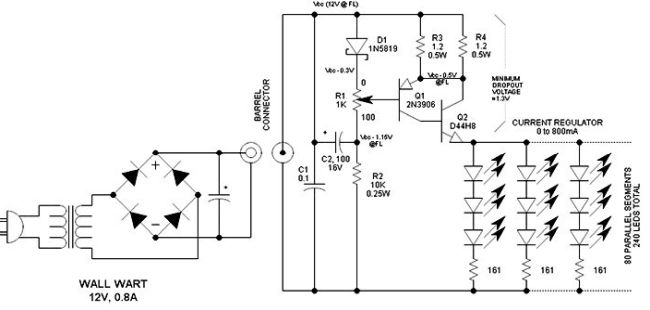
Dimmer circuit for the LED strip on the integral stabilizer of the KREN series.
In the classic voltage stabilizer connection scheme, the stabilization value is set by a resistor connected to the control input. Adding capacitor C2 and a variable resistor to the circuit turns the stabilizer into a kind of comparator.
The advantage of the circuit is that it combines both the power driver and the dimmer at once, so the connection does not require additional circuits. The disadvantage is that with a large number of LEDs on the stabilizer there will be significant heat dissipation, which requires the installation of a powerful radiator.
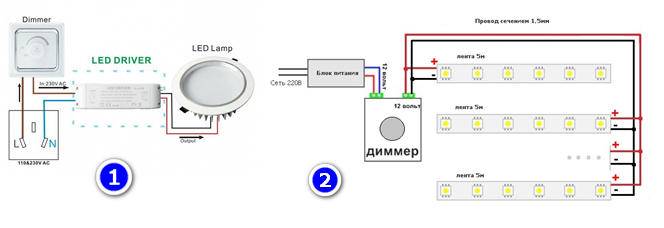
How to connect a dimmer to an LED strip depends on the dimming tasks. Connecting in front of the LED power driver will allow you to adjust only the overall illumination, and if you assemble several dimmers for the LED with your own hands and install them on each site LED strip after the power supply, it will be possible to adjust the zonal lighting.



