- How to choose a grate for a heating radiator
- Making your own screen-box
- Necessary tools and materials
- Sizing and sketching
- Cutting parts
- Assembly
- Installation
- Types of screens for batteries and their features
- Making a decorative screen with your own hands
- Step 1: drywall preparation
- Step 2: product assembly
- Step 3: Decorating
- What is a grille?
- What is the radiator grill made of?
- Furniture items
- Tasks and materials
- Decorative lattice device
- Types of decorative panels
- Mounted
- Embedded
- flat
- convex
How to choose a grate for a heating radiator
Important!
- Today, the choice of the consumer is offered the following types of battery panels:
- flat - involve decorating a heating element, which is located in a niche. They are suitable for different types of radiators;
- mounted - they are a grid and are suitable for batteries that are located in a niche under the windowsill;
- hinged with a lid - designed for cast iron products that protrude slightly above the plane of the wall;
- boxes - completely cover the battery, but have many holes for ventilation.
Wooden panels are not suitable for decorating converter-type heating elements.Metal products reduce the harmful effects of thermal radiation on humans, while not interfering with heat transfer. Plastic should not be exposed to high temperatures, otherwise it will go out of service very quickly.
To increase the heat transfer of the screen, it must be covered with black paint from the inside - it contributes to a better absorption of heat energy and its transfer to the room.
If the radiator is located under the window sill, or in the case when the decorative box is closed from above, you can install an aerodynamic chute - a visor that will not allow heated air to stagnate under the horizontal ceiling.
It is not difficult to make it from a piece of sheet steel or even cardboard covered with foil. It is located along the entire length of the radiator, attached to the wall in its upper part and ending under the edge of the window sill.
You can further increase the efficiency of the battery by removing the heated air into the room, which inevitably accumulates between the outer surface of the radiator and the inner wall of the screen. This simple device, called a heat injector, can be made using the same material as the visor.
Two planes are used here, which form a tapering nozzle along the entire length of the radiator. Thus, two narrow horizontal slots are formed at the top of the screen - warm air comes out of the first from the upper part of the box, and from the second - from the front.
There are a lot of options offered for sale, there are plenty to choose from, given all the requirements that a decorative screen for a heating radiator must meet. And for people who are firsthand familiar with the secrets of home craftsmanship, it should not be difficult to make this piece of furniture on their own.
In the presence of gas, the most economical way to heat a private house is a double-circuit gas boiler.
Or alternatively an electric boiler.
Making your own screen-box
Some home craftsmen make boxes on their own. There is nothing difficult in this. There would be a desire and time.
Necessary tools and materials
From what to make stitching, each craftsman decides for himself. The materials are listed above. However, not everyone has a welding machine for steel or plastic, so they will have to be abandoned. Usually, the lining is made of wood, using plywood or chipboard. Popular and laminated fiberboard. You can aim at a combined option: a wooden frame and plastic panels, for example.
A few tools are needed:
- roulette;
- pencil;
- drill driver;
- set of drills;
- wood saw;
- "Bulgarian"
- construction stapler;
- dowels and screws.
You will also need pine bars with a section of 50 x 50 and 40 x 40 mm for the frame. They can be replaced with steel corners 25 x 25 mm.
Sizing and sketching
First, measure the dimensions of the radiator: length, height, width. The box should be 100 mm longer and wider than the radiator, and 50 mm higher.
A sketch of the future sewing is preliminarily drawn on a sheet of paper, on which all real measurements are sequentially applied. At this stage, you need to think about the method of fastening the future structure. The most optimal options are hinged or floor-supported (attached). In the second case, the casing will have 4 legs, if the pipe does not interfere with those that are near the wall. Otherwise, you will have to shift the hind legs forward or rely on the pipe.
If it is possible not to fix the structure to the wall, you must do so, because in the future the protection will have to be removed for maintenance and repair of the battery. And if an emergency arises, everything must be done quickly.
Cutting parts
First, according to the dimensions from the sketch, the frame parts are cut from a corner or bar with a section of 40 X 40 mm. If the facade is made of fiberboard or plastic, two additional horizontal ties must be installed under it so that the panel does not sag. Then cut out the details of the skin.


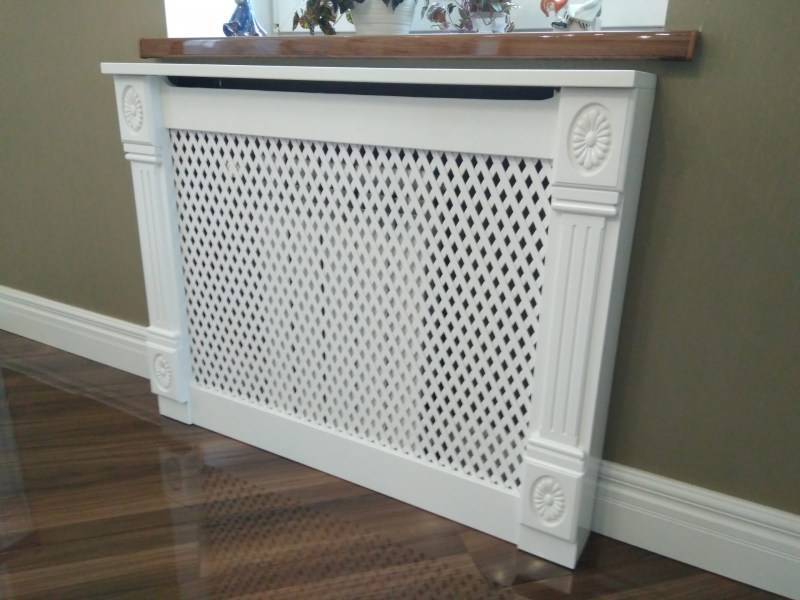


The front part must necessarily be with holes, and they are made in such a way that the total open part is more than 50% of the panel area. Otherwise, the principle of convection will be violated and the heat will remain inside the box. If you have a jigsaw, you can cut neat grooves.
Next, cut out the side walls (they are usually solid) and the top cover (removable or blind with holes).
Assembly
The frame made of wood is assembled on self-tapping screws, steel - using "cold welding" on an epoxy basis. If the house has a welding inverter, then the task is facilitated. When assembling, right angles are controlled. The resulting design is tried on to the battery. If all is well, sheathing sheets are installed on the frame, having previously made cutouts for pipes in the sidewalls.
Installation
After assembly, the screen is installed in a regular place.
Installation methods may be different:
- hinged (supported by a radiator);
- to the wall with dowels and screws;
- attached (on legs with support on the floor);
- hanging (to the windowsill from below).
Fastening should be simple so that dismantling takes a minimum of time.
Types of screens for batteries and their features
The modern market offers residents dozens of varieties of screens that differ not only in the shape or material from which the product is made, but also in size, as well as in the manufacturer. Screen selection begins with determining the optimal material for specific conditions.
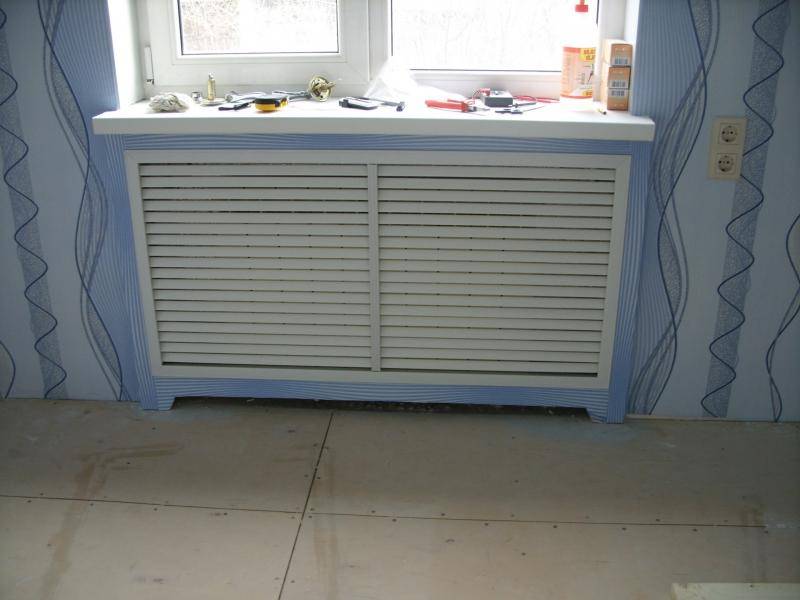
The metal screen-box looks like a full-fledged cabinet and fits well into the overall interior
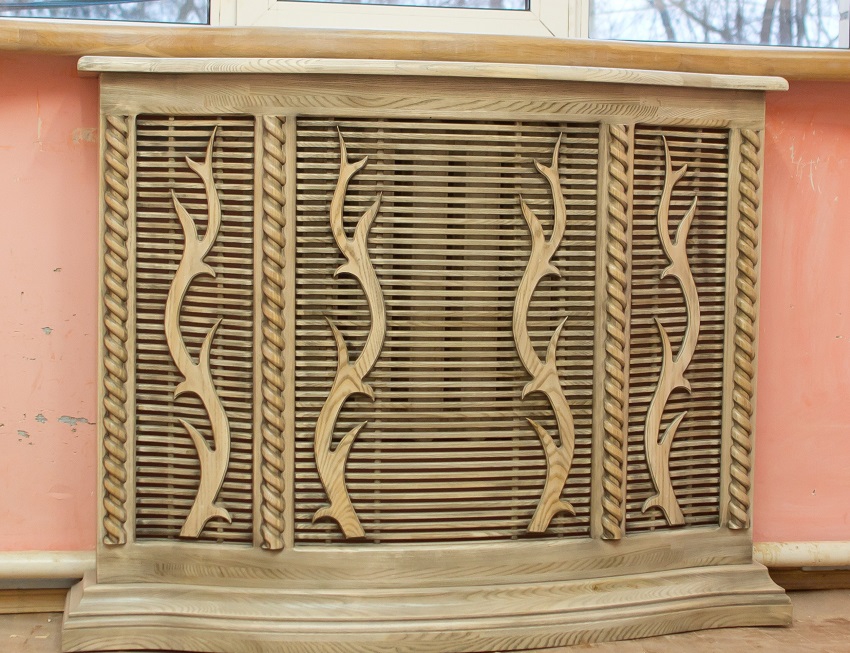
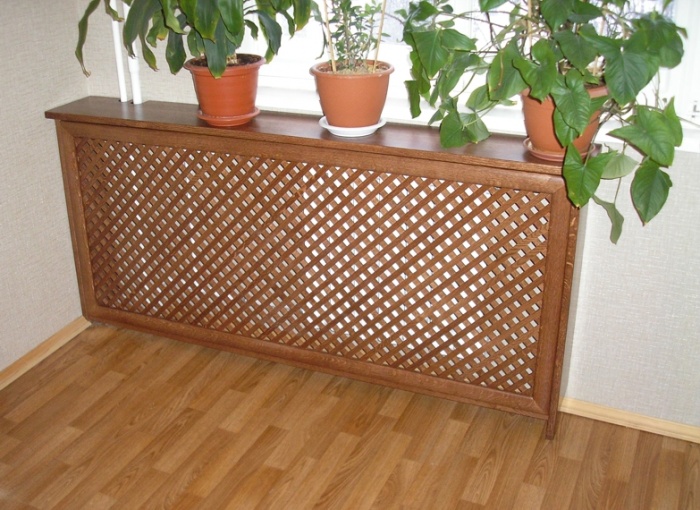
Wooden battery screens are the most common type. Attractive in such products is the safety of the material for humans, and the quality factor, and spectacular appearance. High-quality products made of expensive wood species become not just protection for radiators, but a real work of art and interior decoration. Wooden boxes will be a great addition to a classic or historic interior, as well as a soft and homely country style.
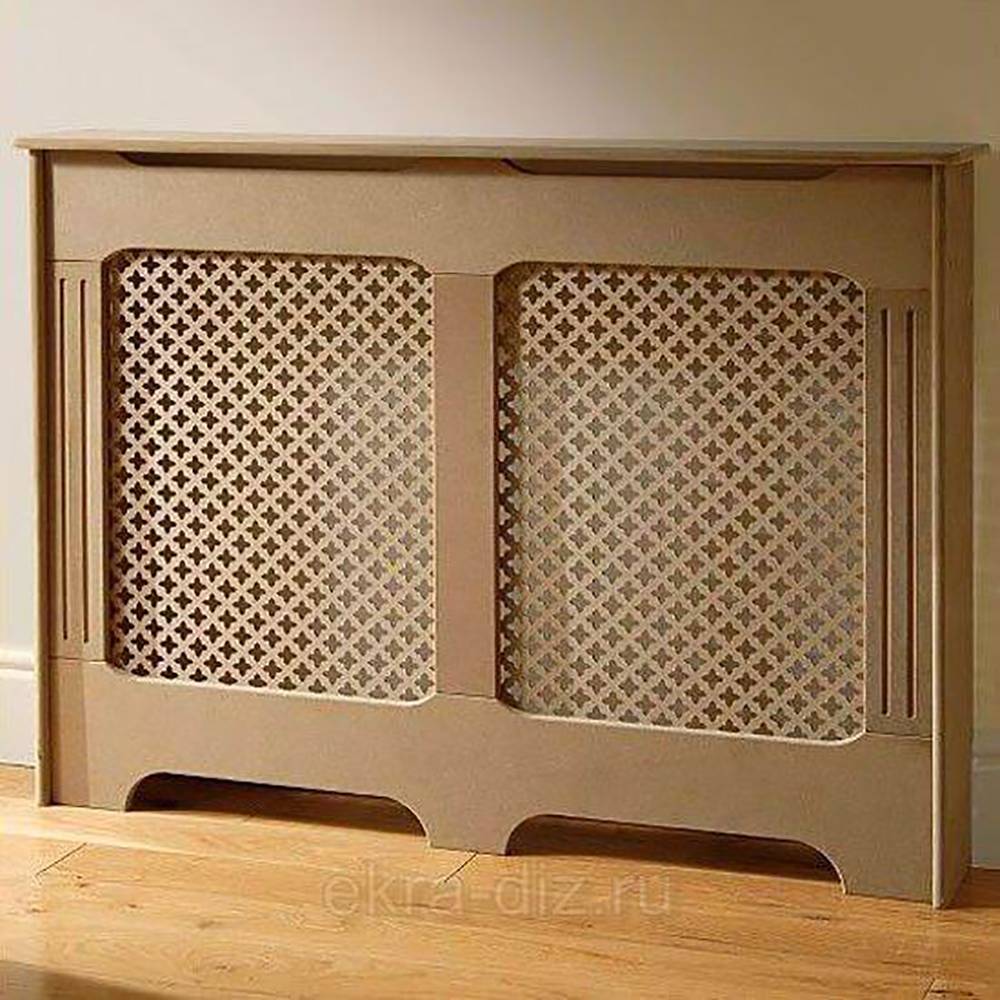
If the battery to be hidden is not initially located in a niche, then it is better to choose a screen for a radiator with a box
Wooden screens are great for decorating purposes as they look quite attractive.
The metal screen for the battery is suitable for modern interiors, as it is concise and simple. In addition, such sheet steel products are relatively inexpensive due to the ease of production, while remaining quite reliable. A much more spectacular option is a stainless steel box, which will be more attractive in appearance due to the possibility of applying a perforated pattern, but at the same time it will cost much more. Caring for metal models is easier than for wooden and glass models: a simple wash under running water is enough.
Properly installed screens will transform the room and at the same time will not interfere with the propagation of infrared radiation into the room and will not reduce heat transfer and heating efficiency.
A variety of protective canopies made of stainless steel are quite practical and, subject to certain rules, look aesthetically pleasing in the interior of a living room
Flat screens are most in demand, this is due to the fact that they are used to decorate radiators built into niches under windows.
Glass screens for radiators - a new word in battery protection. For their manufacture only tempered glass is used. The optimal thickness of the glass should be at least 8 mm, and the presence of a processed edge guarantees the safety of the residents of the apartment. The attractiveness of such models lies in their visual lightness and airiness.




Glass screens for radiators - a stylish interior detail
Rattan panels are considered the most environmentally friendly and safe for human health, and a wide range of colors allows you to choose the perfect option for any interior. When choosing a material, it should be remembered that artificial rattan is the preferred option in terms of ease of maintenance. Most often, rattan is used not autonomously, but as a filling for an MDF box. Such a screen looks attractive and stylish.
Screens made from natural materials are more suitable for classic and vintage interiors. Artificial materials are more typical for interiors with a modern design.
Another way to classify is to take into account the shape of the screen. On this basis, the following types of screens are distinguished:
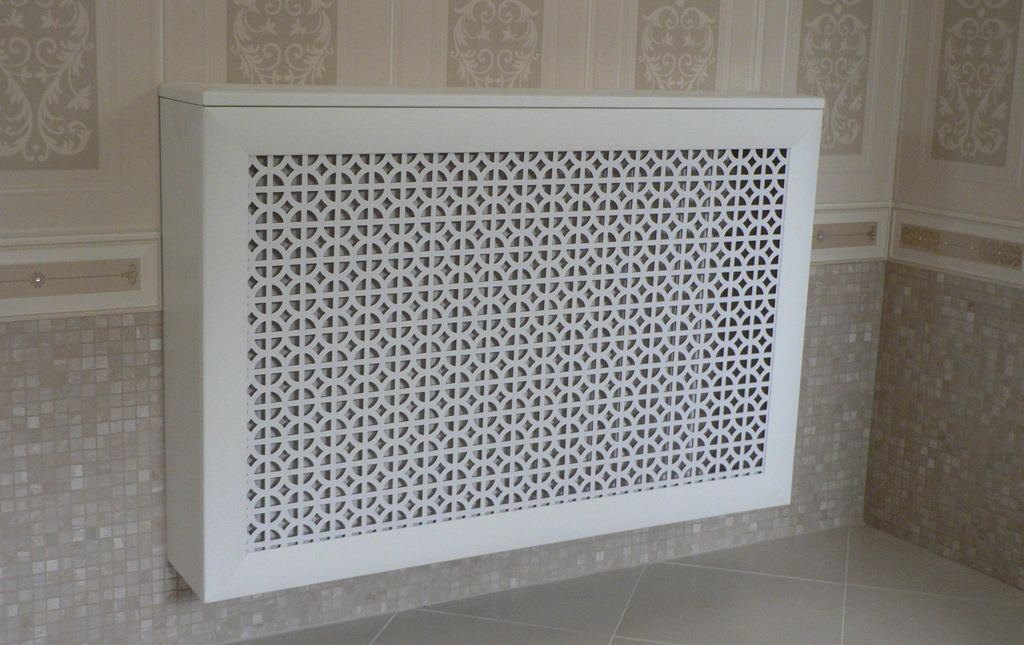
Flat battery protection panels are suitable for recessed radiators.Carving and drawing on the screen plane allow you to turn it into a stylish and original interior decoration.
A hinged screen for a battery without a cover is used when there is a need to decorate cast-iron batteries protruding beyond the window sill. Unlike a box, such a screen looks much lighter and does not clutter up the room.
The hinged screen for the battery without a cover ensures maximum penetration of warm air into the room and at the same time perfectly copes with a decorative purpose.
Hinged screen made of sheet metal
Hinged panels with a lid are traditionally made of metal and are installed independently without any problems. Such screens do not interfere with the passage of heat and help maintain a comfortable atmosphere in the room.
A protective screen for a heating battery, the structure of which, a chaotic grid, is an unusual and rather attractive solution.
The boxes allow you to completely close the battery, and the box itself can be used not only as a protection for the radiator, but also as a stylish and original bedside table.
Radiator box, which, thanks to its bright color, will become an accent for any interior
Openwork metal box for the radiator looks luxurious
Making a decorative screen with your own hands
The technology for making a drywall box is quite simple. If you prepare the material properly, you can give it a marketable appearance that will not differ from that produced on professional equipment.


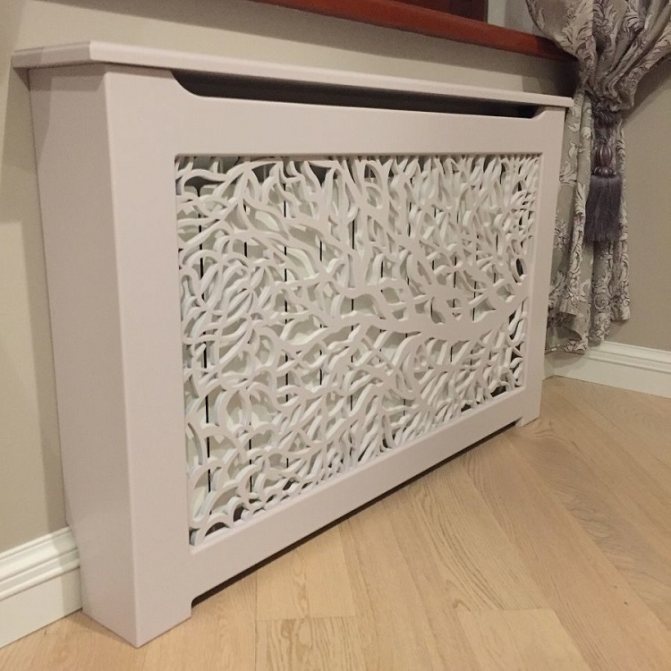

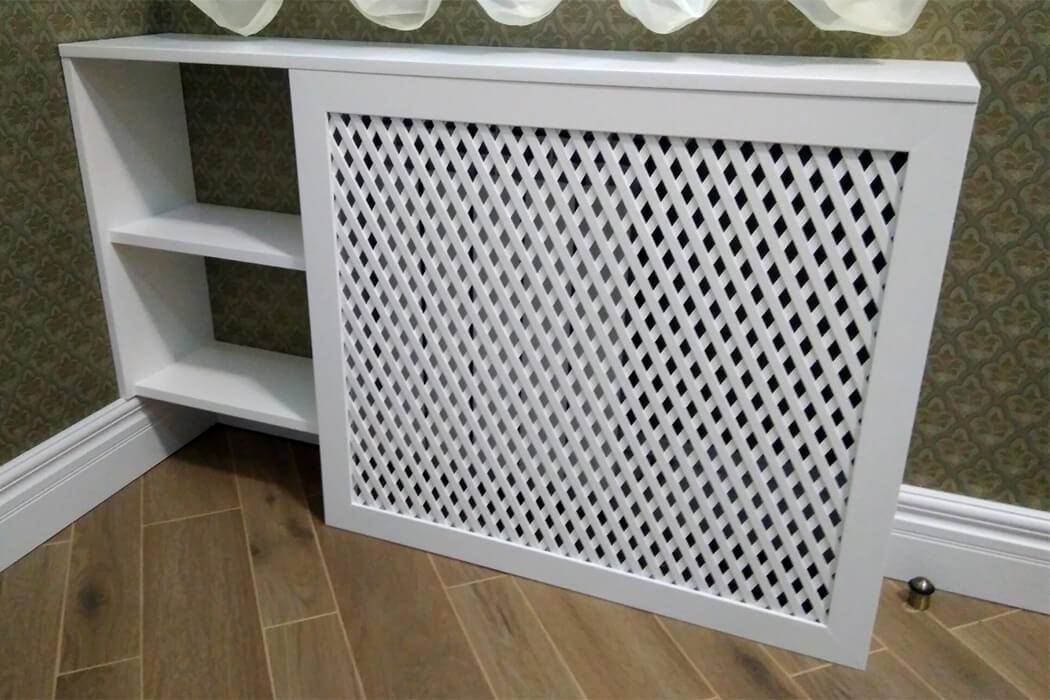


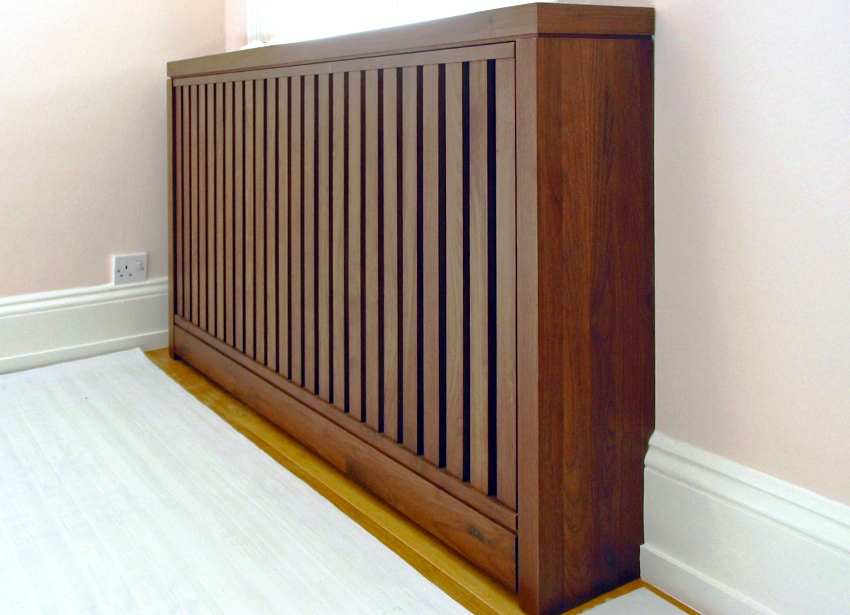

To make a box, you will need the following tools and materials:
- drywall sheets;
- metallic profile;
- jigsaw;
- metal mesh or wooden grate (for thermal "windows");
- PVA emulsion (2 or 3 l);
- self-tapping screws, screws, dowels;
- Decoration Materials.
To increase thermal conductivity in the box, you can use fragments in the form of blinds - this looks aesthetically pleasing and provides air circulation.
A small number of holes or their incorrect distribution can lead to heat loss (it will go back through the pipes) or condensation in the upper part.
Step 1: drywall preparation
First you need to measure the battery and cut out the details. 7–10 cm must be added to the width, 3–5 cm to the height. Increase the depth of the upper wall (if any) by 3–4 cm. It is recommended to roll the cut sheets of drywall with a needle roller from the wrong side. You don't have to buy it, you can rent it.
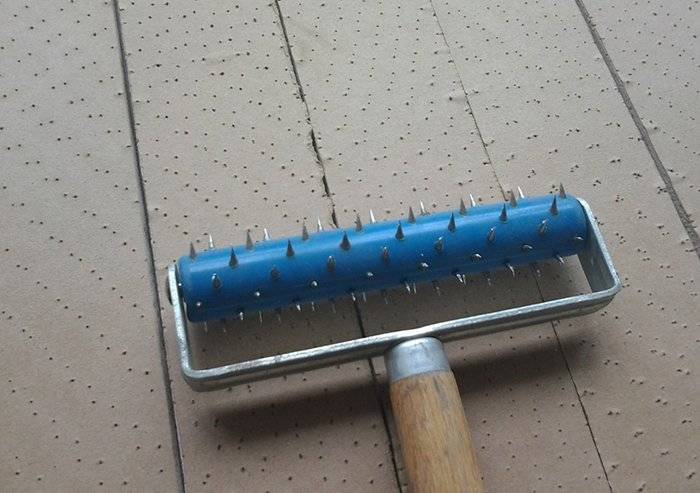
Then the blanks are impregnated on both sides with PVA emulsion. This procedure must be repeated twice.
Impregnation with an emulsion in combination with the work of a spiked roller gives the following effect:
- Improves the thermal conductivity of drywall.
- The material impregnated with emulsion does not dry out due to constant heating.
- The paint lays down in a more even layer, no need to putty.
- Cutting the processed material with an electric or manual jigsaw is more even, without chips.
Aerobatics - to make a crate of drywall strips, which are glued together with PVA glue.
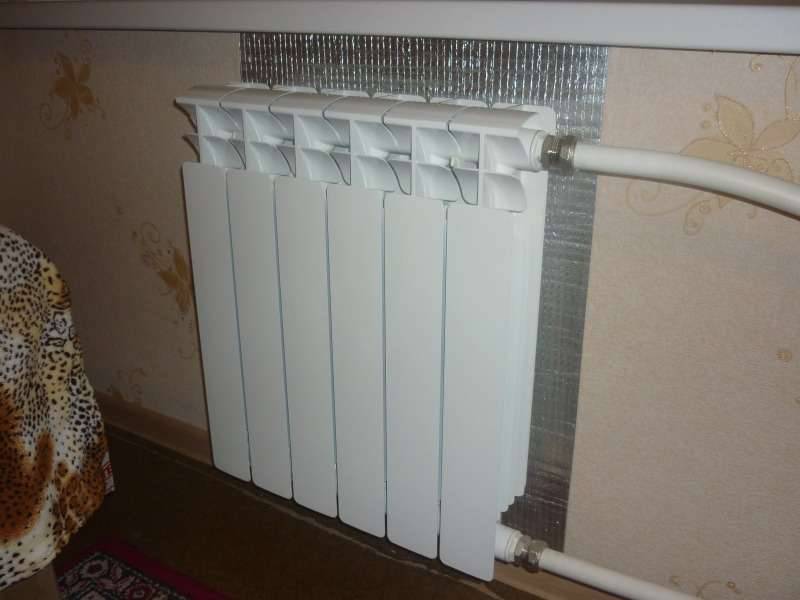
In addition, on the advice of the masters, a shiny, reflective material, such as foil, can be glued behind the battery. This will also increase the heat dissipation of the radiator.
Step 2: product assembly
The frame of the product is assembled from a metal profile. Racks are connected with metal corners.

Then drywall is attached to the frame with self-tapping screws.The entire structure is checked using the building level.

A hole is cut in the designated place, then a metal mesh (or several, depending on the size of the entire product) is attached to the glue.

Step 3: Decorating
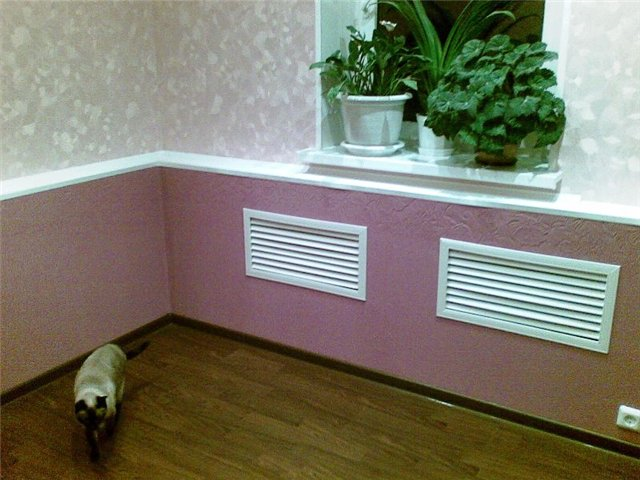
Decor options can be chosen independently. If you do not want the battery to stand out against the general background, you can paste over the box with the same wallpaper as the walls
If, on the contrary, you need to focus on this element, you can paint it in a bright color.
What is a grille?
In another way, the product is called a box. Battery grills are an important part of the interior. They allow you to hide old batteries and complement the design of the room. There are several reasons (besides aesthetic ones) why people put grates on radiators, for example, the products save on heating costs. The area of the grates is evenly heated, and they distribute heat energy throughout the room. It should be noted that the style and design solutions of the grilles do not affect the technical characteristics of the radiator.




What is the radiator grill made of?
Product design may vary. The grille for heating radiators is a surface with protrusions on the sides. They have fixing elements. With the help of these devices, the grille is mounted on the radiator. The product is available with or without a top cover. There is one common design feature for all radiator grilles - they do not have a hole on the surface or bottom.
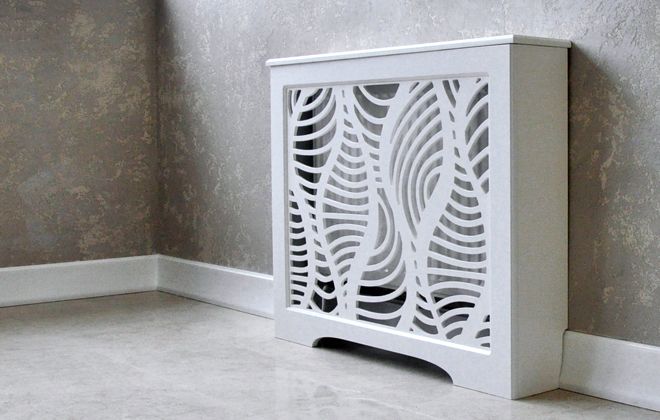
Furniture items
A few examples of furnishing a kitchen combined with a living room:
- 1. Sofa. It becomes an object that zones the space. The sofa is placed with its back to the place where food is prepared.In small rooms (less than 20 sq m) they put a corner, which is located against a wall installed perpendicular or parallel to the kitchen.
- 2. Headset. According to the designers, minimalist models without elaborate details look modern. The service, vases or glasses are placed on an open shelf. You can buy a fashion showcase for them. Furniture is placed near the wall. If the space is large (20 sq m, 25 sq m or 30 sq m), then in the central part you can install an island, which also has departments for kitchen appliances.
- 3. A set of furniture. Style should be combined with the design of both rooms. In small rooms, a compact table and chairs made of transparent material or painted in light colors look good. In the interior of the living room, you can put a table with a round top. In spacious rooms, the kit is installed near the wall or in the central part. An elongated rectangular dining table will look good here.
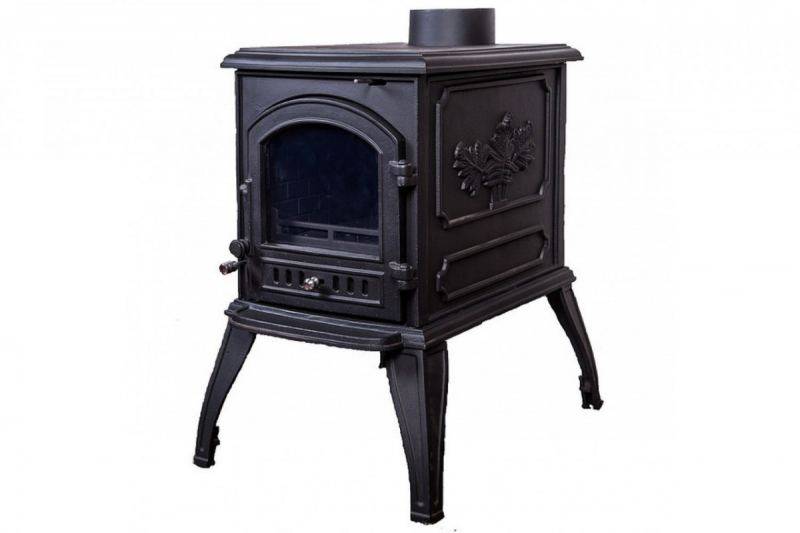
Tasks and materials
Most often grilles on heating radiators are installed for decoration - not all heaters look attractive, and the grilles are sometimes very beautiful. The second task that battery screens often perform is to cover sharp and hard edges. This is true in families with children, especially if old-style cast-iron radiators, such as "accordion", are installed. Their shape is dangerous, and they look unattractive, they will only be in loft-style rooms.
They make grilles for heating radiators from different materials:
-
Metal screens for batteries are mass-produced. They are made from thin sheet steel, which is then coated with paint.For the most part, they cost a little, but they look average. The duration of operation depends on the quality of the color. Preferably powder enamels. They last longer, retaining their attractiveness for decades. From the point of view of the effect on heating, metal screens for radiators are the best choice. The metal heats up quickly, and then it begins to radiate heat. So the option is inexpensive (usually) and does not greatly affect the temperature in the room (in the presence of perforation).
-
Forged lattices are very beautiful. But forging is too openwork, so some kind of background is required, and it is often made contrasting in order to highlight the forged elements brighter. To ensure normal air circulation, it makes sense to make a “background” from a perforated metal sheet.
-
Wooden lattices and screens. Wood has always been and remains a premium material. The high plasticity of the material allows you to make them in different styles and shapes. And although there are inexpensive products made of wood, they look very good. But, as mentioned above, working with a radiator closed on all sides by wood transfers little heat into the room.
-
MDF and HDF. For the manufacture of laminated sheet materials are used. Staz should say that binders are not used in the production of MDF and HDF. The softened wood fibers are pressed, and lignin, a natural binder found in wood, is released in the process. Lignin and glues the fibers. So both of these materials are absolutely safe. If we more or less know products from MDF, then HDF is an unfamiliar material for many. It differs from MDF only in terms of pressing.It is molded under higher pressure, as a result it turns out to be very thin (3-4 mm), but more dense and uniform. HDF holds its shape well, therefore openwork grilles for heating radiators are often made from HDF. From the point of view of their effect on heating, they are slightly better than wood - the layer is thinner, there are usually more perforations.
-
Plastic. Plastic products are most often used in bathrooms and toilets. This material is the most hygienic, it can be washed an unlimited number of times. For manufacturing, heat-resistant plastic is used, which is not afraid of heating up to 60-80 ° C. If the grate bars are installed at an angle, as in the photo, the heating will work efficiently. Air flows freely through the cracks. It all depends on how the lid is made.
-
Glass screens on radiators appeared several years ago. They are not ideal in terms of heating, but they have an attractive appearance. They are made of special tempered glass, matted or applied with a pattern.
Used in the manufacture of decorative grilles for radiators and more exotic materials. For example, bamboo and rattan. Such products are more demanding on interiors and are rare.
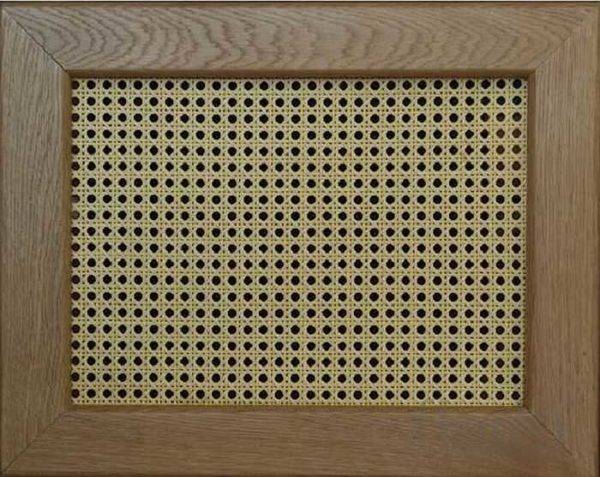
Rattan screen on wooden frame
There are also combination grids. Most often there is a wooden frame, on which some kind of decorative mesh is stretched. Bamboo and rattan braids are most often attached to such a frame. Panels made of MDF and HDF are usually mounted on a wooden frame.
Decorative lattice device
Before installing decorative radiator grilles, you need to find out how they are generally arranged, and what should be the device that can best perform its functions.
Immediately it is worth noting a number of devices that are not recommended for use due to their poor efficiency:
- One of the most unfortunate designs is the solid panel, which has very small holes in the bottom and top surfaces. Such dimensions of the decorative grille for the heating radiator do not allow the heated air to circulate freely, and no tricks will help in this case. Naturally, a decrease in heat transfer will lead to an unjustified increase in heating costs.
- The second option, only slightly more effective than the previous one, is a wooden grate, the front part of which is made of slats installed at some distance from each other. Such a design will not interfere with direct thermal radiation, but you can immediately forget about creating a thermal curtain and normal convection when using it. Of course, from the visual side, a wooden protective screen looks very attractive, but from the point of view of efficiency, this is far from the best choice.
It is undesirable to use the described types of gratings due to the fact that they significantly reduce heat transfer. A much better option would be the last type of grid, the design of which allows you to create a thermal curtain and provide normal direct heat transfer. In the upper part of such a device, there must be holes or gaps that allow heated air to go up.
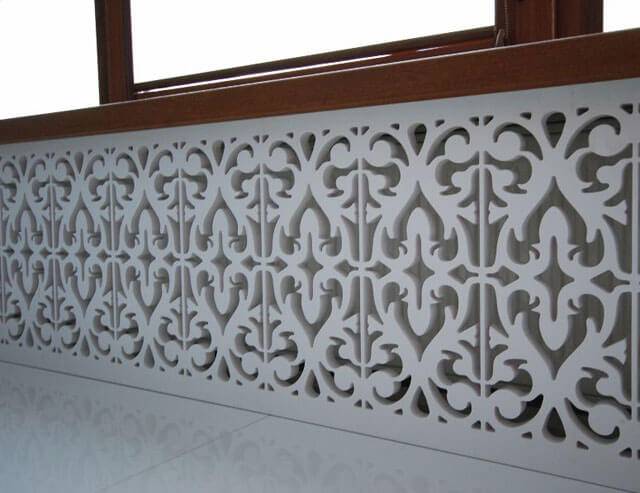
High-quality and functional beautiful grilles for heating radiators are equipped with an aerodynamic visor, which is relevant if the radiator is located under the windowsill. The visor, which can be made using a small metal strip or even thick cardboard, prevents the accumulation of heated air directly above the radiator.
In addition, a good battery grille can be additionally equipped with a heat injector. The generated heat is usually collected in the space between the grill front panel and the battery itself. The heat injector, which is two directional blades, allows you to direct all the heat into the room. At a low temperature of the coolant, this phenomenon will not be noticeable, but when the system warms up to the maximum, the increase in heat transfer will become apparent.
The general design of the optimal decorative lattice is as follows:
- A layer of reflective insulation having a foil coating is installed between the heating radiator and the outer wall;
- Above the radiator, from the wall to the edge of the window sill, there is an aerodynamic visor;
- In the upper front part of the structure, two blades are installed, forming a heat injector;
- The front decorative panel on the heating radiator itself is a grille with a fairly large cell.
The principle of operation of the lattice, made according to this scheme, looks like this:
- The cold air below enters the radiator and, after warming up, freely goes up, which is facilitated by the mounted visor;
- When the coolant is heated, the injector starts to work, significantly increasing the intensity of convection heating;
- Direct heat radiation passes through the holes in the grille, and heat loss is minimized due to the presence of a heat-reflecting layer located behind the radiator;
- Thermal energy can either pass directly into the room or be retained by the grate material, as a result of which the latter becomes a heat accumulator, further increasing heat transfer.
Types of decorative panels
The choice of the design of the protective panel depends on how you want to close the radiator - completely or partially. Most often, the grille is installed from the front side, however, models of boxes have been developed that cover the entire battery.
Decorative screens are divided by design into the following types:
- hinged;
- built-in;
- flat;
- convex.
Mounted
Hinged metal screens do not require professional installation. They can be installed by the owner of the apartment on their own, as they are simply hung on the upper collector of the heater.



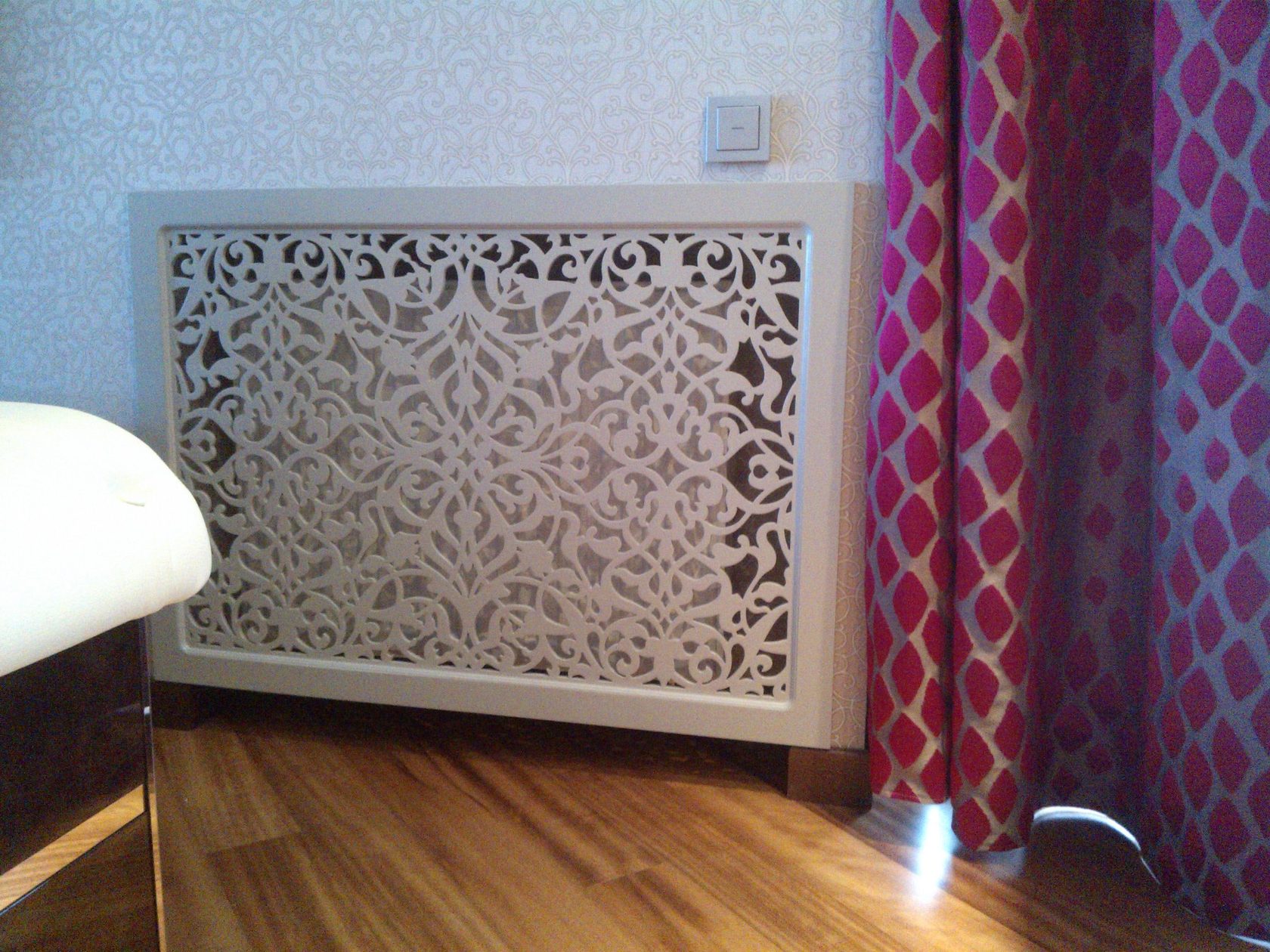
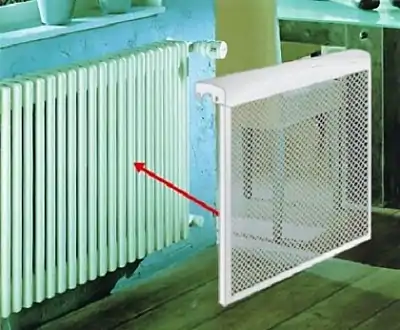
To give the structure stability, the appropriate shape of the screen is specially designed and fasteners (hooks) are provided. Such protective panels are made of metal sheets with decorative perforations of various shapes.
The metal is characterized by high thermal conductivity, perforation can significantly improve convection, and, consequently, heat transfer.
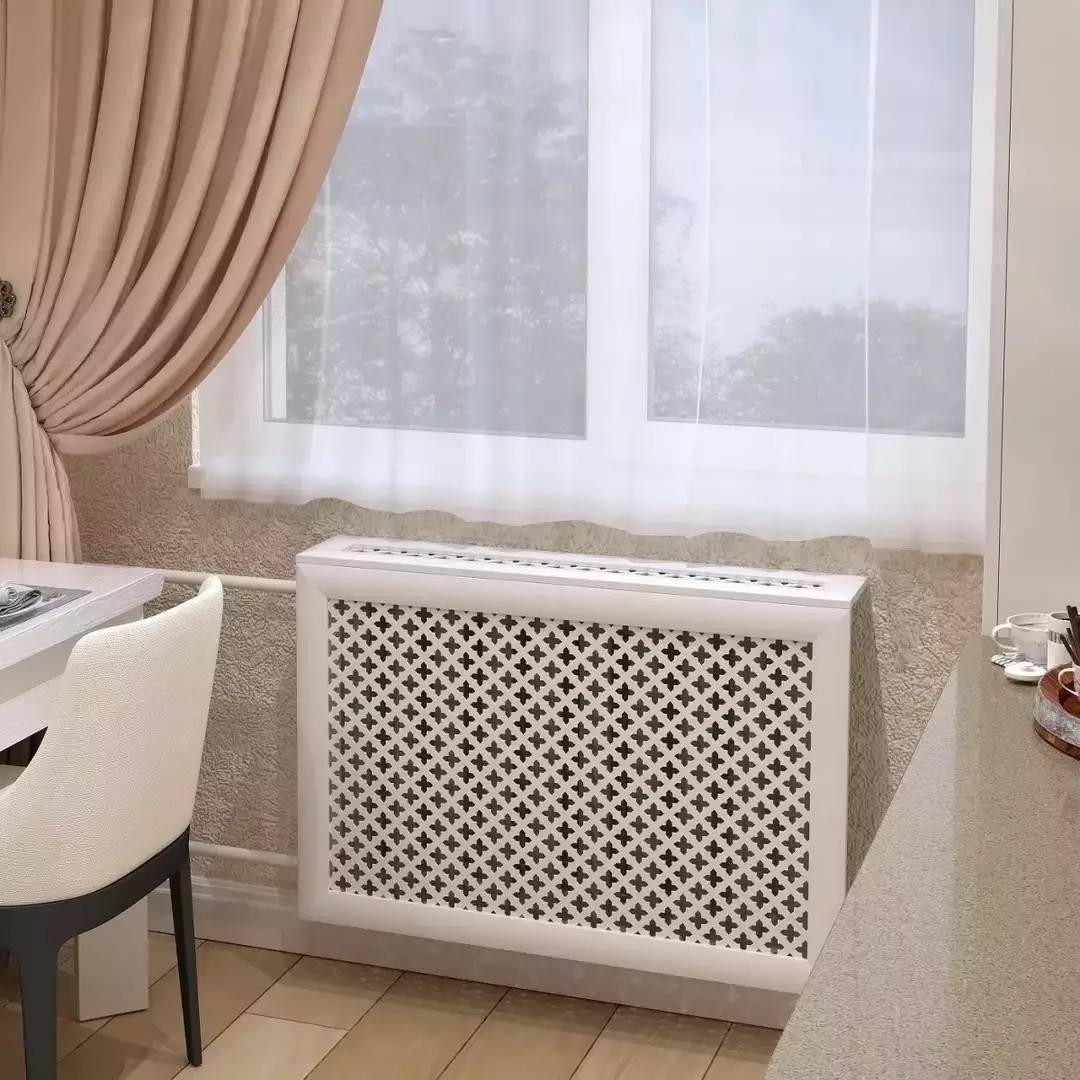
Manufacturers offer models with a rounded or rectangular edge, which are made taking into account the option of connecting pipes to the heating radiator (two- or one-sided). Modifications of hinged panels can be both with a cover, and without it. When the radiator is located directly under the window sill, you can use the model without a cover.In the event that the battery is not closed by a window sill, a modification with a lid is used.
Embedded
If openings or special niches are provided to accommodate the heating system, built-in protective panels made of perforated sheet metal are used. Installation of this design is carried out using self-tapping screws or special silicone sealants. To perform installation work, you will need some experience, so it is better to turn to professionals.
Important! The shape of the protective panels depends on the dimensions of the heaters.
flat
In the event that the radiator does not protrude beyond the window sill or a special niche, a flat protective screen is installed. It can be mounted or built-in, the owner of the room chooses the design and shape according to his taste.
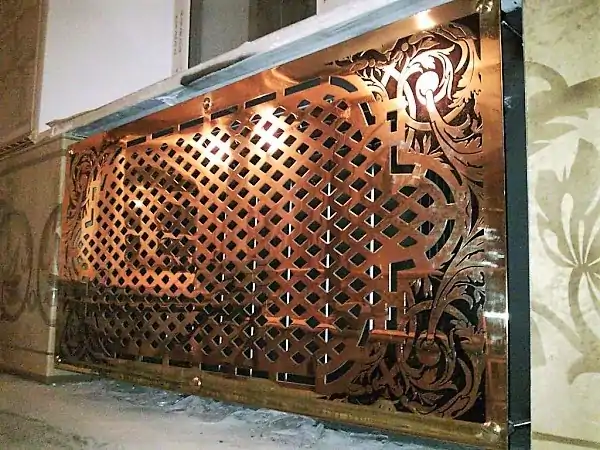
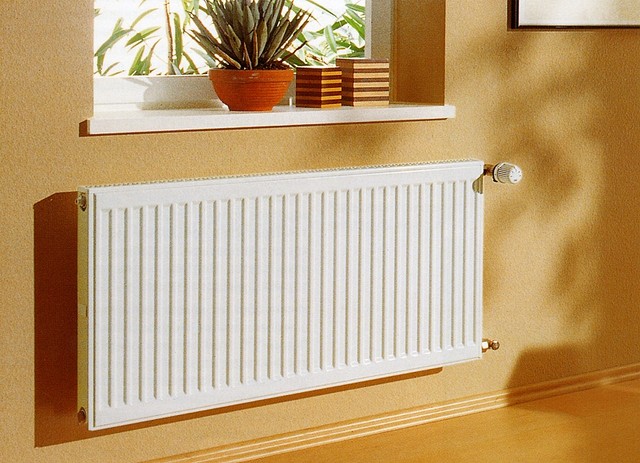
Photo 1. Flat metal screen for a radiator: the design does not go beyond the window sill and a special niche.
convex
If the radiator protrudes beyond the niche, then a convex perforated screen must be installed. It will help close the battery better, thereby reducing heat loss.