- Designation of pressure in the pipeline
- What to do if there is no pressure or it does not meet the standard?
- How to align?
- How to make permanent?
- What to look for when choosing
- The main reasons for the decrease in water pressure in the water supply system
- Helpful Hints
- Options for placing pumps and pumping stations in the apartment
- What is the capacity in the DHW and cold water system?
- How to measure
- Maximum water pressure in the water supply
- How to install a pump to increase water pressure
- How to increase water pressure
- Artificial increase in pressure in the plumbing system
- Inclusion in the circuit of an additional pump
- Partial alteration of the water supply system
- Installing a hydraulic accumulator
- Installing a booster pump
- How to measure
- What pressure in the water supply is the norm
- Pressure standards in the pipeline
Designation of pressure in the pipeline
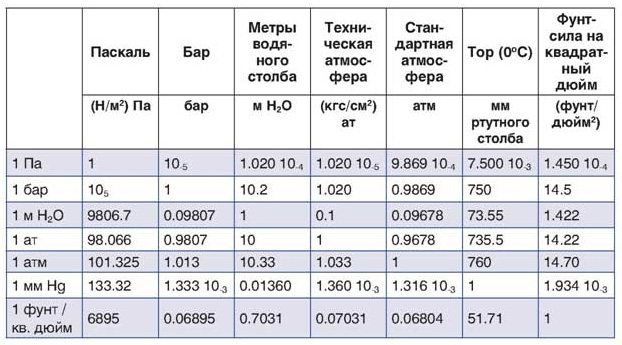
Traditionally, pressure is measured in Pascals (Pa), but other symbols have been adopted in the field of water supply, while in different countries they differ:
- In Russia, pressure is usually measured in kgf / cm². 100 kgf / cm² is identical to 980.67 Pa.
- In European countries, another conventional unit is used - a bar, which is equal to 10⁵ Pa.
- In England and the USA, the designation psi is used, which corresponds to 6.87 kPa.
Pressure is also measured in technical atmospheres and millimeters of mercury.
Note. A water pressure of 1 bar corresponds to 1.02 atmospheres and is equivalent to 10 meters of water column.
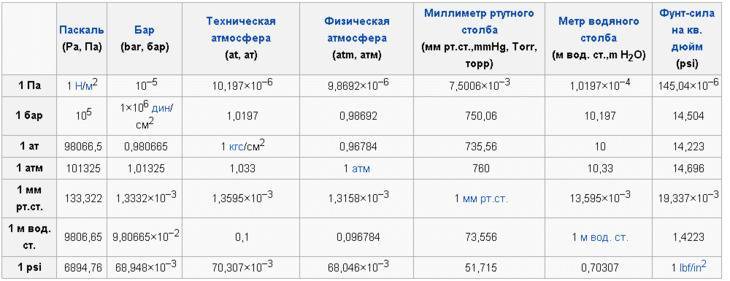
The ratio of the values of different designations is given in the following table:
What to do if there is no pressure or it does not meet the standard?
In this case, two situations are possible. The first is that water enters the pipeline, but the pressure is too weak. The second - on the upper floors, water does not enter the pipeline.
First you need to check the water supply system, since clogging of the pipeline can be the cause of both problems.
This is done in several steps:
- Dirt filters are checked first, since it is their clogging that is the most common cause of a decrease in pressure. If necessary, they are cleaned.
- Then check the aerators, which can also become clogged, reducing the pressure. Sometimes just cleaning them is enough to normalize the pressure.
- The condition of the armature is checked. If the clearance narrowed, then this was due to deposits, and it is better to change the shut-off valves.
- The last step is to check the pipes. They can also form insoluble deposits, and this affects the head performance. There is only one way out - replacement.
If there is no blockage, then in the first case, you need to install a pump that increases the pressure. It may be worth buying higher power equipment. However, if the reason lies in reducing the resource of the source, then a more efficient pump will not only not help, but even exacerbate the problem.
And if water does not enter the second floor, then you will need to install a storage tank or a home station with a hydraulic accumulator. The latter is also often referred to as a membrane tank.
It is a device with a sealed housing, which consists of two chambers separated from each other by a membrane made of a safe and durable material - butyl. One part of the tank is filled with pressurized air, while the other part gradually accumulates water coming from the water supply.
A station with a hydraulic accumulator is already good because it allows you to create some supply of drinking water in the house. And at the same time it solves pressure problems by regulating the pressure inside the accumulator chambers.
When the air pressure indicator reaches the threshold value, the built-in relay automatically turns off the running pump. When the pressure in the water chamber decreases as it flows, the relay turns on the equipment. To regulate the pressure in the membrane tank there is an air valve.
To install such a station with a hydraulic accumulator, remember that:
- the choice is made taking into account all the parameters of the system;
- it can be placed at any level of the house;
- it must be installed so that there is free access to the equipment in case of repair or maintenance.
How to align?
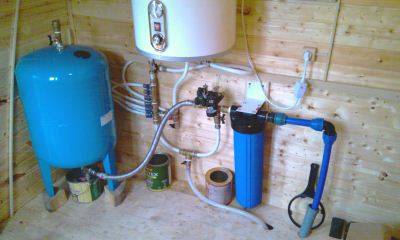
The ideal option would be to install a station with a hydraulic accumulator, where pressure switches and safety valves allow you to adjust the indicators without the intervention of the owner of the house.
Sometimes only safety valves are used for equalization, in the presence of which the compensator will send excess water to the sewer.
How to make permanent?
In order for the autonomous water supply system to work with a stable pressure head, it is necessary to eliminate the risk of water hammer, which remains high even when using a hydraulic accumulator with a membrane.
In addition, it is important to achieve pressure stabilization in those homes where several water points can operate simultaneously: for example, if one person uses the shower, the second starts the dishwasher, and the third decides to water the garden. In this case, you should install a frequency converter that: In this case, you should install a frequency converter that:
In this case, you should install a frequency converter that:
- maintains a stable water pressure at several points;
- can operate in smooth mode both at start-up and at stop, which prolongs its service life;
- equipped with protection against idling;
- makes it possible to significantly reduce the volume of the membrane tank, which allows you to immediately solve the problem of an unpleasant odor that occurs during stagnant water.
The installation of the frequency converter should not cause any special problems. Moreover, many pumping stations already include a built-in converter.
But you can buy it separately and integrate it into a working system. It is only necessary when choosing to take into account such characteristics as power, voltage and rated current.
What to look for when choosing
Buying water pump electric to increase pressure, check with the consultant for the following nuances:
- power. The more powerful the device, the more consumers will be able to enjoy its benefits. Consider the number of taps in the apartment and household appliances connected to the water supply;
- noise level, which is different for different models;
- certain pump models are designed for specific pipe sections.If you use a device for a water supply system with an inappropriate cross section, the pump will work with overloads, and the pressure will be less than the calculated one;
- the height of the water level. A pump for water pressure in a water supply system, designed for a lower load, may simply not reach the liquid to the desired level (this item applies to the purchase of a pumping station);
- the size of the unit also matters, because sometimes it has to be installed in very small rooms in which the entrance to the apartment is located;
- An important factor is the reliability and fame of the manufacturer.
The main reasons for the decrease in water pressure in the water supply system
There are many reasons for a decrease in water pressure in the water supply. However, the most common reasons are:
blockages. The pump or pumping station is located underground. Accordingly, they can be clogged with underlying rock - sand, clay, silt, etc. As a result, the pump cannot pump the original volume of water, which reduces the pressure. Suspensions in the water itself can also reduce pressure - they clog filters and treatment structures.
Leaks. Pressure can be reduced as a result of damage to a pipe that is underground. The reasons for this may be - depressurization of the joints, damage to the pipe itself (breakthrough of plastic pipes or cracks as a result of corrosion of metal pipes).
Equipment breakdowns. If the equipment is used for a sufficiently long time, then various breakdowns of parts are possible. For example, screws and gears in pump mechanisms. The failure of the impeller or rubber piston will lead to additional hydraulic losses.If automatic systems are contaminated, a shift in the mechanism for switching between low and high pressure can occur. Tightness plays an important role in the operation of the equipment. If it is broken due to rupture or stretching of rubber membranes, silicone joints, then there is an increase in water loss during pumping, which means a decrease in pressure.
Breakage of plumbing fittings. Pipes are fastened with special fasteners. Moreover, the fasteners are located along the entire length of the pipe. Breakage of these fasteners, hinges lead to the loss of a large amount of water, which significantly reduces the pressure inside the water supply
There can be several reasons for breakdowns - careless handling, improper installation, poor quality materials.
Change source settings. Any well or well has its own service life.
For example, if the well is installed on sand, then after some time (depending on the sand itself) siltation occurs. As a result, the pump increases the amount of pumped water and energy expended, but reduces the pressure. This is due to blockages in the equipment itself. Therefore, when designing a house, it is necessary to prepare several places for new wells in advance.
Helpful Hints
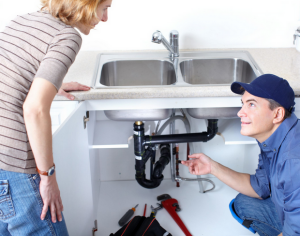 Summing up the above, I would like to raise one more question.
In a detached mansion, the use of a boiler for heating must be carried out in strict accordance with the instructions that are attached to it.
Quite often, the following situation may occur:
for a heater, it is quite, enough, pressure in the aggregate of water lines - 2.3 - 2.5 atmospheres.
But this is not enough to turn on other household appliances. What to do in this situation?
The boiler must be equipped with an individual water supply circuit, with a pressure that meets all requirements.
Always listen to the opinion of experts or sales consultants when choosing a pump for a private house or apartment (approximate prices can be found here).
Knowledgeable people say that it makes no sense to install too powerful equipment. It is better to install a low-power device near each device that consumes water.


At the moment, there are no problems with choosing the right pump for your needs for a long time. There is a huge range of products on the market for every taste and wallet thickness.
See how the owner of the house solved the problem of low water pressure in the pipeline.
Options for placing pumps and pumping stations in the apartment
Often the apartment does not have enough space to allocate a small technical area where the boiler can be located, as well as pumping equipment to increase the water pressure. In this regard, it is required to find a place where it is possible to install the pump. It is usually located under the bathroom behind the retractable screen. Since there is little space there, and it is not very convenient to work during installation, only a pump without a hydraulic accumulator is installed.
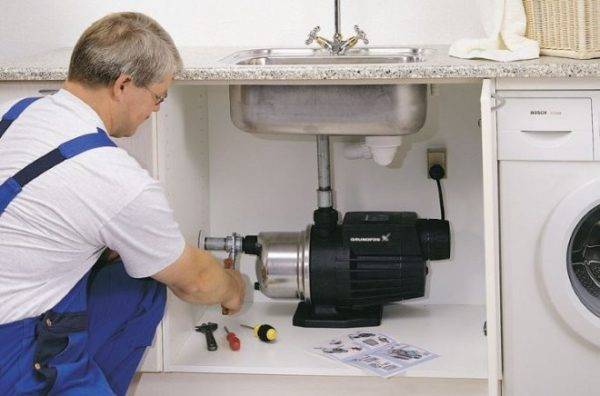
It is most convenient to operate and maintain these systems when they are located in a cabinet under the sink. Depending on where the riser is located, it can be a kitchen or a bathroom. If there is no space at all, then you can put a miniature pump only directly in front of an important consumer. It can be a washing machine or instantaneous water heater.The pumps used for this are very small in size, and hardly exceed the size of a water meter.
What is the capacity in the DHW and cold water system?
Water pressure in multi-storey buildings connected to the central water supply network is not constant.
It depends on such factors as the number of storeys of the house or the time of year - so in the summer season, especially in multi-storey buildings, the lack of cold water becomes especially noticeable, which at this time goes to water the adjoining or household plots.
In practice, municipal services try to keep the level at an average of 3-4 atmospheres, although not always successfully. The minimum indicators at which the pipeline of the house can function (for both cold water and hot water) are 0.3 bar per floor.
The pressure of hot and cold water supply is somewhat different in favor of the latter (a difference of up to 25% is allowed).
This is explained simply - cold water is used more actively, since it is necessary for the functioning of the sewage system. Therefore, the maximum indicators for cold water will be 6 atmospheres, and for hot water - 4.5 atmospheres.
How to measure
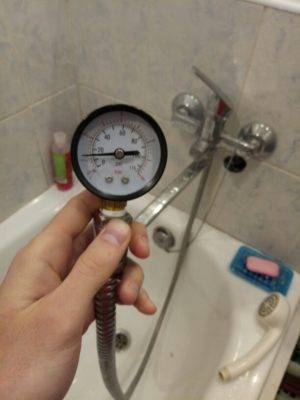
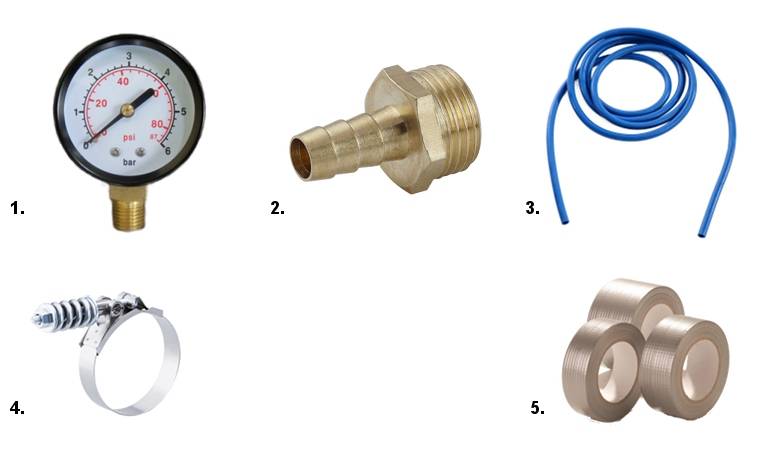
The pressure gauge is mounted on an adapter for connecting to a hose. The hose is selected with a diameter close to the diameter of the gander of the mixer or tap. The hose is put on "in tension" on the adapter and on the gander of the crane. If a tight connection fails, clamps must be used. On sale there are pressure gauges that are easily attached to the shower hose, instead of a watering can.
The valve opens and the pressure in the pipes is measured.
If a household pumping station is used in the water supply system, then what pressure in the water supply system can be determined by the station's pressure gauge.
In the absence of a pressure gauge, it is possible to measure the time taken to draw 10 liters of water from a standard tap or mixer. At 1 kgf/cm2 the set time is about 1 minute, at 2 kgf/cm2 about 30 seconds.
Maximum water pressure in the water supply
The upper limit is limited by the performance of the pumps and the ring stiffness of the fittings. Therefore, the maximum pressure in the water supply theoretically reaches 15 atmospheres. After all, neither pipes nor shut-off valves can withstand large indicators.
But in practice, the maximum indicator in the city water supply system does not exceed 7-10 atmospheres. And it is typical only for internal networks of multi-storey buildings.
Well, inside an apartment or house, the pressure is limited at around 6-7 atmospheres, since a greater pressure can damage the fine mechanics of modern plumbing fixtures.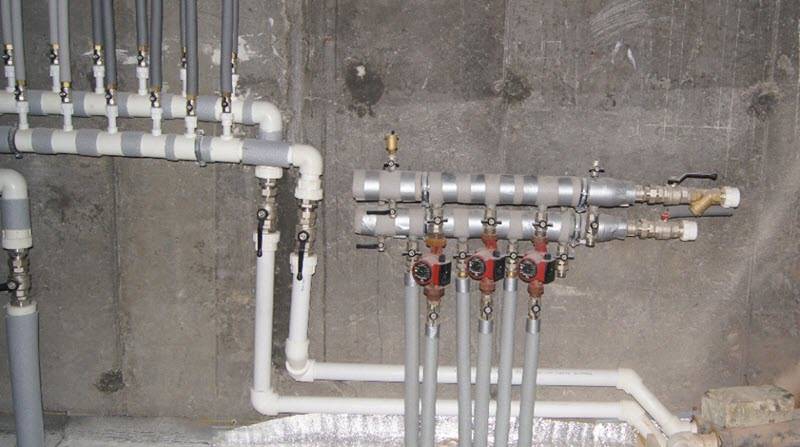
Thus, the maximum pressure provides a strong pressure and guarantees uninterrupted water supply to multi-storey buildings. However, with this indicator, the risk of damage to the “stuffing” of all plumbing fixtures increases.
How to install a pump to increase water pressure
The connection of the circulation booster and the preparation for operation of more complex in design pumping devices, equipped with a hydraulic accumulator, differ significantly.
Connecting the circulation booster
Installation of a circulation unit to increase water pressure in a multi-storey building is carried out in the following order:
- A grinder or a special device for plastic pipes on the inlet line cuts a piece of pipe corresponding to the installation size of the device;
- In accordance with the material of the pipeline, connecting fittings are mounted.If metal pipes are used, either a welded joint or threaded drives are used; if the pipes are plastic, a special soldering iron is used;
- Using the nuts included in the delivery set, the product is mounted in the trunk.
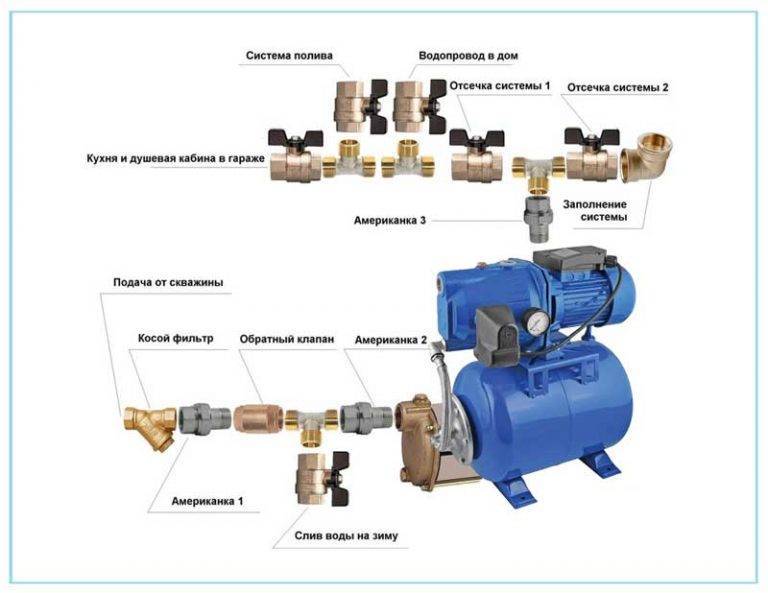
Installation of a suction pump module with a hydraulic accumulator is a much more laborious process. To begin with, we list the main modules available in a typical injection system:
- Self-priming module;
- storage capacity;
- Automatic control system;
- Primary filter that prevents various abrasive fine contaminants from entering the system;
- Plumbing fittings, pipelines and flexible hoses.
To prevent the outflow of water from the pump housing when the power is turned off, a shut-off valve is provided in front of the inlet pipe. In high-rise buildings, the supply line acts as a source of water; in the private sector, this is most often its own well or well.
The method of connecting the injection unit in the private sector
- The installation should be installed in the immediate vicinity of the water intake;
- The temperature at the installation site should not fall below +5 C;
- Contact of installation modules with walls is not allowed;
- The place of installation must allow the maintenance and repair of the units.
There are several most common options for installing a pumping station with a hydraulic accumulator:
- Directly in the house;
- In the basement or basement;
- In the well;
- In a caisson;
- In a special insulated building.
Each of these options has its own advantages and disadvantages, so the choice of installation depends primarily on the layout of the site and the features of the building. After choosing the installation site, proceed to the installation of the station, which consists of the following main steps:
Preparatory activitieswhich include:
a) Arrangement of a site for the installation of equipment. The foundation must be strong and provide reliable fastening of the apparatus;
b) Digging trenches for laying pipelines;
c) Providing power
2. Installation of the water intake system. Depending on the modification of the pump used, there are:
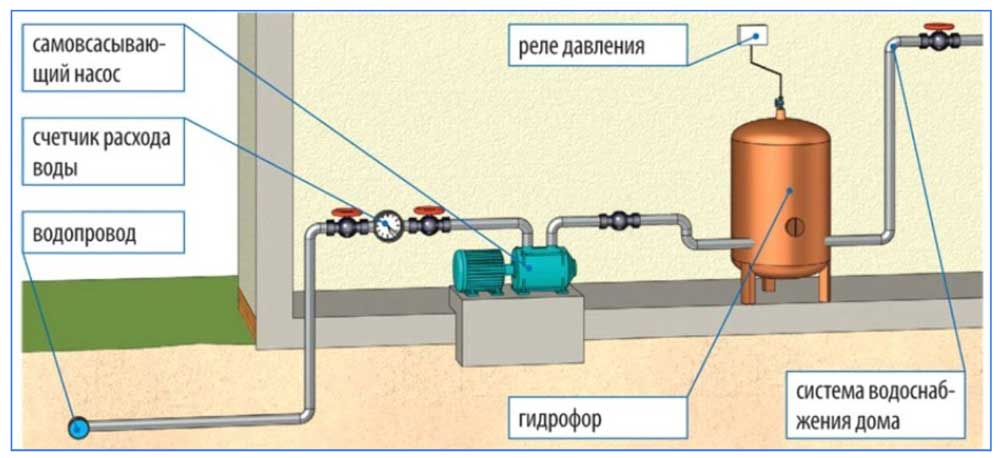
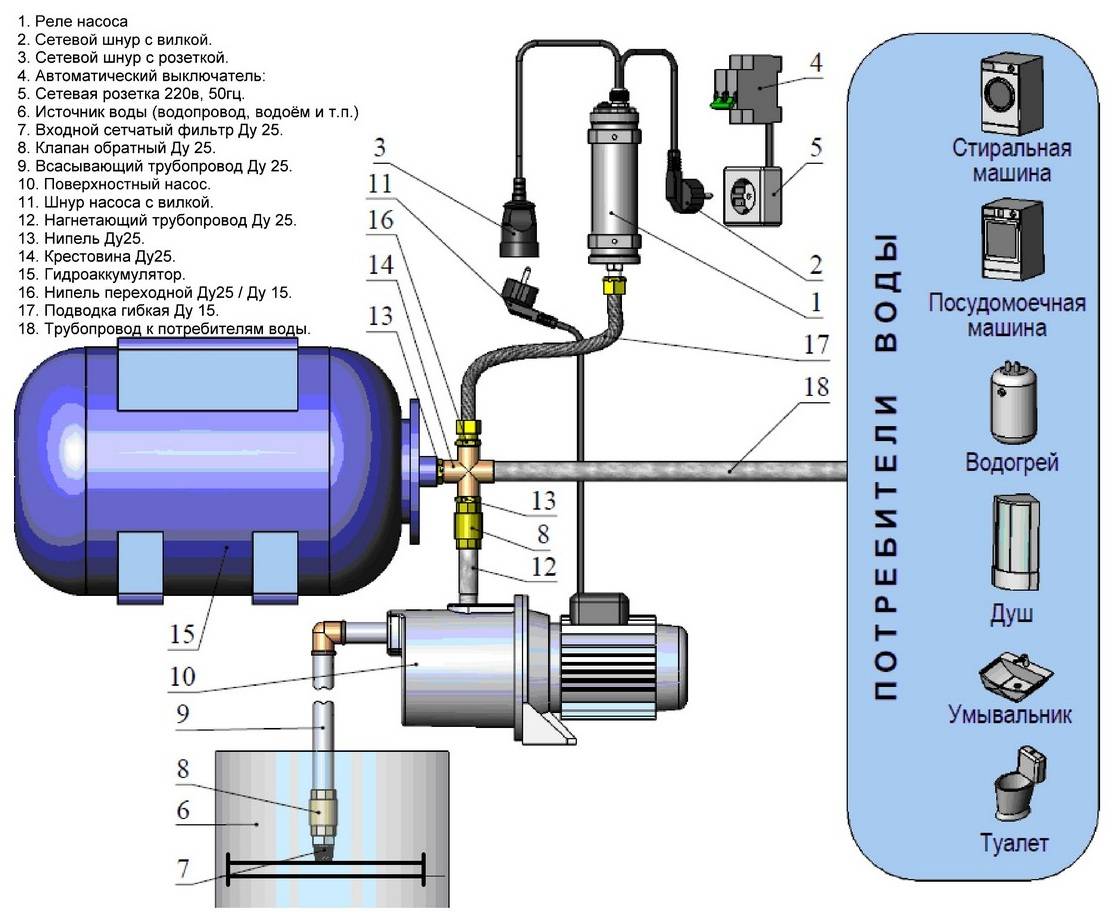


a) standard scheme, with a surface pump unit and a built-in ejector. In this case, the design is a polypropylene pipe, with a check valve connected through a special coupling with a built-in coarse filter;
b) Using an external ejector. With this design, a check valve with a coarse filter is installed on the inlet pipe of the ejector;
c) With submersible pumpequipped with a strainer. In this case, it is sufficient to connect the non-return valve and the supply line.
3. Installation of surface modules. At this stage, it should be remembered that the connection of each subsequent element should be made using ball valves and check valves. This design will provide the possibility of maintenance and repair of individual pump modules without resorting to draining water from the entire line;
4. Initial start-up of the station is made after filling with water through a special neck located on the top panel of the working chamber.
Before starting any step-up generator, make sure that the ground is present and in good condition!
How to increase water pressure
The problem of insufficient water pressure is most often encountered:
- residents of city apartments on the upper floors of multi-storey buildings;
- owners of country houses in the summer, when the water intake increases significantly.
Owners of city apartments, before deciding to purchase equipment to increase water pressure, need to find out the cause of the problem. Insufficient pressure may be associated with clogging of pipes with mechanical particles and lime deposits, as a result of which the diameter of the pipes has decreased over time. In this case, only the replacement of the water supply will help.
If the problem is not related to clogged pipes, it is possible to stabilize the water pressure in the following ways:
- Purchase and install a circulation pump that increases pressure and helps draw more water out of the pipes;
- Install a pumping station with a hydraulic accumulator;
- Equip an autonomous water supply system.
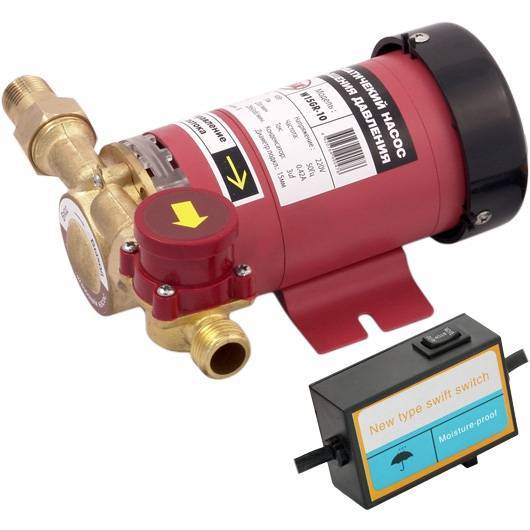
Water pressure booster pump
Specify the problem to select the appropriate option:
- there is always water, but the pressure is not enough for comfortable consumption and operation of household appliances;
- There is water only on the lower floors of the building, but not on the upper ones.
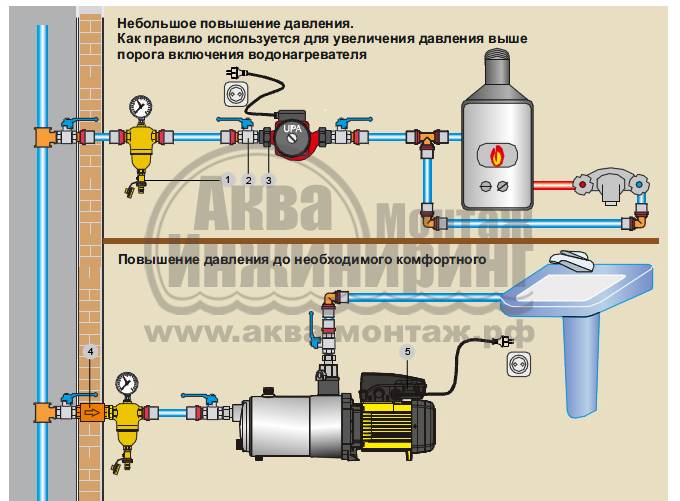
In the first case, when the pressure, although weak, is constantly available, the circulation pump will help to strengthen it. This device, small in size and power, cuts into the existing plumbing system directly in front of water consumption points.
Artificial increase in pressure in the plumbing system
If, after the revision of the pipeline system, no malfunctions were found, you can try to increase the pressure in the network by installing additional water pumps.
There are several ways to artificially increase the pressure in the water circuit:
- Installing an additional network pump in the water supply system.
- Installation of a water pumping station and a storage tank.
- Installation in a pumping station complete with a hydraulic accumulator tank.
Inclusion in the circuit of an additional pump
Installing additional water pressure equipment in the water circuit allows you to increase the volume of water supplied to the water distribution points. Installing an additional network pump allows you to increase the pressure by 1-2 atm.
If the pressure indicators in the network are too low, and it is not possible to increase the water supply to the network, it is recommended to install an individual pumping station with a storage tank. Too low pressure makes it impossible to work most plumbing fixtures and household equipment associated with water supply. During the time when the residents do not use the water supply, a sufficient amount of water accumulates in the storage tank.
If necessary, water is supplied from the storage tank to the system using a pumping station, which creates the required pressure indicator for the smooth operation of household appliances. The disadvantage of this method is that when the storage tank is empty, you will have to take a break and wait for it to fill up again.
What to look for when choosing a pump
When choosing pumping equipment, you should pay attention to its operating parameters:
- The performance of the equipment is characterized by the supply of a certain volume of water in liters per minute.
- Head height, in meters.
- Output power, in watts.
When choosing a pump, you need to take into account the average water consumption in the house. It depends on the number of residents, the number of water distribution points and the number of storeys of the building.
A pump that is too weak will not be able to solve problems with low pressure, and too powerful can lead to premature failure of plumbing equipment - rupture of pipe joints, extrusion of gaskets, etc.
If you are not sure about the correctness of your calculations, it is recommended to contact plumbing engineers with this question.
Partial alteration of the water supply system
Sometimes the cause of insufficient pressure is an incorrectly assembled piping network. Most often this happens if the system is assembled independently by non-professional tenants, without consulting a specialist. At the same time, it is possible to underestimate the necessary parameters of the pipes, when, due to the small diameter, the throughput of the water supply system is insufficient for the normal supply of water to the entire house. Replacing pipes that are too thin will increase the pressure in the water supply network to acceptable levels.


Installing a hydraulic accumulator
A good alternative to an open storage tank with a pumping station can be the installation of a hydraulic accumulator in the house, also known as a hydraulic tank. Its functions are approximately the same - the accumulation and supply of water to the network. However, the pressure in it is not created due to the network pump, but due to the elastic force of the internal diaphragm and the air compressed by it. Its principle of operation is as follows:
- The device displays the lower and upper pressure values. At the lower pressure indicator, the automation turns on the borehole pump, and the tank is filled with water. In this case, the membrane is stretched, the pressure in the accumulator increases.
- When the pressure reaches a certain upper level, the pump automatically turns off, and water is supplied under pressure to the network.
- As the water is consumed, the pressure in the network drops, and when it reaches the lower set value, the hydraulic accumulator automation again turns on the borehole pump.
Installing a booster pump
Installing a conventional pump to increase water pressure in a city apartment is quite simple. At least if there is at least a little knowledge in the field of plumbing and some building skills. Work is carried out according to the instructions given in the table below. The simplest pump is installed directly on the water supply pipe.
Grundfos UPA 15-90
Table. Installation of a pump for increasing pressure.
| Steps, photo | Description of actions |
|---|---|
| Step 1 | It is necessary to prepare all materials and tools. This is the pump itself, a gas wrench, pliers, adapters, a pencil, plumbing tow, an angle grinder, a die for threading. |
| Step 2 | On the pipe in the place where the pump will be installed, the places where the pipe will be cut are marked with a pencil - they will be at a distance from each other equal to the width of the device together with the adapter. |
| Step 3 | The water flow is blocked, its remnants are bled off through a water tap, then the intended piece of pipe is cut off with an angle grinder, and the thread is cut along the edges with a die. |
| Step 4 | The threaded adapter is screwed onto the pipe using a gas wrench. |
| Step 5 | Special fittings are screwed into the adapters, which are included in the kit in this model. And so they are called "Americans". Thanks to them, the pump is easy to remove and put on. |
| Step 6 | The pump is installed in its place. |
| Step 7 | The pump is connected to the electrical network using a cable. A three-wire double-insulated cable is laid in the bathroom, connected to a waterproof outlet, into which the device itself is turned on. |
It is worth remembering that when working with plumbing, it is important to seal all connections with plumbing tow or FUM tape for greater density. Using FUM tape
Using FUM tape
Water pressure in the water supply: determining the norm, ways to increase pressure
There are several reasons for a decrease in pressure in the plumbing system.
Clogged pipes are another possible cause of pressure drop.
On average, the pressure in a city apartment should be about 4 atm.
Too much pressure is also undesirable.
The washing machine will not work if there is insufficient pressure.
Increasing the pressure in the water supply
pressure booster pump
Working pump boosting pressure
pumping station
Step 1
Step 2
Step 3
Step 4
Step 5
Step 6
Step 7
Table of indicators of daily water consumption (in liters per person)
Characteristics of water pressure in the plumbing system
Various filters for water pipes
Autonomous water supply
Water pump
Pressure booster pump installed in front of the gas water heater
Typical device of a pumping station
Grundfos UPA 15-90
Using FUM tape
How to measure
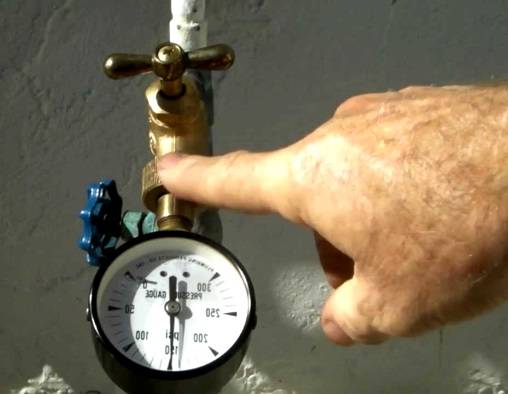
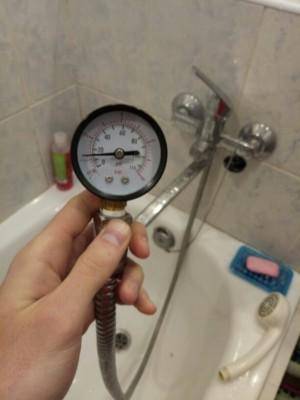 To find out what pressure is in the water supply pipes in the apartment and compare it with the normative one, it is necessary to measure. To accurately measure the pressure, a pressure gauge with a scale from "0" to 6.0 kgf / cm2 or Bar is required.Can be used with a large measurement range, but the measurement accuracy will be reduced.


The pressure gauge is mounted on an adapter for connecting to a hose. The hose is selected with a diameter close to the diameter of the gander of the mixer or tap. The hose is put on "in tension" on the adapter and on the gander of the crane. If a tight connection fails, clamps must be used. On sale there are pressure gauges that are easily attached to the shower hose, instead of a watering can.
The valve opens and the pressure in the pipes is measured.
If a household pumping station is used in the water supply system, then what pressure in the water supply system can be determined by the station's pressure gauge.
In the absence of a pressure gauge, it is possible to measure the time taken to draw 10 liters of water from a standard tap or mixer. At 1 kgf/cm2 the set time is about 1 minute, at 2 kgf/cm2 about 30 seconds.
What pressure in the water supply is the norm
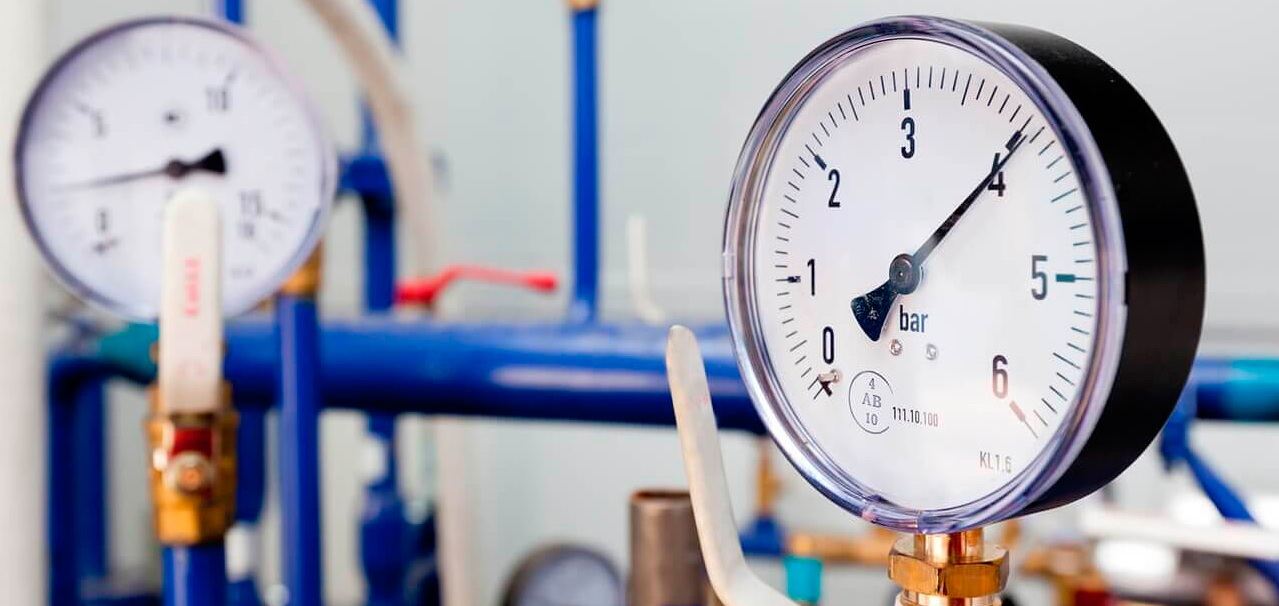
Water pressure in a water supply system is measured in bars, but sometimes this value is indicated in atmospheric units. For clarity, under the influence of a pressure of 1 bar, water can rise to a height of up to 10 meters. If we translate them into atmospheres, then 1 bar is equal to 1.0197 atmospheres.
In cities, the water pressure in the water supply system is 4 atmospheres. This is enough to provide multi-storey buildings. The range is set according to special documents and SNiPs. For cold water, these figures range from 0.3 to 6 bar, and for hot water - up to 4.5.
As for the owners of private houses, they need to calculate these indicators on their own. If an autonomous system is installed in the house, it increases the pressure to 10 bar. However, for the operation of household appliances and all water supply points, in a private house, 1.5-3 bar is enough. Such indicators pressure available to most pumping stations. This range must not be greatly exceeded. Otherwise, the connected devices will not work correctly, and quickly fail. The maximum allowable water pressure in the system of a private house is 6.5 bar.
A pressure of 10 bar can only withstand specialized equipment installed in artesian wells. Ordinary connecting nodes and lintels for cottages will not be able to withstand such loads, and will leak.
It is worth considering the established pressure indicators for certain devices. Without following these indicators, they will not work:
- washing machine - 2 bar;
- fire safety system - 1.5 bar;
- jacuzzi - 4 bar;
- watering lawns - 4-6 bar;
- faucet in the bath and shower - at least 0.3 bar.
According to most owners of their homes, a mark of 4 bar is the most optimal for providing all points of water consumption. At the same time, it is not critical for fittings and various connectors. Next, you will learn how to measure water pressure so that you can plan your next steps.
Pressure standards in the pipeline
Water pressure is measured in bar. The quantity has an alternative name - the atmospheric unit. Under a pressure of 1 bar, water can rise to a height of 10 m.
In urban networks, pressure is usually 4-4.5 bar, which is enough to service multi-storey buildings.
According to regulatory documents, in particular the instructions of the collection SNiP 2.0401-85, the allowable pressure for cold water varies from 0.3 to 6 bar, for hot - from 0.3 to 4.5. But it does not follow from this that a pressure of 0.3 atmospheres will be optimal. Only the allowable pressure limits are given here.
Image gallery
Photo from
Low pressure affects operation
Difficulties with getting water
Difficulty receiving procedures
Switching off the washing machine
Threat of instantaneous water heater burnout
Consequences of overpressure
Excessive pressure at water intake points
Electronic control failure
Residents of private houses are forced to calculate the pressure in the water supply individually. If the system is autonomous, the pressure may exceed the limits allowed by regulatory documents. It can fluctuate around 2.5-7.5 bar, and sometimes reach 10 bar.
The standard values for the normal operation of the system with a pumping station are considered to be an interval of 1.4 - 2.8 bar, corresponding to the factory setting of the pressure switch indicators.
If excessively high pressure is provided in the system, then some sensitive devices may fail or work incorrectly. Therefore, the pressure in the pipeline must not exceed 6.5 bar.
High pressure in the water supply system can cause the pipe to leak, so it is important to pre-calculate the optimal pressure level yourself
Gushing artesian wells are capable of delivering a pressure of 10 bar. Only welded joints can withstand such pressure, while most fittings and shut-off and control units are destroyed under its action, resulting in leaks in the areas.



It is necessary to determine what water pressure is necessary for the normal functioning of the water supply system of a country house, taking into account the household appliances used. Some types of plumbing fixtures do not work at low pressure.
For example, for a jacuzzi, a pressure of 4 bar is required, for a shower, a fire extinguishing system - 1.5 bar, for a washing machine - 2 bar.If you provide for the possibility of watering the lawn, then there should be a strong pressure of 4, sometimes - 6 bar.
Household plumbing fixtures connected to the water supply are able to work correctly only from a certain pressure, which is usually at least 1.5 bar
The optimal pressure indicator for a country house is 4 bar. This pressure is enough for the proper operation of all plumbing devices. At the same time, most fittings, shut-off and control valves are able to withstand it.
Not every system can provide a pressure of 4 bar. Typically, for country houses, the pressure in the water supply is 1-1.5 bar, which corresponds to gravity.