
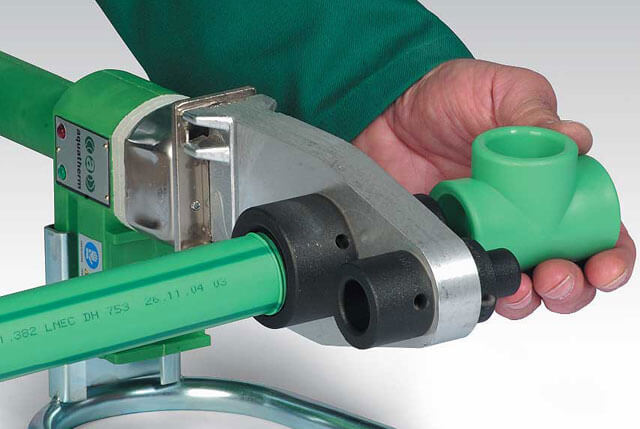
- How to use the welding machine
- The price of installing plastic pipes for plumbing
- Stages of work welding process
- Preparing the Welding Machine
- What is the welding process?
- How to prepare pipes
- What is welding of polypropylene pipes
- How to solder
- Installation of polypropylene pipes
- Pipe fixture
- Video lesson on soldering pipes
- Solder heating time
- Types and purpose
- Determination of the optimal diameter
- Polypropylene pipe connection technology
- With the use of welding
- "Cold" way
- Glue option
- Features of welding polypropylene pipes
- Types and characteristics of pipes
- Option #1: metal
- Option #2: Plastic
- Option # 3: metal-plastic
- Important installation details
How to use the welding machine
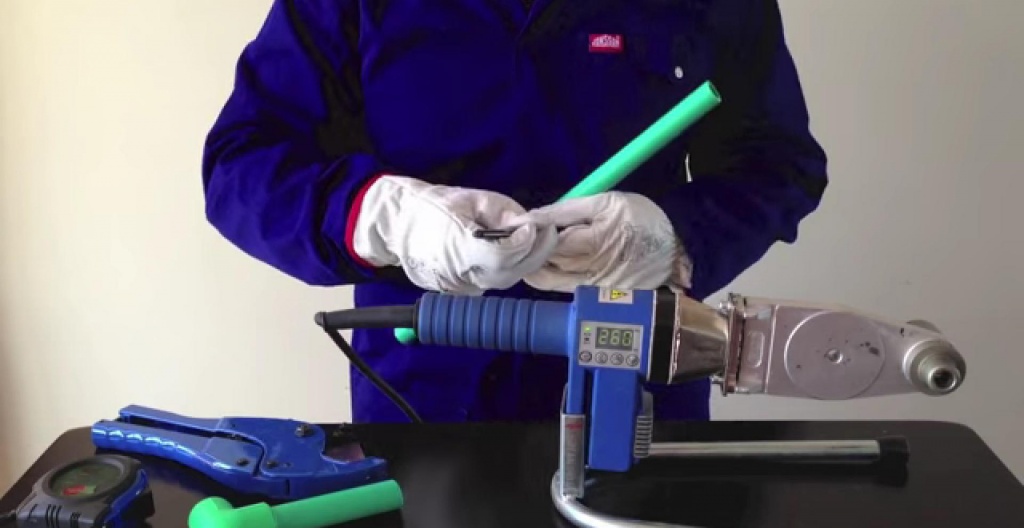
For proper installation, a flat surface and fixing is required. Before heating the apparatus, it is necessary to equip it with everything necessary, including nozzles of the proper size. The nozzle will warm up evenly, it does not depend on the position on the heater, so the craftsmen position it so that it is most convenient to use. If you mount the pipes on the wall, then it is recommended to assemble the entire structure separately, only then fix it.
Such work should not be done alone, the quality depends on the little things, so you need to have a partner who will support the whole thing and help. Different pipes require different temperatures, this should not be neglected. Polypropylene pipes for comfortable welding require a temperature of 260 ° C. Work with polyethylene should take place at a temperature of 220 ° C. Naturally, the heating time will vary depending on many factors, such as the ambient temperature. If the temperature in the room or outside is below 0°C, then welding cannot be carried out.
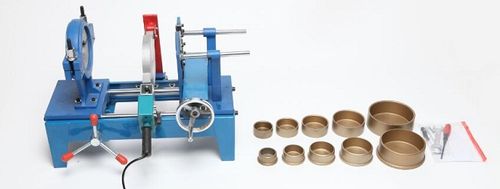
This is due to the physical reactions of these materials. If the temperature, on the contrary, is high, say 40 degrees, then the welding process will last a little less. The reverse process occurs at low temperature
There is one important rule for craftsmen, the diameter of an unheated fitting should be slightly smaller than the diameter of the pipe. As soon as the welding machine has heated up to the required temperature, maintain it for another 2-3 minutes, only then proceed with the first welding
Do not forget to clean the nozzle after each use, it should not have a lot of stuck plastic on it.
The price of installing plastic pipes for plumbing
In the photo, the installation of plastic pipes for water supply
When determining the cost of assembling the highway, all the work associated with its arrangement is taken into account. The price of installing plastic pipes for water supply is influenced by such factors:
- The type of distribution of water pipes is manifold or tee. Installation of collector wiring will cost more, because. to create it, you will need more pipes than in a tee. Accordingly, there will also be more joints.
- Installation method - open or closed.In the first case, the pipes are fixed over the walls with clamps. With the closed method, they fit into strobes (grooves in the walls), which must be completed in advance. Therefore, the closed method of installing plastic pipes is more expensive than the open one.
- To pass pipes through walls, holes of the appropriate diameter must be made. The more holes to be made and the stronger the material of the wall, the more you will have to pay.
- A large number of turns, which are performed with the help of corners, increases the installation time and increases the price.
- The cost of work is influenced by the ability of one person to assemble part of the track separately, in a convenient place. The services of an assistant will also have to be paid.
- Installation of plastic pipes for water supply with external reinforcement is more expensive due to the need to remove the braid with a special tool.
- The cost of installing plastic pipes per 1 meter is influenced by the quality of the products. If pipes and fittings have deviations in quality (holes are elliptical, diameters do not match each other, etc.), the master will have to spend a lot of time to make the joint turn out to be of high quality. You will also have to pay for this.
- The cost of installing a hot water supply system is more expensive due to the presence of more joints than in a cold main - it contains thermal expansion joints.
- Connecting polyethylene pipes is more difficult than products made from other materials due to thin walls and poor adhesion. Therefore, the master will have to work very carefully and slowly, which reduces his productivity and increases the price of the work.
The price of installation of plastic pipes for water supply in Ukraine (Kyiv):
| Service | Working conditions | Units | Price, UAH. |
| Line installation | Depending on the length and diameter of the pipe | m.p. | 10-50 |
| Pipe connection to plumbing fixtures | Depending on the type of equipment | dot | from 160 |
| Installation of a joint for a fitting | Depending on the diameter | dot | from 10 |
| Pipe fastening | — | dot | from 12 |
| Ball valve installation | Depending on the diameter | dot | from 30 |
| Chasing to hide pipes in the wall | depending on wall material | m.p. | 70-150 |
The price of installation of plastic pipes for water supply in Russia (Moscow):
| Service | Working conditions | Units | price, rub. |
| Line installation | Depending on the length and diameter of the pipe | m.p. | 150-1420 |
| Pipe connection to plumbing fixtures | Depending on the type of equipment | dot | from 300 |
| Installation of a joint for a fitting | Depending on the diameter | dot | from 680 |
| Pipe fastening | — | dot | from 80 |
| Ball valve installation | Depending on the diameter | dot | from 150 |
| Chasing to hide pipes in the wall | depending on wall material | m.p. | 350-800 |
How to make plumbing from plastic pipes - look at the video:
From the examples given in the article, it can be seen that it is not difficult to make a water pipe from plastic pipes with your own hands. The result will depend on how responsibly you reacted to solving the problem. Some of the risk in assembling pipelines is offset by the ability to stretch the route the way you want, not the workers, and save money.
Find out what is the price of plastic pipes for water supply in Ukraine and Russia
Stages of work welding process
Having measured the required length of the pipe, make a mark on it with a marker. With a pipe cutter or scissors, cut the product at an angle of 90º to the axis. The tool must be sharp enough so that the pipe does not deform.
The pipe is cut at an angle of 90º to the axis
The edge of the reinforced product must be cleaned, getting rid of the top layer and foil. Without this stage, the aluminum foil, which is part of the pipes, will come into contact with the liquid during operation. As a result, corrosion of the reinforced layer will lead to a violation of the integrity of the seam. Such a connection will leak over time.
The edge of reinforced pipes is cleaned
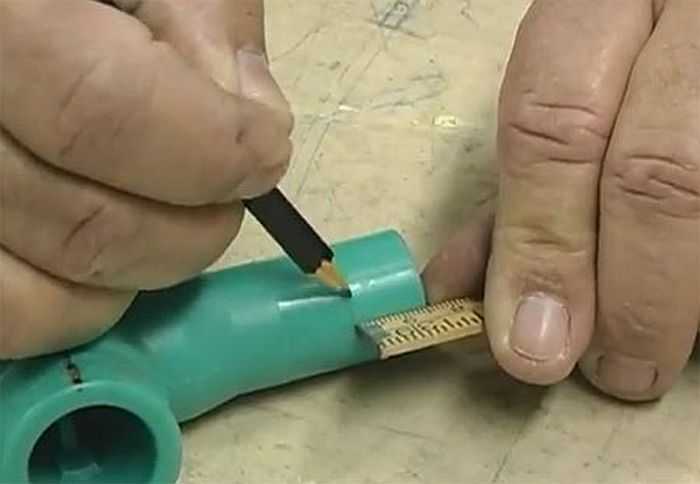
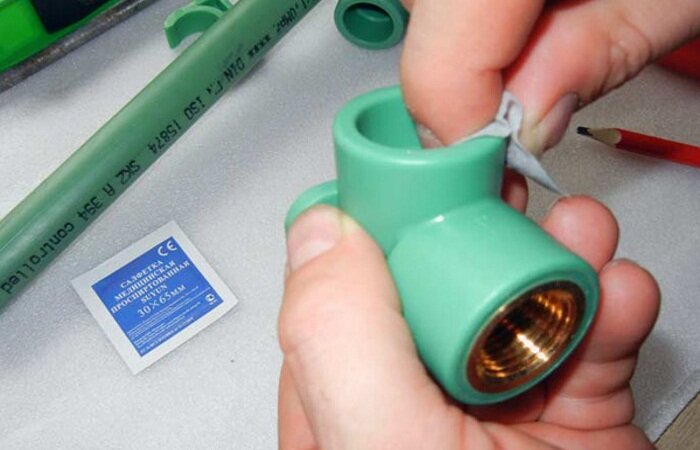
For non-reinforced products at the end of the pipe, the depth of welding is indicated, focusing on the length of the fitting sleeve. Another important point in preparing pipes for welding is degreasing the surface. Treatment of the junction with alcohol will provide more reliable contact of the parts.
Preparing the Welding Machine
Before welding plastic pipes, it is necessary to prepare the welding machine. The handheld device is fixed on a flat surface. The details of the apparatus must be clean and without defects. Clean them with a cloth soaked in alcohol. The heating elements are put on when the tool is off. A mandrel is used to fuse a fitting, a sleeve is used to fuse a pipe.
The heating time of parts for welding is determined according to the table
Then the device is connected to the network. At the same time, the indicators located on the unit body should light up. One of them signals that the device is connected to the network. The second, after reaching the required heating temperature, should go out. After the indicator goes out, it is desirable that five minutes pass and only then begin the welding process. This time depends on the ambient temperature and lasts from 10 minutes to half an hour.
What is the welding process?
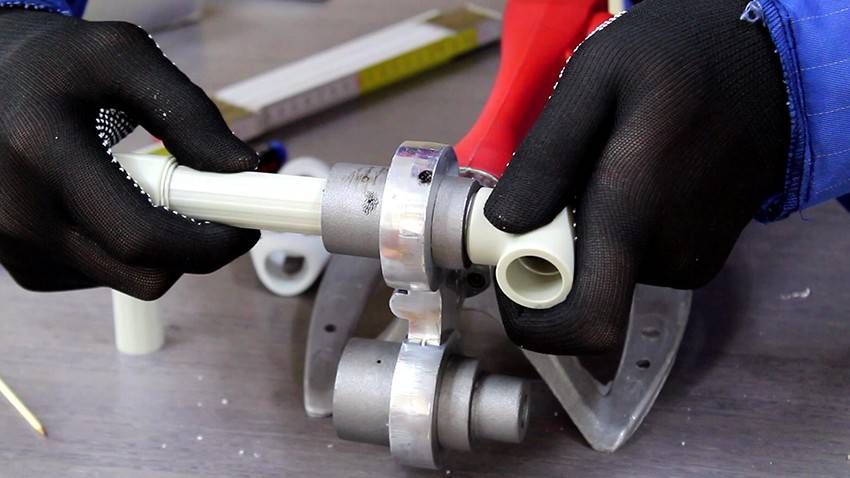
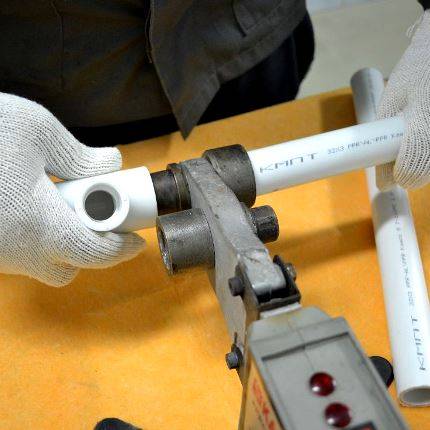
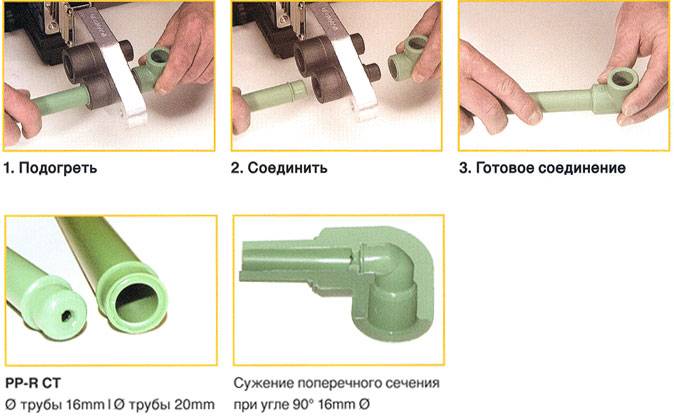
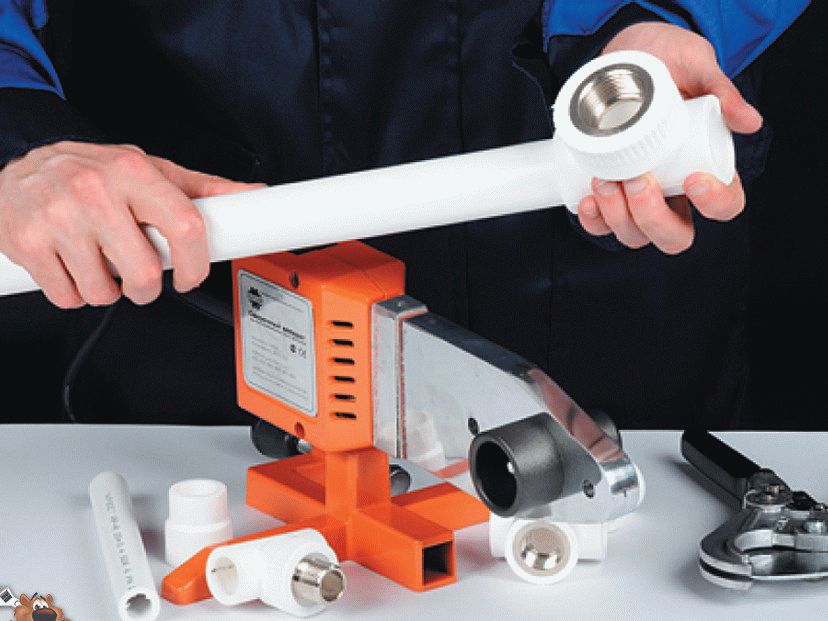
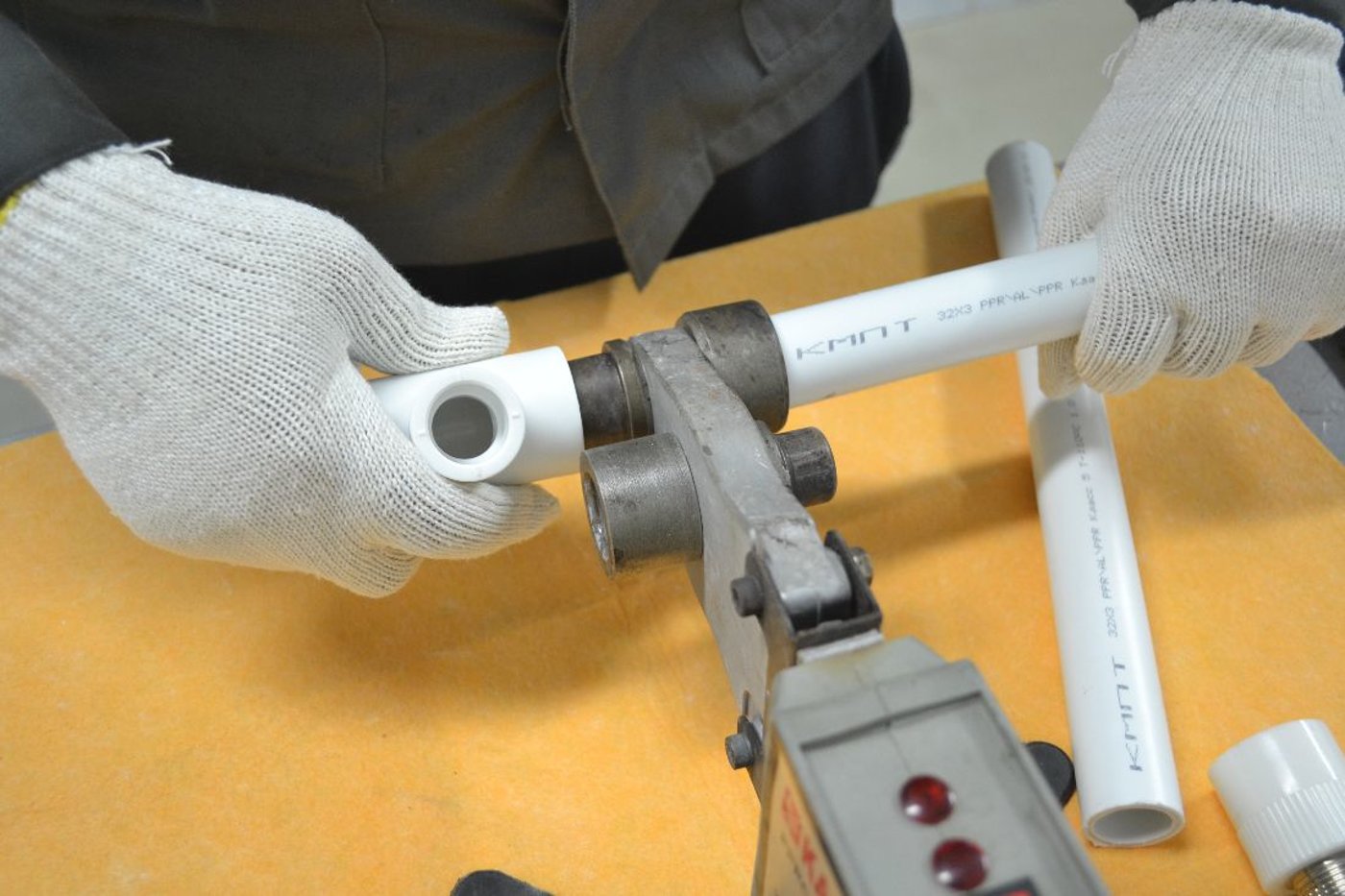
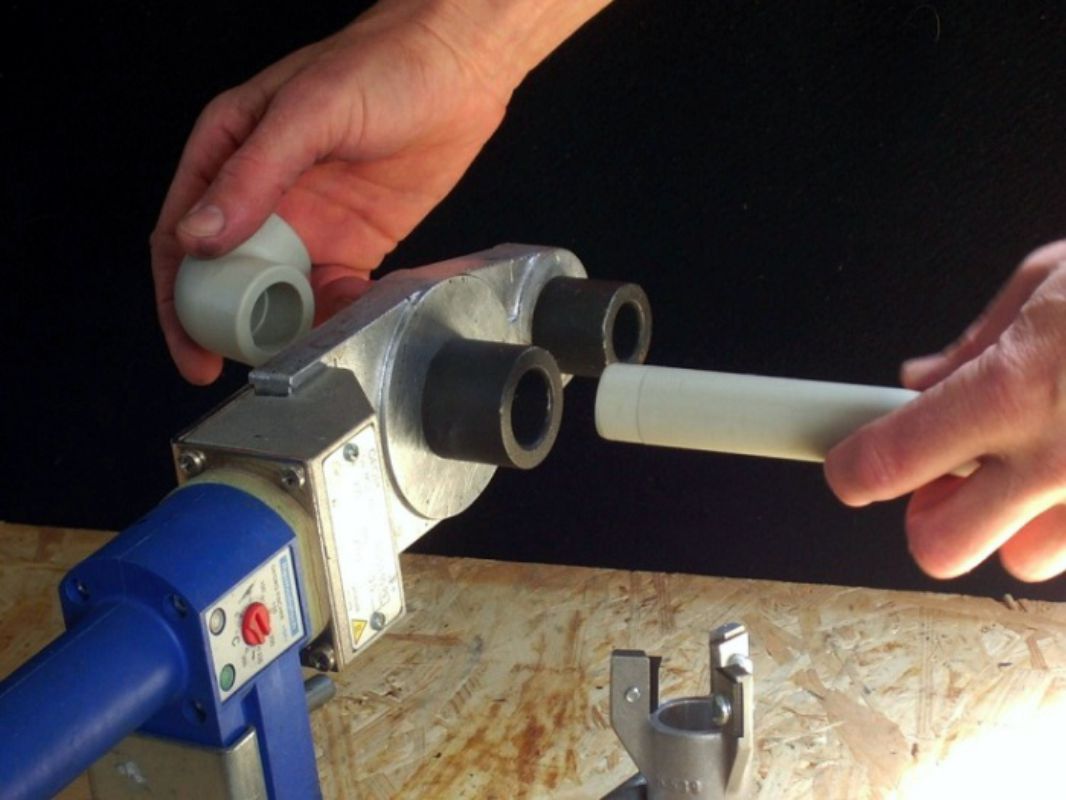
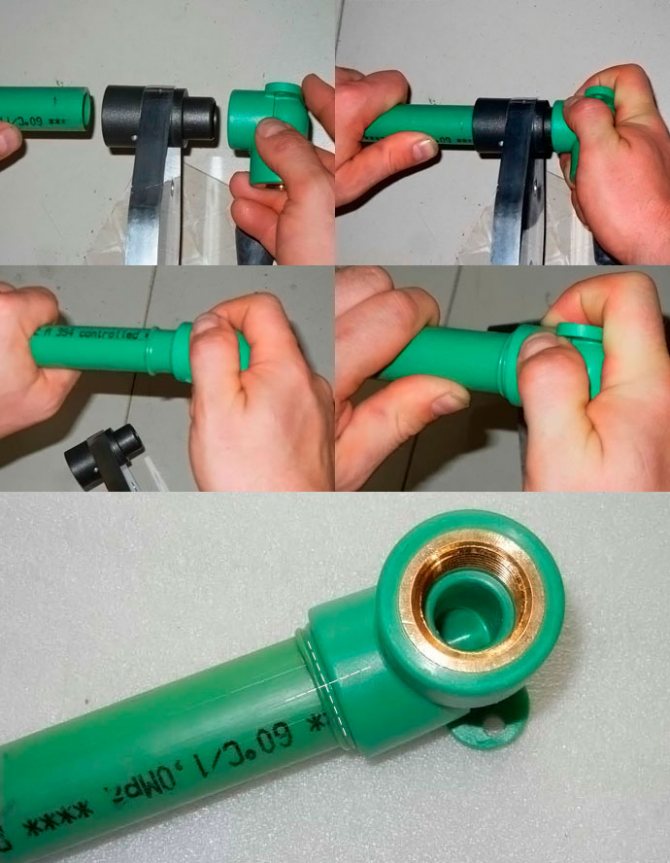
After heating the apparatus, put the fitting on the mandrel, and insert the pipe into the sleeve. This is done at the same time and with little effort.
After heating the device, put the fitting on the mandrel, and insert the pipe into the sleeve
In order to know how to properly weld polypropylene pipes, it is necessary to take into account the heating time. The correct period will allow the parts to warm up to the required temperature and not melt. It depends on the diameter of the pipe.
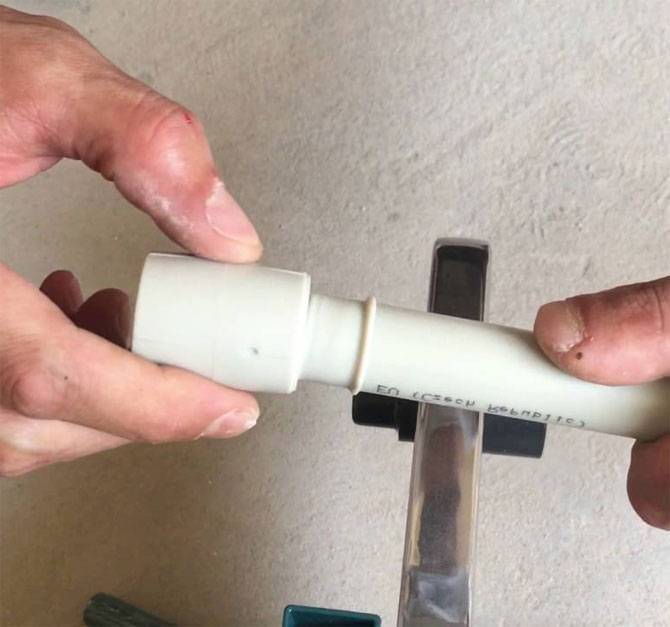
After the required period of time, the parts are removed from the apparatus and connected. In this case, the pipe must enter the fitting strictly up to the mark. During this process, it is forbidden to rotate the parts along the axis.
In the process of connecting parts, it is prohibited to rotate products along the axis
After joining the parts, mechanical impact on the seam is not allowed until it has completely cooled down. Subject to technology, the result should be a strong and tight seam.
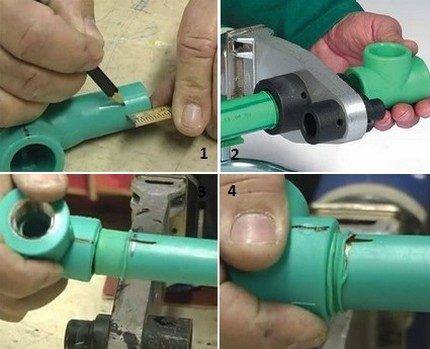



The article gives the necessary recommendations on how to properly weld pipes, with a detailed description of each stage. By putting these tips into practice, you can independently conduct a pipeline for water supply or heating. The main thing is to choose the right pipes and follow the process technology. Only then the polypropylene pipeline will serve for a long time and uninterruptedly.
Cast iron has not been used in modern water supply and heating systems for a long time. It was replaced by light, easy-to-install and non-corrosive plastic. Today we will talk about welding of polypropylene pipes do-it-yourself for beginners - the main stages of this process and its intricacies.
How to prepare pipes
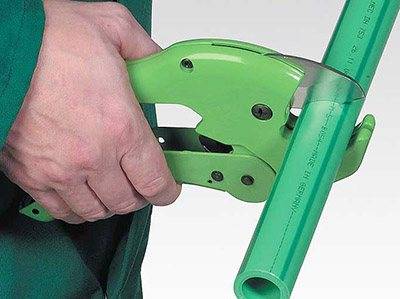
We cut the pipe at 90 degrees
Having measured the desired section of the pipe, a mark is made with a marker.Then, with a pipe cutter or scissors, which should be placed strictly perpendicular to the cut pipe, the desired part of the product is cut off.
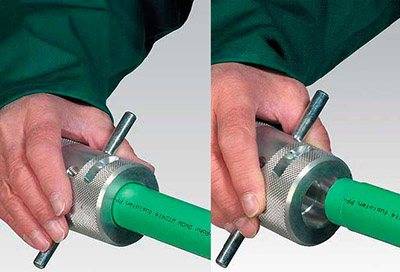
We clean the edges of the pipe
Since there is an aluminum layer in the reinforced pipe, it is necessary to get rid of it. The fact is that over time, aluminum foil will begin to break down from contact with water. To do this, use a stripper to remove the top and foil layers.
For elements without a reinforcing aluminum layer, the depth of welding at the end of the pipe is noted, depending on the length of the couplings.
Then you should degrease the welding points with alcohol-containing liquids. This will make the connection more reliable and durable.
In this case, you should carefully examine the surface of the welded pipes. Any, the smallest particle that gets into the seam, can spoil not only this joint, but the entire system.
What is welding of polypropylene pipes
Polypropylene is characterized by increased rigidity, and fittings from the same material are used to create systems of the required configuration. These are various angles, tees, bypasses, adapters, couplings, etc. They are connected to pipes by soldering. This process is also called welding, but its essence does not change: two elements are heated to a melting point and, in a hot state, are connected to each other. When done correctly, the connection turns out to be monolithic and serves no less than the pipes themselves.
Fittings for polypropylene pipes allow you to create a system of any configuration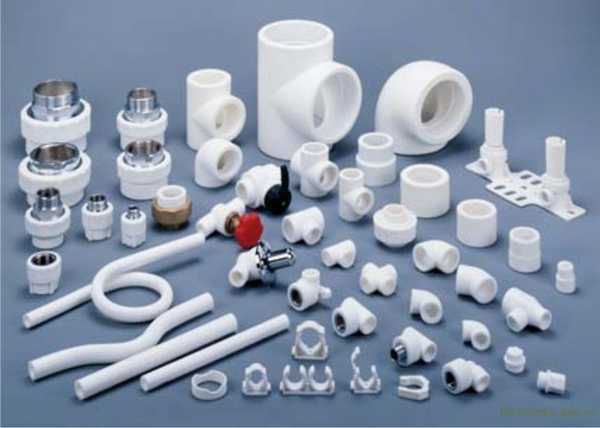
To connect polypropylene with metals, there are combined fittings in which one part is made of metal and is connected using a threaded connection, and the second - polypropylene - is welded.
How to solder
Polypropylene pipes are welded using a special device called a soldering iron or welding machine. This is a small metal platform, inside of which there is an electric spiral that heats up the surface. Because of this design, this unit is also called an iron.
Two designs of PP pipe welding machine
To connect two elements, the spliced surfaces are heated to a melting point (+260°). To heat the element to the desired depth, two different Teflon-coated metal nozzles are installed on the welding platform:
- a mandrel (smaller diameter) is used to heat the inner surface;
- a sleeve is placed to heat the outer surface.
Nozzles for soldering polypropylene pipes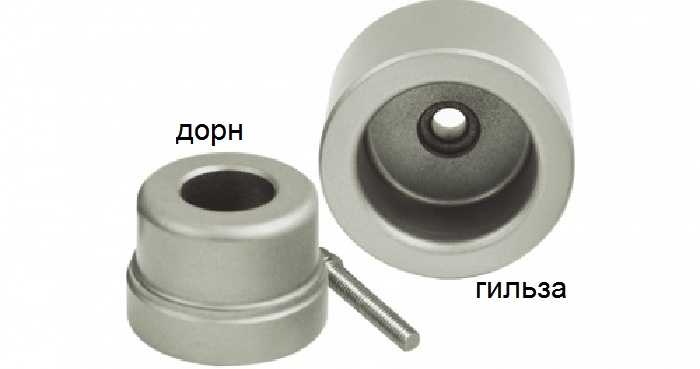
Two connected elements are simultaneously put on the corresponding nozzles, held for a certain period of time (several seconds), then connected. This is how polypropylene pipes are welded.
Installation of polypropylene pipes
Important! Due to the fact that the strength of polypropylene pipes is not as great as, for example, steel pipes, then the fasteners during installation should be installed more often, somewhere every fifty centimeters. So, let's look at the main components of such a heating system.
So, let's look at the main components of such a heating system.
- Fasteners necessary to ensure that the entire structure remains stationary.
- AGV, or maybe any other heating boiler.
- Expansion tank, necessary so that the water, which expands at high temperatures, cannot damage the entire system.
- Radiators, other heat-releasing elements.
- And, in fact, a pipeline that allows the coolant to circulate between the radiators and the heating device.
Pipe fixture
For such soldering, special soldering irons are used. They heat up the material to two hundred and sixty degrees, after which it becomes a homogeneous monolithic compound. This is explained by the fact that the atoms in it, as it were, penetrate from one piece of pipe to another. Moreover, such a connection is characterized by strength and tightness.
Video lesson on soldering pipes
Soldering consists of several stages, consider them:
- The soldering iron turns on. We wait until the signal indicator on it goes out a second time.
-
We cut a piece of pipe according to the dimensions we need, for this we use specialized scissors, which are sold with a soldering iron.
- We clean the cut ends of the pipes from everything superfluous, in particular, from the foil. To do this, you can use a regular knife, or you can use a channel.
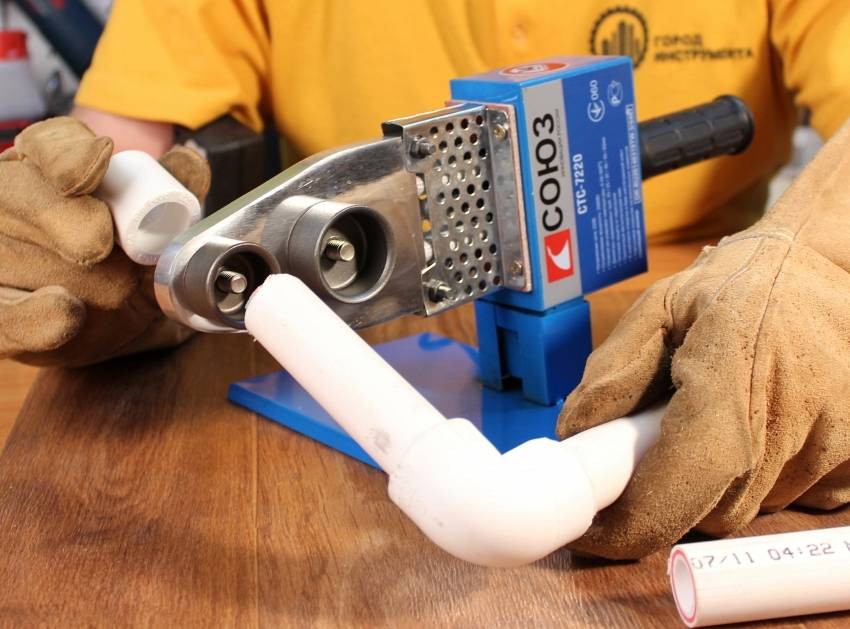
- The pipe is inserted into the fitting and held there for some time.
Important! The time that the pipe must spend in the fitting depends entirely on its diameter, a special table must be included with the soldering iron, which indicates all these values. The parts are neatly joined, there should not be any distortions.
We hold them like this for some time, it is forbidden to turn the channel.
The parts are neatly joined, there should not be any distortions. We hold them like this for some time, it is forbidden to turn the channel.



![[instruction] do-it-yourself soldering of polypropylene pipes: a description of the types of materials used, components and tools | video](https://fix.housecope.com/wp-content/uploads/5/e/f/5ef5cec6af3e4fa77befb7dbc78e6b51.jpg)


Particular attention should be paid to swivel fittings, especially for polypropylene pipes.Be sure to check if they are set correctly, because if the turn is directed in the wrong direction, the entire assembly will have to be completely redone, and the attached part will completely become unusable
The pipes are interconnected by means of "American women" - special devices that are quickly put on and taken off. They are attached to the ends of the pipes. So that during thermal expansion deformation does not occur (after all, pipe reinforcement does not completely save from this, it only reduces it), all pipes should be securely fastened to the surface of the walls and ceiling, while the step, as already mentioned, should be no more than fifty centimeters.
For fixing radiators, special devices are also used, they must be present in the kit. It is not advisable to use hand-made appliances for radiators. The fact is that factory fasteners were specially calculated for the weight of radiators completely filled with coolant, so home-made fasteners may simply not withstand it.
Solder heating time
In order for pipe soldering to be as efficient as possible, it is strongly recommended to adhere to the specified warm-up time. You can find out about it from the table below.
| Diameter cm | 11 | 9 | 7.5 | 6.3 | 5 | 4 | 3.2 | 2.5 | 2 |
| Warm-up time, sec | 50 | 40 | 30 | 24 | 18 | 12 | 8 | 7 | 7 |
| Time to connect, sec | 12 | 11 | 10 | 8 | 6 | 6 | 6 | 4 | 4 |
| Cooling, min | 8 | 8 | 8 | 6 | 5 | 4 | 4 | 3 | 2 |
| What should be the seam, cm | 4.2 | 3.8 | 3.2 | 2.9 | 2.6 | 2.2 | 2 | 1.8 | 1.6 |
It is important to know that if the part is heated to a higher temperature than the soldering technology requires, then it will simply deform. And if the heating is insufficient, then the full fusion of the material will not occur, which in the future will cause leaks
We talked about fastening to the walls, the step there is 50 centimeters.In the case of ceiling mounting, this distance should be the same, but not greater.





It is desirable to use movable clamps, and any suspended compensating devices are not needed. It should also be fastened firmly, reliably, because the thermal expansion of the pipe can deform it.
In general, we figured out how to make a heating installation from polypropylene pipes. We hope the article will be useful to you.
Types and purpose
Polypropylene pipes There are four colors - green, grey, white and black. Only black ones differ in characteristics - they have increased resistance to ultraviolet radiation and are used when laying an irrigation system on the ground. All the rest have similar characteristics and are laid indoors or buried in the ground.
By appointment, polypropylene pipes are of the following types:
- For cold water (temperature up to +45°C). It is easy to distinguish them by the longitudinal blue stripe.
- For hot water supply (heating up to +85°C). A distinctive feature is a red stripe.
-
Universal (maximum heating up to +65-75°C depending on the manufacturer). Two stripes are applied side by side - blue and red.
For both cold and hot water, there are pipes with different characteristics. This is displayed in the label:
- PN10 are used exclusively in cold water supply systems (up to +45°C) with low pressure (up to 1 MPa). They have a small wall thickness. Not suitable for high rise buildings.
- PN16. They are often labeled as universal, but more often used for cold water - they withstand heating of the medium up to + 65 ° C and pressure up to 1.6 MPa.
- PN20. Thick-walled pipes, which can transport medium with temperatures up to +80°C, withstand pressures up to 2 MPa.Used in the distribution of hot water and heating systems.
- PN25. These are reinforced polypropylene pipes (foil or fiberglass). Due to the presence of a reinforcing layer, they often have a smaller wall thickness than PN20. Medium heating temperature - up to +95°C, pressure - up to 2.5 MPa. They are used for hot water supply and heating.
All of them are produced in different diameters - up to 600 mm, but in apartments and private houses they are used mainly in sizes from 16 mm to 110 mm.
Please note that the inner diameter is indicated, as the wall thickness may vary.
Determination of the optimal diameter
The installation of the line is always preceded by a preliminary calculation of polypropylene pipes. It is carried out in order to determine the number and optimal diameter of products for a particular pipeline system, based on its purpose.
Properly selected diameter ensures minimum losses and necessary pressure in the system even during the hours of maximum (peak) water consumption. Calculation is especially important when designing a water supply system for an apartment building with a large number of plumbing fixtures.
You can calculate the internal diameter of the pipe yourself using the formula:
- where Qtot is the maximum (total) water consumption,
- V is the speed at which water is transported through the pipes.
For thick pipes, the velocity value is taken equal to 2 m / s, and for thinner pipes - 0.8 - 1.2 m / s.
But, owners of apartments and small country houses should not waste time on complex calculations. Considering that the overall permeability of the pipeline system depends on the throughput of the narrowest point, it is sufficient to purchase pipes with a diameter of 20.0 mm, provided that the length of the water supply system does not exceed 10 meters.With a standard number of sanitary appliances (sinks, toilet bowls, washbasins), the throughput of pipes of this diameter will be sufficient.
With a total length of the pipeline up to 30 meters, it is necessary to use 25 mm products in diameter, and with a length of more than 30 meters - 32 mm.
Polypropylene pipe connection technology
Docking and connection of polypropylene pipes can be performed by exposing their ends to high temperature, by installing connecting fittings, or by gluing.
The device for welding polymer products can be rented at the construction center
With the use of welding
Connect polypropylene pipes with your own hands is impossible without the so-called "iron" - a welding machine powered by the mains.
Without the necessary skills in working with the device, it is worth practicing before performing basic manipulations. Trial docking will make it possible to determine the pressure force and “catch” the optimal holding period. Therefore, materials should be purchased with a small margin.
- In places of future docking, cuts are made on the pipes, the ends are carefully cleaned. At the ends, with a marker, marks are made indicating the depth of immersion of the ends into the heating device. The soldering iron itself is heated to 270 ° C.
- The ends of the pipes and the connection elements are put on the nozzles of a hot soldering iron strictly perpendicularly.
- After holding for 10-15 seconds for the melt, the heated elements are removed from the nozzles and connected to each other, slightly pressing down, but not turning.
- The docked parts are left for several minutes in a fixed position until completely cooled.
If everything is done correctly, then a monolithic joint is formed at the place of soldering without depressions and "sagging".
The installation process is clearly shown in the video:
When welding pipes with a diameter exceeding 40 mm, socket soldering is used. But it is better to entrust this work to a specialist who knows the intricacies of the process and has professional equipment.
Tip: To create strong knots, the elements are heated from the inside, and the pipes are heated from the outside. When joining heated parts along the inner surface of the pipes, a small tubercle may form, reducing the permeability of the pipe. This can be prevented by blowing the structure.
"Cold" way
This method involves the use of compression fittings. To connect polypropylene pipes with fittings, in addition to the main elements, only a crimping key is needed.
Tightness is achieved due to the rubber seal, which is clamped with this key.
- After making cuts at the ends, check the perpendicularity of the edge. With the help of a fine-grained skin or a wire washcloth, the ends are cleaned of burrs.
- A coupling nut is put on the end of the pipe, directing it with a thread towards the fitting. After it, a compression ring is put on, placing it with a long bevel to the fitting.
- A fitting is strung on the prepared end, inserting it all the way against the inner surface of the socket.
- Tighten the coupling nut, check the system for leaks.
If a leak is detected during a test run of water, all joints are sealed, and the connection is tightened.
Glue option
Unlike the welding method, which involves hot exposure, gluing polypropylene pipes is carried out in a cold mode.The method is based on the dissolution of the outer surface of plastic elements under the action of chemical compounds.
Glue is applied only to pre-cleaned and degreased ends
The key to the strength of the joints is the correct choice of composition. In the manufacture of adhesive compositions, manufacturers add substances to them that act as a component of polymer pipes. Therefore, when choosing an adhesive, it is worth giving preference to compositions designed to work with polypropylene products.
![[instruction] soldering polypropylene pipes | video](https://fix.housecope.com/wp-content/uploads/9/c/a/9cac7367bc73d17c055fc8c928af0f6f.jpeg)



The composition is applied in a thin layer, after which the parts are docked and fixed in a stationary position for 10 seconds.
The tightness of the joints of the glued elements is checked after 15-20 minutes, and the strength test of the pipeline is after a day.
- Volgorechensk Pipe Plant (Gazpromtrubinvest)
- Izhora Pipe Plant (ITZ)
- Royal Pipe Works (KTZ)
- Chelyabinsk Pipe Insulation Plant (ChZIT)
- Kstovo Pipe Plant
Add company
- We carry out calculations for the pipe deflection independently
- Features of insertion into gas pipes
- Dealing with condensate from chimneys
- Ways to fix leaking pipes under pressure
- How to make a fungus on a chimney pipe with your own hands
TrubSovet .ru We know everything about pipes
2015–2017 All rights reserved
When copying materials from the site, be sure to place a back link to
Features of welding polypropylene pipes
Installation can be carried out in several ways: by butt, socket, and socket welding. The first connection option is the most common, because.does not require the use of additional parts and is the most economical, unlike the next two, when couplings and fittings are needed. Polypropylene pipes are connected by means of a special apparatus, which, according to the principle of operation, resembles a soldering iron or an iron. The surfaces are heated, and the machined ends of the parts are connected under pressure; the result is a seam that is not inferior in strength to the pipe itself. The welding equipment offered by manufacturers today is classified into two types:
Table of welding times for polypropylene pipes.
- Mechanical welding device for polypropylene pipes: produced in the form of a metal frame, combined with a hydraulic unit and a block of control devices. It is used for welding large diameter pipes when serious force is required to align the joints.
- Manual welding machine: has small dimensions, well suited for welding work on elements up to 125 mm in diameter, well suited for domestic use.
Since the mechanical device belongs to professional equipment and is used when welding long lines, it makes sense to consider the criteria for choosing a manual device for connecting polypropylene pipes, which is successfully used in the installation of small diameter pipes used in the construction of water supply, sewerage, heating systems in residential buildings.
Types and characteristics of pipes
For the correct connection of pipes made of various types of materials, you should know the main types and properties of such products.
Option #1: metal
Such elements, which differ in hardness and mechanical density, are able to withstand considerable loads.A common disadvantage of metal products is the high cost.
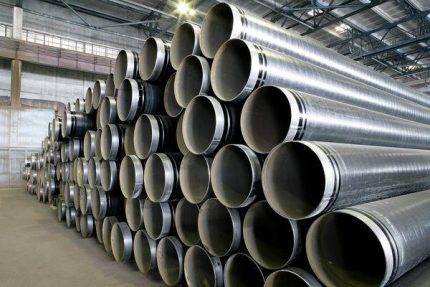
Metal pipes made of copper, steel, cast iron have high rates of rigidity and strength, but are not always able to resist corrosion, and are also prone to clogging
Among the most common options are the following types of pipes.
Cast iron pipes. The most popular material, which is characterized by good durability, durability, as well as a relatively budget price.
The negative factor of cast iron pipes is fragility, due to which these products require careful handling during storage and transportation.
Before starting work, it is important to inspect the cast-iron elements for chips, cracks and other defects.
Steel pipes. Under this name, various product options are connected:
- Pipes made of ordinary steel are quite easily covered with rust, and also have a tendency to overgrow the internal space, which leads to blockages.
- Galvanized steel is not prone to corrosion, but is quite difficult to install.
- Stainless steel has the highest consumer properties (resistance to aggressive substances, strength), however, products made from this type of metal are expensive and require labor-intensive processing.
It should be noted that steel elements are more expensive than cast iron.
Copper pipes. A rather rare option, since copper pipes are expensive. However, such high-quality elements are sometimes used for communications (elevator assembly) in the construction of private houses.
Option #2: Plastic
For laying communication systems, pipes are used, in the manufacture of which various types of polymers are used.All plastic products are characterized by such important advantages as inertness to chemical environments (even aggressive), corrosion resistance, resistance to clogging, and affordable cost.
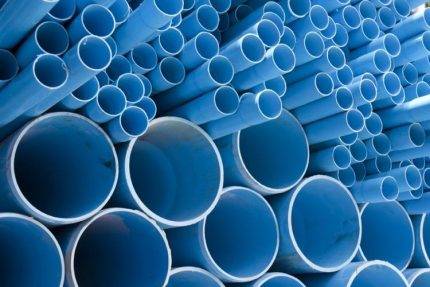
Polymer pipes are widely used in modern construction work due to their low cost and excellent resistance to aggressive substances.
At the same time, a number of characteristics of plastic pipes directly depend on the characteristics of the material from which they are made.
The most commonly used:
- Polyethylene: products made from this polymer have good elasticity and sufficient density. However, they are not able to withstand high temperatures (PET softens already at 80 degrees Celsius), which is why it is undesirable to use them for transporting hot liquids and gases.
- Polypropylene: pipes made of this plastic are the most widely used, as this material ideally combines low weight with strength and durability. Polypropylene elements withstand high temperatures well, which allows them to be used in hot water supply systems even without reinforcement.
- Polyvinyl chloride (PVC). The least common option, since products made from this plastic are quite fragile. Such pipes should be laid only in places where loads will not fall on them, most often they are used to create sewer systems.
In everyday life, all of the listed types of pipes are used.
Option # 3: metal-plastic
The composite material, which has recently received great recognition, consists of five layers, including two plastic shells (inner and outer), two layers of adhesive and aluminum foil.
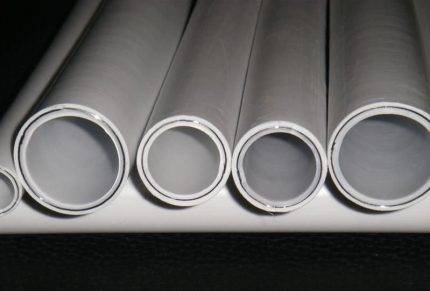
Metal-plastic pipes have a combined design, which includes, in addition to two polymer layers, a glued layer of aluminum foil. Such products are of high quality, combining aesthetics with durability and low weight.
Such products are distinguished not only by their high consumer qualities (durability, reliability, lightness), but also by their beautiful appearance, which allows them to be used without additional finishing. Metal-plastic pipes can be used for laying various communications: water pipes, sewerage, heating and drainage systems.
Important installation details
The connection of PP pipes is carried out using threaded / non-threaded fittings. In turn, threaded products can be:
- one-piece;
- detachable.
It is worth noting that the installation is primarily affected by operating conditions.
- All polypropylene parts must be protected from fire.
-
In the case of a tie-in water meter or storage tank, it is advisable to take detachable threaded elements. However, a one-piece connection is only acceptable for flexible hoses.
- The use of deformed or dirty connectors is strictly prohibited! As well as self-cutting threads.
- Couplings are used when connecting flat sections or transitioning a pipeline to a different diameter.
- For turns, special squares are used; bending of pipes is unacceptable.
- Tees are used for branching lines.
After reviewing all the necessary information, you can get to work.



