- Features of decorative radiators
- What is the service life, operation of cast iron radiators
- Types of radiators
- Cast iron
- Aluminum
- Steel
- Bimetallic
- Tips
- Technical characteristics of cast iron radiators
- Features of the choice of cast iron radiators
- Modern market
- Bimetallic heating radiators: video
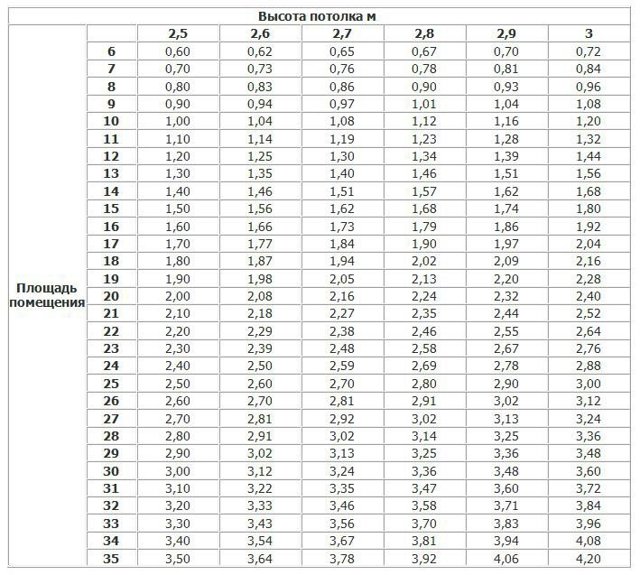
- Calculation of the power of radiators for the whole room
- Technical parameters of batteries
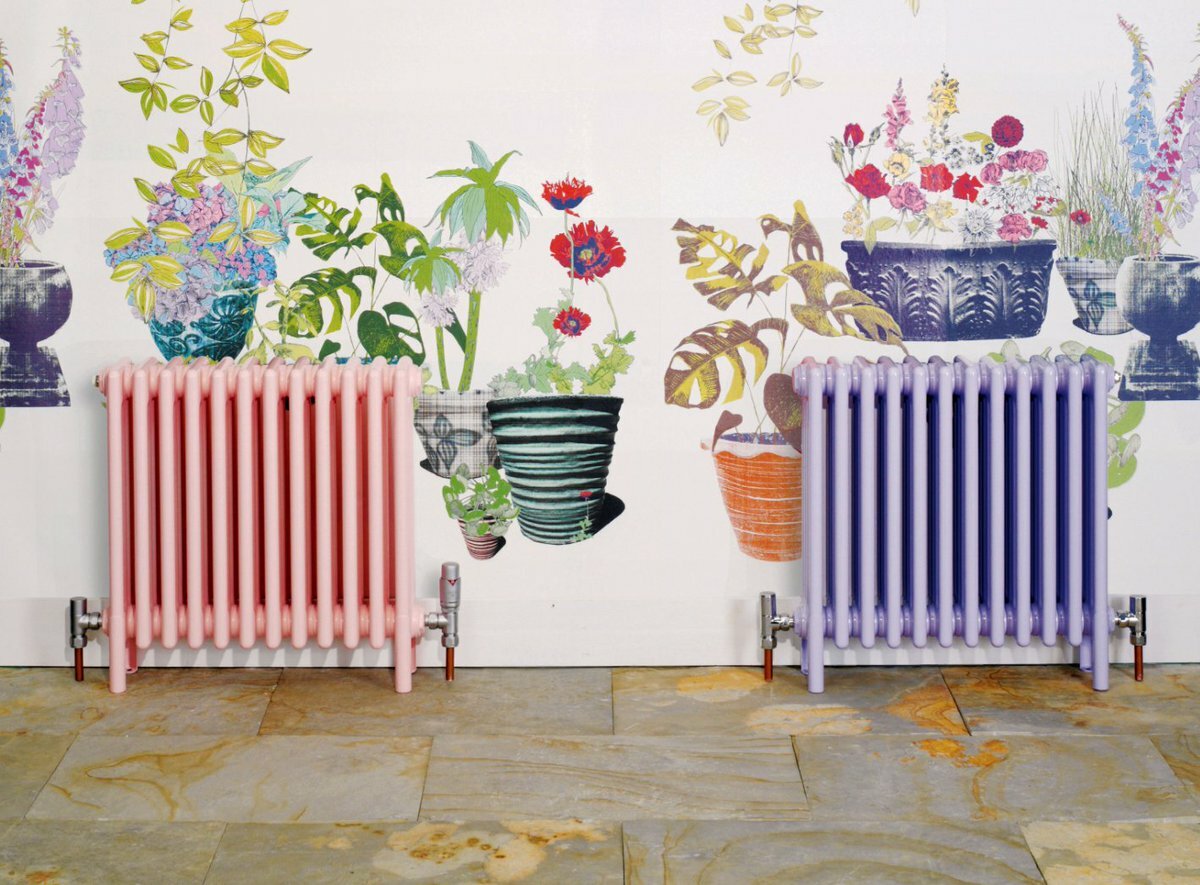
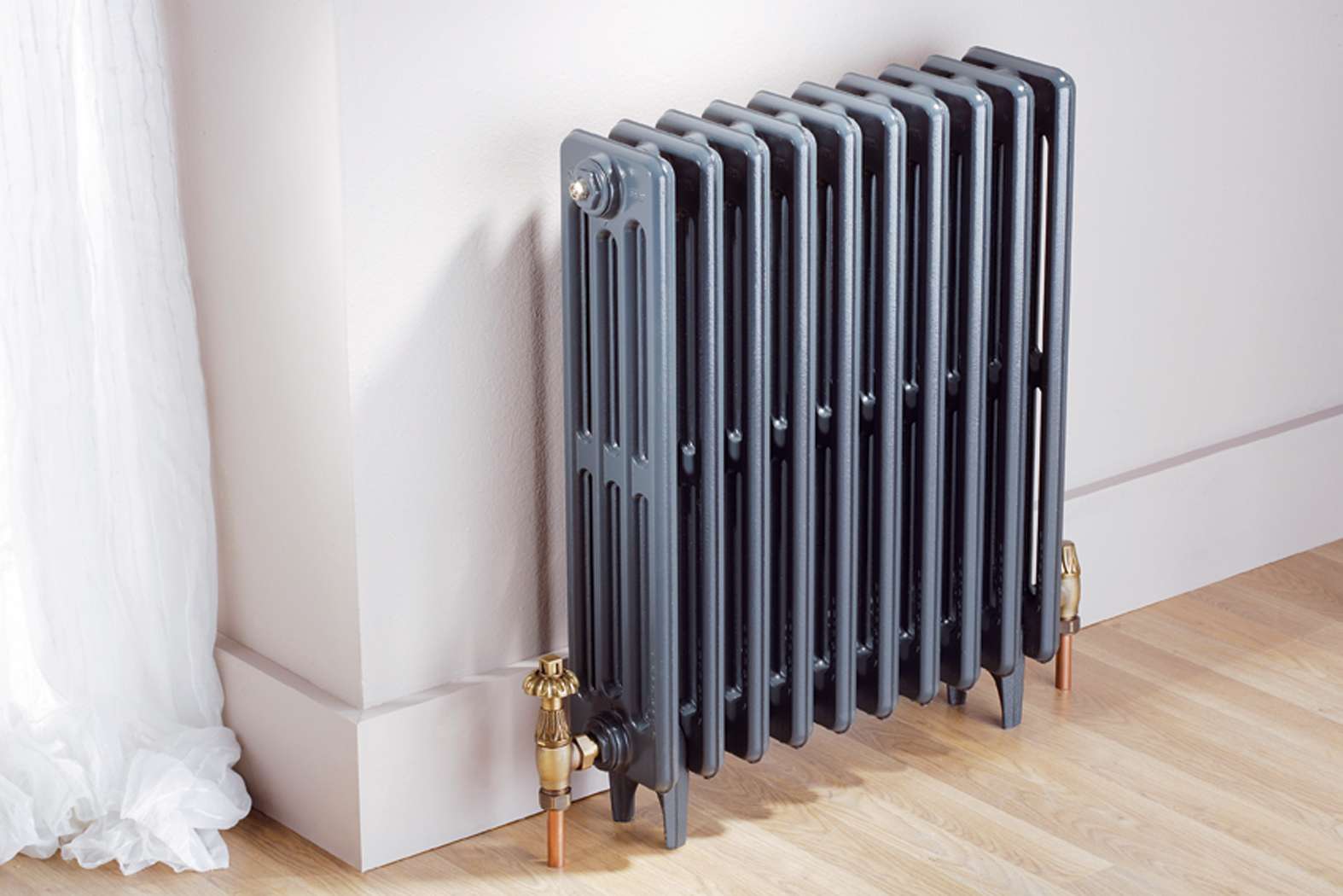
Features of decorative radiators
Designer products do not have such good technical performance:
- The heat transfer is somewhat lower, which is associated with an additional layer of paint, in some cases - with an ornament.
- The average power is less, because the dimensions are often cut. This helps to create an interior, but interferes with the direct purpose of the battery.
- The hydraulic resistance drops as the pipes are made small, neat.
- Unlike simple radiators, decorative ones are much more expensive.
These features look negative, but beauty requires sacrifice. Problems can be easily solved by minor design changes or by combining radiator heating with another.
What is the service life, operation of cast iron radiators
How many years can cast iron radiators be used?
Cast iron radiators can last a long time.On average, the service life is 35 - 40 years, and this period depends on the operating conditions of the cast iron appliance. In an autonomous heating system (if the coolant is not drained from the system), a cast-iron radiator can last more than 50 years.
With a long service life in a cast-iron radiator, intersection gaskets and radiator nipples may begin to break down, which causes leaks. Due to the rough and porous surface of the inner walls of the radiator, sediment and plaque form in it over time, therefore, the heat transfer of the radiator decreases. In an autonomous heating system, it is recommended to flush sections once every three years, and in an apartment building this should be done every year after the end of the heating season.
The manufacturer almost always indicates this information in the product passport, if we talk about average numbers, then this is 25, 40 years of operation.
Warranty 25, 30 years.
Of course, radiators can be operated in different ways, the coolant can be different both in composition (for example, water and antifreeze) and in purity (in pollution), all these factors can affect the durability of cast iron radiators.
From practice, I can say that the actual service life exceeds these figures, more than once I changed cast-iron radiators to others, the service life of which (cast-iron) exceeded 50 years (!) perfect condition, people were not satisfied with the "terrible" (not modern)
The system must be flushed after the season, if the housing office does not care about its duties, then this is done annually before each season.
In this case, the batteries are ideal even after 50 years of operation.
Cast iron radiators are "long-livers" among "colleagues", no other radiators have a longer service life.
I think I won’t reveal a secret or anything new for someone, especially with our mentality, anything, including cast-iron batteries, can be operated as long as they serve properly without any problems that may prevent or create inconvenience.
That is, the rule works - let them work while they work!
But this is a general rule, and in fact nothing is eternal, the manufacturer claims trouble-free operation for a period of 25 to 75 years from a different manufacturer, but this is only a figurative meaning.
Batteries have paronite gaskets that can sag and the battery will leak, and although cast iron resists corrosion quite strongly, internal build-up and external multi-layer coatings will significantly reduce the efficiency of such a battery.
Of course, you can remove, disassemble, wash, burn, twist on new belts, prime and paint them, reinstall them back and they will serve you with renewed vigor, but is this procedure and costs worth it to buy and install modern bimetallic or aluminum alloy batteries?
Therefore, you need to assess the situation concretely and with a cold mind, if your batteries do not leak, are not painted with a centimeter layer of different colors on top, but retained patency inside, then you can safely leave them to work, changing only the piping to plastic, even if our cast-iron batteries and 50 years!
And if you have suspicions, at least on one issue, then either a strict revision and repair, or a replacement.
And so, cast-iron batteries, on average, serve without problems for 50 years or more, in the central heating system and under 100! in private homes!
And you can always give them a unique and elegant appearance, or simply close them with decorative grilles.
Types of radiators
What is the best radiator to choose for installation in an apartment or a country house? First of all, it is required to determine the material for the manufacture of heating equipment.
Modern manufacturers produce batteries from the following materials:
- cast iron;
- aluminum;
- become;
- bimetal.
Cast iron
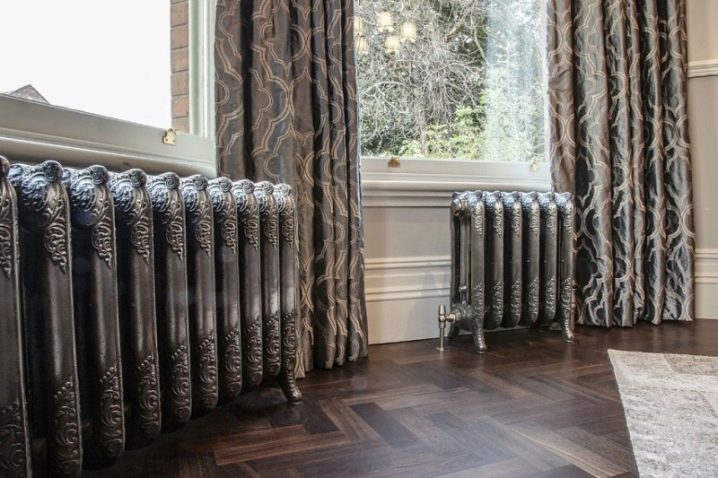
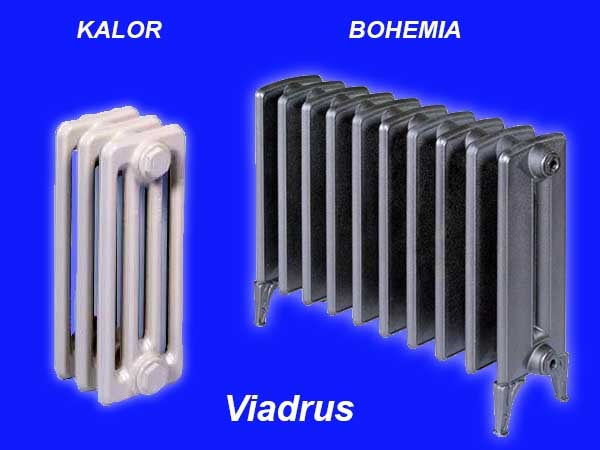
Cast iron radiators, which were popular earlier, have not lost their former glory. Only modern batteries have a more attractive appearance and, according to the manufacturer, can be separate decorative elements.

Decorated cast iron batteries
The advantages of this material are the following qualities:
- the ability to retain heat for a long time;
- durability. The average life of a cast iron battery is 50 years;
- inertness to corrosion and various chemical compounds;
- the ability to withstand short-term pressure surges in the heating system;
- operating pressure up to 15 amperes, which is optimal for an apartment in a multi-storey building with a common heating system;
- low cost (from 2,000 rubles).
Cast iron batteries also have negative qualities, which include:
- the need for a long period of time for complete warming up;
- the absence of a convention that allows the room to warm up evenly;
- great weight.
Cast iron radiators are recommended to be installed in houses with a centralized heating system.
Aluminum
Aluminum radiators are:
- low weight, which greatly facilitates the processes of transportation and installation;
- strength;
- elegant appearance;
- high thermal conductivity.About 50% of thermal energy is transferred due to natural radiation and the remaining 50% due to the presence of convection;
- the ability to withstand pressure up to 16 atmospheres.
Aluminum Batteries for Residential Applications
Among the disadvantages are:
- susceptibility to corrosion (especially if substances based on ethylene glycol are used as a carrier);
- the need to install an additional device - an air vent valve (valve), which helps to expel air from the collector.
Aluminum batteries are equally suitable for a private house with an autonomous heating system, and for premises in an apartment building with a central system.
Steel
For the manufacture of steel radiators, as a rule, low-carbon steel is used. Finished products are:
- high rate of heat transfer;
- strength;
- reliability. As a rule, steel batteries are one-piece. The design lacks various connecting elements, which are the first to become unusable and become the causes of a leak;
- variety. Manufacturers produce batteries with a bottom connection, diagonal or side.
Steel radiators can be of the following subspecies:
tubular. The device consists of separate tubes of a certain diameter, on which the power of the equipment depends. Tubular batteries have an attractive appearance. They are strong and durable. Under normal conditions, they can withstand pressure up to 16 atmospheres;
Tubular steel battery
panel. Heating collectors consist of a large number of plates interconnected by panels.A panel radiator is distinguished by a higher cost (approximately 25% - 30% higher than tubular structures) and the ability to withstand lower pressure (no more than 10 atmospheres).
Sectional steel panel battery
Steel radiators are recommended to be installed in houses with an autonomous heating system, since even a short-term increase in pressure in the network can lead to deformation and cracking.
Bimetallic
Recently, bimetallic radiators made of steel (heater core) and aluminum (battery case) have been widely popular.
Thanks to the combination of two metals, the following is achieved:
- product strength;
- resistance to corrosion and chemical impurities;
- durability. Batteries can last over 35 years;
- the ability to withstand high pressure in the system. Some batteries are capable of operating at pressures up to 50 atmospheres;
- high heat transfer coefficient.
bimetallic battery
Among the shortcomings can be identified:
- high price;
- smaller cross-sectional area;
- the presence of a high level of hydraulic resistance.
Due to the high resistance of bimetal batteries, it is recommended to use in systems with high pressure (multi-apartment buildings, large industrial premises, etc.) and is not recommended for installation in private houses with a minimum level of internal system pressure.
Tips
The accuracy of the calculations will allow you to assemble the most comfortable system for your home. With the right approach, you can make any room warm enough. A smart approach also brings financial benefits. You will definitely save money by not overpaying for extra equipment.You can save even more if you install the equipment correctly.




A single-pipe heating system is particularly difficult. Here, an increasingly cold carrier enters each subsequent heating device. To calculate the power of a one-pipe system for each radiator separately, you need to recalculate the temperature.
So that the last battery in the branch does not turn out to be huge, in practice the problem is solved by setting the temperature through the bypass. This will help regulate heat transfer, which ultimately compensates for the temperature of the coolant.
If the task is to approximately calculate the number of radiator sections, then this is easy and fast to do. Much more attention and time will be spent on adjustments related to the characteristics of the room, the choice of connection method and the location of devices.
For example, when calculating, specialists make adjustments depending on average temperature indicators.
The default odds look like this:
- -10 degrees - 0.7;
- -15 degrees - 0.9;
- -20 degrees - 1.1;
- -25 degrees - 1.3;
- -30 degrees - 1.5.
The mode of the heating system will also affect the power of thermal radiation. When choosing a radiator according to passport indicators, it should be understood that manufacturers usually indicate the maximum power. The high-temperature mode of the heating system assumes that a carrier heated to 90 degrees runs in it. In this mode, in a room with a precisely calculated number of radiators, there will be about 20 degrees of heat.
However, heating systems rarely operate in this mode. Modes of modern systems are usually medium or low. To make adjustments, you need to determine the temperature difference of the system.This takes into account the difference between the temperature in the room and the heating devices.
How many cast-iron heating radiators are needed for high-temperature and low-temperature conditions, we calculate using an example: the size of a standard section is 50 cm, the room is 16 square meters. m.
One cast iron section operating in high temperature mode (90/70/20) will heat 1.5 m2. To provide heat, 16 / 1.5 - 10.6 sections will be required, that is, 11 pieces. In a system with a low temperature regime (55/45/20), you will need twice as many sections - 22.
The calculation will look like this:
(55+45) /2-20=30 degrees;
(90+70) /2-20=60 degrees.
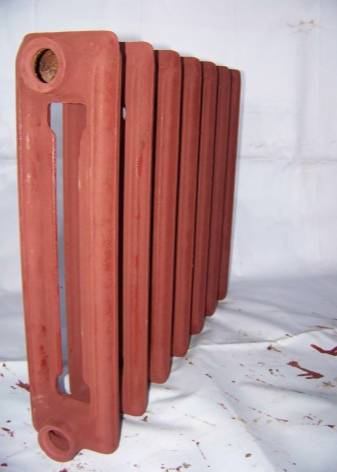
A battery of 22 sections turns out to be very large, so the cast-iron version is definitely not suitable. This is one of the reasons why cast iron radiators are not recommended for use in low temperature systems.
For information on how to calculate heating radiators, see below.
Technical characteristics of cast iron radiators
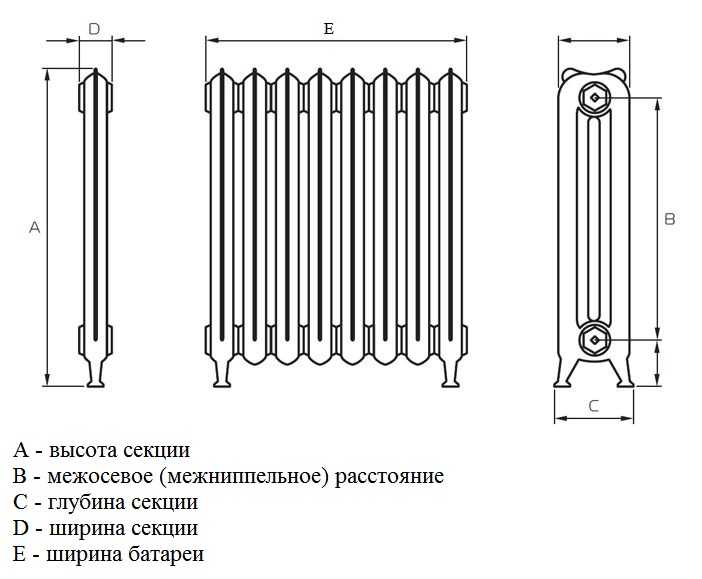
The technical parameters of cast iron batteries are related to their reliability and endurance. The main characteristics of a cast iron radiator, like any heating device, are heat transfer and power. As a rule, manufacturers indicate the power of cast-iron heating radiators for one section. The number of sections may vary. As a rule, from 3 to 6. But sometimes it can reach 12. The required number of sections is calculated separately for each apartment.
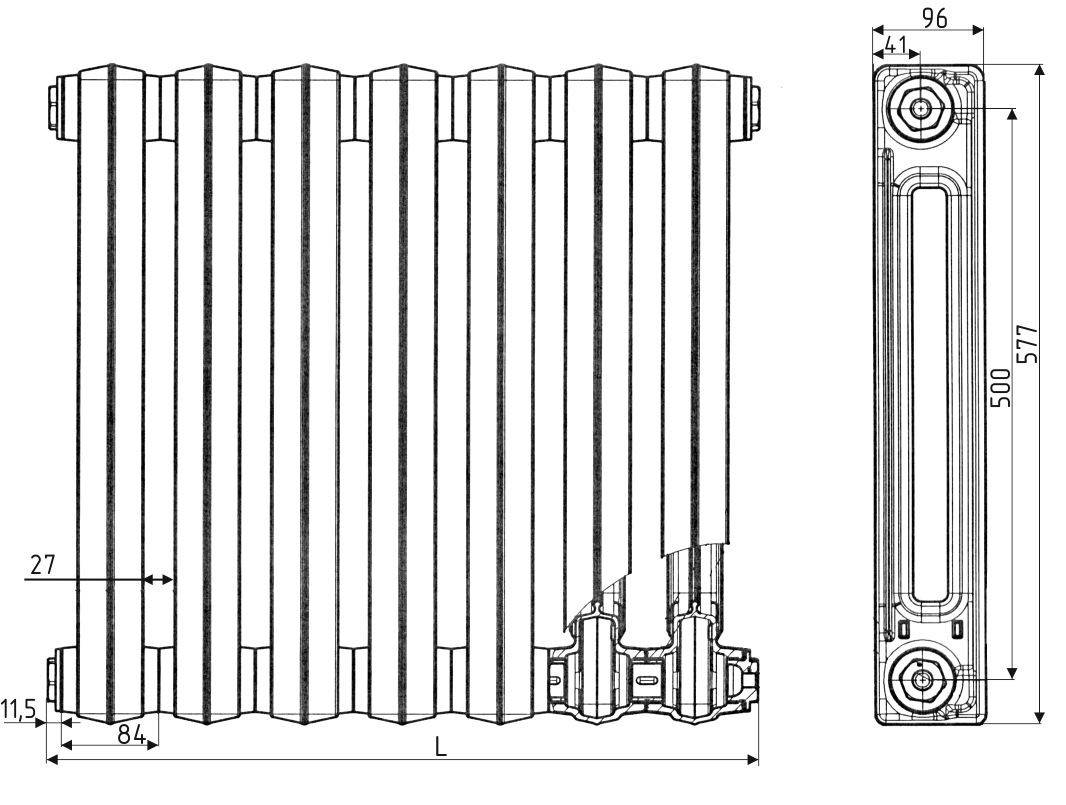


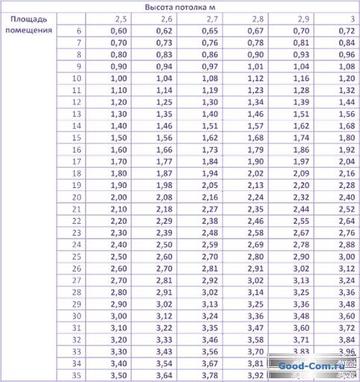
The number of sections depends on a number of factors:
- area of the room;
- room height;
- number of windows;
- floor;
- the presence of installed double-glazed windows;
- corner apartment.
The price per section is given for cast-iron heating radiators, and may vary depending on the manufacturer. The heat dissipation of batteries depends on what material they are made of. In this regard, cast iron is inferior to aluminum and steel.
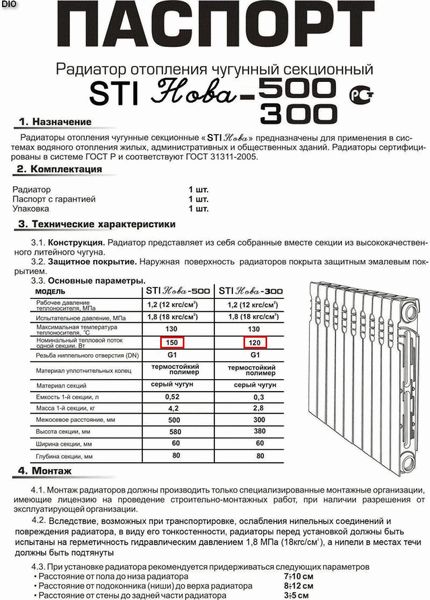
Other technical parameters include:
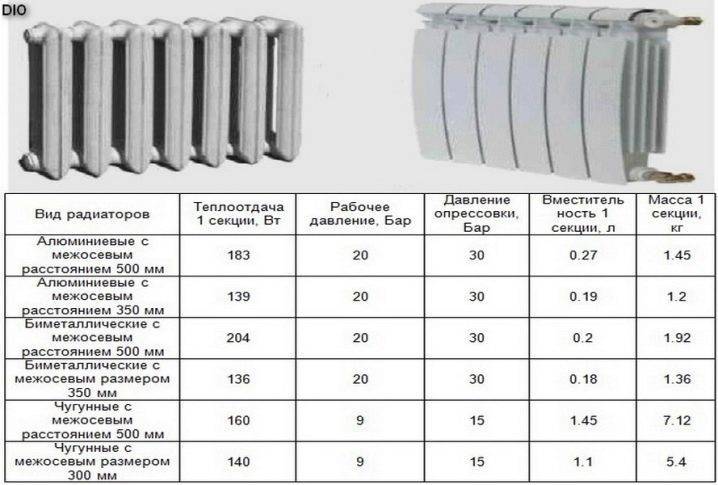
- maximum working pressure - 9-12 bar;
- maximum coolant temperature - 150 degrees;
- one section holds about 1.4 liters of water;
- the weight of one section is approximately 6 kg;
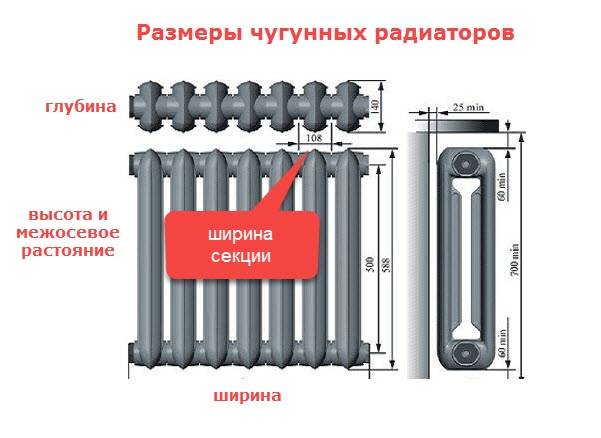
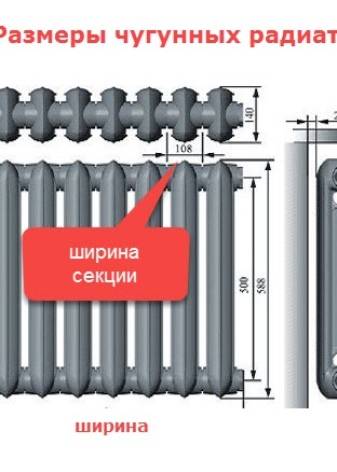
- section width 9.8 cm.
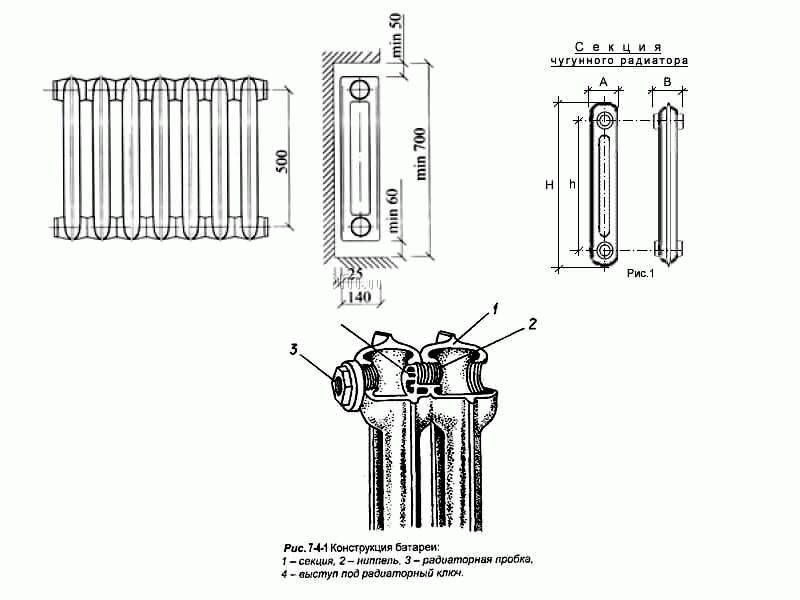
Such batteries should be installed with a distance between the radiator and the wall from 2 to 5 cm. The installation height above the floor should be at least 10 cm. If there are several windows in the room, batteries should be installed under each window. If the apartment is angular, then it is recommended to carry out external wall insulation or increase the number of sections.
It should be noted that cast iron batteries are often sold unpainted. In this regard, after purchase, they must be covered with a heat-resistant decorative composition, it must first be stretched.
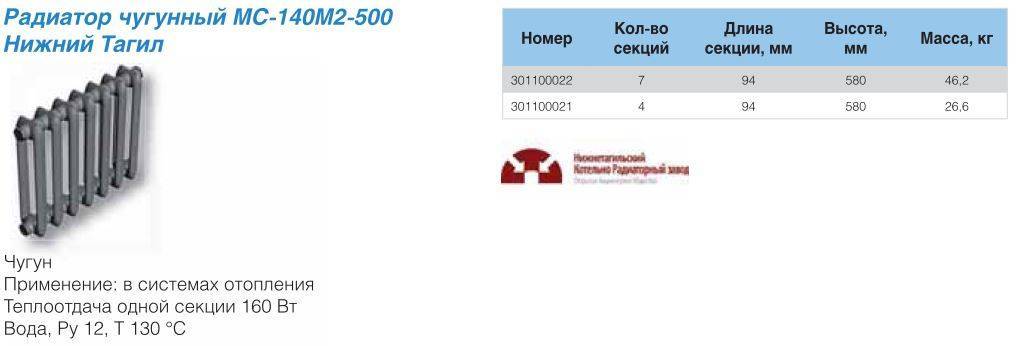
Among domestic radiators, the ms 140 model can be distinguished. For cast-iron heating radiators ms 140, the technical characteristics are given below:
-
- heat transfer of the MS section 140 - 175 W;
- height - 59 cm;
- the radiator weighs 7 kg;
- capacity of one section - 1.4 l;
- section depth is 14 cm;
- section power reaches 160 W;
- section width is 9.3 cm;
- the maximum temperature of the coolant is 130 degrees;
- maximum working pressure - 9 bar;
- the radiator has a sectional design;
- pressing pressure is 15 bar;
- the volume of water in one section is 1.35 liters;
- heat-resistant rubber is used as a material for intersectional gaskets.
It should be noted that cast iron radiators ms 140 are reliable and durable. Yes, and the price is quite affordable. Which determines their demand in the domestic market.
Features of the choice of cast iron radiators
To choose cast iron heating radiators which are best suited for your conditions, you must consider the following technical parameters:
- heat transfer. Choose based on the size of the room;
- radiator weight;
- power;
- dimensions: width, height, depth.
To calculate the thermal power of a cast-iron battery, one must be guided by the following rule: for a room with 1 outer wall and 1 window, 1 kW of power per 10 sq.m is needed. area of the premises; for a room with 2 outer walls and 1 window - 1.2 kW .; for heating a room with 2 external walls and 2 windows - 1.3 kW.
If you decide to buy cast-iron heating radiators, you should consider the following nuances:
- if the ceiling is higher than 3 m, the required power will increase proportionally;
- if the room has windows with double-glazed windows, then the battery power can be reduced by 15%;
- if there are several windows in the apartment, then a radiator must be installed under each of them.
Modern market
Imported batteries have a perfectly smooth surface, they are of better quality and look more aesthetically pleasing. True, their cost is high.
Among domestic analogues, konner cast-iron radiators, which are in good demand today, can be distinguished. They are distinguished by a long service life, reliability, and fit perfectly into a modern interior. Cast iron radiators konner heating are produced in any configuration.
- How to pour water into an open and closed heating system?
- Popular Russian-made outdoor gas boiler
- How to correctly bleed air from a heating radiator?
- Expansion tank for closed heating: device and principle of operation
- Gas double-circuit wall-mounted boiler Navien: error codes in case of malfunction
Recommended reading
2016–2017 — Leading heating portal. All rights reserved and protected by law
Copying site materials is prohibited. Any copyright infringement entails legal liability. Contacts



Bimetallic heating radiators: video
Calculation of the power of radiators for the whole room
By multiplying these values by the total area of your room, you can calculate exactly how much kW of heat you need from the installed heating radiator.
Measuring the area is quite simple - the width of the room is multiplied by its length. It is worth noting that if your room has a rather complex perimeter, then in this case, you can also take coarser measurements, but the error should always be interpreted upwards.
You should also decide on the height of each section of the bimetallic radiator so that it fits the place of its installation. At the same time, if you have high ceilings or an increased window area, then in this case you should also multiply the value you received by the correction factor in order to understand how many to install bimetallic radiators. How many sections of a bimetallic radiator are needed, therefore, we will calculate a little differently.
In order to determine how many sections of the radiator you need, you need to divide the power that, in accordance with the calculations, is required to heat your room by the power that the sections of the model that you like have. Often, the power of the section is necessarily indicated in the passport of each device, so it is not difficult to find out how many kW are in a bimetallic radiator. In extreme cases, you can look at the power on the Internet.
As already known, the power required for the normal heating of each m 2 is approximately 100-120 watts. In order to determine the battery power for your room, you can multiply its area by 100, and then divide by the power that each section of the bimetallic battery you have chosen has. The resulting number will be the number of radiator sections you need.
Separately, it should be said that certain models of modern radiators can have a number of sections that is a multiple of two, and some devices do not provide adjustment options and have a strictly fixed number of sections.
In such a situation, you should choose a battery with the closest number of sections, but their number must be more than the calculated one, because it is better to make the room a little warmer than to freeze all winter.
30*100/200 = 15.
That is, to heat such a room, it is necessary to install a radiator with 15 sections. The use of this formula is relevant for ordinary rooms with a ceiling height of no more than three meters, as well as only one doorway, a window and a wall that goes outside the building.In the event that the calculation of the number of bimetallic heating radiators is carried out for non-standard premises, that is, those located at the end or in the corner of the building, it will be necessary to multiply the resulting number by a coefficient.
In other words, if the room considered in the above example had 2 exterior walls and 2 windows, it would be necessary to calculate further as 15*1.2=18. That is, in this situation, it would be necessary to install three radiators, each of which has 6 sections.
Technical parameters of batteries
Each radiator is characterized by technical and design features that allow some models to warm up the room faster, while others, for example, consume less coolant. The ratio of these characteristics of the product, necessary for the buyer, often determines his choice:
Power
The larger the device and the higher the number of sections in it, the greater the power. This characteristic determines the quality of the heat transfer of the battery. But high power means high energy consumption, so for efficient heating you will have to pay for the use of more electricity.
Pressure
The value of the operating pressure level varies greatly for radiator models: from 6 to 100 atmospheres. The higher this indicator, the better the product tolerates water hammer. In addition, a device that can withstand from 16 atmospheres can be installed in a district heating network.
Temperature
It depends on how much the coolant inside the working area heats up (according to SNIPs, this value cannot exceed 95 ° C).For example, oil-filled radiators have a surface temperature of up to 150 °C, while most district and autonomous heating systems do not exceed 100 °C.
Heat dissipation
This is one of the most important characteristics of any radiator, since it determines how quickly and efficiently the device will heat the air in the room.
The highest levels of heat transfer are for products with convectors and wide heat-removing plate casings.
Room heating
There is a direct dependence on the first and fourth characteristics. The more powerful the battery and the higher the level of heat transfer, the faster it will warm the entire room to the temperature required by the homeowner.




Important! It is practically useless to heat a room with poor insulation - even the most powerful heating systems will not help here. Before installing a radiator in a house, garage, apartment or any other room, it is important to make sure that hot air will not escape from cracks in walls or windows.