- type of instalation
- Connection options for precision air conditioners
- Air conditioner indoor unit
- The device of compressor models
- Outdoor unit
- Outdoor unit device
- inverter air conditioner
- Mounting and installation
- Kinds
- Types of claim systems
- Principles of operation of precision air conditioners
- Precision air conditioning, what is it?
- Mounting and installation
- Classification of precision air conditioners
- Freon precision air conditioners
- Liquid Precision Devices
- Installation methods
- Advantages and disadvantages of precision engineering
- Advantages and disadvantages
- Features of split systems
- The general concept of an air conditioning device
- water cooled
- Air supply and intake
- Conclusion
type of instalation
Precision air conditioners are divided into inverter and periodic. The task of the inverter device is to transform the speed of rotation of the electric motor by inverting direct current into alternating current of the required frequency.
Periodic non-inverter air conditioners are designed to maintain certain air parameters by cycling the compressor. Such installations are more difficult to set up, but they are cheaper.
Inverter air conditioners withstand stable temperature, humidity and airflow rates, they last longer because there is less wear on parts than when the engine is cycling.
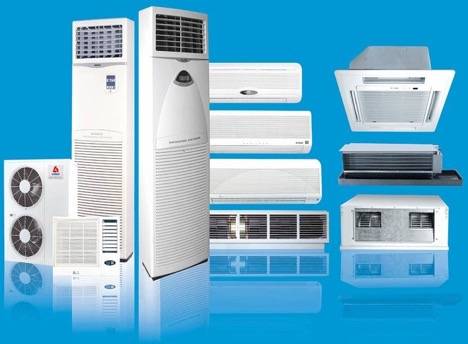 Varieties of inverter air conditioners
Connection options for precision air conditioners
Most often, standard connection options are used. A remote outdoor unit with a condenser is installed on the roof of a building, an indoor cabinet unit is installed indoors (see Fig.).

Wiring diagram for precision air conditioners with outdoor units on the roof.
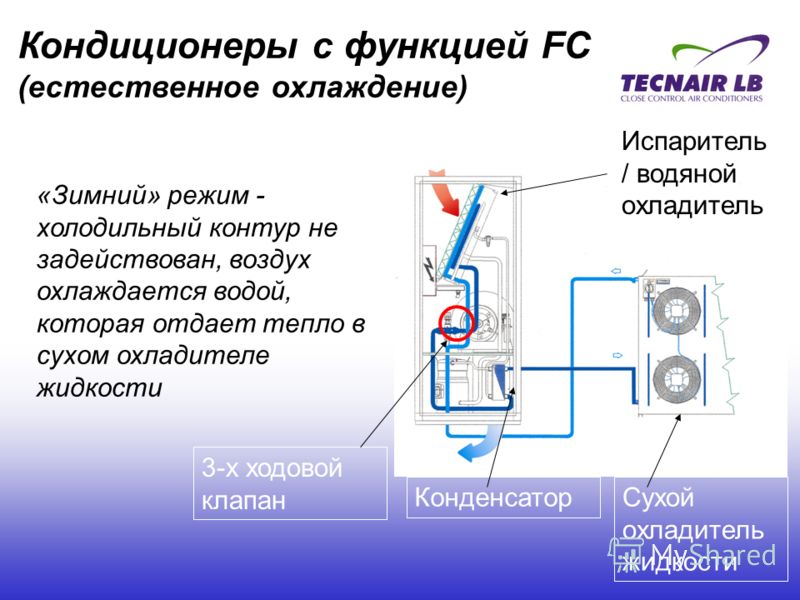
When using systems with air supply (Free Cooling), exhaust ventilation is equipped. This method of cooling allows you to reduce energy costs if the temperature outside is lower than that produced by the heated equipment. The illustration shows an example with cabinet air conditioners with outdoor units.

Wiring diagram for precision air conditioners with air supply and exhaust ventilation.
Precision air conditioners can be used in conjunction with a chiller and/or cooling tower (see illustration). In this case, their efficiency increases. But the total cost of the equipment is growing.

Scheme of connecting precision air conditioners to the chiller and cooling tower.
If several small rooms need to be cooled, a precision air conditioner can be connected to the ventilation system. At the same time, he needs to provide an influx of heated air. Or use an outside air intake system. And in the cooled rooms to make exhaust ventilation.

Precision air conditioner connected to the ventilation system.
As an option, not air, but water can be used as an external medium. this method of cooling or heating is more efficient.But for this it is necessary to equip a special heat exchanger.
Air conditioner indoor unit
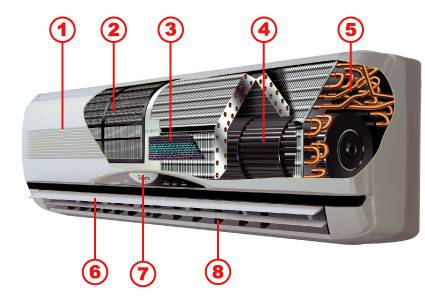
- 1. Front panel - is a plastic grate through which air enters the unit. The panel can be easily removed for maintenance of the air conditioner (cleaning filters, etc.)
- 2. Coarse filter - is a plastic mesh and is designed to trap coarse dust, animal hair, etc. For normal operation of the air conditioner, the filter must be cleaned at least twice a month.
- 5. Evaporator - a radiator in which cold freon is heated and evaporated. The air blown through the radiator is cooled accordingly.
- 6. Horizontal blinds - regulate the direction of the air flow vertically. These blinds are electrically operated and their position can be adjusted from the remote control. In addition, the blinds can automatically make oscillatory movements to evenly distribute the air flow throughout the room.
- 7. Display panel - indicators (LEDs) are installed on the front panel of the air conditioner, showing the operating mode of the air conditioner and signaling possible malfunctions.
- 3. Fine filter - there are various types: coal (removes unpleasant
- odors), electrostatic (detains fine dust), etc. The presence or absence of fine filters has no effect on the operation of the air conditioner.
- 4. Fan — has 3 — 4 speeds of rotation.
- 8. Vertical blinds - serve to adjust the direction of the air flow horizontally. In domestic air conditioners, the position of these shutters can only be adjusted manually.The ability to control from the remote control is only in some models of premium air conditioners.
- Condensate tray (not shown in the figure) - located under the evaporator and serves to collect condensate (water that forms on the surface of a cold evaporator). Water is drained from the sump through a drain hose.
- Control board
- (not shown in the figure) - usually located on the right side of the indoor unit. This board contains an electronics unit with a central microprocessor.
- Union connections
- (not shown in the figure) —
- located at the bottom rear of the indoor unit. Copper pipes connecting the outdoor and indoor units are connected to them.
The device of compressor models

It is this type of air conditioners that can work both for cooling and heating air, which largely determines its wide distribution. The basic set of components in the internal device of a compressor-type air conditioner can be represented as follows:
- The condenser is a compact radiator module in a block designed for outdoor installation (from the street side). This node provides the process of condensation, that is, the transition of gas into a liquid state. Usually radiators are made of aluminum or copper.
- The compressor performs the function of compressing the refrigerant (working medium like freon) and keeps it circulating in the refrigeration circuit.
- The evaporative radiator is located in the indoor unit (indoor). It provides a process that is the reverse of condensation, that is, with a sharp drop in pressure, the refrigerant already passes from a liquid state to a gaseous one.
- Regulating fittings - a throttle that lowers the pressure in the area before the evaporator.
- Fans circulate air streams, thereby blowing the condenser with the evaporator unit.
Outdoor unit
The air conditioner consists of an indoor and outdoor module, the latter is located outside the building.
This is caused by the noisy operation of the fan and compressor, as well as the independent removal of warm air to the atmosphere.
Outdoor unit device
- Compressor. It is able to compress freon and give a certain movement along the contour.
- Condenser located in the outdoor unit. It turns the refrigerant into a liquid state.
- Evaporator. The radiator is located inside the apparatus - it serves to convert freon from a watery phase to a gaseous state.
- Thermostatic expansion valve (TRV). By means of the device, the pressure of the refrigerant is reduced.
- Fans. The task of these devices is to blow the evaporator and condenser in order to create a more intense heat exchange with the atmosphere.
- Filters. These parts of the air conditioner protect the circuit from foreign particles (dirt, dust)
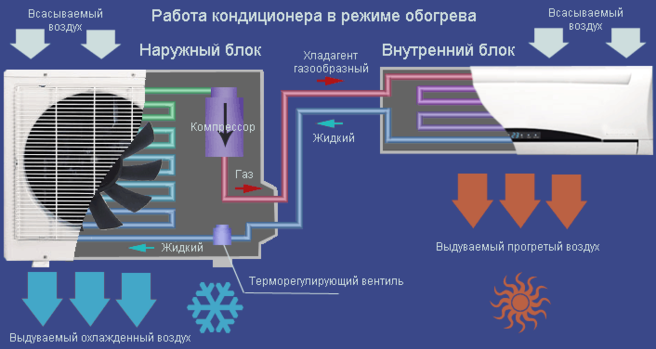
Air conditioner operation in heating mode
inverter air conditioner
The main purpose of the inverter air conditioner is to save energy and extend the working condition of the compressor. In such systems, work does not take place in jerks “on-off”, but with smooth power control. The air conditioner runs continuously, however, not at full capacity. This allows the compressor motor to increase its resource. In addition, maintaining a stable temperature in the room requires much less energy than with the “jerky rhythm” of a conventional air conditioner.

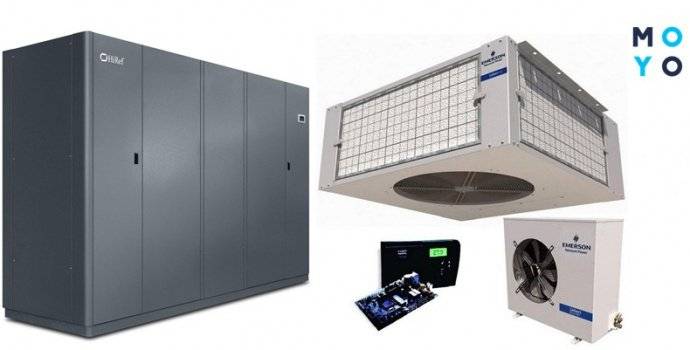


Compressor speed control is achieved by converting (inverting) the incoming AC to DC, and then back to AC, but at a different frequency. The electronics decide how to change the engine speed - reduce or increase, and speed changes occur smoothly.
But it is important to understand that an inverter air conditioner is more economical only in those places where a conventional air conditioner is turned on only from time to time. With continuous operation, a conventional air conditioner is much more efficient at the same energy consumption, because it does not spend electricity on converting
Therefore, if your inverter air conditioner is running at full capacity almost continuously, its power has been selected incorrectly.
An engineer from the Climate Control company will tell you about what an inverter air conditioner is and whether it is worth overpaying for it:
Mounting and installation
- Monoblock air conditioners can be installed both outside the building and indoors. External mounting facilitates air access, but makes maintenance more difficult. When installing a monoblock inside, air ducting is required.
- The ceiling air conditioner is installed in the center of the served room. Air supply / exhaust is carried out through ventilation or specially mounted ducts.
- The cabinet air conditioner is installed in the room where it is required to maintain the set temperature. The intake of heated air is most often carried out from above, and the issuance of cold air is carried out from below, under the raised floor.
The standard scheme provides for the installation of an outdoor unit with a condenser on the roof, and an indoor unit in the room.If the system uses free-cooling (free-cooling) mode, an exhaust ventilation device is required. For more efficient cooling of the premises, it is possible to connect a chiller and / or cooling tower.
Kinds
Precision air conditioning systems are conventionally divided into several categories, depending on:
The number of schemes of work of precision conditioning.
a) single-circuit;
b) Double-circuit.
Executions.
a) On ceilings (with a power of 4-15 kW) are placed in rooms with a small area;
b) Cabinet. It is used in large rooms (with a power of up to 100 kW). Outdoor module as separate condenser;
c) Precision air conditioner - monoblock (with a power of about 20 kW). It has two evaporators and a compressor in one housing.
Cooling heat exchanger.
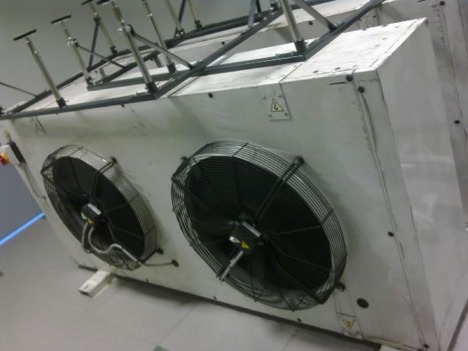
a) Air. It works on the principle of a split system, consisting of two blocks: an outdoor unit (a compressor with a condenser in one housing) and an internal evaporator;
b) water. Combination of the module with a refrigeration unit (chiller) when the temperature drop is due to the liquid cooler;
c) Combined.
In addition, depending on the type of temperature range maintenance area and the number of circuits in the initial state, climate systems differ in their functioning.
 Precision cabinet type air conditioners
Types of claim systems
There are several types of devices that are combined under the general name of precision-type air conditioners. They can be divided into several subgroups according to certain criteria.


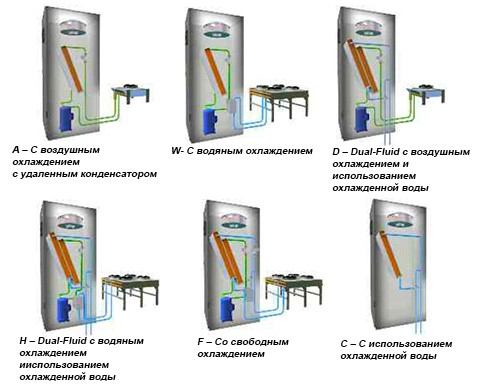

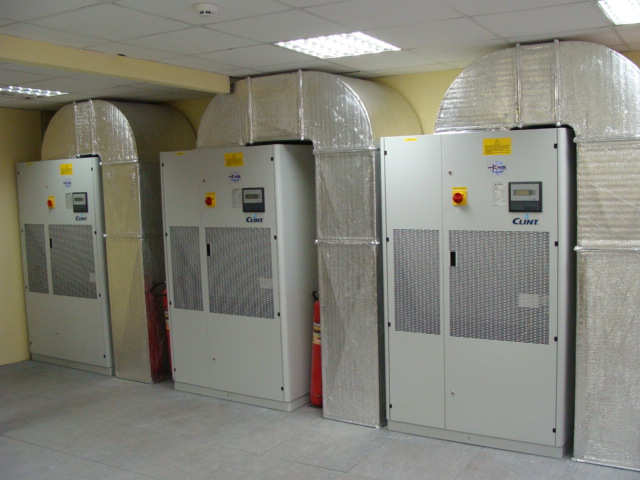
- Various in design. A modern manufacturer offers the following types: monoblock, ceiling and cabinet-type structures.
-
According to the method of cooling air flows, the following options can be distinguished: air, water and mixed.
- By the number of circuits, there are single-circuit and double-circuit devices of a precision type.
- By functionality, there are several types of constructions: cooling, cooling and humidification, cooling and heating, cooling + heating + humidification.
For small and medium rooms, you should opt for monoblock devices. But for large industrial premises it is best to use cabinet-type air conditioners. Ceiling systems are also most often used in small square rooms where the installation of another type of air conditioner is difficult.
Principles of operation of precision air conditioners
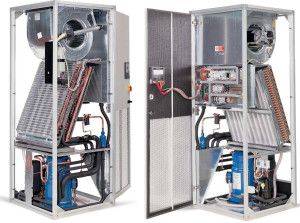 Precision internals
There are several principles of operation of precision air conditioners, depending on the type of cooling and the number of circuits.
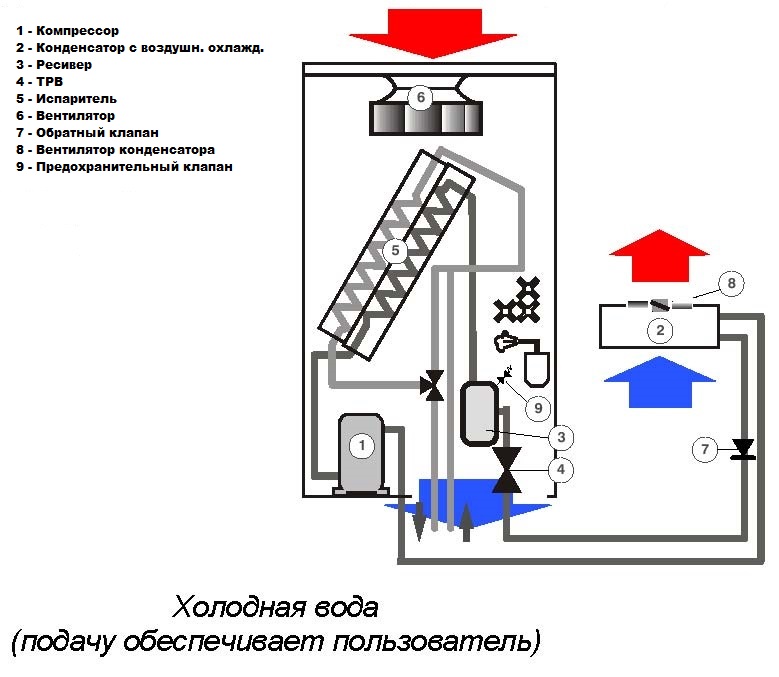
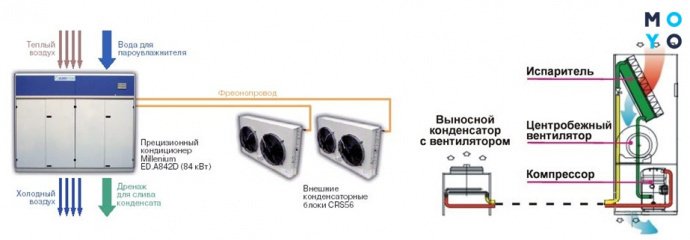
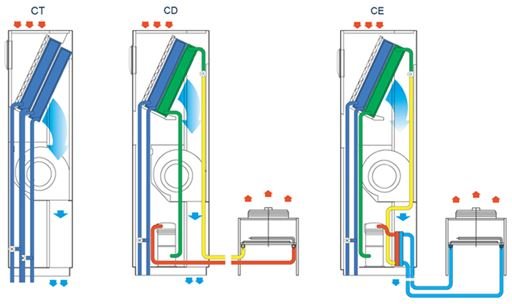
Air-cooled systems feature the most familiar refrigeration cycle, similar to that of a conventional split system. Freon under pressure is compressed in the compressor, and then enters the condenser, where it passes into a liquid state. From here it passes through a thermostatic expansion valve (TRV) where its temperature is lowered. Getting into the evaporator, freon again goes into a gaseous state and enters the compressor again. The air is then cooled as it passes through the evaporator and exits. Heat is removed from the condenser by a fan.
You can see the operation diagram of a precision air conditioner with a remote air condenser in this photo.
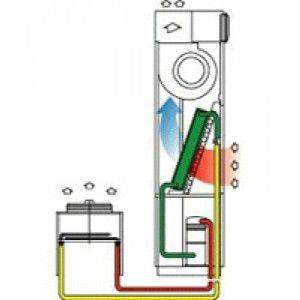 remote air condenser circuit
This principle of operation of precision air conditioners does not differ much from the circuit diagram of a device with a drycooler. The difference is that the heat is not discharged through the fan, but into the water. A freon-water heat exchanger is installed in the indoor unit, to which an outdoor unit (drycooler) with a water pump is connected. Heat is transferred through the heat exchanger, and it is discharged to the street thanks to the fan of the outdoor unit.
If the air conditioner is water-cooled, then it is usually combined with a chiller. In the indoor module, the air is cooled by the refrigerant, which lowers its temperature in the liquid cooler.
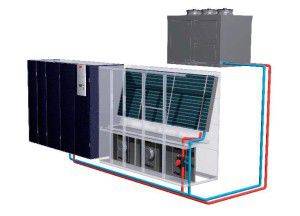 chiller cooling scheme
This photo shows a diagram of the operation of a precision air conditioner with water cooling through a chiller.
Precision air conditioners with a double circuit are characterized by a different principle of operation, in which the air from the servers enters the evaporator of the indoor unit of the precision air conditioner and is cooled there, from there it is already released into the room. The heat load removed in this way passes into a condenser built into the indoor unit of the device and cooled by water, and then is transferred to the water circuit. From here, the heat comes out with the help of a drycooler and is discharged into the atmosphere.
Precision air conditioning, what is it?
From English, the word precision (precision) is translated as "accuracy", "accuracy". This characterizes the basic requirements for such climate equipment. Precision air conditioners can:
- Work 24/365 for 10 years or more;
- Cool rooms with deviations from the set temperature of the order of 0.5-1 degrees;
- Work in the temperature range from -50 to +50 °С;
- The possibility of taking cold air from the environment to improve energy efficiency (Free Cooling);
- Air filtration.
In addition to the usual tasks, precision air conditioners can perform the following functions:
- Maintaining the set humidity within 2-3% of the set;
- Heat the room and maintain the temperature with a deviation from the norm of no more than 1 degree;
- Provide ventilation with air flow;
- Possibility of integration with a chiller;
- Air blowing system;
- Direct air heating.
Mounting and installation
- Monoblock air conditioners can be installed both outside the building and indoors. External mounting facilitates air access, but makes maintenance more difficult. When installing a monoblock inside, air ducting is required.
- The ceiling air conditioner is installed in the center of the served room. Air supply / exhaust is carried out through ventilation or specially mounted ducts.
- The cabinet air conditioner is installed in the room where it is required to maintain the set temperature. The intake of heated air is most often carried out from above, and the issuance of cold air is carried out from below, under the raised floor.
The standard scheme provides for the installation of an outdoor unit with a condenser on the roof, and an indoor unit in the room. If the system uses free-cooling (free-cooling) mode, an exhaust ventilation device is required. For more efficient cooling of the premises, it is possible to connect a chiller and / or cooling tower
Classification of precision air conditioners
Depending on the design of indoor units, precision air conditioners are classified into the following types:
- ceiling;
- cabinet precision types of air conditioners;
- inter-row.
Depending on the method of cooling condensers, they are air and liquid. Based on the classification used coolant - water or ethylene glycol.



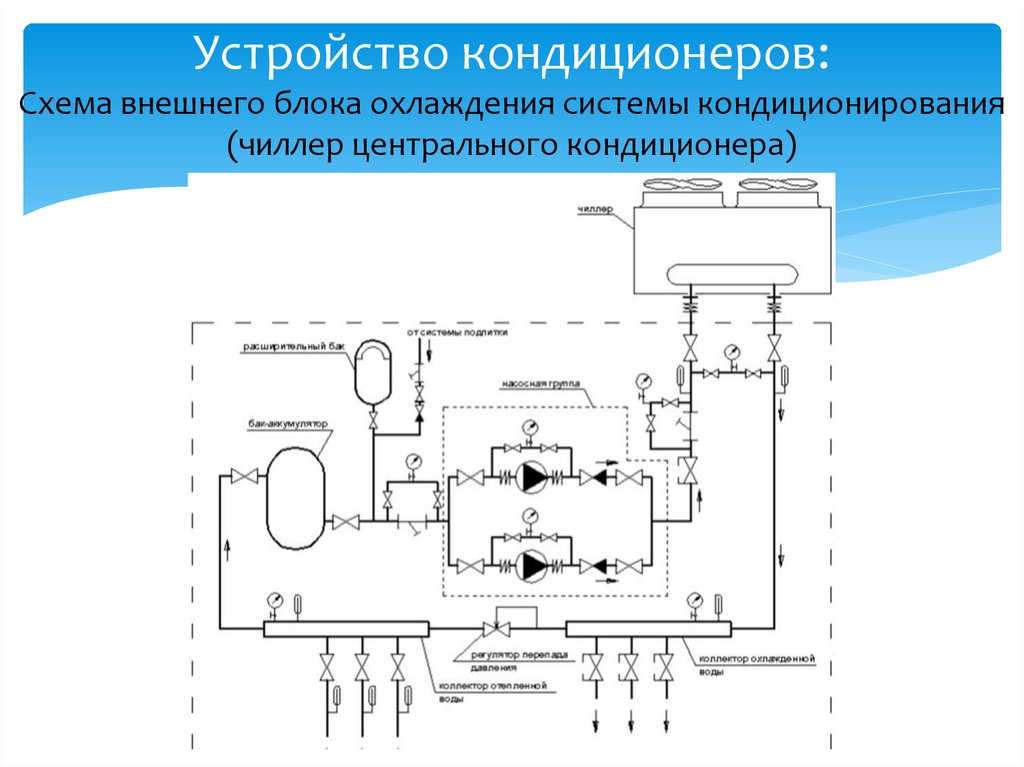

Each of the categories listed above has its own characteristics, advantages and disadvantages, which must be taken into account when choosing a room temperature and humidity control system.
Freon precision air conditioners
Freon monoblocks and precision-type climate control systems are provided for telecommunications facilities.
For larger stationary objects, cabinet indoor units and inter-row air conditioners are used.
The classic and most economical solution for server rooms in terms of capital costs are cabinet air conditioners equipped with a direct expansion evaporator, they are also freon.
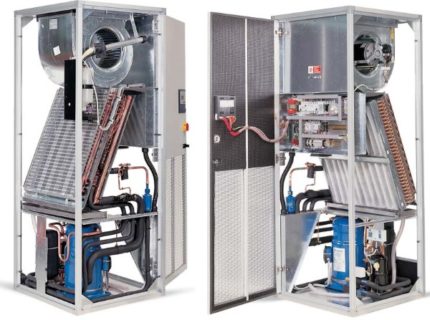 This is what freon precision air conditioners look like in a section. The diagram shows the same device, only from different sides.
Various versions are possible: with an external air-cooled condenser, with a built-in liquid-cooled condenser, and also equipped with a dry cooler.
Inter-row air conditioners with direct expansion also differ in similar types of condensers (the category is encrypted as DX).
Liquid Precision Devices
Cabinet precision air conditioners equipped with a liquid heat exchanger are used in the cooling chiller circuit as closers.
In this case, the reliability of operation and the temperature regime of cooling are determined by the adopted concept of the object's refrigeration supply - the scheme includes the presence of chillers and pumping groups.
Starting capital costs exceed by 30-40% the costs associated with freon air conditioners. It should be noted that the optimization of the refrigeration scheme makes it possible to reduce operating costs.
Installation methods
Like all air conditioning devices, precision air conditioners can be outdoor and indoor according to the type of installation. Outside, the structures are mounted when it is necessary to introduce the air conditioner into the existing system, as well as when there is not enough space for internal installation. This option is more economical, because standard outdoor structures are equipped with an automatic cooling system, which uses air currents from the street. Usually these are monoblock structures controlled remotely or by means of a thermostat.
Inside, cabinetry and ceiling fixtures are installed. For their installation, you need to cut 2 holes through which the condenser will be cooled.
Advantages and disadvantages of precision engineering
The ability to precisely control the microclimate in the room, along with the ability to work around the clock for many years. These two important parameters alone have made any precision air conditioner one of the most sought-after climate control devices.
Additionally, a “smart” electronic circuit is capable of maintaining the set parameters for an average of fifteen years with minimal user intervention. As a rule, control is reduced to a visual check of the device display readings.
The main disadvantage of this category of climate control equipment is the price.It is clear that a precision air conditioner that is capable of controlling the microclimate around the clock and continuously, for at least fifteen years, does not differ in availability. But the cost of installation, service and the mandatory organization of the necessary working conditions did their job.


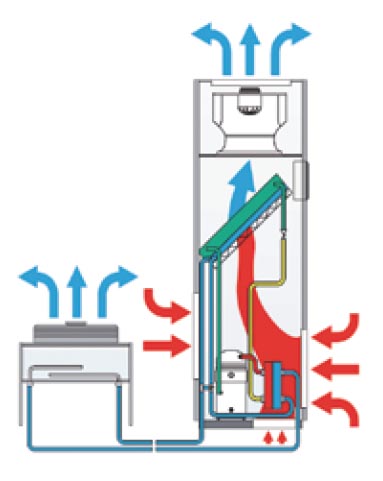


Advantages and disadvantages
Reliable and uninterrupted support of the specified climatic parameters in the served room by a precision air conditioner is beyond doubt. As an additional guarantee, manufacturers usually equip the equipment with a backup cooling unit, which turns on in the event of a failure of the main unit. These positive aspects are very significant and important, for example, for scientific laboratories.
However, the type of air conditioning systems under consideration is expensive equipment. In addition, additional costs are required for design and survey and commissioning activities. Also, the negative aspects of precision systems include their overall dimensions, which complicate delivery to the installation site. It follows that this equipment is not suitable for domestic use.
Features of split systems
This group includes all models of air conditioners that are divided into two blocks, one of which is taken out to the street, and the other is mounted indoors. A typical split air conditioner device provides for the presence of a compressor, condenser, filters, fans and a connecting line. Actually, the main working processes take place in the remote unit, and the internal module only provides communication with it, being also responsible for regulating the microclimate parameters.This separation reduces the harmful effects of the refrigerant and completely eliminates the noise in the room from the working compressor.
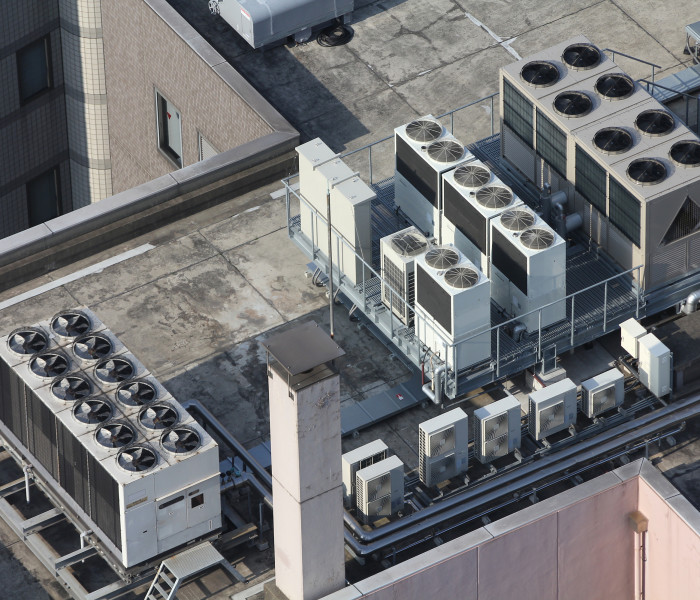
As a result of the technological improvement of the two-unit design, the concept of a multi-split system has appeared and is successfully applied. This type of air conditioner device is different in that several compressors with condensers and multi-way valves can be used in one working infrastructure. Multi-component systems allow you to control from one indoor unit, while controlling the operation of several external modules.
The general concept of an air conditioning device

This is an electrical device, the list of the main tasks of which includes maintaining comfortable climatic conditions in rooms for various purposes. In addition, there are small-sized air conditioners for vehicles and industrial equipment. The bulk of these devices is a class of household and industrial models. In the second case, the intended use is somewhat different than in the domestic segment. But in both categories, the basic concept of an air conditioner can be represented as follows: an electrical appliance, the work of which is aimed at regulating the temperature regime in a certain range. According to the standards, climate control equipment must provide the ability to control the temperature in the range of 17-25 °C. At the same time, modern devices are able to support modes in the range from -5 to 40 ° C. In addition, multifunctional devices also regulate humidity (coefficient - 50-60%), air mass mobility (up to 0.15 m / s) and even the content of certain gases (for example, oxygen).
water cooled
Precision air conditioners that use water for cooling are not equipped with a heat pump. Heating of rooms is carried out thanks to the electric heaters integrated into these models.
This type of precision air conditioners has the simplest design (it is a monoblock) and has a lower price. In addition, its installation will not cause inconvenience - it can be carried out in any part of the room where water can be supplied. The main advantage of water-cooled precision air conditioners is the independence of its operation from the weather conditions outside the building.
Air supply and intake
Air masses, moving through the heat exchanger in which the refrigerant is located, cool down and enter the room. Such installations are of two types: with bottom and top air supply.
- Surface feed installation.
Air intake into such a device comes from a room, from air ducts or through an air conditioner panel. Air is supplied to the free space of the ceiling and thus air is exchanged, while these units have a simple system and an extended set of capacities.
- Conditioner with bottom feed.
This device allows handling maximum air masses and alternating them through the floor space.
The noise level of these air conditioners is reduced by scroll compressors, fans and the shape of the evaporator face.
The air supply unit and refrigeration units are located in different places of the air conditioner, which reduces the noise level. For the movement of air masses, fans with electronic and step speed control are used.
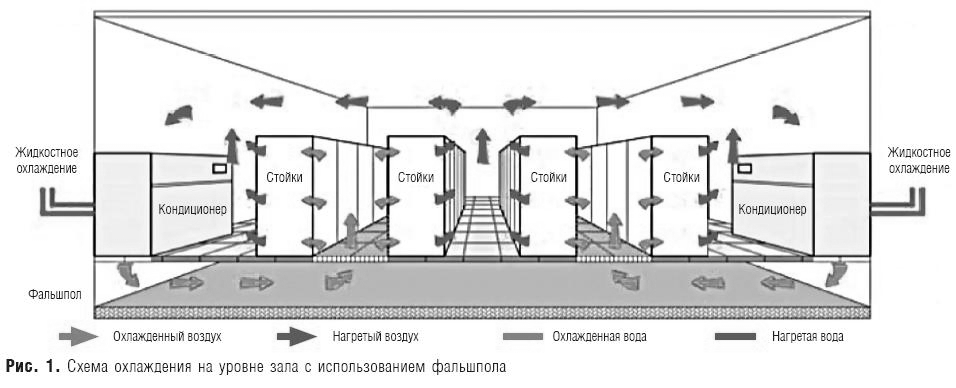
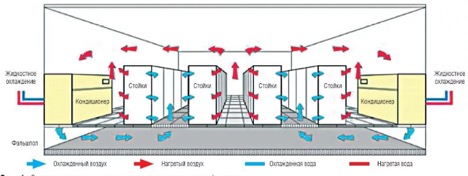 Cooling scheme at the hall level using a raised floor
Conclusion

In order for the air conditioner not to disappoint during operation, it is necessary to approach its choice correctly. Experts recommend considering this issue as a whole, taking into account the functional content, features of the workflow, the possibility of regulating individual microclimate parameters, etc. Of course, power consumption is also important. What is an air conditioner in terms of energy consumption? On average, such devices consume 0.8-1 kW / h. It must be taken into account that approximately 1 kW of cooling power It goes to the maintenance of premises up to 10 m2. If we are talking about evaporative models, then this figure can be reduced to 0.8 kW, since its principle of operation is less costly in terms of energy resources.