
- Conventional and inverter air conditioner: differences
- Operation of a conventional air conditioner
- The principle of operation of the inverter system
- Differences are known in comparison
- inverter air conditioner
- Conventional split system
- Which cooler is better to choose
- Power and space
- What are inverter split systems
- How is it different from a conventional air conditioner
- Pros and cons of inverters
- How compresses work in an inverter air conditioner
- Video description
- Briefly about the main
- Preventive work
- Household split air conditioner
- How to choose the right inverter air conditioner
- Air conditioner inverter or conventional
- Popular device models
Conventional and inverter air conditioner: differences
Before deciding for yourself which air conditioner is better, you need to get acquainted with the “different varieties” of wall systems.
Operation of a conventional air conditioner
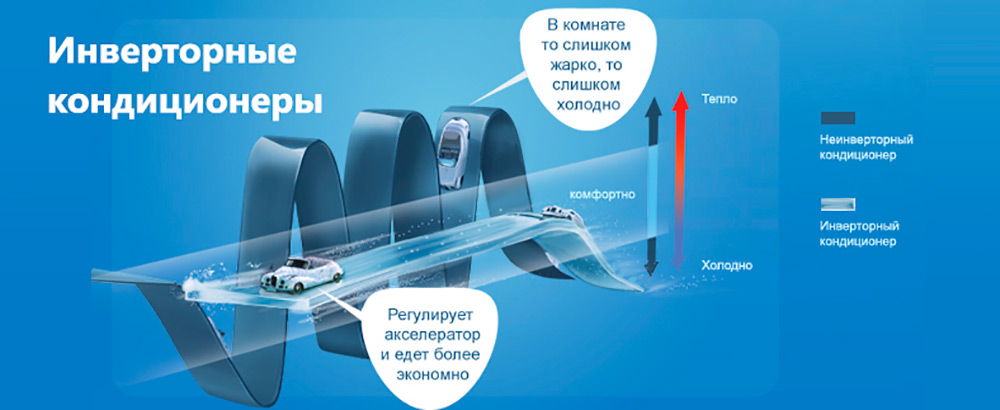
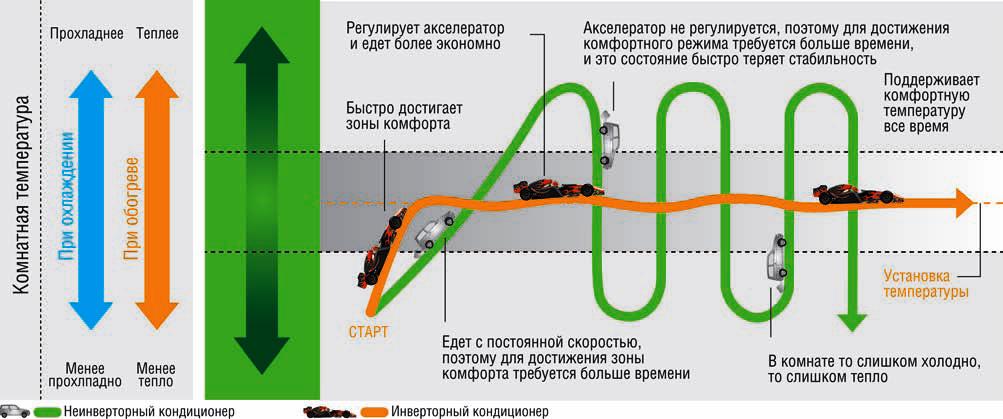
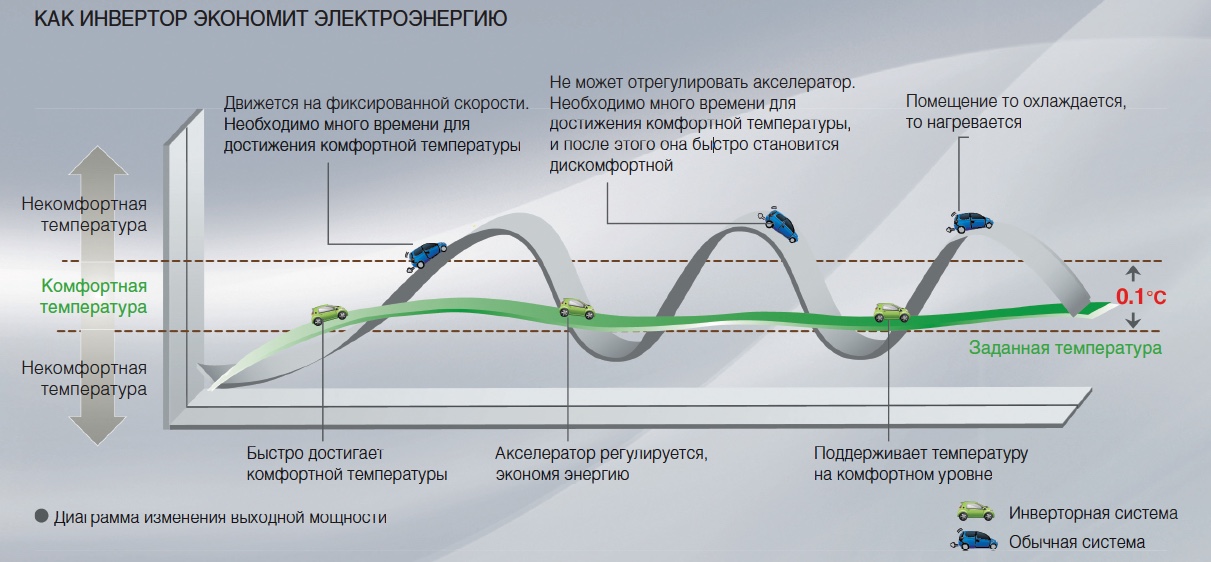
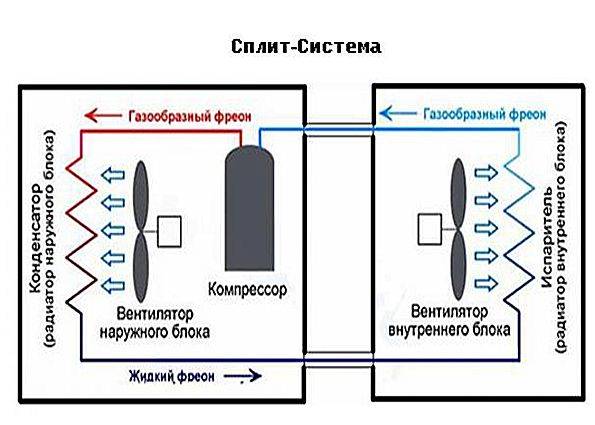
This equipment either works or it doesn't. When the required temperature is reached in the room, the system switches off. Freon "rests", and only the fan continues to work, so the air conditioner still provides the movement of air masses. If the optimum temperature changes (decreases or rises), then the compressor starts up again, forcing the refrigerant to move along the line. When the ideal is reached again, the compressor "calms down" again.
The principle of operation of the inverter system
Such a split system, unlike the usual one, “works” tirelessly. After starting, the equipment does not gain power immediately, but gradually. When the set temperature is reached in the room, the air conditioner only slows down, but the refrigerant continues to move through the pipes, cooling slightly. The fan also does not stop, helping to maintain the temperature at the right level. When operating an inverter system, compared to a conventional system, the cost of electricity is “maximally minimal”.
Differences are known in comparison
To find out and understand which air conditioner is better, you need to compare the characteristics of both models.
Noise. Everyone (sellers, manufacturers) convince potential buyers that inverter air conditioners are quieter than conventional ones. They are right, but this difference is difficult to catch by ear: it is 5 dB, no more. In both cases, the indoor unit does not make too much noise (18-25 dB). More noise level depends on the brand, operating mode, model power, etc.
Saving electricity. In this case, the difference is noticeable. To maintain the desired temperature, an inverter air conditioner needs 10% of the power, when compared with working at maximum. A conventional split system is constantly turned on, so the device has to spend additional resources to “accelerate” the refrigerant, to overcome the resistance of the cooled oil. The difference is significant: it is 20-25%. In some cases, up to 30%.
Lifetime. Any equipment will work longer if it does not experience maximum loads when starting at full power.
To a greater extent, this applies to the most important (and therefore expensive) device - the compressor.If it fails, then it is more logical, more profitable to buy new equipment
The compressor of a conventional air conditioner turns on several times a day, which accelerates its wear. Devices in inverter systems, as a rule, last three times longer (by 30-40%).
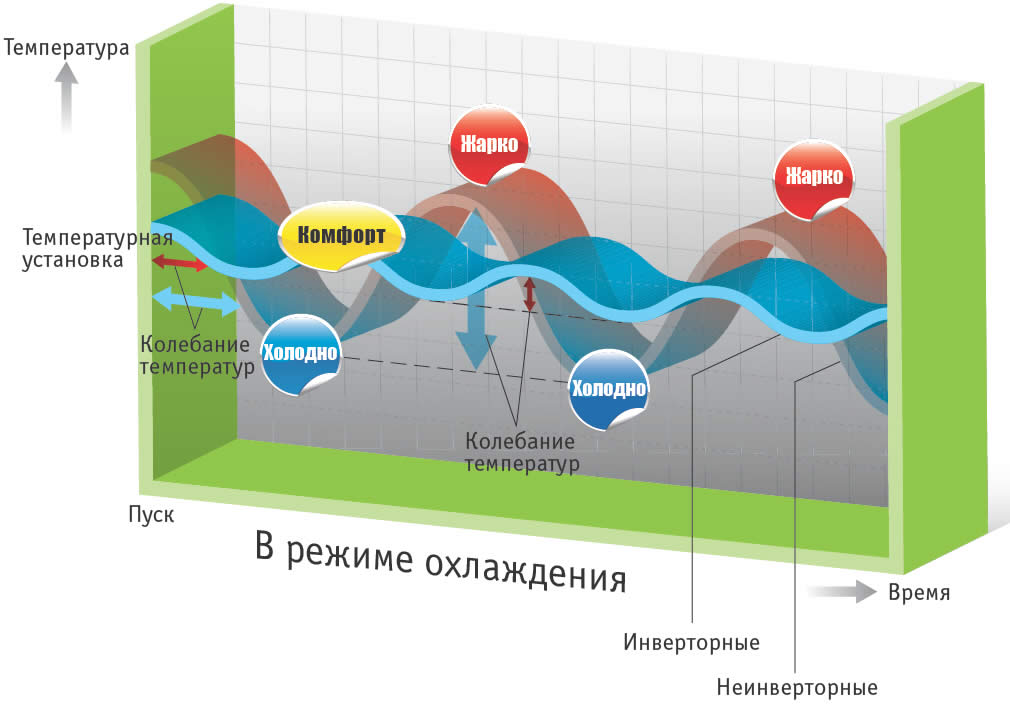
Temperature fluctuations. Here the competition is also won by inverter air conditioners. In this case, the difference in maximum oscillations is 1.5°. The reason is the constant control by the compressor, which, when changed, instantly changes the speed of freon. Conventional equipment is switched on if the difference is 1°, but the temperature of the blown air rises by 3-5°. The reason is the inability to start working at minimum power. This difference is noticeable if the person is close to the indoor unit.
Inverter equipment "puts on the blades" of a competitor in other categories as well. Due to the work without constant and serious loads, these air conditioners fail less often, their energy efficiency is 20-30% higher. The only advantage of conventional split systems is their price. However, high-quality inverter models are now being produced, the cost of which is quite acceptable.
inverter air conditioner
Its advantages:
- quieter operation of the outdoor unit;
- no temperature fluctuations;
- long service life;
- economy.
Minuses:
- expensive repair / replacement of the compressor;
- higher price.
Conventional split system
Her virtues:
- low price;
- cheaper compressor replacement/repair.
Flaws:
- temperature fluctuations;
- greater consumption of electricity;
- more noise during operation of the external unit;
- risk of malfunction due to increased loads.
Which cooler is better to choose
Regarding the choice of a split system, we will give a few recommendations:
- The inverter is appropriate in living rooms where no more than three people stay at the same time - a nursery, a bedroom, a living room.
- For a kitchen, large hall or office, it is better to take a traditional air conditioner.
- If the budget is limited, it is worth buying a classic model from a reliable manufacturer. A cheap inverter from the Middle Kingdom will cause a lot of problems, ranging from noise to repairs.
- Do not hope that the inverter version of the "split" will replace the full-fledged heating of the room in winter.
When choosing an air conditioner, remember a simple rule: the higher the cost of the product, the more expensive its repair and spare parts. Instead of a conclusion, we suggest watching a thematic video:
Power and space
To determine the performance of an air conditioner, you can use complex formulas that take into account the number of windows, the number of people in the room, the sunny or shady side of the room.
But it is much easier to navigate by the area of \u200b\u200bthe room.
All household air conditioners by power can be divided into 4 types:
low-power up to 2.5 kW
average power up to 3.5 kW
high power up to 4.5kw
maximum power over 4.5 kW
There is no point in overpaying for the device to work at half strength. In small rooms - nurseries, bedrooms, kitchens up to 20m2, low-power models up to 2.5 kW are suitable.


Here the calculation is very simple. For every 10 m2 with a ceiling height of up to 3 meters, at least 1 kW of cooling capacity is required. If you have a sunny side, then 1.5 kW.
Start from these data, substituting your quadrature.
Most often, when mentioning performance, sellers simply say 7-ka, 9-ka, 12-shka. What does it mean?
This refers to British thermal units BTU. For them, the formula 1BTU \u003d 0.3W applies.
What are inverter split systems
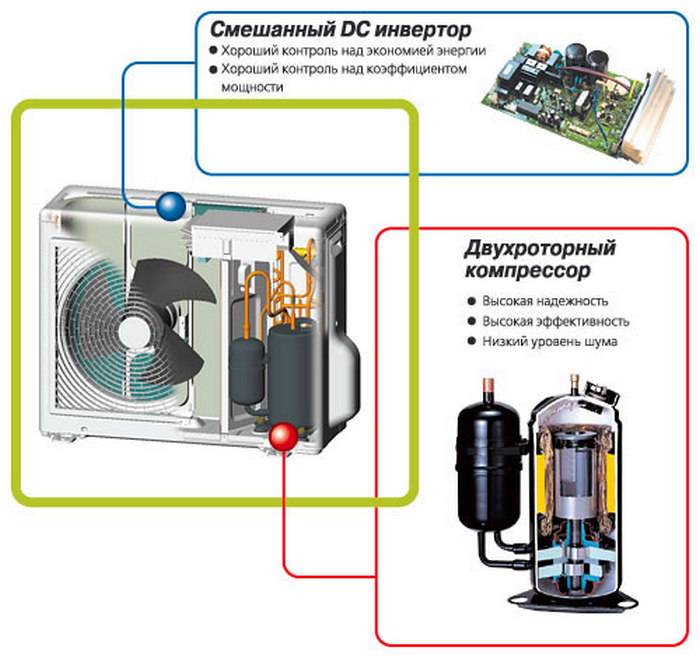
Inverter household appliances, although they appeared recently, managed to find supporters. In any split systems, the most vulnerable node is the compressor. If it breaks, then all the equipment "turns" into an ordinary fan, which does not really perform its functions.
Inverter models use a revolutionary way to control the motor - using an electronic system.
This means that the technique independently sets the speed at which it should rotate, based on the ambient air temperature.
How is it different from a conventional air conditioner
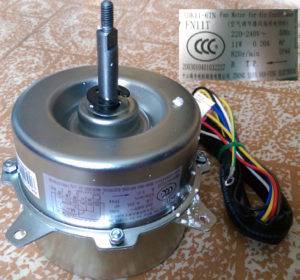 air conditioner motor
To understand the differences, you should familiarize yourself with how an ordinary linear air conditioner functions:
- standard models of climate technology are in the on or off state (on / off). It is worth turning on the air conditioner, it starts working until the set temperature level is reached in the room, then it turns off. But, heat constantly “leaves”, so the equipment has to work again, which is a minus of conventional devices;
- inverter models of air conditioners operate in continuous mode, that is, there is no “on or off” definition for them. Power control (motor rotation) is performed by an inverter that converts AC to DC and vice versa.
The task of the converter is to change the voltage, on which the speed of the motor depends. It also smoothly regulates the degree of cooling, based on data from temperature sensors installed on the air conditioner.
After turning on the equipment for the first time, it will work at full power until it reaches the set temperature.
As soon as this happens, the motor will start to operate at minimum speed, maintaining the set mode. This reduces the load on the compressor and saves energy.
Pros and cons of inverters
 Inverters have a low noise level
An inverter-type air conditioner has a lot of advantages that can be appreciated after a short period of use:
- unlimited working time (classic without pauses can work no more than 8 hours a day);
- does not cause network congestion. Reduced load - energy savings (30 - 50%);
- economical (there are no so-called "idle loads");
- precisely maintains the set temperature;
- the generated air flow has a more gentle effect (when the "air conditioning" mode is on, the temperature of the outgoing air flow is in the range of +12 - 15 degrees Celsius;
- low noise level. This value is 19 - 23 dB, while the classic models have 30 - 32 dB;
- long service life;
- inverter equipment can heat the room even at temperatures of -25 degrees.
Of the minuses:
- soft thermoregulation is a feature that is not applicable to every room. For a bedroom or a children's room, such an air conditioner is best suited, but it makes no sense to install it in an office or any other public place where windows and doors always open / close (convector devices will do);
- inverter equipment is not suitable for the kitchen, as its operation may be disturbed by the heat generated by the stove or kettle. Climate technology is sensitive to constant changes in temperature;
- maintainability.Yes, you can fix it, but it will cost a lot. For example, for the replacement of the electronic board alone, you will have to pay about 10,000 rubles;
- high price. Innovative technology "beats" the pocket, so it is not available to everyone.
How compresses work in an inverter air conditioner
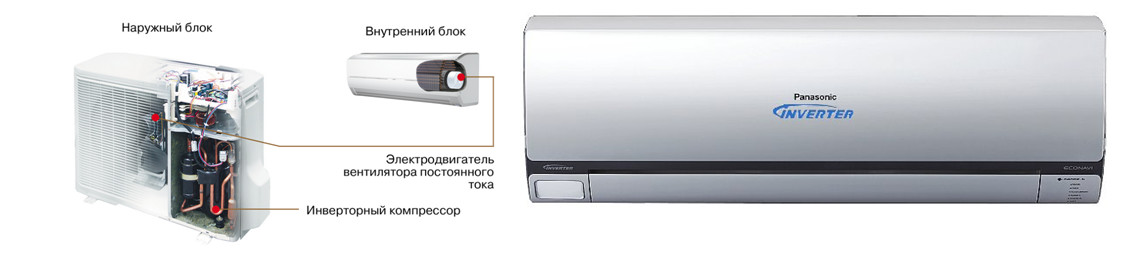
Let's start with the fact that the principle of air conditioning in inverter air conditioners is exactly the same as in conventional ones. Therefore, there is no point in arguing here. The two units differ in the principle of operation of the compressor. Therefore, the first question that needs to be answered is what is an inverter in an air conditioner. Because this device is not in conventional split systems. The name comes from it.
Inverter in outdoor unit
On our website you can find contacts of construction companies that specialize in the design and installation of ventilation and air conditioning systems. You can directly communicate with representatives by visiting the exhibition of houses "Low-Rise Country".
So, what functions does the inverter perform in split systems? He has one task - to change the voltage supplied to the compressor. What happens in this case with the latter:
- as soon as the temperature sensor has transmitted a signal that the temperature in the room has reached the set value, the inverter starts to lower the voltage;
- at the same time, the compressor does not stop working, but the speed of the electric motor decreases, respectively, the speed of the compressor decreases, it starts to work more slowly, which leads to a drop in the pressure of the refrigerant inside the system;
- a decrease in freon pressure leads to a decrease in the speed of its movement, and this entails a decrease in the processes of heat transfer in the condenser and cold in the evaporator, that is, the air conditioning process fades;
- as soon as the room temperature begins to rise and passes the set value, the temperature sensor sends a signal to the inverter, which raises the voltage for the compressor motor;
- the latter begins to gain momentum, bringing them to the required ones, at which the air conditioner starts to operate normally.
Inverter air conditioner runs smoothly
That is, we get the following that the compressor does not stop its operation, which means that its parts are always in oil, extending its service life. This is the first. Secondly, there are no power surges at the starting torque, which increase the value of the consumed voltage. And this in some situations is a serious savings in electric current consumption, which can reach up to 30%. This is why inverter air conditioners are considered to be in the category of economical household appliances.





The advantages include low noise values, and the absence of loads on the electrical networks in houses, and more accurate temperature control up to 1 °. Experts also note that inverter split systems cool rooms faster, they have almost twice the service life of conventional units, and they can operate at -25C outside. Usually devices operate at -10C, not lower.
Benefits of an inverter air conditioner
And a few words about the disadvantages of inverter air conditioners:
- they cost 40% more than conventional counterparts;
- more complex electronics system;
- react worse to power surges, although today many manufacturers have solved this problem with the help of a power surge protection unit;
- difficult to repair, spare parts are expensive.
Pay attention to the first item in the list of disadvantages. It is the price that does not allow manufacturers to completely switch to the production of inverter air conditioners.
Therefore, when inverter and conventional split systems are compared - which is better, not all of their preferences are given to the first. Especially consumers in the southern regions, where the compressor is rarely turned off and on due to the difficulty of achieving the required indoor temperature. This is again due to the high air temperature in summer.
That is, it turns out that everything depends on money. If finances allow, then the best option is an inverter air conditioner. If there are problems with money, then the usual one will do. After all, the main task in the summer is to cool the premises and create comfortable living or working conditions. Both options will serve faithfully for many years. The main thing is to ensure a competent installation.
Video description
The video talks about how an inverter air conditioner differs from a conventional one:
Briefly about the main
So, we figured out the question of what an inverter air conditioner is, and how it differs from a conventional one. Many believe that the inverter version is a new generation device. And they are mistaken in this, because the very principle of conditioning is not changed here. The issue of increasing the operational resource of both the unit itself and the supply network of electricity has simply been resolved. Other than that, it's the same conditioner.
Preventive work
Even a state-of-the-art air conditioner can fail without proper maintenance.
It is important to know that inverter-controlled split systems require certain maintenance rules to be followed.
- Do not allow liquid to enter the cold circuit. This is fraught with the formation of acid, which will corrode the insulation of the engine.
- It is important to constantly monitor the level of oil and refrigerant used. Freon will decrease - the pressure in the system will also drop, which means that the device will start to work for wear.
- Regular cleaning of the heat exchanger is also important, because the accumulation of dirt is a direct path to its overheating, pressure increase and load.
Information about what inverter split technology is allows you to understand the prospects for its use in all its beauty. But is it worth it to overpay for its purchase? The answer will be this: with a small budget, it is better to opt for conventional air conditioners, but of the highest class. There are service centers available where they can provide qualified assistance.
Air conditioners of this type can be recommended for installation in apartments - residents will appreciate the "soft" cold and quiet operation. But if there are constant power surges in the house, it is better to refuse such a purchase. And one more thing: it is not worth thinking that the device will quickly pay for itself due to its energy-saving consumption. According to experts, such a period should be at least 5 years - during this time, no equipment is insured against breakdowns and overloads.
Household split air conditioner
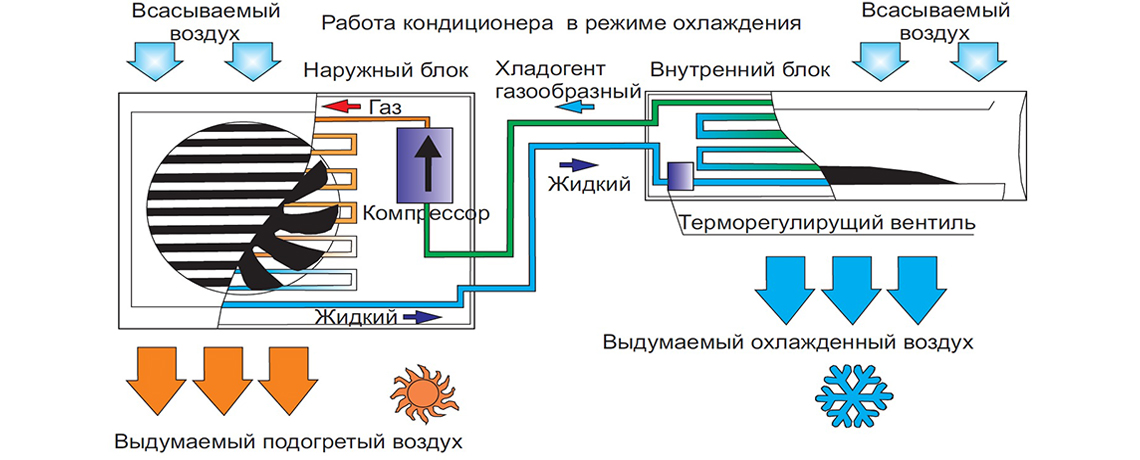
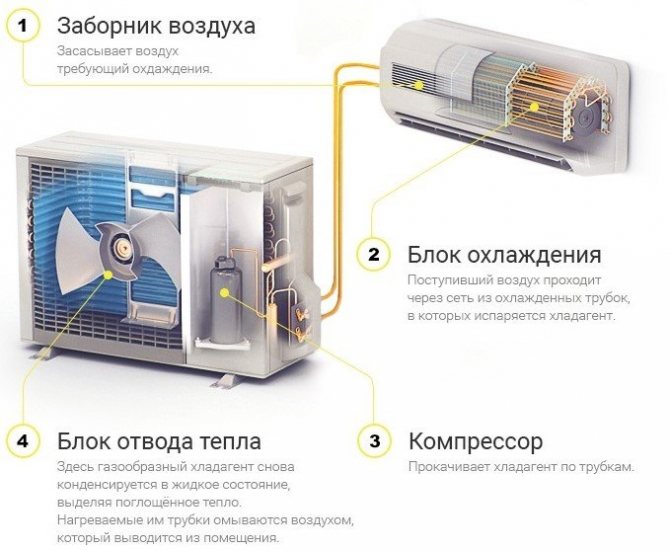
Today, split-construction is the most efficient and low-noise climate system. The noisiest unit - the outdoor one - contains a compressor that compresses the refrigerant to a pressure of 20 atmospheres, and the main fan, which immediately removes heat from the compressed freon.
If the fan does not blow out the heat from the heated freon in time, it will overheat in a few minutes or half an hour or an hour to a temperature above the critical one, and the coil will break through at the weakest point (the joint or at one of the bends). To this end, the outdoor fan is made with large impeller blades, rotates at a decent speed and produces noise up to 30-40 decibels. The compressor, compressing freon, adds its own noise - and increases its overall level to 60 dB.
The indoor unit of the split air conditioner contains a freon evaporator, which is strongly cooled when the refrigerant liquefied by the compressor of the outdoor unit changes into a gaseous form. This cold is picked up by the air flow created by the indoor fan propeller and blown into the room, due to which the temperature in the room is 10 degrees or more lower than outside. At +35 in the summer heat outside the window, you will get +21 in the room in half an hour. A thermometer inserted into the slightly open curtains (blinds) of the indoor unit will show +5 ... +12, depending on the level of workload of the entire split system.
Through the pipelines, or "route", liquefied (in a smaller diameter of the tubes) and gaseous (in a larger one) freon circulates. These pipes connect the coils (circuits) of the external and internal blocks of the split air conditioner.




A type of split system used in private houses and all-weather summer cottages is a floor-to-ceiling structure. The outdoor unit is no different from a wall-mounted split system, and the indoor unit is located either in the ceiling near the wall, or a few tens of centimeters from the floor.
The temperature indicators of the units are read every second by thermal sensors located on the coils, the compressor and outside on the indoor unit of the air conditioner.They are transferred to the electronic control module, which manages the work of all other units and units of the device.
How to choose the right inverter air conditioner
Despite the listed shortcomings of inverter split systems, their popularity in the Russian markets is growing every day. And the point here, perhaps, is not at all that the principle of their operation allows saving electricity consumption by almost 30%. These devices create the optimum temperature in the room in a much shorter period of time and maintain it until the device is turned off.
Having figured out what an inverter split system means, you can proceed directly to the choice of such a device. The modern market for these products offers a wide variety of models, among which you can meet both foreign and domestic manufacturers.
It should be noted that all inverters can be conditionally divided into two types:
- Technology of American manufacturers Digital Scroll;
- Japanese development of DC Inverter.
It is not worth delving into the details of which of these two types is better. But, for a more complete understanding, it is worth noting that the Japanese technology is somewhat better than the American Digital Scroll and much more efficient than a standard start / stop device.
When choosing inverter air conditioners, it is necessary to take into account one more important point: air conditioners and inverter split systems are complex technical devices that in no case can be repaired on their own, this business should be entrusted to qualified specialists. Although with competent and proper operation as such, the need for this will not appear.
Summing up, you should once again clearly identify the pros and cons of the inverter split system.
- Significant energy savings due to special manufacturing technology. The air conditioner runs at low speed after the set temperature is set in the room.
- Additional characteristics that create comfortable operating conditions for the device are the minimum noise level, as well as the optimal temperature regime, which does not create drafts throughout the room. This quality of split systems with inverter drive allows you to install such air conditioners in bedrooms, children's rooms, hospitals and other rooms of the appropriate type.
- Stable maintenance of temperature within the range of specified parameters.
- A significant advantage of inverter air conditioners is also that such systems allow you to warm up the room at an external air temperature of -12 C to -15 C.
It is worth dwelling on the last property in a little more detail. Standard models of air conditioning systems are also often equipped with a heating function. But how is a split system different from conventional air conditioners?
Of course, this type of air conditioning system has many more advantages compared to already familiar devices. Yes, the cost, of course, can alert, but is it comparable to the comfortable conditions that create a split air conditioning system.
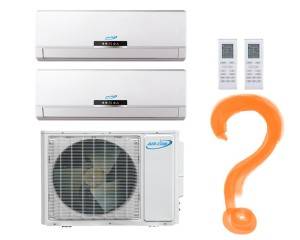
Moreover, this is still the relevant market, mainly filled with products from foreign manufacturers. Already at present, domestic manufacturers are developing similar devices, which, of course, will cost much less compared to foreign counterparts.And this means that soon inverter multi-split systems will become even more affordable, creating a comfortable temperature regime in every ohm and in any room.
Air conditioner inverter or conventional
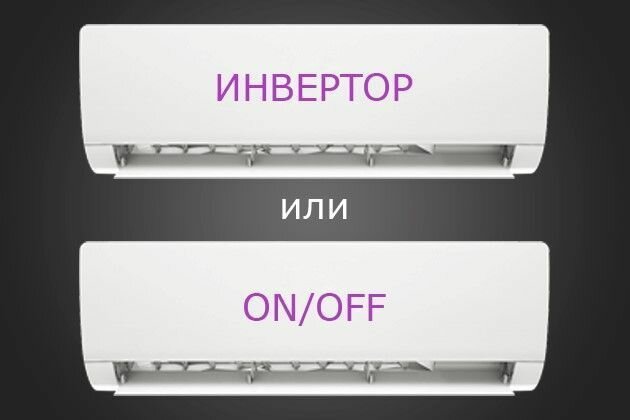
So, the most important choice is to buy an inverter or non-inverter model. What are their differences?
Inverters are more modern products. Their outdoor and indoor units are much quieter.
If you have problematic neighbors who constantly quarrel and complain to all authorities for any reason, then your choice is definitely an inverter option. Therefore, they say that living in a high-rise building, there are two potential buyers for the air conditioner - you and your neighbor.
Some even rest to such an extent that they forbid mounting anything under their windows. We have to take out the route of the freon main and the block itself as far as possible.
Also, if you are going to be heated by air conditioning in winter, in winter, and not only on cold days in autumn and spring, then your choice is again with the inverter.
A conventional air conditioner normally works for cooling when the temperature outside is from +16C and above. It is capable of heating when outside the window is not lower than -5C.
Inverter options will be able to heat your apartment at an outside temperature of -15C. Some models work even at -25C.



In addition, ON / OFF air conditioners periodically turn on and off during operation. Actually, hence their name.
Inverter ones do not turn off at all, but independently maintain the optimal mode, if necessary, smoothly changing their power from 10 to 100%.
As the advertising materials say, this ensures:
significant energy savings
longer service life
However, practically no one will tell you that all this is true when the device is running 24 hours a day, that is, continuously. This scheme works well, for example, in the southern states of the United States.
In our reality, when we leave for work in the morning, we turn off the air conditioner. In the evening or at night, turn it on for several hours. At the same time, both a modern inverter system and a conventional one will work almost the same in this short period of time, at maximum modes.
Therefore, the advantage in the form of significant energy savings can be safely crossed out as a publicized myth. At least for our living conditions and our climate.
The same applies to durability in this mode of operation.
And if it is an inverter, then there are already two masters - a refrigerator + electronics engineer.
A big drawback of fashionable inverter models is sensitivity to power quality.
For dachas, where voltage drops due to accidents in the networks or lightning during a thunderstorm are not uncommon, failure of the air conditioner electronics is the most common problem. Saves only the installation of special protection.
It is not in vain that masters say that it is more difficult to find inverters and spare parts, and the repair itself is more expensive.
In terms of maintainability, the budget inverter is evil. Instead, it is better to take a branded ON / OFF split system from Daikin, Mitsubishi, General, etc. at a comparable price.
Therefore, the only real plus of the inverter is the ability to warm up in winter. If this is not relevant to you, then you should not overpay.
So, the arguments FOR the inverter:
heating
less noise
FOR the normal version:
price
ease of maintenance
Popular device models
Daikin inverter air conditioner
Many manufacturers produce inverter climate control equipment.Air conditioners of such brands are considered the most reliable: Daikin, Mitsubishi, Toshiba, Panasonic. These brands are working to improve and improve the models of their vehicles, increasing their efficiency and reducing noise levels. Japanese-made air conditioners can vary their performance from 25 to 75%, and the most "running" models from 5 to 95%.



Most popular models:
- Daikin. A distinctive feature of Daikin split systems is reliability and long service life. This applies to wall and floor models. At the same time, they do not create much noise - no more than 22-27 dB, and the most popular models are even less - 19 dB. The FTX and FTXN lines are most in demand. All models are economical, equipped with various functions, capable of performing self-diagnosis.
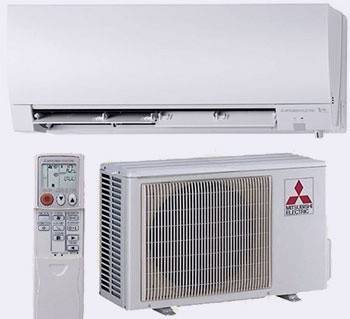
- Mitsubishi Electric. If we take into account the price and reliability when choosing, then Mitsubishi Electric air conditioners are clear favorites among climate control equipment. All of them are tested for at least 20 minutes of work, and selective instances are tested in all respects. There are models of Mitsubishi Electric split systems that are able to heat the room when it is -20 degrees outside the window. Mitsubishi Electric inverter air conditioners consist of two lines - MCZ-GE and MSZ-HJ, which do not differ much from each other.
- Toshiba. If we compare air conditioners from Toshiba and similar equipment from Panasonic, Mitsubishi and Daikin, then Toshiba's more reasonable price immediately catches the eye. At the same time, the split systems of this manufacturer are in no way inferior in quality. The consumer has plenty to choose from, because different lines of inverter air conditioners have their own characteristics.PKVP has an increased track length, and SKVP-ND can work in cold weather down to -10 degrees. There are also standard SKVs.
- Fujitsu. Inverter split systems of this Japanese manufacturer do not require specific maintenance, while they are of high build quality. Low-power models (5-8 kW) intended for residential premises are in great demand. The Fujitsu company, when releasing split systems, equips them with a large set of functions. The equipment can perform self-diagnostics, restart, has a sleep timer, etc.
- Samsung. The Korean manufacturer Samsung, unlike Japanese brands, produces products in a more affordable price segment (economy class). Despite the relatively low cost, Samsung inverter air conditioners are high-quality equipment. The lower price is due to a shorter service life (7-9 years) and a more modest set of functions.
Samsung Inverter Air Conditioner
Inverter air conditioners are a good solution for creating comfort in the apartment. After all, the device works quietly, gently, without creating any discomfort. But this does not mean that you do not need to take care of protecting the apartment from power surges. Also, you should not count on a quick payback of a split system. Despite the high level of energy saving, the air conditioner of any inverter type manufacturer will pay for itself in about 5 years. This is a long period during which any equipment may fail or require repair.



