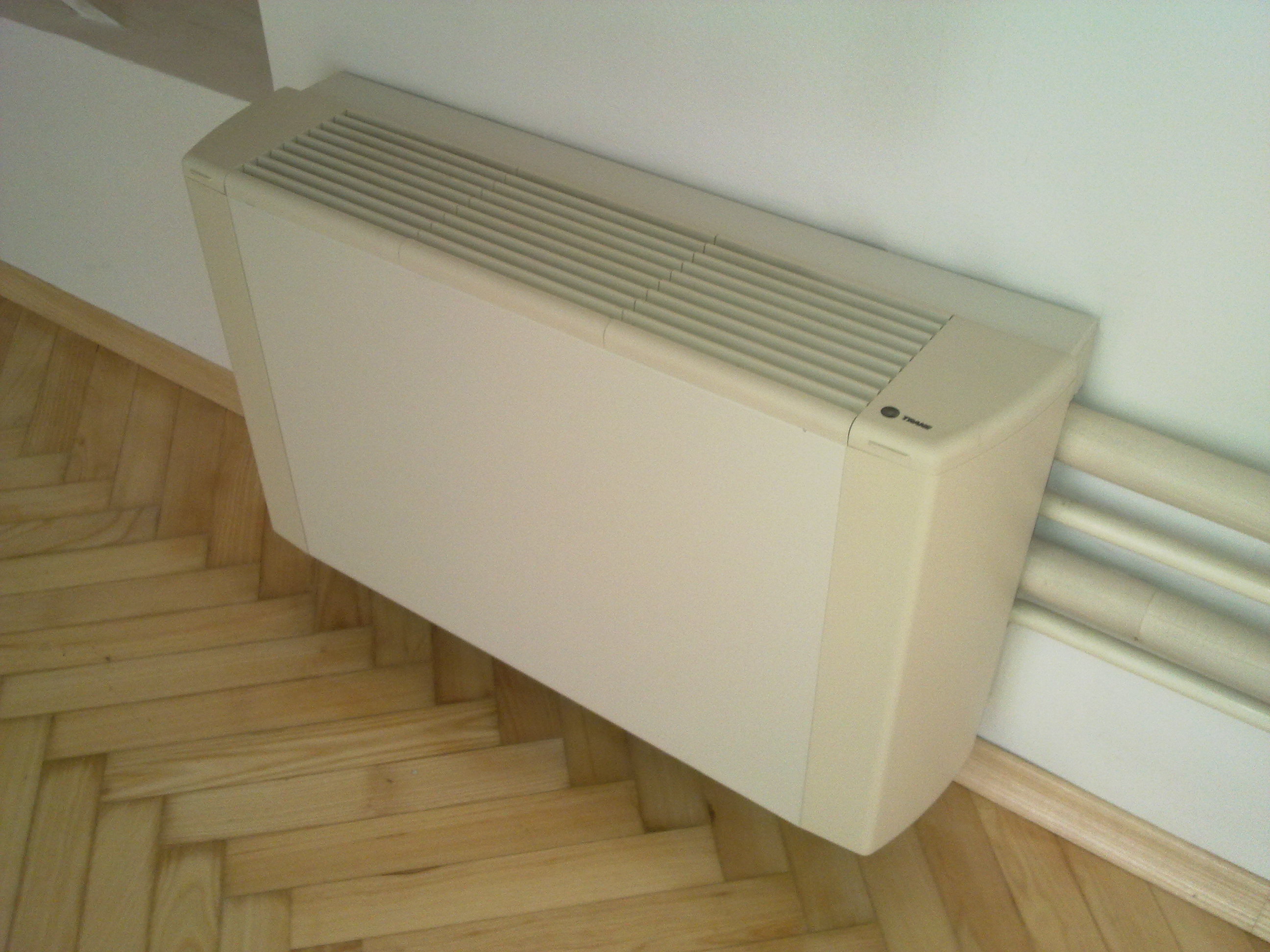
- fan heater
- Principle and features of work
- Advantages and disadvantages
- Round one. Comparison in terms of price and convenience
- fan heater
- Hot inside, cold outside
- The type of heater matters
- Installation of the heating system of a country house
- What is better to choose - a convector or a fan heater
- Features of heaters (video)
- Convectors
- Peculiarities
- What to choose: a heat gun or a convector?
- fan heater
- Convectors - the principle of operation, advantages and disadvantages
- Convector type heaters
- Convectors - device, pros and cons
- Summing up
fan heater
Principle and features of work
The basis of the device is a heating element blown by a fan. As a result, cold air enters the housing from one side, passes through the heater, and from the other side enters the room already heated. To control the degree of heating of the element, a thermostat is used, which turns it off when a certain temperature is reached, and a regulator that sets this value.
Fan heater device1 - body; 2 - heating element; 3 – fan; 4 - regulator
There are several types of heaters:
- spiral;
- tubular electric heater (TEN);
- ceramic.
The spiral heater is a nichrome wire thread wound around a rod, giving it a certain shape. This design has serious disadvantages:
- dust falling on a hot wire burns and emits an unpleasant odor, releasing harmful substances;
- With this heating, the air is significantly dried and loses oxygen.
In heating elements, the hot wire is hidden in a housing in the form of a tube filled with a heat-conducting substance. The use of such a heater is much safer while maintaining high calorific value device.
A ceramic heater is an element made of conductive ceramic pierced by a plurality of honeycomb holes through which the heated air passes. This is the most progressive and safe design, which has higher consumer qualities compared to previous types.
Leading manufacturers strive to give the fan heater an original appearance
Advantages and disadvantages
Fan heaters have the following advantages:
- Low cost.
- Rapid heating of the air in the room.
- Adjustable temperature and heating speed.
The disadvantages include the following factors:
- Noise during fan operation.
- The intense movement of air lifts dust from the surfaces in the room, which gets inside the appliance and burns there, creating an unpleasant odor.
- Heating the air on a hot surface dries it out and burns off some of the oxygen it contains.
- Significant temperature difference in height in the room.
Round one. Comparison in terms of price and convenience
The first thing that the user evaluates is the convenience of using an electrical appliance and its safety.For the average potential owner, this assessment is enough to decide what is better to buy - a fan heater or an oil heater
At the same time, energy consumption and the cost of long-term operation are not taken into account. Therefore, we will make a direct comparison
- Noise level. Net fan heater loss. Although modern models are equipped with horizontal fans or screw turbines, the noise level is significant. The fan heater does not stop, this contributes to the development of fatigue, a decrease in concentration, attention of a person. In addition, with the course of use, the device becomes dirty and starts to make more and more noise.
- Switching modes. Speaking as accurately as possible, both classes of heaters emit clicks, crackles. But with a quality oil heater, uncomfortable noise occurs only when, for example, it was stored upside down or lying down. After being installed in a vertical position, the gurgling and crackling time is short, the device quickly enters the mode and the only sound that is made is the soft start clicks emitted by the thermal relay. The fan heater loudly clicks relay groups much more often. At the same time, a large voltage is switched, the sound is distinct, loud enough, in addition, for many models, the fan motor speed increases at the same time.
- General reliability. Device failures play an important role, and here the fan heater is a frank outsider. It has two temperature protection groups, heaters are subject to constant burnout, lubricant depletion - the fan group, oxidation and drying - regulators. A good oil cooler has only two bottlenecks.A bimetallic plate in the regulator, which will oxidize or burst after ten years, as well as a universal temperature and pressure fuse - in case of any malfunctions associated with overloads and violation of oil pressure, it blocks the operation of the device and must be replaced.
- Safety of use. The fan heater is lightweight, often not equipped with a position sensor. It is easy to brush, drop, break. However, there is no guarantee that it will stop working. And this causes an additional possibility of ignition of objects, short circuits, electric shock. Oil cooler - durable, heavy, solid. It is difficult to drop it, damage it, hurt other objects with it. But the heated elements of the fan heater are covered with grilles, and you can touch the oil cooler heating unit with a temperature of up to 90 degrees. Therefore, in terms of the level of safety of use, both classes have their own niches, where each of them is able to win.
- Microclimate. The fan heater plays with a loud crack. It burns oxygen. In addition, dust is constantly sucked into it, burns on a spiral and emits an unpleasant odor. The oil cooler has no problems. Modern models equipped with a humidification unit are able to improve the microclimate, including saturating the air in the room with aromatic oils.
- Humidifier nozzle, can be used to dry clothes. The comparison can be carried out for a long time. The undoubted advantages of oil coolers, the gain in many positions are visible during operation. But when choosing a model in a store, a fan heater wins, it is cheap, lightweight, compact, you can buy a model of any power.
fan heater
In fan heaters, air is heated by a hot electric coil and a fan that drives air through it.
The heat in the room becomes quite fast, but when it is turned off, it also quickly cools down.
Since the spiral is very hot, this type of heater dries the air and burns house dust.
As a result, specific odors appear. Therefore, in recent years, models with a ceramic heating element, which are devoid of these shortcomings, have become widespread.
In addition, during operation, the fan heater is quite noticeably noisy. So you won't get much sleep with him at night.
Hot inside, cold outside
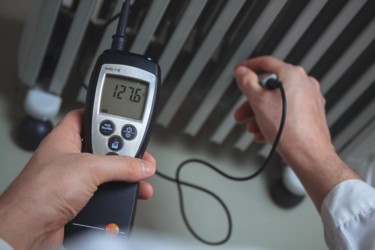
The temperature of the hottest surface accessible to touch is measured.
Accidental contact with the surface of the heater is common. And if the temperature of this surface does not exceed 60 degrees, then there will be no negative consequences. If the body is heated to 120-150 degrees, then the risk of getting burned increases many times over. Especially in young children who are not able to quickly withdraw their hand.
Ilya Sukhanov, Head of the Testing Laboratory of NP Roskontrol:
Our standard sample safety evaluation program includes, in addition to case surface temperature measurements, stability tests and overheat protection trips. In the first case, depending on the type of heater, the samples are placed on an inclined surface or face a certain force (we dose it with a digital dynamometer), and in the second case, we wrap the heater with a thermal cape and monitor its automation.After all, despite the big “do not cover” warning, customers often use heaters to dry socks, underwear or even jackets, which, of course, should not be done. Fortunately, all 13 models of heaters successfully passed the stability and overheating tests (otherwise, the guilty samples would instantly be blacklisted), but who will guarantee the safe operation of heater models outside the test group? So if you see a "do not cover" warning, take it seriously.
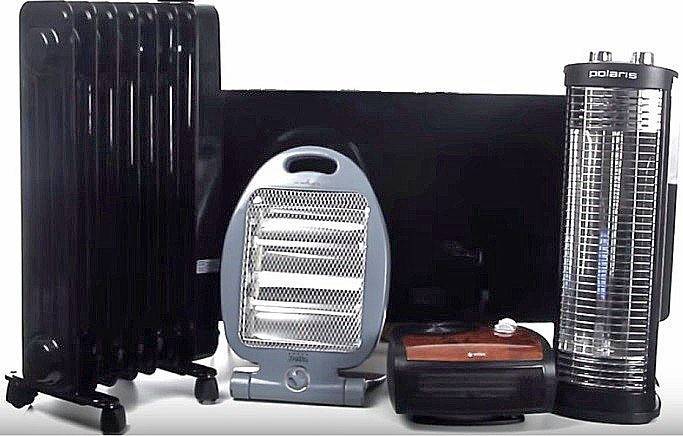

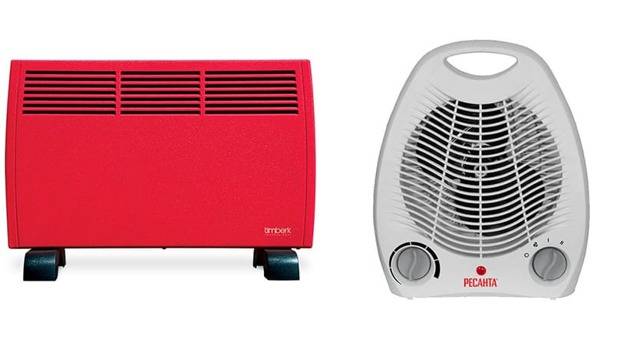

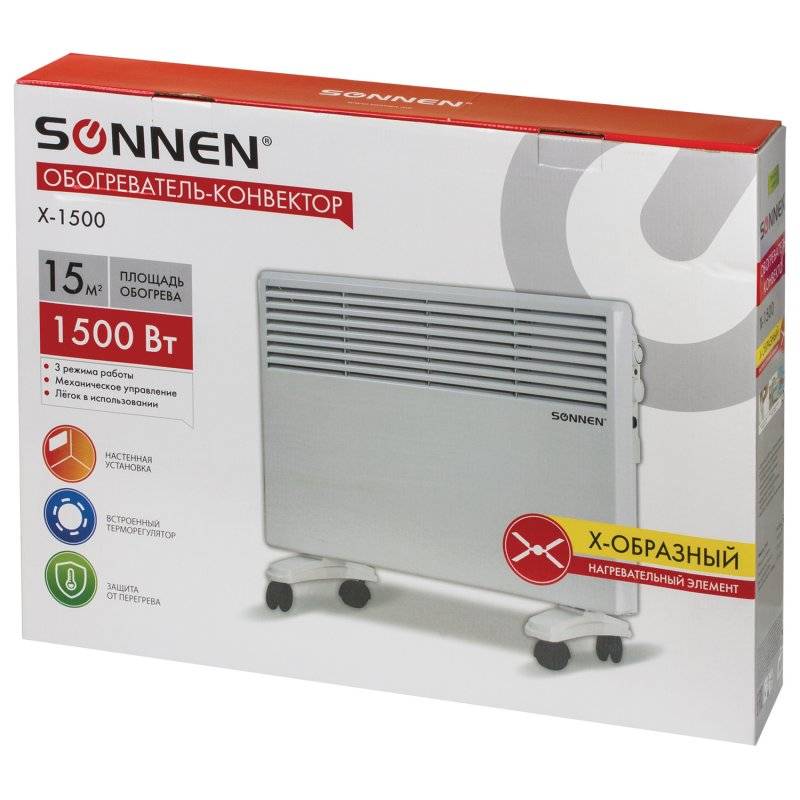

The type of heater matters
Fan heaters and convectors are more often bought for apartments in high-rise buildings, but sometimes they are also needed in houses. In an apartment, the heater serves as the main heating in cold weather, and in a private house, the owner can use it as an additional and / or alternative.
Also, devices are installed in rooms that need a special temperature regime (nurseries, bathrooms, etc.).
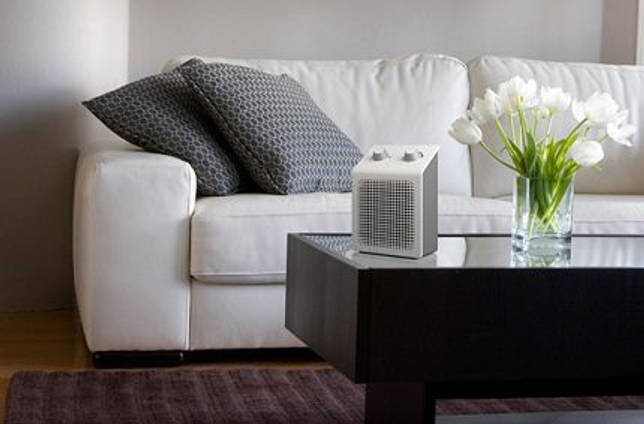
Fan heaters are ideal if you need to quickly warm up the air. They are indispensable in the cold season in cottages, garages, workshops, etc. Convectors require more time, but their operation is more stable, and energy consumption for heating is less
The basis for a meaningful choice of any device is an understanding of the principle of its operation, device, disadvantages and advantages. There is no ideal and universal technique, so you need to figure out which models are best suited for specific operating conditions. You should also decide on your own needs, priorities and expectations.
This is interesting: How to choose an air ionizer for an apartment and a house
Installation of the heating system of a country house
Preparation of heat engineering calculation. Our experts will calculate all heat losses that may affect the performance of the equipment.
If the ceiling height is three meters or less, for 10 sq. m area will be enough 1 kW of power.
A double-circuit boiler will also provide housing with hot water.
If there is no connection to the gas pipeline, we will offer you alternative solutions.
Assistance in the selection of heating devices. Our company works with the brands BUDERUS, Ferroli and Prorherm. This is a high-quality proven technique, choosing which you do not have to worry about possible leaks, sudden power drops, etc.
Our specialists will come directly to the object and advise you absolutely free of charge on all questions that have arisen!
Having decided to order the installation of a heating system, if necessary, you can take advantage of the possibility of payment by installments.
Did our offer seem interesting to you? Or maybe, in addition to installing a heating system for a country house, you need other services that are part of the scope of our company? Place a complex order with us and we will give you a personalized discount.
For more information, please call: 8(495)744-67-74
What is better to choose - a convector or a fan heater
For a bedroom or a nursery, it is better to choose a convector, due to the absence of noise during operation, which is especially disturbing at night. Also, in case of insufficient central heating or its complete absence, it is possible to create a whole network of convectors and set them to maintain the temperature set by the user.
In working rooms, especially in those where, with frequent opening of doors, cold air enters, it is also better to install a fan heater. Moreover, it can be installed under the table and directed to the feet. For installation above a street door in the cold season, a thermal curtain is more suitable. If it is necessary to dry the air in the room, for example, in a country house after winter, it is also more advisable to use a fan heater.
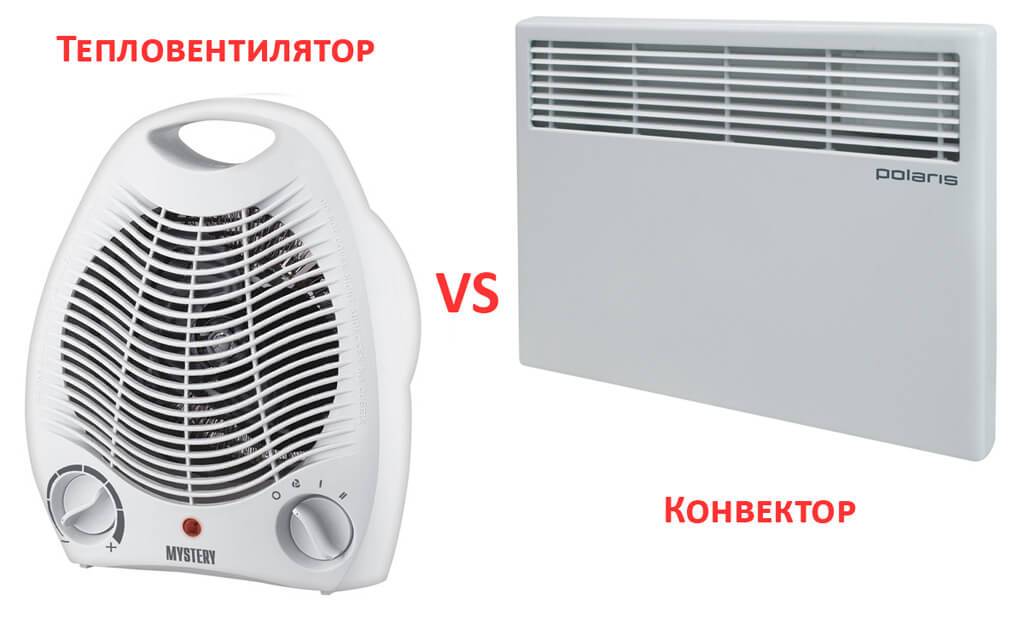
When choosing between a convector and a fan heater, you first need to determine the main purpose of using the heater. For regular and long-term use of the heater, in addition to or instead of the heating system, as well as to maintain the set temperature, it is worth choosing a convector. If an additional source of heat is needed not constantly, but only from time to time, it is worth choosing a fan heater.
Features of heaters (video)
These devices have a low price, which makes them accessible to a larger number of consumers. Devices of various power are produced, which can fluctuate over a wide range. More powerful units are placed on the floor, devices with less power are very compact and can be installed on various surfaces.
The principle of operation of a fan heater is extremely simple. The device consists of a heating element and a fan that moves a large volume of air.
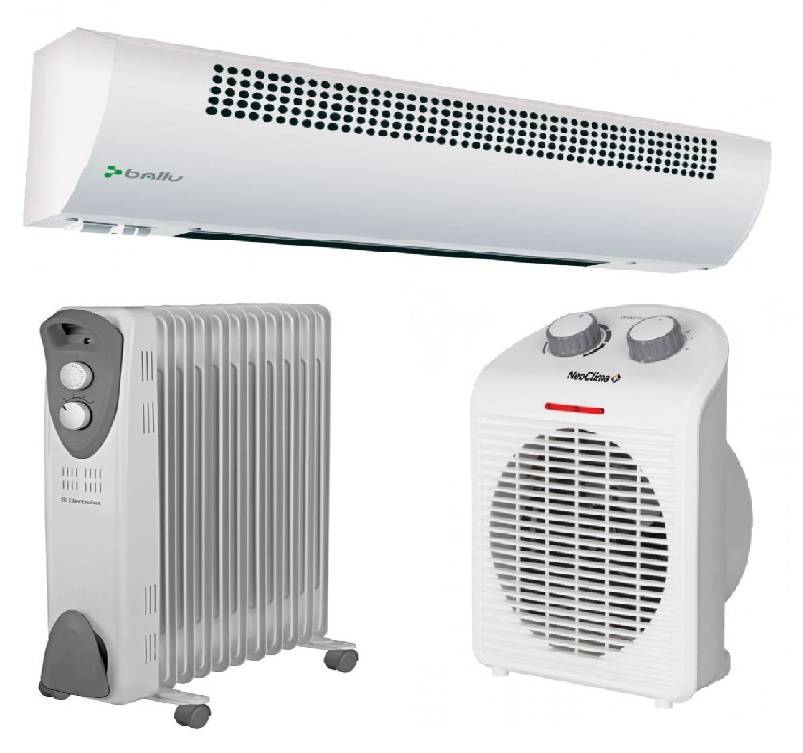




Tubular fan heater
- Electric coil heated up to 800°C.
- Tubular electric heater having an operating temperature of about 200°C.
- Ceramic tiles with heating temperature up to 200°C.
The cleanest air is provided by devices having a ceramic heating element.Fan heaters of other designs, especially those with an open coil, pollute the air with their combustion products. Also, heaters can cause an unpleasant odor that occurs when debris and dust get on the heating element. This is also most common with open coil devices, especially given their high heating temperatures.
The principle of operation of the fan heater
- Low price.
- Compact dimensions, even for high power devices.
- Fast heating of air and its uniform distribution throughout the room.
- Elegant design that allows you to integrate the device into almost any room.
- Ability to perform additional functions.
Proven manufacturers of fan heaters are such brands: Ballu, Bork, Climate, De'Longhi, General, Electrolux, NeoClima, Polaris, Rolsen, Saturn, Scarlett, Supra, Timberk.
Also, when buying, you can use the following tips:
- Models with ceramic heating elements are better in operation, although they are more expensive.
- Appliances with a coarse sponge filter on the rear panel keep the air clean.
- The optimal power of a household appliance is from 1 to 3 kW; for ease of use, it should be smoothly regulated.
- It is recommended to purchase appliances with a well-thought-out safety system, having protection against overheating and equipped with an automatic shutdown in the event of a rollover.
The convection heater also heats the air, but its movement occurs with the help of natural convection, and not forcibly. Cold air enters the unit from below, passes through the heater and exits from above.After that, the air is distributed throughout the room also due to natural processes.
Convection heater device
Various types of convectors are produced - floor, wall and combined. Floor units have wheels for easy movement. When placing the convector on the wall, it is recommended to place it a few centimeters above the floor. This will provide the best heating of the room.
If the device is used in a bathroom or other rooms with high humidity, then you should pay attention to the electrical and moisture protection class. A somewhat special design have devices built into the floor
The advantages of convectors are as follows:
- Ability to work for a long time.
- Multiple placement options in the room.
- The presence of thermostats that allow you to maintain a certain temperature in the room.
- The possibility of combining devices into a heating system;
- Safety of use.
- Quiet operation.
The only significant drawback of converter heaters is the slow heating of the air in the room. This is due to the limited possibilities of natural convection.
Having familiarized yourself with the types of heating devices and their features, you can make an informed choice. If the device requires quick and short heating, then the fan heater will be optimal. If you need a long-term operation of the device, you should purchase a convector. The choice of model is recommended to be carried out according to the technical characteristics of the product.
Convectors
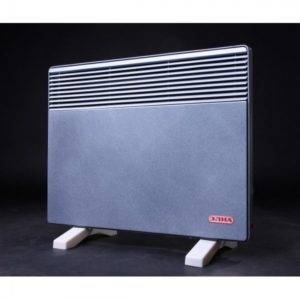
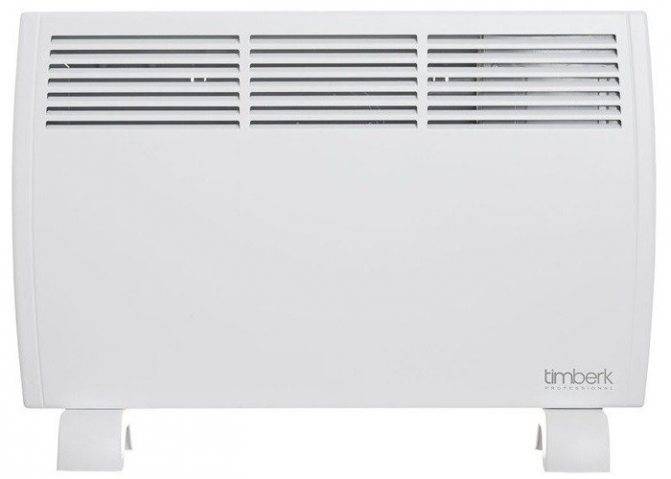
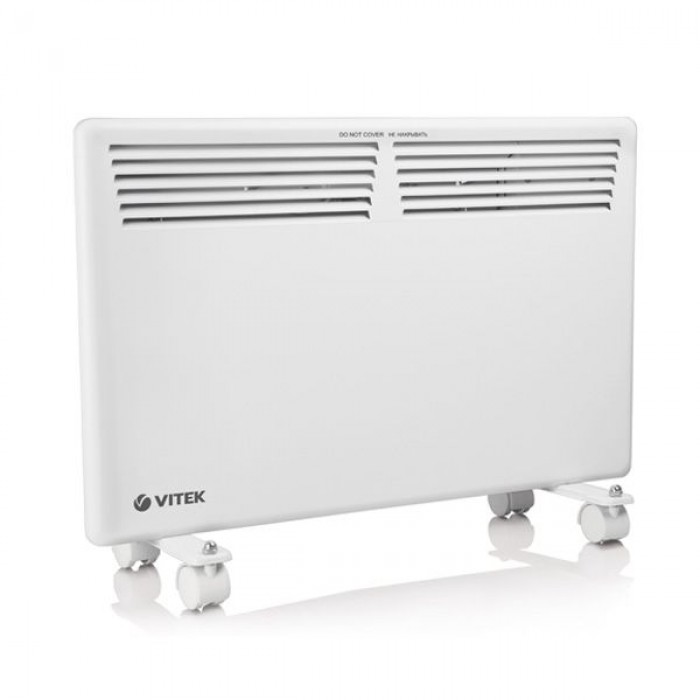
In their work, such equipment is similar to a fan heater. Only in this case, the convector first passes air through the element that heats it, and then blows it around the room.What is the difference? In the absence of a fan that will distribute warm air throughout the room. In this case, the propagation process occurs due to convection, which lifts warm air up. This is also some disadvantage of this device - heating is slow. Convectors look like panels with gratings.
In fact, convectors can be different, depending on what kind of heating element they have:
- heating elements (tubular electric heaters) are an inexpensive device known to many people. Quite reliable, proven by many years of service and inexpensive device;
- needle convector - heats up very quickly, however, it is subject to a serious drawback - it often burns out;
- monolithic convector - works the longest, but is also the most expensive. It is structurally part of the case, therefore, when heated, it expands proportionally with it, which lengthens the duration of its operation for many years. The best convector, of course, is monolithic, despite its cost.


The thermostat is the main device installed in electric convectors. These devices are as follows:
- mechanical. These are cheaper products, but they consume a lot of electricity, and also cannot constantly maintain a certain heating temperature. They make clicking sounds during operation. Basically, these thermostats have a manual switching mechanism. Such devices are the most budgetary on the market;
- electronic convectors operate silently, they consume little electricity. There are remote control models.

Peculiarities
Convectors are usually wall-mounted. You can install them under a window, as a well-known radiator, or in any other place. Many models can be mounted on the legs that come with them. Electric converters have the shape of a parallelepiped with different sizes - low, long, high, narrow. Often they are placed under windows in order to cut off cool air from the windows. Convectors with a moisture-proof housing can be used in bathrooms.

An electric convector can be equipped with some useful features:
when dropped, it turns off.
This is important when the convector is left unattended;
ionizes and humidifies the air;
filters the air, removing dust that floats in the air. The best option for a convector is one that has a monolithic heater, and electronic control cannot be ignored
Such a heater will cope quite well with maintaining a comfortable temperature, and at the same time it will not use a lot of electricity.
The best option for a convector is one that has a monolithic heater, and electronic control cannot be ignored. Such a heater will cope quite well with maintaining a comfortable temperature, and at the same time will not use a lot of electricity.




What to choose: a heat gun or a convector?
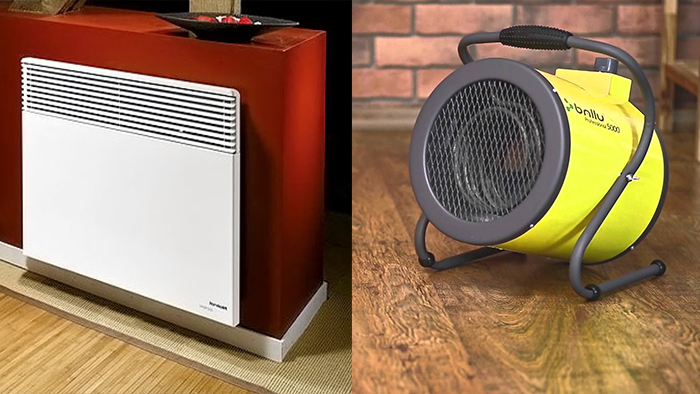
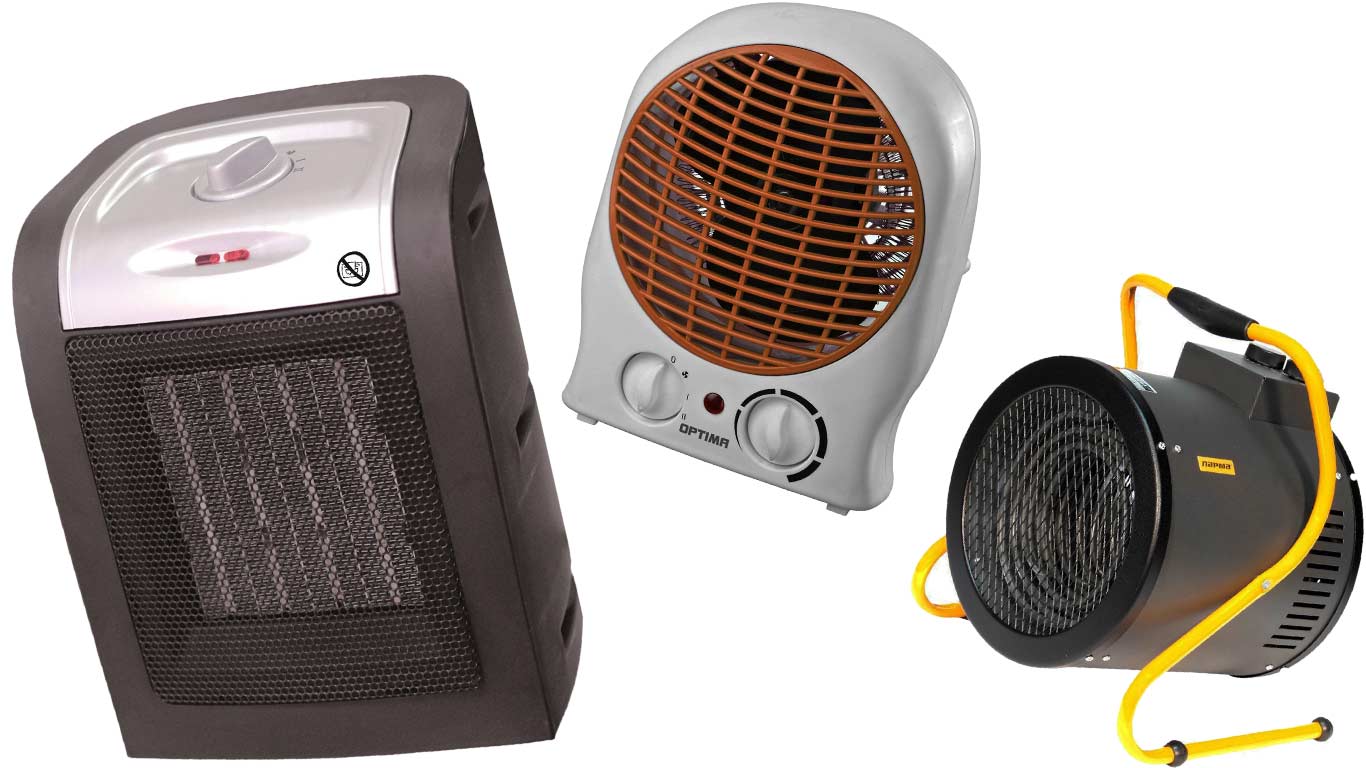
When the analysis begins on the topic: a fan heater or a convector, which is better, the strengths and weaknesses of each type of device are weighed. Heat guns are based on a fan of a certain power, which moves warm air at high speed.
The power of such equipment starts from 5 kilowatts, so the devices are quite powerful and productive. The device is most widely used in construction. In particular, at such facilities where there is no possibility of connecting to electrical energy, but it is necessary to maintain an optimal temperature regime or it is necessary to dry the wall.
The convector does not have an element that forcibly moves air, and this unit uses heating elements of various capacities, and the heated air masses exit the housing through special grooves.
It is important to choose a device with an increased security system and the ability to turn off in case of problems with the hot air supply. If you need to choose and the question arises, which is better a heat gun or a convector, then it is necessary to take the purposes of using the equipment as a basis
Convectors are more convenient and compact, and from them there is a minimum of harm to others, so that they can be mounted in a residential area. Heat guns have tremendous productivity, but are undesirable for residential premises, except perhaps in the process of repair work.
fan heater
The fan, equipped with heating elements, provides heat in the room as well as coolness in summer. The principle is clear and simple, by blowing air on a spiral, heating elements or ceramic plates, the device produces hot air. Fan heaters are floor and desktop, they work from a socket and can be installed in a way that is convenient for the consumer. The direction of the air flow is manually adjusted vertically, and the heat can be automatically started horizontally at an angle of coverage up to 150 degrees.
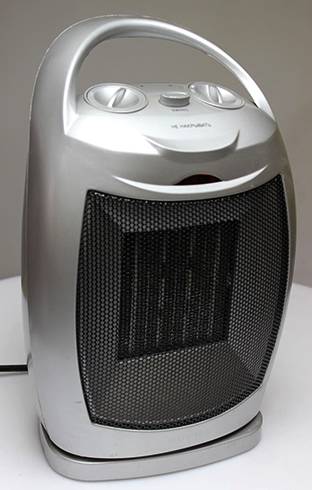
The cost of this type of heater is determined largely by the applied heating element and the level of automation. The cheapest are equipped with an open coil with a high heating temperature, which dries the air and gives off a smell of burnt dust. Fire safety in this case is also not up to par, in the event of a fall or ingress of flammable objects, a fire may occur. In the middle price segment, heating elements are more often used, the temperature of which is significantly lower, respectively, the minuses are less critical.
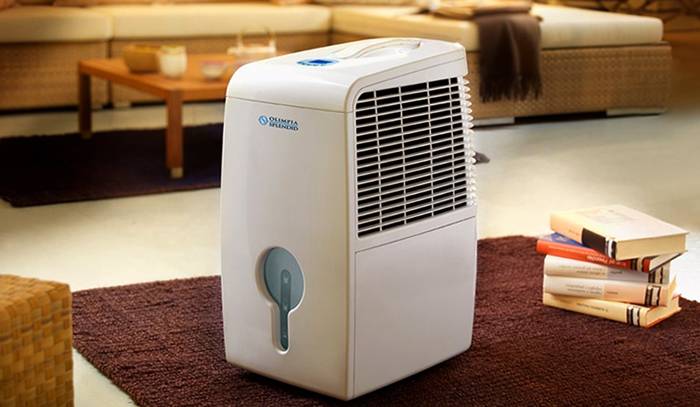
The most expensive fan heaters are equipped with a ceramic heater with a low heating temperature, but due to the large area of \u200b\u200bthe element, heating also occurs quickly. Cool air, passing through such elements, does not lose moisture and does not dry dust, therefore it is more comfortable. Of course, the level of automation and the set of options in this price category is the largest. Of the most important, fan speed control, connection of the number of heater plates, automatic maintenance of the set temperature, shutdown in case of overheating and falling.
In practice, the power of stationary fan heaters is determined by approximately 10 m2 - 1 kW for a standard room. In the case of higher ceilings and on walls that are too insulated, increasing the power by 50% will not go wrong with heat. For portable floor and table heaters this indicator is not so important, because you can move it to any place.
Convectors - the principle of operation, advantages and disadvantages
Convectors are classified according to the type of energy used:
- electrical equipment is the easiest device to operate, since its operation requires only a source of electricity and a competent choice of power;
- gas equipment - the operation of such a device is cheaper compared to an electrical counterpart, but the cost is slightly higher. The connection process is difficult, as a gas line is required.
- floor - the design provides wheels for greater mobility;
- wall-mounted - in this case, for better heating of the room, the device is mounted a few centimeters above the floor;
- combined - such models can be installed in any area of \u200b\u200bthe room.
Convectors are equipped with two types of thermostats - electronic and bimetallic. Thanks to this device, the temperature in the room remains constant for a long time. It is better to give preference to models with an electronic thermostat, which clearly demonstrates the temperature in degrees Celsius. The graduation of bimetallic thermostats is less clear, as it is presented in conventional units.
If the heating equipment is planned to be used in wet rooms, when choosing, you need to take into account the class of protection against moisture and electrical protection.
- Long period of uninterrupted work.
- Possibility of choosing the method of installation in the room.
- The presence of thermostats, through which the temperature regime is adjusted.
- Several devices can be combined to form a heating system for the entire building.
- The equipment is safe.
- The device operates silently.
A significant drawback of convector devices is the slow heating of the air, this is due to the limited possibilities of natural convection.
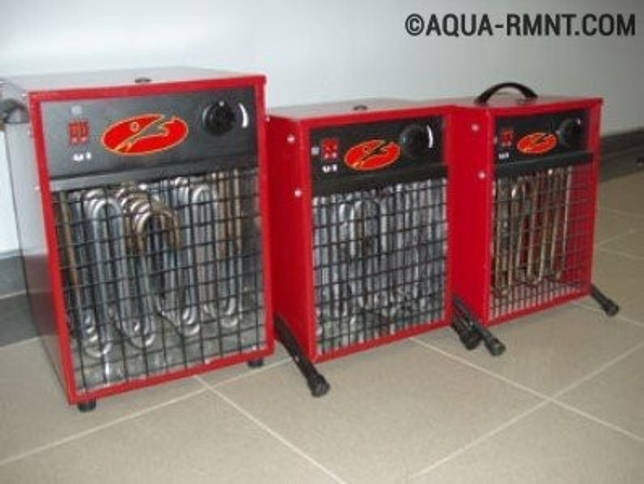
Top brands: Ballu, Polaris, ADAX, NeoClima, Electrolux, Stiebel, Eltron, Timberk, Nobo, Termor, Noirot.
The best choice is models equipped with a thermostat that determine the temperature in the room with an error of no more than one degree.
The main feature of the equipment is its affordable price, which means that
designed for a wide target audience. The product line is represented by models of various capacities, which varies over a wide range. Devices with high power are mounted on the floor, and less powerful units can be installed on different surfaces.
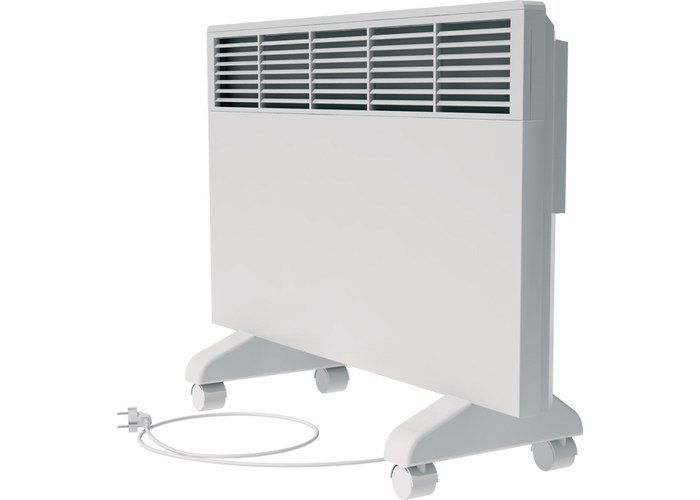


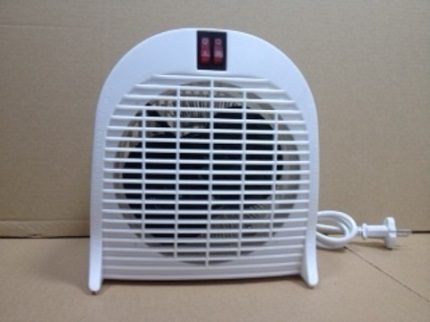

All fan heaters differ in the type of built-in heating element:
- spiral - capable of heating up to 800 degrees;
- tubular element - operating temperature 200 degrees;
- ceramic tiles - heating temperature - no higher than 200 degrees.
It is the ceramic device that is able to maintain the cleanest air in the room. You should not choose models with an open spiral - combustion products will enter the air, and if dust enters the room, an unpleasant odor will appear.
Modern models of fan heaters operate in several power modes, it is also possible to regulate the temperature regime. Models with a built-in electronic control system are equipped with a remote control.
- democratic value.
- Even a powerful device has a compact size.
- Rapid heating of the air and uniform filling of the entire volume of the room.
- The equipment looks stylish and corresponds to modern design solutions.
- Large selection of useful related features.
The disadvantage is loud noise during operation of the equipment. This applies to powerful models, and the operation of cheap devices is accompanied by an unpleasant odor.
Convector type heaters
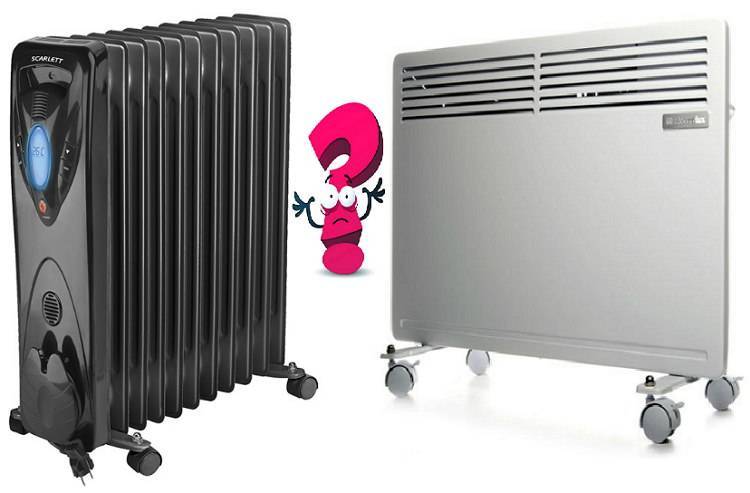
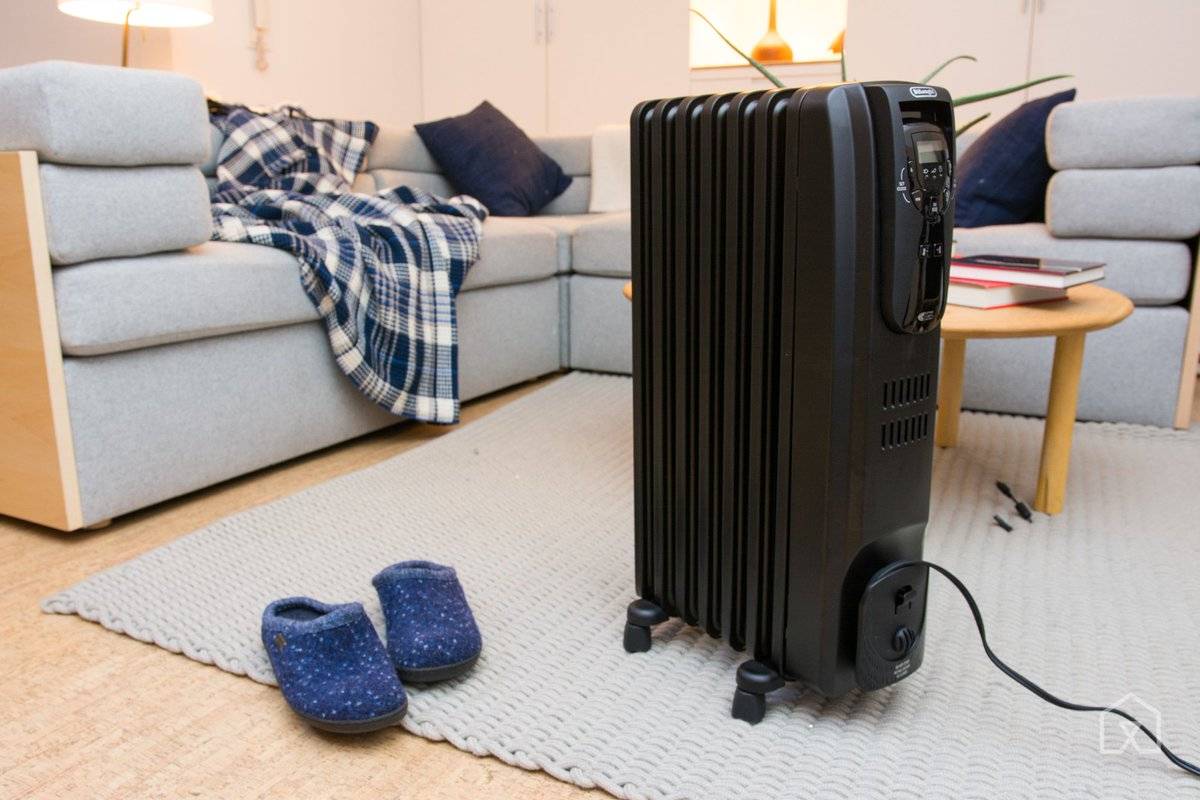
They differ from oil coolers in the shape of the body - they have it flat and smooth. It has a room thermostat, thanks to which the desired temperature is maintained in the room.
Simple convector heaters in a classic design.
Unlike oil-type heaters, which are mainly floor-mounted, convector radiators are mainly fixed to the walls. But there are also floor models - usually they have wheels for movement.
The convector, which has fasteners, can either be hung on the wall or mounted on wheels.
Skirting convectors can be from 15 cm high and 1500 cm long.
Oil heaters radiate heat. Convectors have minimal heat radiation - only from the front panel. And the air is heated by the exchange of heat between cold and hot air masses. In this case, there is a constant movement of air along the surfaces of the heater.
Convectors do not make any noise, their work is based on a natural process - air convection. They quickly and evenly heat the room. Mounting the device on the wall is easy and simple, and if desired, you can install it on the floor. There are convector heaters for both home and office, commercial or industrial premises.
In a convector device, air moves, moving to different heights.Hot, rarefied air flies up to the ceiling, and heavy cold air tends down to the floor. If convection occurs correctly, then constantly there are flows of air masses that heat the room.
This is how air masses move during convection.
The device consists of the following elements:
- Convection chamber (heater body);
- Heating element built into the housing.
Convector heater with front cover removed.
During operation, cold air entering the convector is heated by a heating element. The air becomes lighter, it rises and exits through the upper shutters. Well, in place of the cold room air that has gone up, a new portion comes.
The heated air has the temperature set on the thermostat. It turns on and off the heating element. The efficiency of this device is very high. The slots located on the front panel are designed to release hot air. So that it does not move straight up, but heats the floor and walls, the blinds for its exit are directed downwards. The air does not come out immediately, but accumulates inside and receives excess pressure. After that, it exits the device in a horizontal direction.
Convector heater thermostat.
Since the heating element is specially fixed in the housing, you do not have to worry about grounding. After all, the heating element does not have contact with the metal of the case - between them there are stops made of special heat-resistant plastic. And structurally, the device is made in such a way that the heat in the room is distributed evenly. This achieves coziness and comfort.
For those who cannot decide what to buy a convector or oil heater, it will not be superfluous to know about the advantages of convector heaters:
- These devices are fireproof and meet the requirements of Eurostandard.
- Such heaters placed in each room and combined into one network can be used to obtain a modular heating system. In a country house or in a country cottage, it may well be used instead of a boiler, which is expensive and requires the installation of numerous heating pipes,
- Thanks to the electronic thermostat and various operating modes, you can save a lot of electricity.
Electronic control system and on-off timer.
Convectors - device, pros and cons
Understanding the question of what is better, a fan heater or a convector, it is necessary to understand the design features of these electrical appliances. Convectors are equipment that works by natural convection. They are equipped with powerful heating elements that are responsible for heating the air masses. Due to this, a comfortable atmosphere is created in heated rooms.
When the heating element is turned on, the air around it begins to heat up, becoming lighter. As a result of this, it rises, forcing the colder layers down so that they also pass through the ribbed heating element. After some time, this process becomes intense enough to affect all air masses. And in order for the air not to overheat, its temperature is monitored by automation.


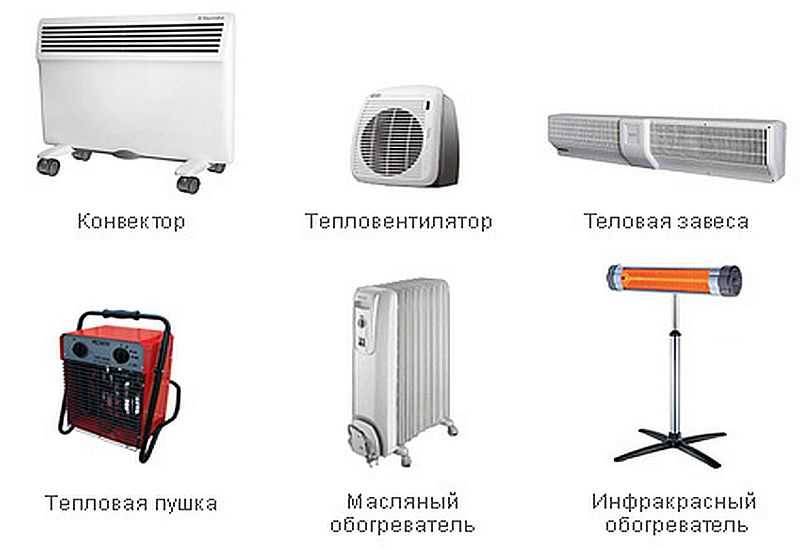
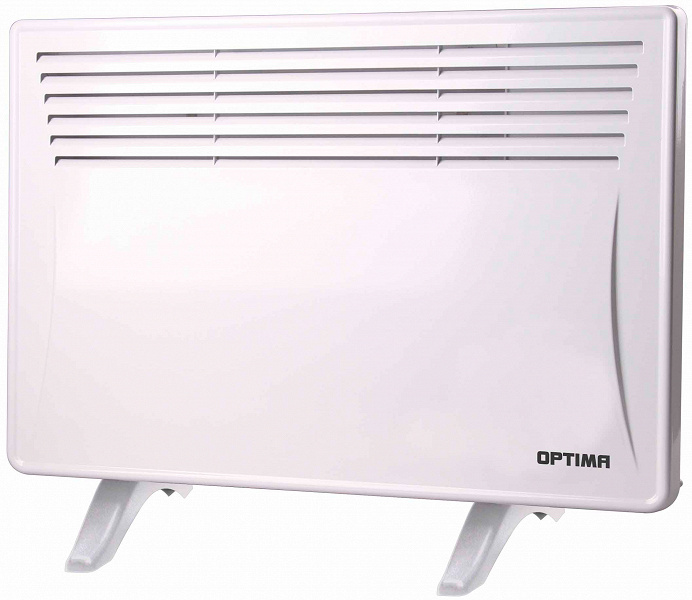
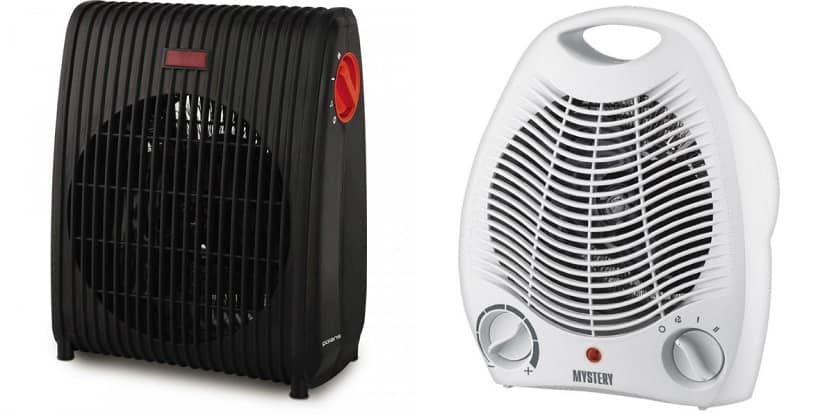

The principle of operation of the convector is the desire of hot air to rise up.
Types of automation systems used:
- Mechanical - works due to the simplest thermoelement based on a bimetallic plate. Ensuring accurate temperature control is impossible here, but such convectors are better because they have an affordable cost;
- Electronic - here the temperature is controlled by an electronic circuit. The accuracy of observing the temperature regime is 0.5-1 degrees. As a result of this, such convectors can boast of some efficiency - this is a really good choice.
The disadvantage of electronic convectors is their increased cost.
Manufacturers claim that savings through the use of electronic temperature control can reach 5-10% - in this regard, models with electronics are better. And the "mechanics" are better due to simplicity.
Let's now look at the main advantages of convectors:
- Absolutely silent operation - convectors work quietly, they can only click a little due to the thermal expansion of materials. At night, silence will be most relevant;
- High efficiency - the air is heated here directly, without a coolant;
- Easy to install - the heater can be hung on the wall using simple brackets or placed in any convenient place right on the floor;
- Ecological cleanliness - convectors do not burn oxygen and practically do not change the humidity of the air (the relatively low surface temperature of the heating element affects).
As a result of the operation of a convection heater, a large temperature difference can form inside the room.
There are also some disadvantages:
- Convectors are a little dusty - convection raises dust into the air, which will not be to the taste of allergy sufferers. But there is a way out - you just need to wipe the equipment more often.You can also purchase units with built-in filters - it is better to take care of your health;
- Some people feel the draft created by such heaters - the problem is partially solved with the help of convectors, in which the outlets are in the front, and not on the top end. If you do not like temperature changes, it is best to purchase just such models;
- A large temperature difference between the upper and lower parts of the room - as long as people walk around the room, it will not be so noticeable. But at rest, the difference can increase.
The flaws are quite tolerable, there is nothing wrong with them.
Summing up
The choice of a heater directly depends on the functional features of the operated premises. For heating living rooms, children's rooms, country cottages, it is better to use convectors, they work quietly and safely, and can be left on for a long time.
If you get to the cottage only on weekends and you need to quickly heat up the room, a heat gun is an indispensable and reliable assistant. Also, heat guns are very convenient to use during construction and repair work, not only for heating, but, for example, if you need to quickly dry the wall. Well, for warehouses and garages - this is a must.