- Heating with electricity or gas. Calculation. Comparison.
- Cons of heating with electricity
- Given conditions
- Heat pump
- Thermal energy from alternative sources
- Using a heat pump
- The specifics of gas heating
- How to connect to the trunk system
- Features of equipment installation
- How is gas measured?
- Best Answers
- Given conditions
- Electricity is a worthy replacement for gas due to its absence
- Estimation of the required volume of energy carrier
- Calculation of the required amount of heat
- Electricity and gas consumption
- Heating a private house: gas or electricity?
- The cheaper it is to heat a house in Ukraine
- What is the cheapest way to heat a house? comparison table
- Important parameters for choosing a heat source
- Conclusions and useful video on the topic
Heating with electricity or gas. Calculation. Comparison.
Many people ask what is cheaper heating with gas or electricity and how much?! The answer is, of course, gas, but how much we will try to calculate.
I will give a particular example. I repeat a private example, fuel tariffs, service prices can vary greatly in different regions, as well as heat loss and house area can also vary.
And so: as of October in the Moscow region
Electricity tariff 4.01 rubles. for 1 kWh
Tariff for gas (main gas) 3.795 rubles per 1 m3 of gas
Electricity supplier Istra electricity networks.
Gas supplier Mosoblgaz (Krasnogorsk), the last 600 m of pipes in front of the user are privately owned.
Natural (main) gas has a calorific value (depending on the field) of 8000 kcal/m. cube (under normal conditions). hence, if you burn 1 cubic meter per hour, you will get 8000 kcal / h or 9304 watts. But! All boilers have efficiency and of course not 100%, but you really need to look at the characteristics of the boiler.
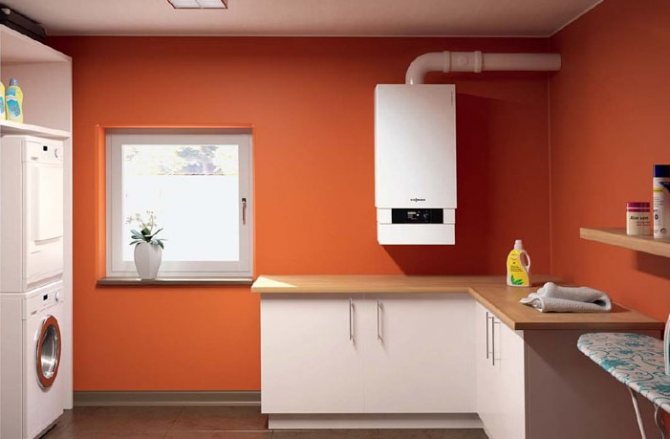
Let's take for example a fairly well-known reliable Viessmann Vitopend 100 boiler and see the maximum thermal power of 24.8 kW, the consumption of natural gas at a maximum power of 2.83 m3 / h, and therefore 1 m3 is only 8.7 kW.
3.795 rubles / 8.7 kW we get 0.436 rubles per 1 kWh on main gas
and for electricity we get 4.01 rubles per 1 kWh, and so the difference is 9 times.
But that's not all.
The efficiency of electrical appliances is almost 100%, well, or 99.9%, in general, 0.1% can be neglected, and no matter what power they are. But gas boilers whose efficiency is calculated mainly for maximum power do not always give out high efficiency, at the time the burner starts, the efficiency is possible much lower until the heat exchanger warms up, yes, it’s a few seconds, but it builds decently a year, in general, even with a new excellent boiler, taking into account the new clean chimney, the new clean heat exchanger, the flow rate will be 10% higher per year than according to the passport, and in the worst case, 50% percent
But let's say we have an excellent boiler. Total 1kWh will cost us 0.48 rubles
But gas boilers whose efficiency is calculated mainly for maximum power do not always give out high efficiency, at the time the burner starts, the efficiency is possible much lower until the heat exchanger warms up, yes, it’s a few seconds, but it builds decently a year, in general, even with a new excellent boiler, taking into account the new clean chimney, the new clean heat exchanger, the flow rate will be 10 percent higher per year than according to the passport, and in the worst case, 50 percent percent. But let's say we have an excellent boiler. Total 1kWh will cost us 0.48 rubles.
Cons of heating with electricity
Do not ignore the disadvantages of this type of heating in search of an answer to the question of what is cheaper: gas or electricity. Let's list them briefly.
- First of all, the cost. On the territory of Russia, electricity is considered the most expensive form of energy.
- It is necessary to maintain a constant power to ensure the operation of the boiler.
- Interruptions in electricity, which entail the impossibility of heating the living quarters.
- Inconvenience in operation. Experts assure that the use of electric heating is an irrational idea for owners of houses whose area exceeds one hundred square meters.
Given conditions
As I wrote above, the task is to heat a house - an apartment of 100 square meters, according to our SNIPAM, it can be argued that for comfortable heating it is necessary to apply thermal energy of 100 W - a square meter, that is, if we have 100 square meters, we need energy - 100 X 100 \u003d 10,000 W or 10 kW, is that a lot? Of course yes, a lot!
I offer a simple diagram, but it will display the full picture:
Let's say it's cold now, the heating of the house (apartment) works in the mode - it heats for 5 minutes, it rests for 5 minutes! Thus, we get that the heating works exactly 12 hours a day! Of course, if your home is well insulated, then this interval will not be 50/50, the heating will turn on less often, but this is very good insulation with foam plastic on the outside and thick walls, which are still few in ordinary (ordinary) houses!
The conditions are set, we begin to identify - which is more profitable:
Heat pump
A calculation was also made for the air-to-water heat pump. This solution is gaining popularity not only in those countries where electricity is expensive, but also in our country. First of all, it looks most competitive in the area where there is no gas or connection to it costs several thousand dollars. Or the power grids cannot allocate enough power to the house to operate the electric boiler.
An Italian heat pump for 10 kilowatts of heat output was offered to the owner of this house. By itself, it costs about 11.65 thousand rubles. But if we add the cost of all the rest of the equipment of the boiler room (the equipment is the same as for the boiler room with an electric boiler), then the figure will grow to almost 32 thousand rubles.
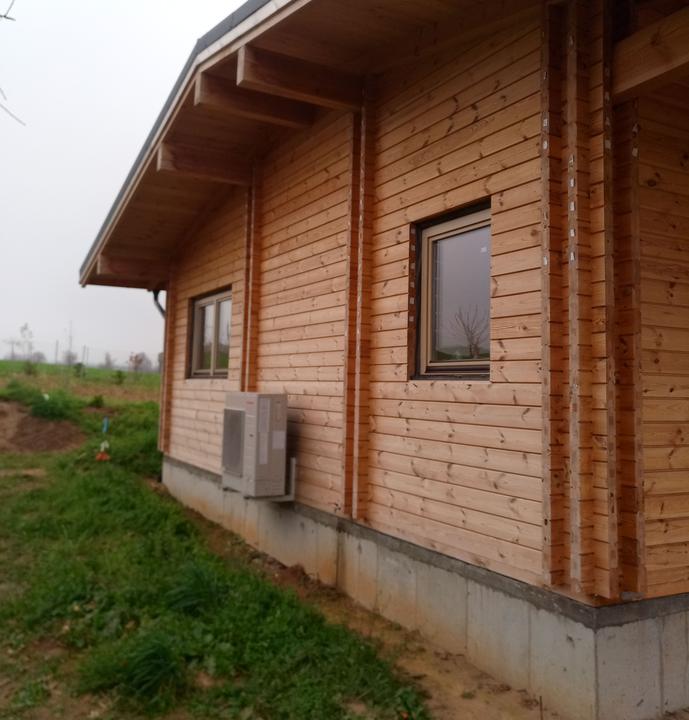
But when using a heat pump, electricity costs can be reduced by about three times - 323 rubles a year (heat pumps consume three times less electricity to generate heat).
Thermal energy from alternative sources
Can natural sources of thermal energy be an alternative to gas heating in a private house? Despite the development of this area of energy, humanity will not give up burning fossil and biological fuels soon.alternative heating is used today only as an auxiliary option.





Using a heat pump
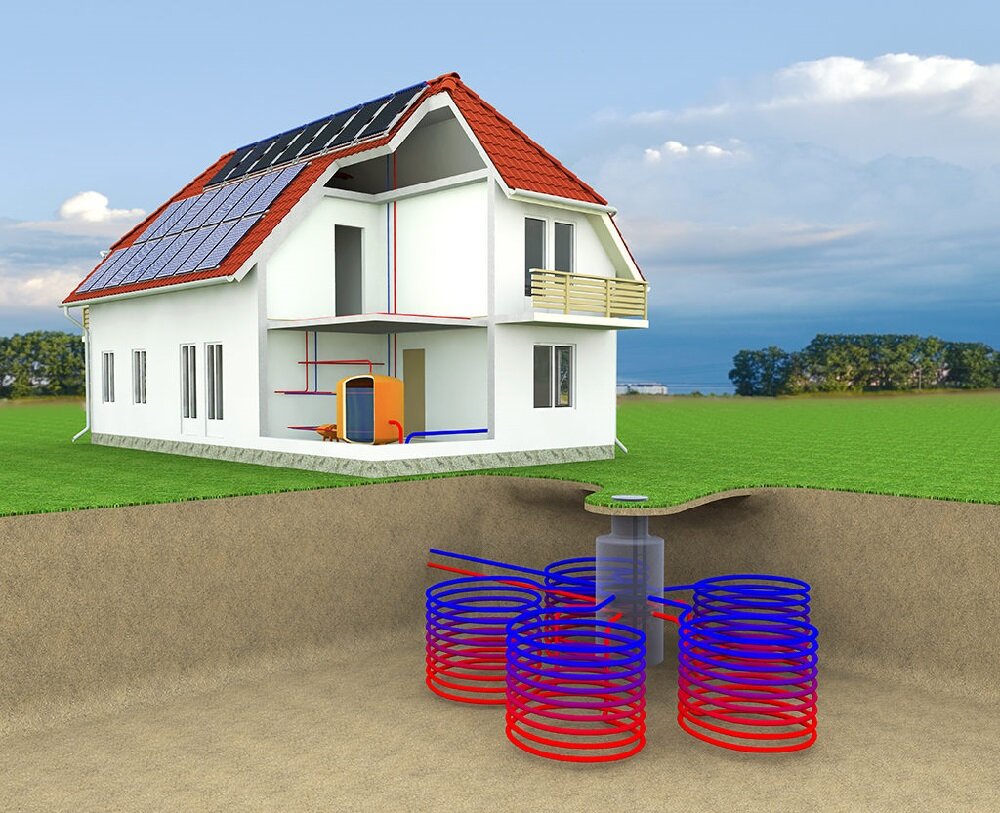
The principle of operation of a heat pump is that the equipment helps to extract thermal energy from a natural source and move it inside the room to heat it.
When deciding how to heat a house with a heat pump, pay attention to the features of the available options: "Air-air" - the equipment functions as a split system in heating mode. "Air-water" - the principle of operation is the same as in the first option, but the thermal energy of the outside air enters the water circuit and heating equipment. "Water-water "- thermal energy is extracted from a reservoir or groundwater and used to heat the coolant; "Earth-water" - to extract thermal energy from the ground and heat the coolant, a geothermal circuit of pipes is mounted
- "Air-to-air" - the equipment functions as a split system in heating mode.
- "Air-to-water" - the principle of operation is the same as in the first option, but the thermal energy of the outside air enters the water circuit and heating equipment.
- "Water-water" - thermal energy is extracted from a reservoir or groundwater and used to heat the coolant;
- "Earth-water" - to extract thermal energy from the soil and heat the coolant, a geothermal circuit is mounted from pipes.
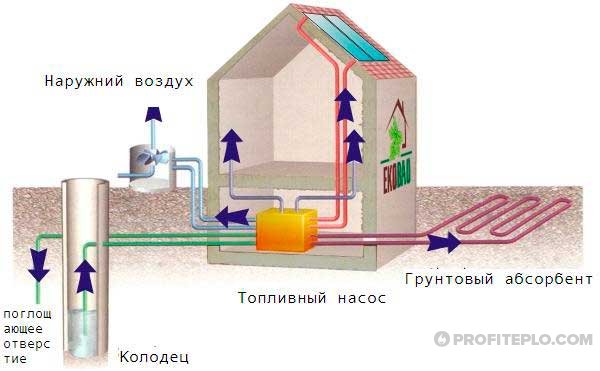
To make the house warm with the help of these technologies, you will need to use electricity. To obtain 3-4 kW of heat, 1 kW of electricity is consumed. In conditions of limited power consumption, the heat pump is able to cope with the heat supply of a house up to 150 m2, provided that the climate is not characterized by prolonged frosts.
Installation of a heat pump for an autonomous heating system will cost a serious amount, and it is difficult to expect that these costs will pay off in the coming years of operation.
The specifics of gas heating
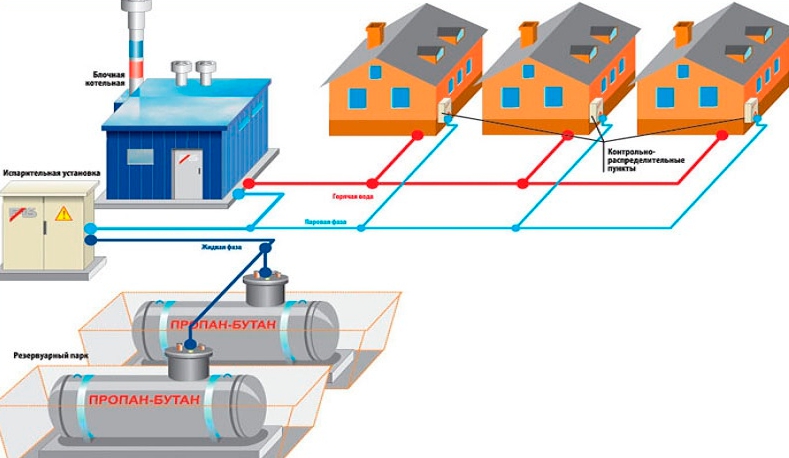
The procedure for obtaining permission to connect to the main, install gas equipment and start it up is more complicated than for boilers powered by electricity. Therefore, it is quite difficult to calculate the costs yourself and you will have to contact the organizations responsible for the delivery of gas and the installation of systems.
How to connect to the trunk system
All work carried out on a territory located outside private property is carried out by a gas supply organization.
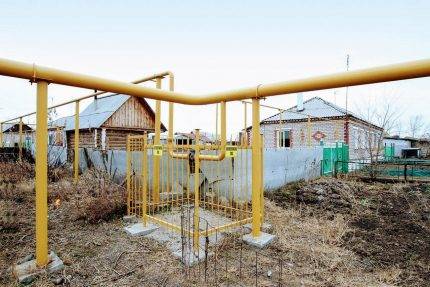
Gas can be brought to the house underground or by air. The second option is less attractive, as it imposes restrictions, for example, on the trajectory of the arrival of personal vehicles on the site
First of all, it is necessary to collect a package of documents and obtain technical conditions with the calculation of the payment for technological connection.
Typically, an individual is classified as a first category applicant who satisfies the following conditions:
- gas consumption is not more than 20 m3 / hour;
- network operating pressure 0.3 MPa;
- distance in a straight line to the network 200 m.
These parameters are specified in paragraph 2 of Decree of the Government of the Russian Federation No. 1314 of December 30, 2013, as amended on February 21, 2019. The cost of technological connection (including VAT) for the first group is set within the range of 20 to 50 thousand rubles. and depends on regional tariff rates.
However, the presence of a fragment of the gas network near the site does not mean that you can connect to it, since it is possible that the entire capacity of this branch has already been selected.In the event that pipes have to be pulled from afar, or additional installation of gas distribution equipment to reduce pressure, the cost of work can increase significantly, up to several million rubles.
Also, the presence of ravines, reservoirs, asphalt-concrete roads and other obstacles on the way to the house can lead to an increase in the cost of technological connection, if additional work is needed to overcome them.
Another disadvantage of using gas is a lot of documents that must be provided to the gas supply organization. This can also be taken into account in terms of money.
The next type of cost is the conduct of gas communications on the site. Owner must pay
It is important to know here that such work can be carried out by any company with SRO approval. Very often, the cost of design and construction at the client's site at gas supply organizations with which it will be necessary to conclude a contract for the construction of the system and connection and maintenance is overstated
Since gas pipelines are classified as objects of increased danger, construction and installation work must be carried out only after a series of studies, which are also paid by the owner:
- preparation of the topographical plan of the site;
- development of a gas supply project;
- coordination of the project in services (architecture, electricians and gasmen);
- registration of the project with gas workers.
Upon completion of the installation of the gas boiler, the final procedure will follow, which also requires financial investments - the commissioning of the entire system: checking the compliance of the facility with the requirements, concluding an agreement, finalizing documents and commissioning.
Features of equipment installation
The use of gas requires compliance with safety regulations that are more complex than those for electricity. Therefore, the placement and installation of a gas boiler must be carried out in accordance with SNiP 41-01-2001 (clauses 6.14-6.15). If inconsistencies with this document are found, the heating system will not be accepted by the gas service specialist.
In order to comply with the requirements for ventilation and removal of combustion products for a floor-standing gas boiler, a separate room must be allocated - the boiler room. This also entails additional costs, especially if this room was not originally provided for in the building design.
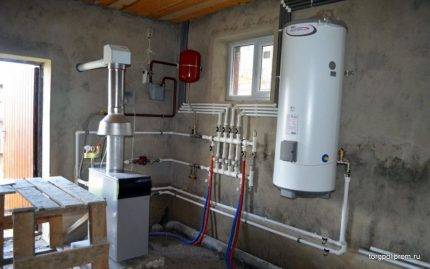
In addition to high-quality ventilation, the boiler room must comply with fire safety requirements, as well as provide convenient access to all equipment.
The total list of works necessary for the installation of a gas boiler includes the following steps:
- placing the boiler on the floor or wall;
- connection to the heating circuit (piping);
- installation of a chimney for a gas boiler;
- first heating start and adjustment.
The combustion products removal system for gas heating equipment has its own specifics. The temperature at the beginning of the chimney will be significantly lower than that of stoves or solid fuel boilers.


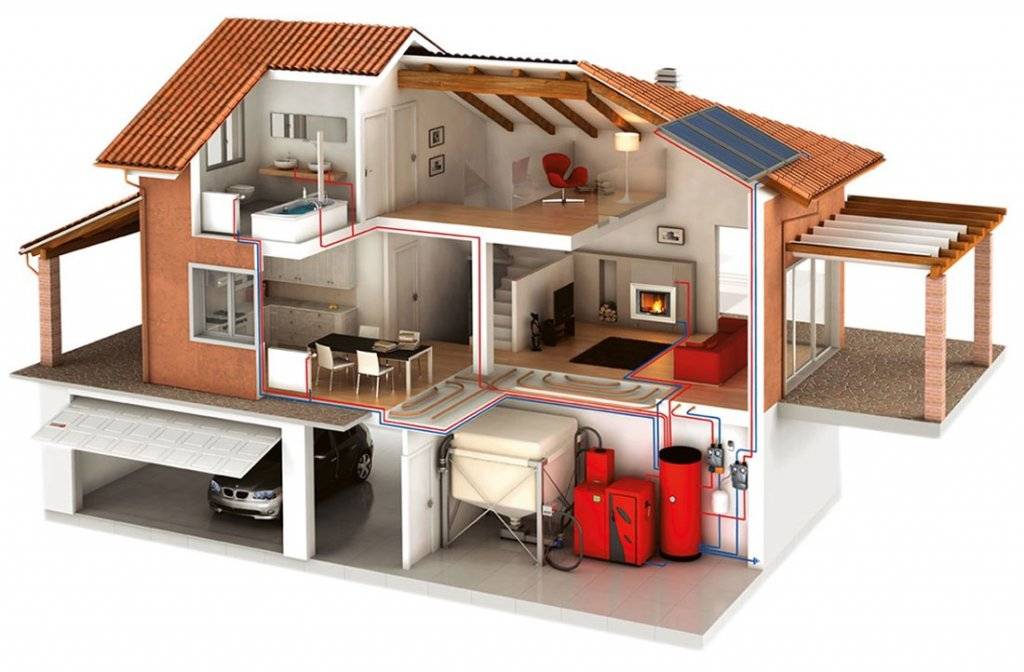



Therefore, it is necessary to comply with all the rules for the diameter and slope of pipes, their location outside the building and insulation. Otherwise, the boiler automation may react to insufficient draft and block its operation.
How is gas measured?
Natural gas is measured in:
- cubic meters (meter in a cube);
- kilojoules (kJ);
- calories (cal).
For gas, there is such a thing as the specific heat of combustion. It is measured in kilojoules.In different sources, these figures vary from 33,500 to 36,000 kilojoules per cubic meter. What is the reason? Gas, like all other energy carriers, has different energy intensity. It all depends on how it is mined and processed. Specific calorific value of gas differs depending on the country in which it is mined, since everywhere it is mined and processed in different ways.
Also for gas there is such a thing as caloric content. In some countries, gas bills are not brought in cubic meters, but in calories. Most people associate the word calories with nutrition. But in fact, not only dishes have calories. A calorie is a unit of energy that must be expended in order to heat one gram of water by one degree at a pressure of one atmosphere. Calorie is the standard unit of measure for energy.
Best Answers
Vladimir Petrov:
I have a house of 140 meters, if it's cold outside, then about 7-8 cubes a day the boiler eats. The cube costs 4.5 rubles. And if you heat it with current, then this is about 70 kilowatts or more per day at 3.5. So here you go
The Executioner's Wife:
Once in ten.
LINDA ROSE:
I heard about an infrared heater, it seems like it doesn’t take much electricity, but it’s warm at home
Ilnar Ziyatdinov:
There are many calculations on the Internet, on average they indicate a 5-7-fold difference in the cost of operation. But at the same time, there is a 5-7-fold difference in the price of equipment and installation (an electric boiler is cheaper and there is no need to pull a gas pipeline). Electric boiler costs 30 thousand. rub. Gas boiler plus conduct and connect gas - 150 thousand rubles. The payback period for gas compared to electricity is from 5 to 10 years.
At the same time, it is now realistic to replace the electric boiler with individual decorative heating panels for each window, plus an electric warm floor. This way you can save on wiring.
Wind:
ten times
Alexander:
Last autumn, we made calculations of the need for fuel for the variants of heating systems for a particular house - a difference of 4-5 times was obtained for specific tariffs. More expensive than electric only diesel. By choosing the right boiler, heating system and components for a particular house, the difference can be doubled. But the cost of equipment and installation increases significantly. Meaning - automation, storage, etc. allow the gas boiler to work most of the time in the optimal mode. The fact is that the efficiency of the heating pad is in any case about 98%. For gas, it is generally 85 or less, depending on the heating mode.
Cat smile:
For the first 5 years, gas heating will cost you 4,080 rubles per month, taking into account the cost of equipment and the gas itself. Losses to electricity will amount to 180,000 rubles. Further, after 5 years, every month, compared to electric heating, you will save 6,200 rubles. , After another 2.5 years - you will reach direct gas savings if the equipment has not failed over the past 7.5 years))
Olga:
When everything is already working, then electric is more expensive BUT it is very expensive to bring gas to the house
Given conditions
As I wrote above, the task is to heat a house - an apartment of 100 square meters, according to our SNIPAM, it can be argued that for comfortable heating it is necessary to apply thermal energy of 100 W - a square meter, that is, if we have 100 square meters, we need energy - 100 X 100 \u003d 10,000 W or 10 kW, is that a lot? Of course yes, a lot!
How will we count?
I offer a simple diagram, but it will display the full picture:
Let's say it's cold now, the heating of the house (apartment) works in the mode - it heats for 5 minutes, it rests for 5 minutes! Thus, we get that the heating works exactly 12 hours a day! Of course, if your home is well insulated, then this interval will not be 50/50, the heating will turn on less often, but this is very good insulation with foam plastic on the outside and thick walls, which are still few in ordinary (ordinary) houses!
The conditions are set, we begin to identify - which is more profitable:
Electricity is a worthy replacement for gas due to its absence
Economical, efficient heating of a private house, dacha without gas should be more focused on maintaining familiar living conditions. The level of comfort determines the choice of an alternative method of heating, in addition, today technology provides ample opportunities for maneuver. To achieve gas savings in the cold season will allow the availability of electricity. Not without reason, many owners of country houses and country cottages, due to the lack technical connectivity to the gas main, give preference to electric heating systems.


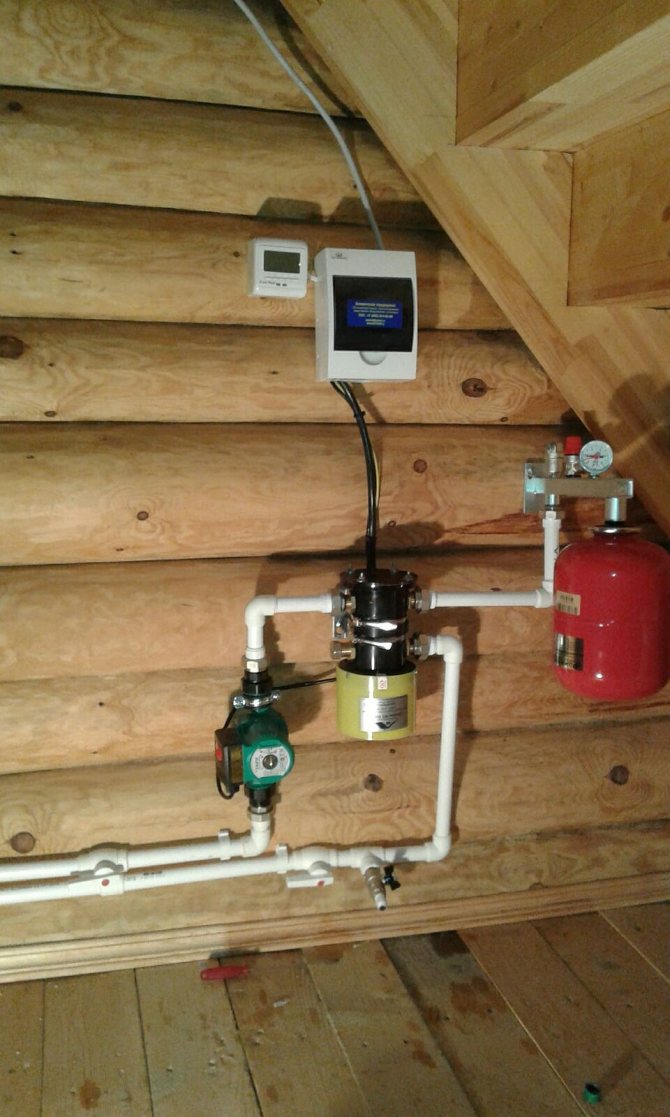

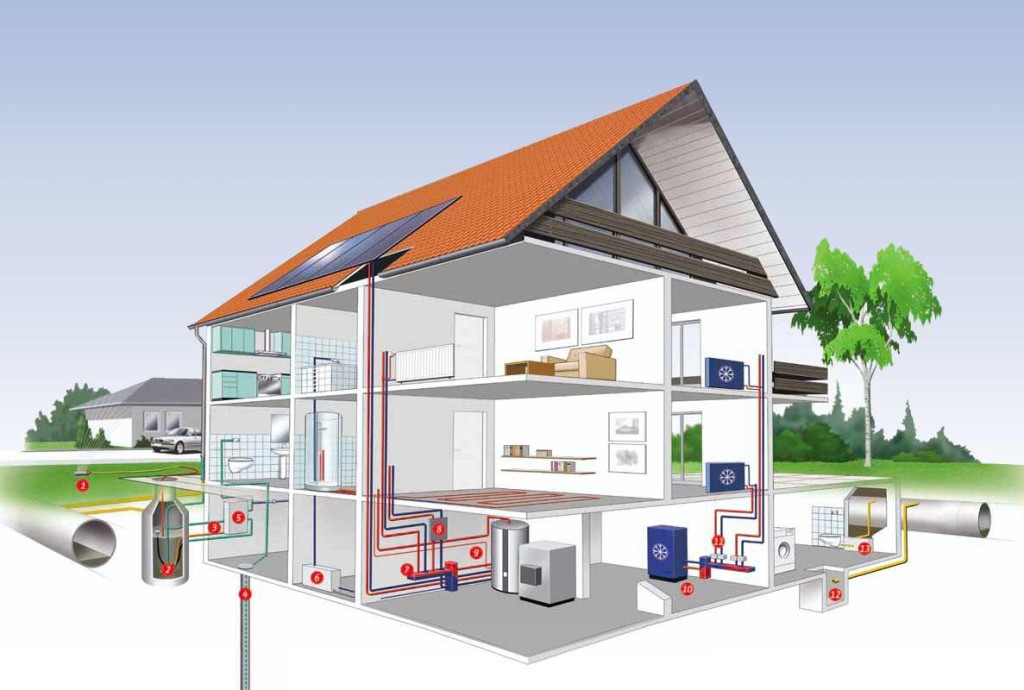

Compared to other heating devices, electric heaters have almost 100% efficiency. A boiler powered by electricity is easy to maintain, inexpensive. In this case, the need for exhaust and chimney equipment is eliminated
Electricity is by far the most affordable alternative to gas heating in terms of efficiency and serviceability.
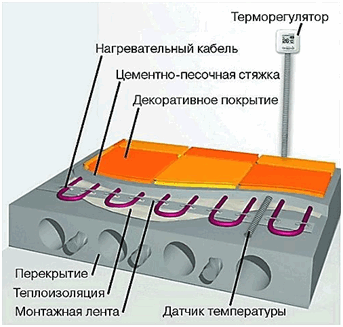
In addition to installing an electric boiler for a water heating system in a house, convectors, heat guns and infrared emitters are actively used to heat residential buildings of a small area. A fashionable phenomenon today is the equipment of underfloor heating in a private house. The technology is quite new, however, has already managed to prove its effectiveness. A variety of offered heat sources give you the opportunity to choose the best way to heat your home.
In the event that a warm floor is the main source of heating for residential premises for you, the power of the equipment should be 150-180 W per m 2 of living space. Warm floors should have an area of at least 70-80% of the total area of the building itself. Otherwise, the expected heating effect will be negligible.
When heating a private house in other ways, even higher economic indicators can be achieved. Without gas, an economical and uninterrupted source of thermal energy on your site can be obtained using a heat pump. The principle of operation of the equipment is based on the temperature difference, in the depth of the soil and on the surface. With the help of a heat pump, which really costs a lot of money, you can provide yourself with an almost eternal source of heat in a country house. The effectiveness of this system is confirmed by simple calculations. An indicator of the successful operation of a heat pump is the heat conversion coefficient (COP).
For example. When the heat pump consumes 1 kW of electricity required to ensure the operation of the entire system (Ptn), the heat conversion coefficient (COP) is 3.0, which means:
Ртн x СОР = 3 kW Рp of energy at the output. Savings and efficiency of this method of heating is more than obvious.
There is no single answer to the question of whether it is more profitable to heat a private house with gas or other types of fuel. In each individual case, the presence of a variety of factors plays a role, among which the economic and technical capabilities of the consumer occupy not the last place.
Almost any fuel can be used instead of gas for heating. Another thing is how much you can fully heat your own house in cold weather, create comfortable living conditions for yourself. Faced with this situation, the choice is yours. How to save, make your heating costs optimal depends on you, on your attitude to the very fact of energy savings and technical capabilities.
- Do-it-yourself project and calculation of a brick fireplace
- How to lay and insulate heating pipes in the ground?
- Why do you need a plinth for heating pipes?
- Choosing ribbed registers, radiators and heating pipes
- How to hide a heating pipe?
Estimation of the required volume of energy carrier
Many cottages were built according to individual projects using building materials of different structure and heat engineering, thermal insulation, and decoration. In addition, the climatic parameters of winter for different regions can vary greatly. Therefore, in calculating the amount of energy that will be needed to heat the house, there may be significant differences.
Calculation of the required amount of heat
Heating is designed to compensate for the heat loss of the building, which occurs for two reasons:
- loss of energy due to freezing of the perimeter of the house;
- replacement of warm air with cold air during ventilation.
In order to understand what is more profitable to heat a private house - gas or electricity, it is not necessary to carry out high-precision calculations.An approximate estimate (± 20%) of the volume of heat losses for the winter period is enough to determine the difference in the final cost of the energy carrier.
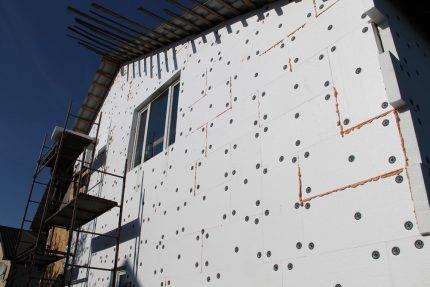
Warming a country house is a great way to save on heating. This will not reduce capital investment, but will reduce annual payments for gas or electricity
There are two options according to which it is possible to determine the volume of heat loss with acceptable accuracy:
- Order the calculation of this parameter from heat engineers. In this case, to save money, it should be mentioned that the calculations can be carried out using a simplified method.
- Carry out calculations on your own, knowing such parameters as the coefficients of resistance to heat transfer of house materials, the perimeter and roof area, ventilation volume, temperature difference, etc.
The results of heat loss should be reduced to a standard unit of measurement - W.
Electricity and gas consumption
Instead of calculating heat loss, you can use the analogy method
If nearby (the coincidence of climatic conditions is very important) there is a building similar in geometry and material, then you can find out the amount of gas or electricity consumed from the meter readings
In this case, we have three options:
- the heat loss of the building is known;
- there is data on the volume of gas consumed at a similar facility;
- the amount of electricity used for heating is known.
It is necessary to know the volume of electricity and gas consumption for the winter period.
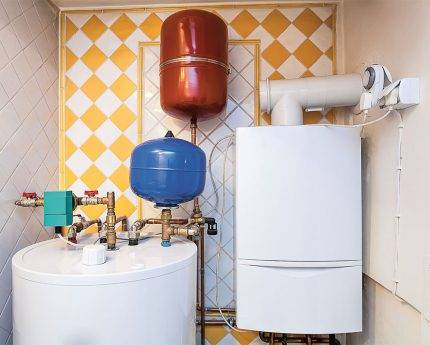
If the boiler also provides hot water, then the additional consumption of electricity or gas will need to be taken into account in the calculations.
First of all, you need to determine the duration of the heating period E (hours). This can be done according to column No. 11, table No. 1 of SNiP 23-01-99.To do this, select the nearest settlement and multiply the number of days by 24 hours.
Since the calculations allow minor approximations, we set the following constants:
- The efficiency of the electric boiler is 98%;
- The efficiency of the gas boiler is 92%;
- the calorific value of natural gas is 9.3 kWh/m3;
- the calorific value of liquefied gas is 12.6 kWh/kg.
In this case, the main conversion formulas will look like this:
- The volume of consumed natural gas V (m3) is known. Building heat loss: Q = V × (9300 × 0.92) / E.
- The mass of consumed liquefied gas V (kg) is known. Here, for a propane-butane mixture, you can use the ratio 1 kg \u003d 1.66 liters. Building heat loss: Q = V × (12600 × 0.92) / E.
- The amount of electricity consumed V (W × h) is known. Building heat loss: Q = V × 0.98 / E.
- Known building heat loss Q. Required volume of natural gas: V = Q × E / (9300 × 0.92).
- Known building heat loss Q. Required volume of liquefied gas: V = Q × E / (12600 × 0.92).
- Known building heat loss Q. Required amount of electricity: V = Q × E / 0.98.
Calculating the heat loss of a building has another purpose - it can be used to calculate the maximum consumption of electricity and gas in the coldest five-day period of the season. This will help to choose the right boiler power and avoid problems with overload.
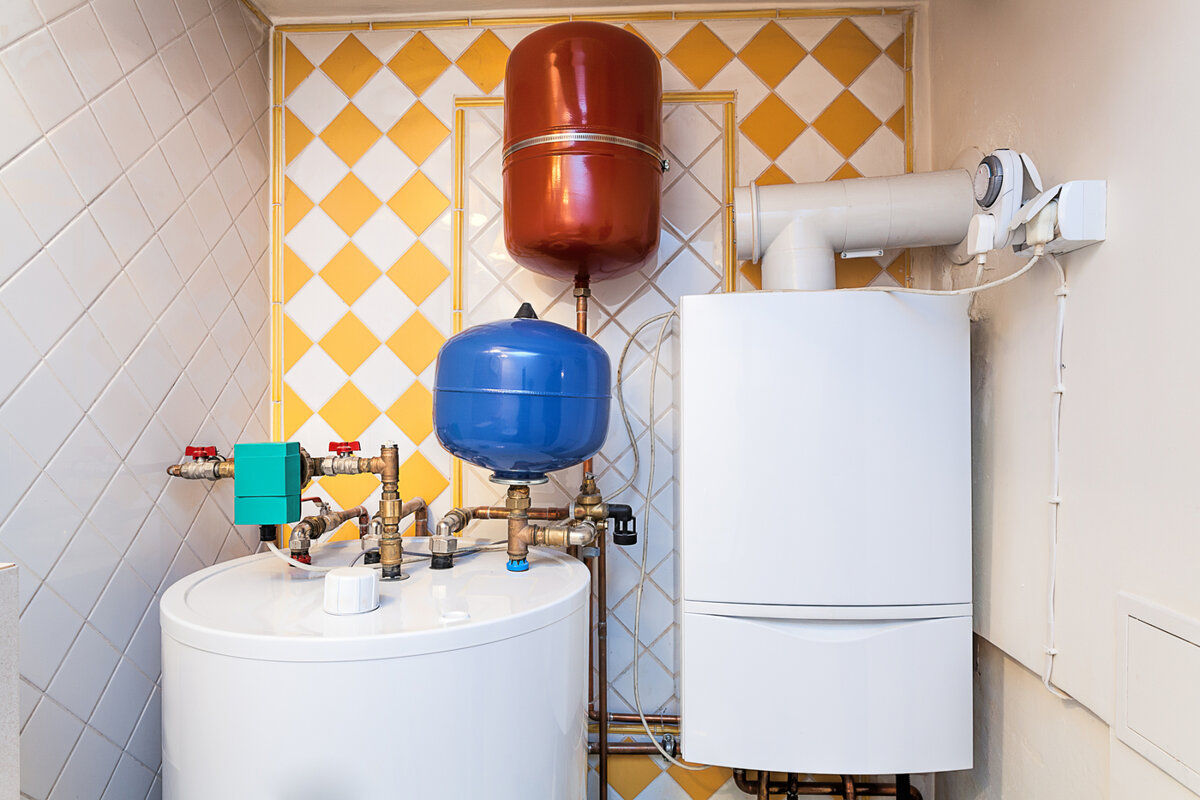
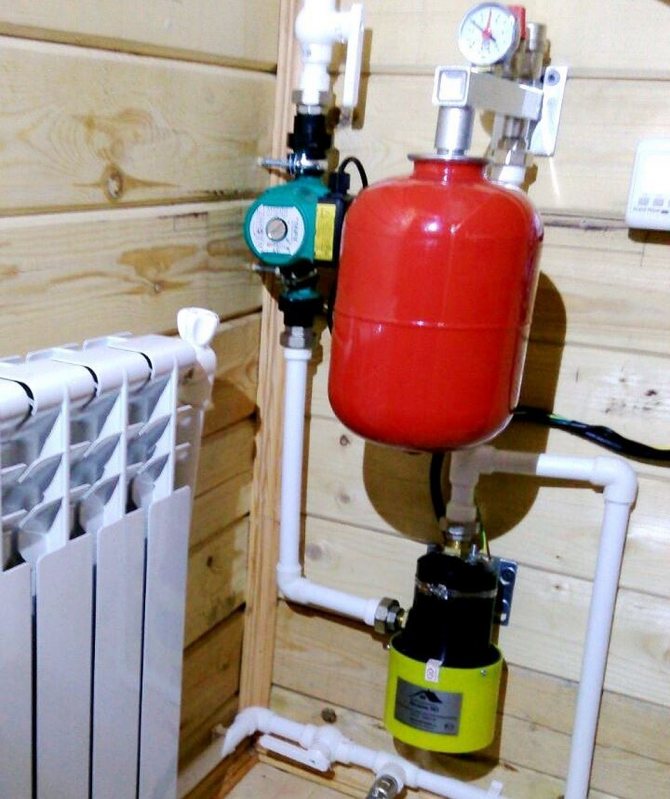

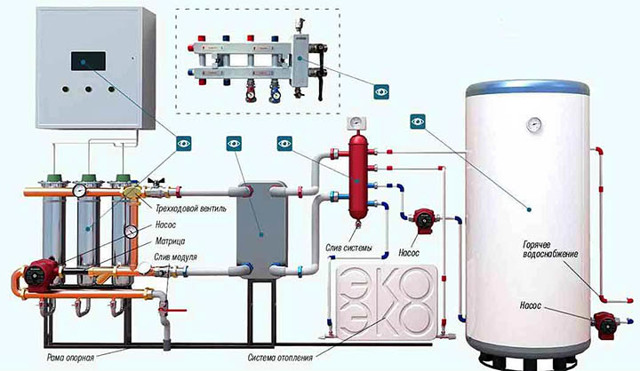

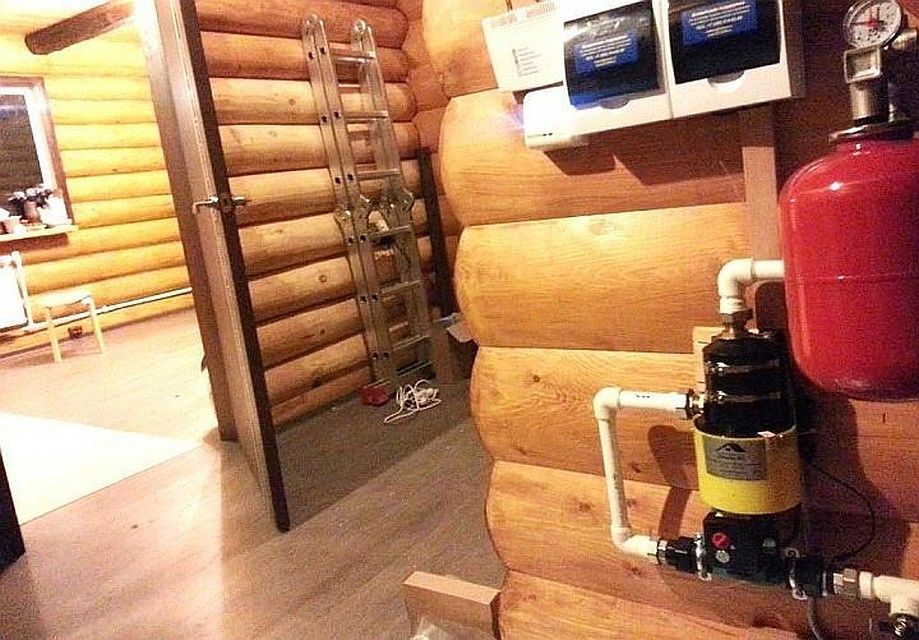


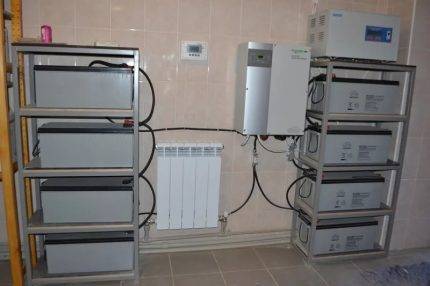
During extreme cold snaps, electricity consumption increases dramatically, which can lead to failures. Therefore, you need to have backup power or use heat accumulators.
When comparing the cost of gas and electric heating, the autonomous power supply system does not need to be taken into account, since in extreme frosts it can be used with any type of fuel.
Heating a private house: gas or electricity?
For this reason, many homeowners are looking for alternative heating methods. And the first of them in terms of popularity and demand were electric boilers.
Electric heating: convenient, clean, safe
If you do not focus on the relatively high cost of electricity, you can see many advantages of this type of heating:
- Ease of installation. The requirements for the installation of electric boilers are minimal; it will not be necessary to allocate a separate boiler room, its registration and approvals.
- Small installation costs. In fact, they come down only to paying for the installation itself.
- Security, incl. ecological. Electric boilers do not threaten to explode, do not emit carbon monoxide, do not form combustion products.
- The ability to reduce energy costs by installing a multi-tariff meter. It allows you to use the electric boiler at night, when the cost of electricity is much less.
- Ease of use. In this capacity, electric boilers are especially advantageous in comparison with solid fuel ones: they do not require the presence of firewood or coal, a place for their storage, or cleaning the boiler of soot.
However, for the efficient operation of such a boiler, a lot of electricity is required. Therefore, the decision to install heating with electricity should be made taking into account the existing capacities, the possibilities for their increase, as well as the maximum heat saving of the house.
Gas heating: cheap, profitable, rational
This type of heating is considered the most appropriate, provided that the main gas pipeline is located near the house. To reduce the cost of its installation will help the correct fulfillment of several conditions:
1) order in one company and the project, and installation, and maintenance of the heating system;
2) competent preparation of the boiler installation site;
3) purchase of a boiler, the type of which corresponds to the area of the premises;
4) selection of the optimal chimney.
In addition to low cost, gas heating has advantages in the possibility of choosing the type of circulation - natural (electronic) or forced, and in a wide range of boilers - wall and floor.
Comparison of the cost of energy carriers for heating a private house
The comparison is based on a cottage with an area of 100 square meters. m.
The cost of equipment and heating when using:
1) main gas (average daily costs - 12 cubic meters):
2) electricity (average daily costs - 120 kW):
It can be stated that with certain savings on equipment and the arrangement of the internal system with electric heating, the seasonal fee is almost 10 times higher.
Expert opinion
With all the diversity of opinions of experts, they can be summarized in several theses:
1) Autonomous heating with gas is much more profitable in operation, but more costly in terms of initial costs.
2) Gas heating is a more rational option in those areas of the Moscow region where power outages occur frequently and regularly. However, for safety net when using an electric boiler, you can purchase an inexpensive generator.
3) When buying a cottage in a village where natural gas is supplied, the price per square meter will be much higher than in its absence.This is due to the developer's significant costs for coordinating gas pipeline tie-in points, obtaining technical conditions, permits, and also for installation. As a result, the cost may double compared to a similar site without gas supply. In addition, electricity appears in holiday villages before gas: it is much cheaper, easier and faster to conduct it than gas.
The cheaper it is to heat a house in Ukraine
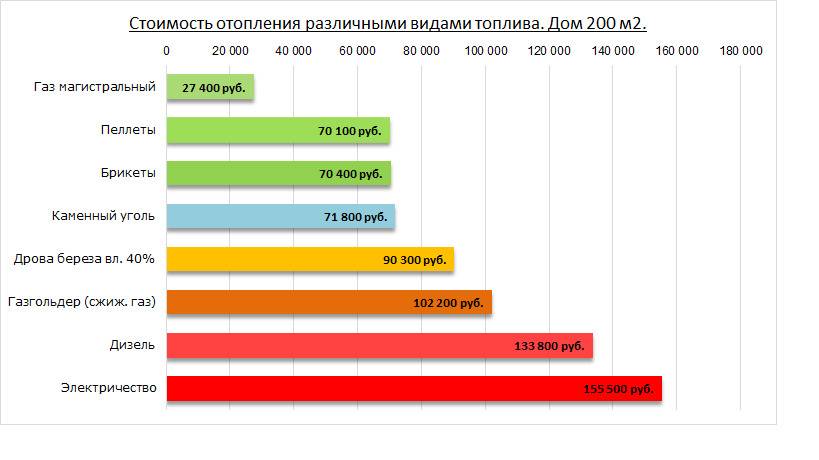
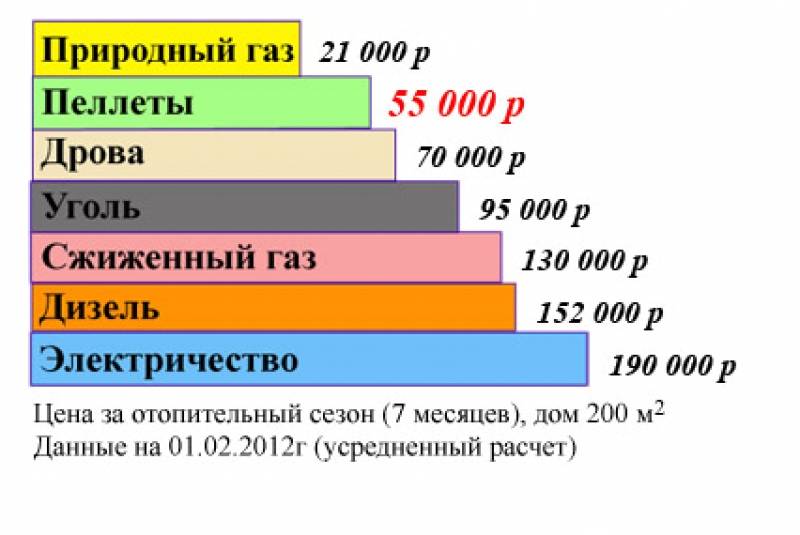
Due to the increase in the price of firewood in 2019, the overall picture of the cost of heating in Ukraine looks very interesting. The layout reflects a similar calculation table:

The first place in terms of cheap heating in Ukraine is still occupied by dry firewood and electricity used at night. But due to the rise in price, their cost has practically caught up with the price of natural gas, which has fallen in price by 5–10% (in the current conditions, it is not easy to voice the exact figure).

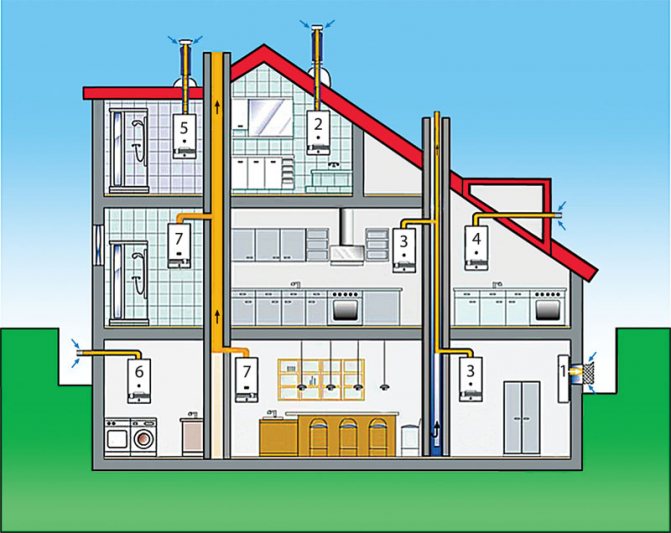



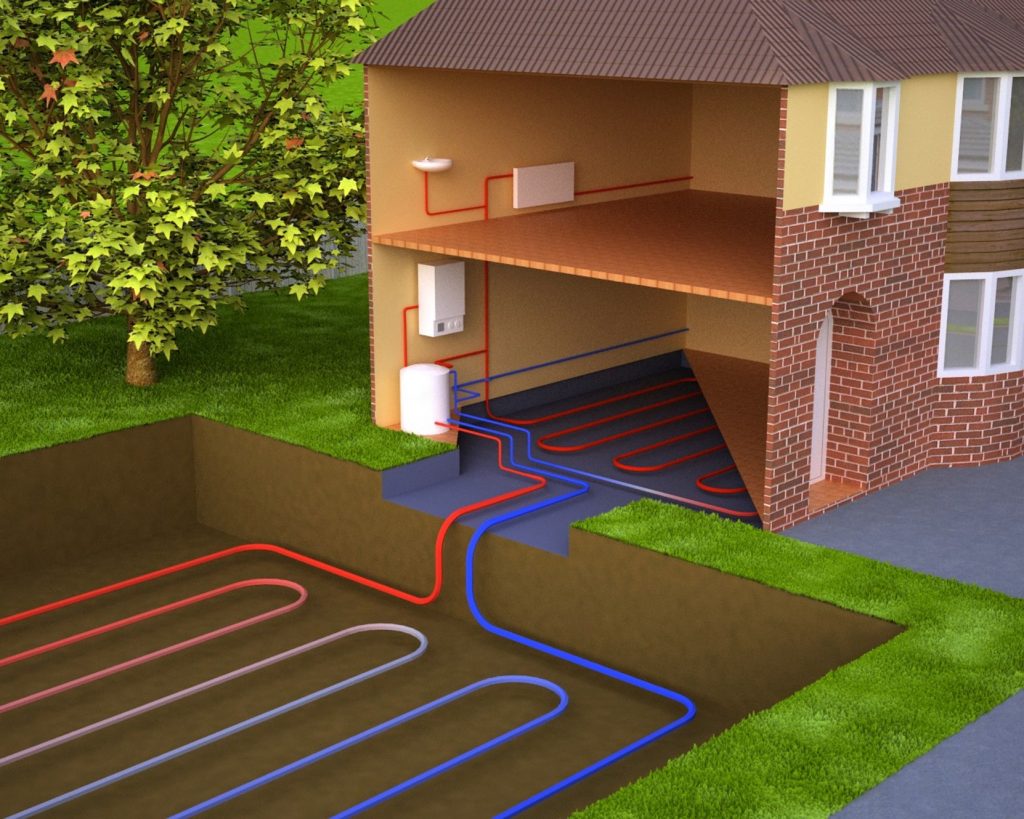

Consider this point: the 2019 table shows average fuel prices. Pellets and briquettes of the worst quality can be bought cheaper, and electricity and gas cost the same everywhere. So, energy carriers are located in the following order (from cheap to expensive):
- electricity at night rate;
- main gas;
- dried firewood;
- pellets, sawdust briquettes;
- freshly cut wood;
- waste oil;
- coal-anthracite;
- electricity at a daily rate (with consumption up to 3600 kW/month);
- liquefied gas;
- diesel fuel.
It is impossible to predict the size of tariffs for gas and electricity in Ukraine due to the unstable economic situation. It is unlikely that energy resources will become significantly cheaper, subsidy payments are decreasing every year.
On the issue of supplying main gas, Ukrainians are in the same position as Russians, whose houses are not connected to gas pipelines due to the high cost of the service. Both have to burn different types of solid fuel or use electricity at night.
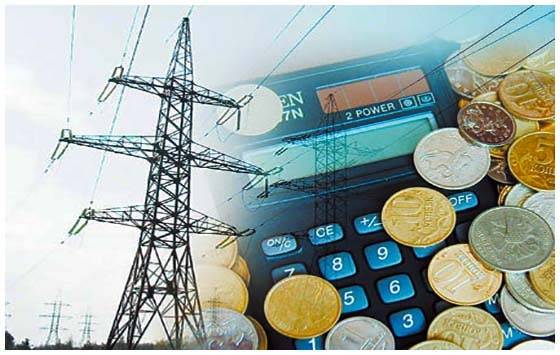
What is the cheapest way to heat a house? comparison table
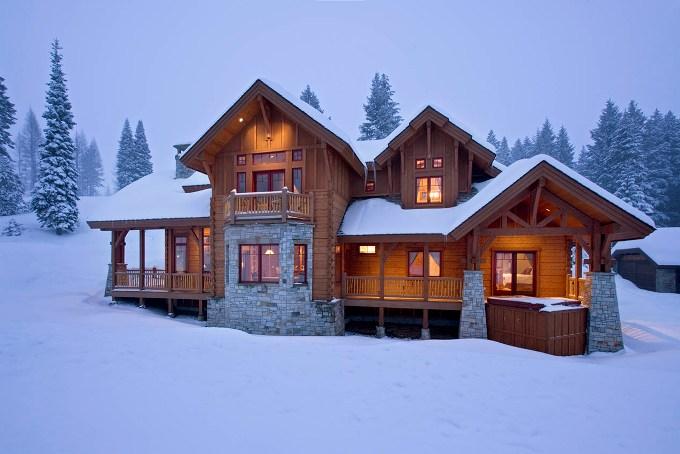
The choice of the optimal method of heating a country house comes down to comparing all types of fuel and the technical characteristics of heating systems.
Fuel comparison table:
| Heat source | boiler efficiency | calorific value. 1 kg per kWh | Need for a house 100m 2 | Seasonal costs |
| Firewood | 70 | 4,5 | 25000 | 25000 |
| eurofirewood | 70 | 5,5 | 25000 | 34000 |
| Pellets | 70 | 5,2 | 25000 | 33750 |
| Coal | 90 | 7,7 | 25000 | 29250 |
| diesel fuel | 75 | 11,9 | 25000 | 71500 |
| Liquefied gas | 75 | 13 | 25000 | 65500 |
| Electricity including night tariff | 99 | 25000 | 112500 | |
| Electricity. Two tariffs | 99 | 25000 | 89131 | |
| Electricity. One tariff | 99 | 25000 | 59300 |
* - trunk gas was not taken into account in this calculation, since it is out of competition.
After doing all the calculations and comparing the positive and negative sides of all types of heating, we will find out the cheaper it is to heat the house and it turned out to be ordinary firewood. It is advisable to install two types of boilers. The one that is more profitable and more convenient in a certain period will be operated.
Important parameters for choosing a heat source
What is the best heating? The answer to this question will depend on what you choose as your evaluation criteria, but three conditions are unconditional for any type of heating:
- The amount of thermal energy must be sufficient to ensure the standard temperature in residential premises.
- Start-up and operating costs should be kept to a minimum.
- Heating should be easy and safe to maintain.
When choosing between gas and electric heating, it is necessary to take into account several important parameters:
- remoteness of the gas pipeline,
- the presence of the power supply network of the required capacity,
- dimensions of the heated room,
- heat loss through windows and walls.
Whichever heating system you choose, the main factor in saving energy will be the thermal insulation of the room and the right choice of highly efficient heating radiators.
Conclusions and useful video on the topic
Works on conducting gas to the house and their cost on the example of a house in the Perm Territory:
On tariffs for the use of electricity for heating a house located in the city. Legal and technological nuances:
The use of gas and electricity for heating a house has its own characteristics. Electric heating equipment is easier and faster to connect, and natural gas is cheaper as a fuel. To determine the best economic model for heating, you need to make calculations for a specific object and draw up a schedule of financial costs.
Do you want to share your own opinion about the most rational and practical heating system? Do you have useful information on the topic of the article that is worth sharing with site visitors? Please leave comments in the block form below, ask questions, post photos.