
- We clean the chimney from soot with folk remedies
- How often should chimneys be cleaned?
- Is it possible to do without cleaning the channel
- Special cases of cleaning the chimney
- How to clean a chimney pipe in a private house
- Video: how to clean a chimney in a private house
- Bath chimney cleaning
- Cleaning the chimney pipe from tar
- Curved chimney cleaning
- How to clean a gas stove chimney
- Why does the chimney get clogged and what does it lead to
- Cleaning the chimney with a regular brush
- What is soot and how is it formed?
- More about chimney prevention
- How to make self-cleaning tools
- Plastic brush: short-lived, but gentle on the chimney
- Plastic bottle brush: at no cost
- Hard round brush: the use of improvised materials
- Asymmetrical wire brush: for difficult sections of the chimney
- Telescopic brush: for work from the room
- Safety
- Chimney cleaning technology
- Helpful Hints
- Causes of soot
- Chimney Blockage Prevention Tips
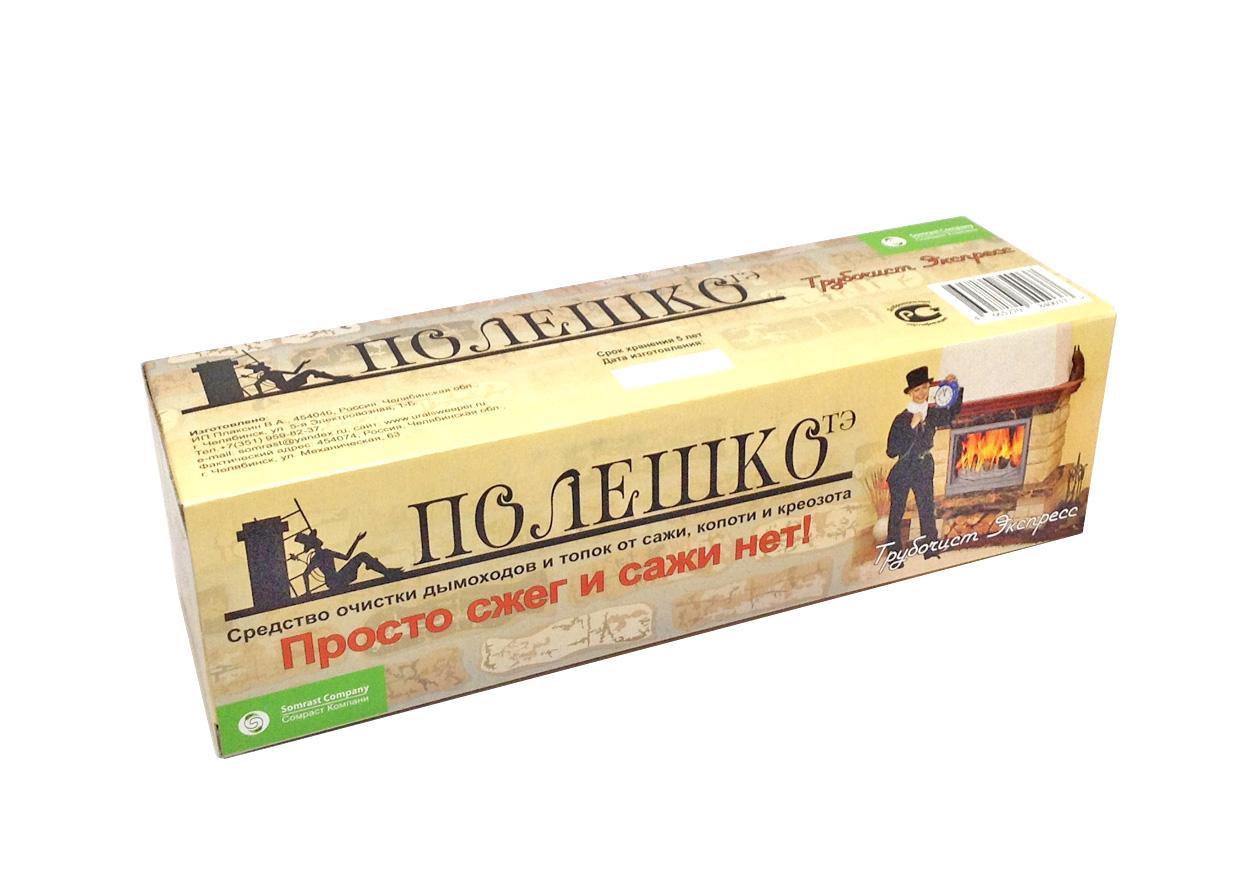
We clean the chimney from soot with folk remedies
Prevention of blockages and soot deposits in the chimney can be carried out in several ways:
- Pipe insulation. This method is based on reducing the formation of water vapor condensate in the pipe during combustion.In the cold season, the temperature difference on the inner and outer surface of the pipe can lead to the deposition of moisture and resins on it, which bind the soot into a solid deposit. The use of "sandwich" pipes with non-combustible insulation reduces the formation of condensate.
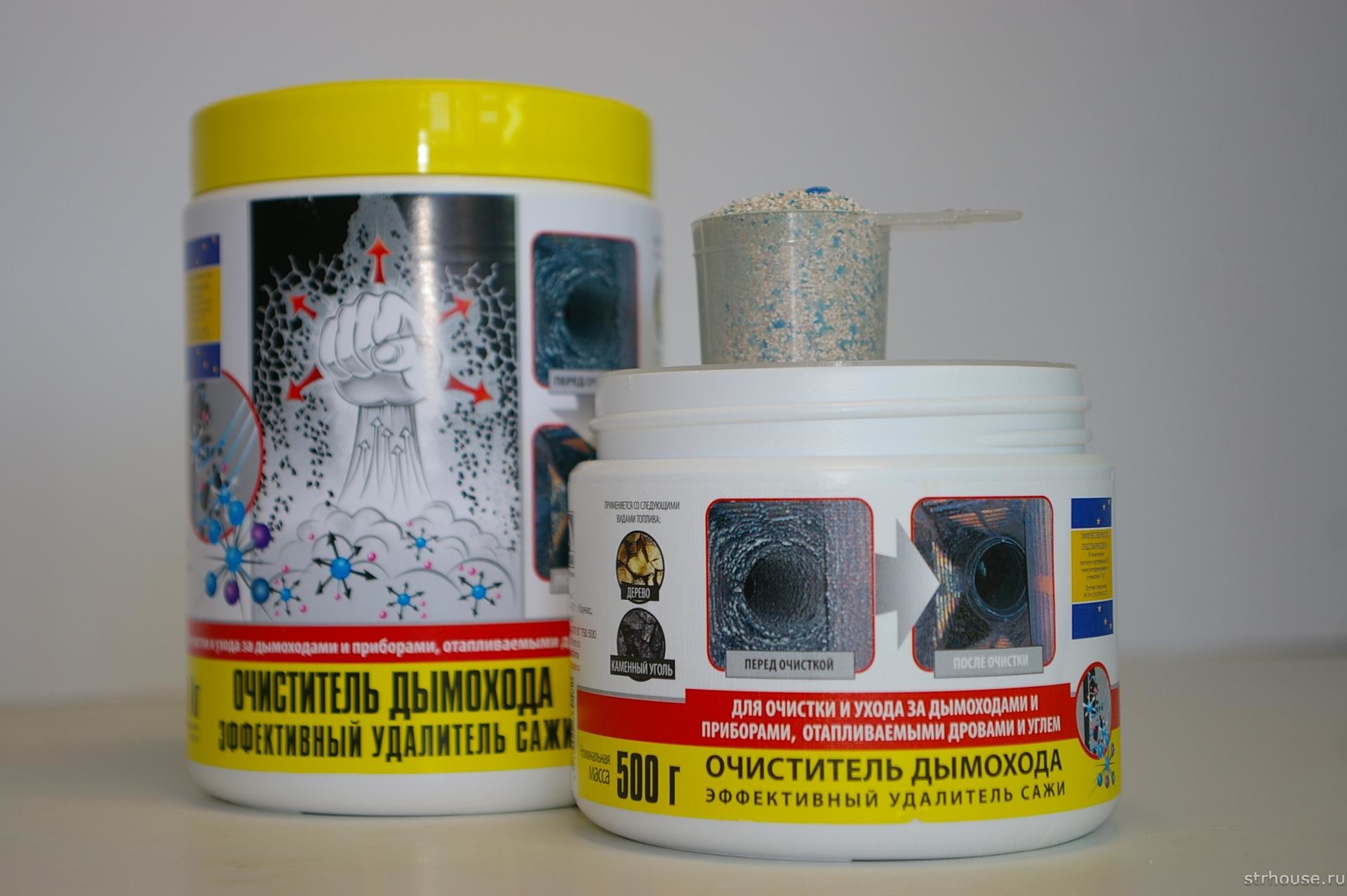
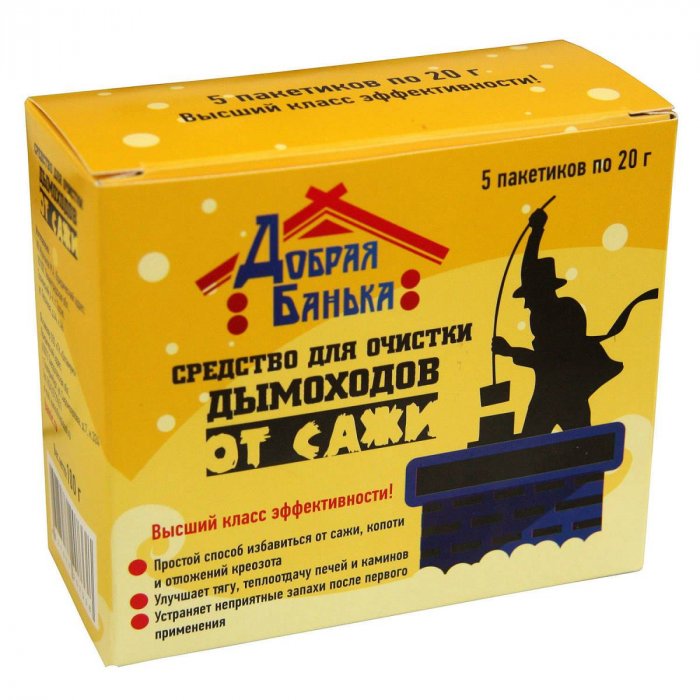
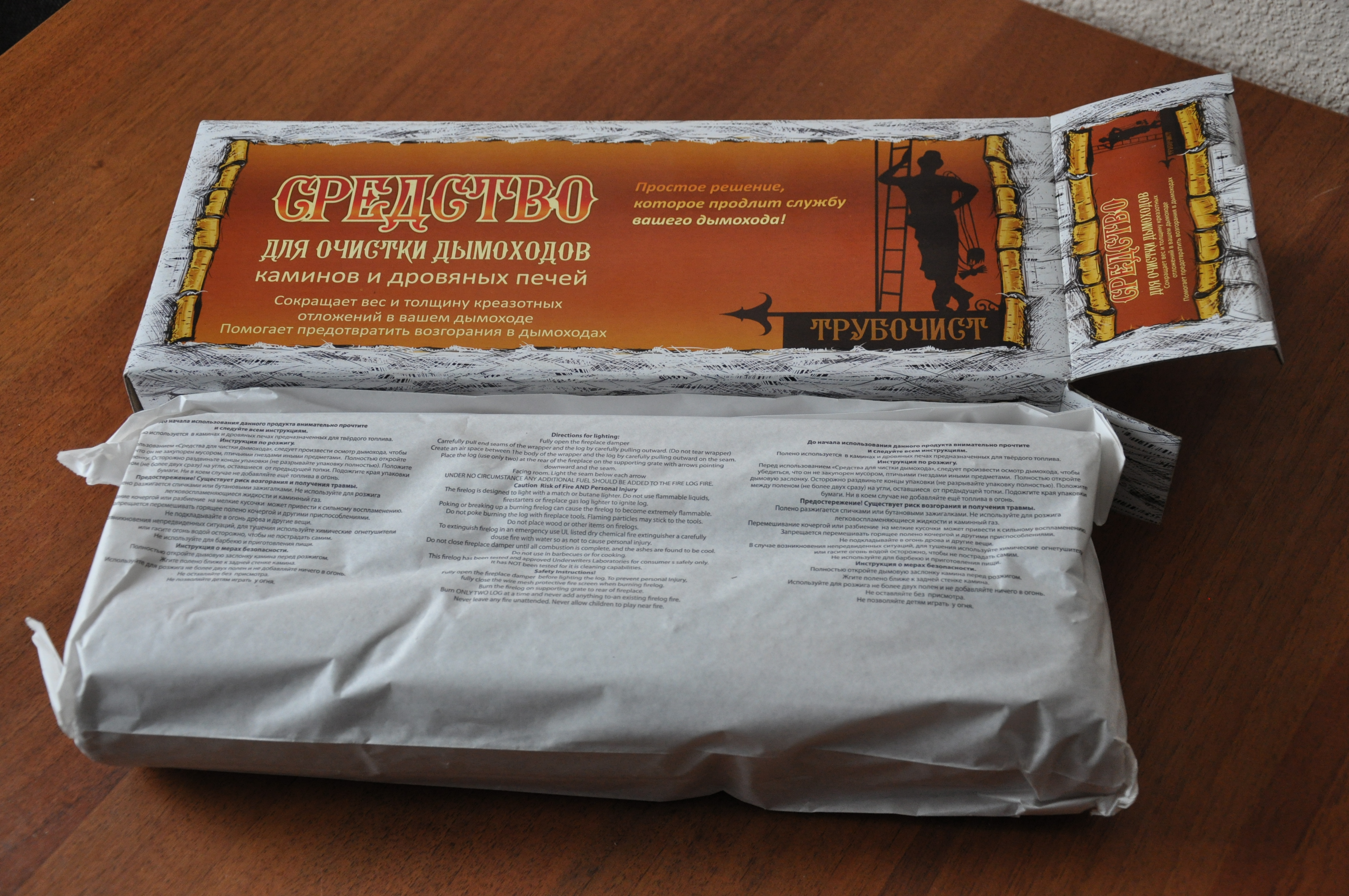
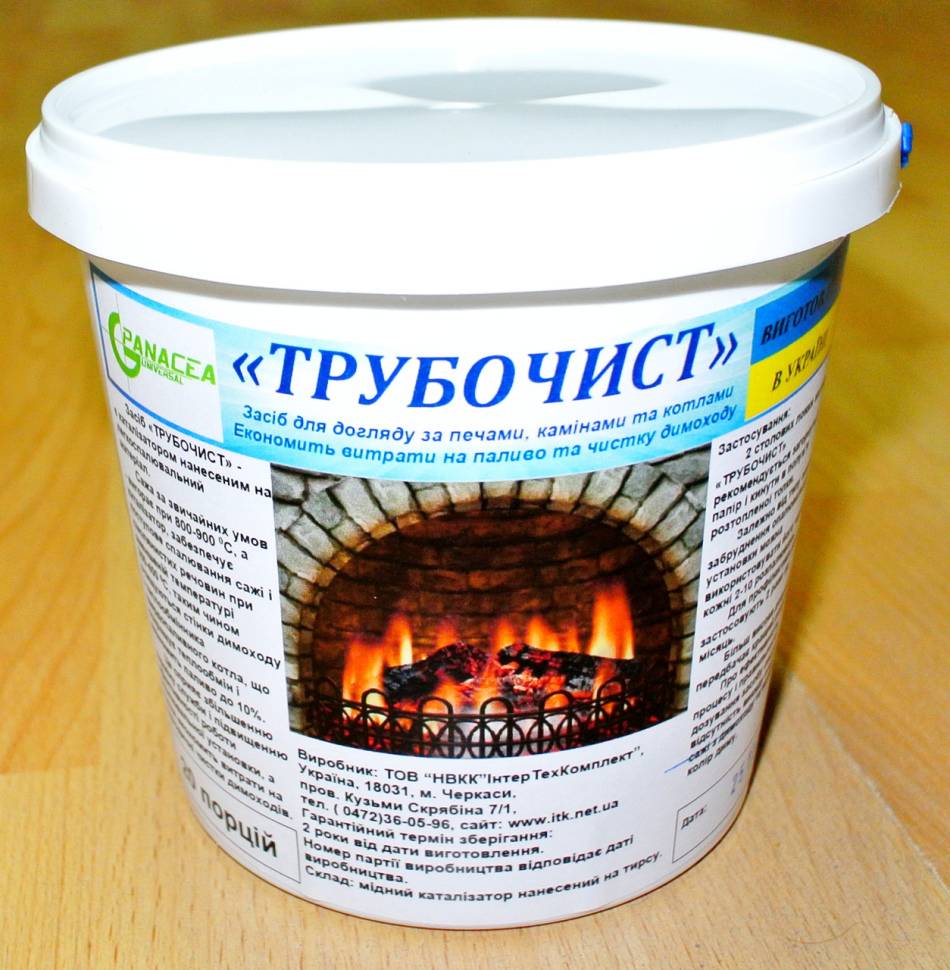
- Regular use of combustion catalysts in the form of tablets or special logs of specific wood species with additives designed to clean the chimney will reduce the deposition of soot on its walls.
- If you heat the stove with wood, add dry aspen logs to them from time to time: the aspen burns with the formation of a strong high flame that destroys the binding elements of the soot and burns it, and with the active rise of smoke, all the soot that has settled in the chimney simply flies out into the chimney. It is better to do this in winter, so that the soot falls on the snow and does not stain the roof much.
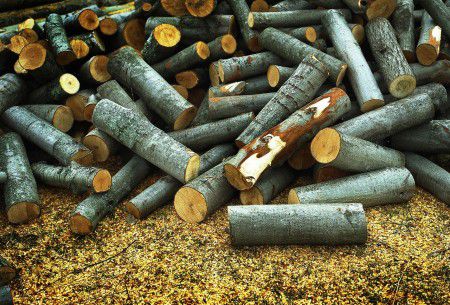
aspen logs
Timely cleaning of the chimney using these methods will make the furnace and fireplace a pleasant experience - just bring a match to dry firewood, and now a live fire is dancing in your fireplace, warming and giving comfort.
How often should chimneys be cleaned?
 Do not leave soot in the chimneys when the heating system is stopped.
Experts recommend not to bring the state of chimneys to complete clogging. Their inspections and cleaning must be carried out after repair and at the end of the heating season.
Preventive cleaning of chimneys is also mandatory before the start of the heating season. During the idle period, leaves falling from trees can accumulate in them. Sometimes birds build their nests in chimneys.
Be sure to clean the chimneys:
Brick chimneys are recommended to be cleaned of blockages at least 1 time in 3 months, and concrete chimneys - 1 time per year.
Is it possible to do without cleaning the channel
Any high-quality fuel during combustion necessarily forms ash, and the combustion process itself is always accompanied by the release of soot. Exhaust gases lift it up, while part of this plaque settles on the inner walls of the chimney. Gradually, the layer of soot becomes thicker. As a result, one of the following situations may occur:
- channel narrowing;
- reduction of traction;
- destruction of the walls of the system;
- low boiler efficiency;
- ignition of soot accumulated in a vertical channel.
When the draft decreases in the furnace, it begins to smoke heavily. The structure will be difficult to melt even with well-dried firewood.
When a large accumulation of soot occurs in the pipe, this negatively affects the combustion process itself. This situation can lead to a fire.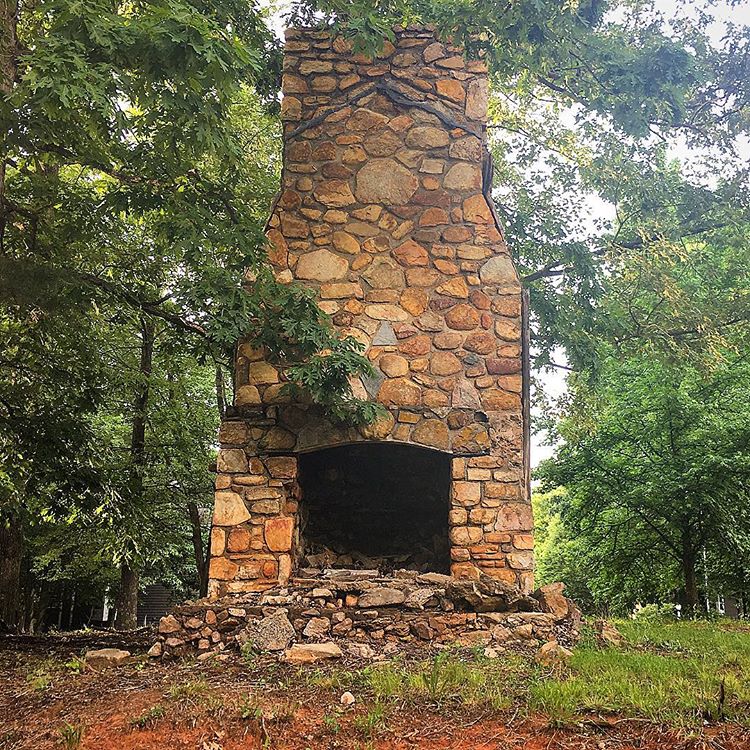
Special cases of cleaning the chimney
Some chimney cleaning situations require separate consideration.
How to clean a chimney pipe in a private house
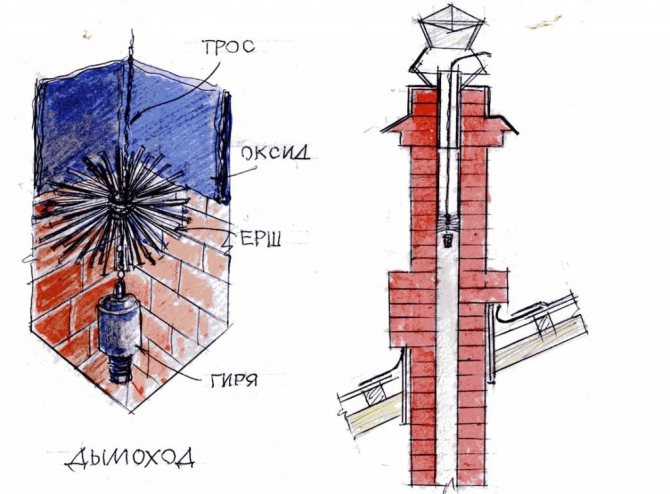
Briefly, the entire process of cleaning the chimney has already been described above. To what has been said, it is only necessary to add that with a strong clogging of the smoke channel, the first operation is to break through the soot with a core without additional devices. Only then are brushes of different sizes and designs consistently used.
When performing work, care should be taken to create a safe working environment.
When working at height, be sure to buckle up with a safety cable.
Video: how to clean a chimney in a private house
Bath chimney cleaning
The chimney in the bath is usually simpler.And most often it is made of stainless pipes, which requires special attention to its cleaning. In order not to negate its main advantage - the high quality of the inner surface - it should be cleaned only with soft plastic or brushes made from natural materials. The easiest way to manage is with straight pipelines, and if there are knees - we recall that there should be no more than two of them - you may have to dismantle the chimney if it does not have special windows for cleaning during installation.
Otherwise, preventive measures and cleaning are carried out in the same way.
Cleaning the chimney pipe from tar
Considering the composition of flue gases, you need to pay attention to two main components - this is water vapor from the fuel and a vapor of difficult-to-ignite creosote. Mixing and settling on the walls of the smoke channel, they form a resin that is difficult to remove due to its viscosity and good adhesion to various types of surfaces.
The only effective way to deal with tar deposits is to prevent its formation. For this, various means are used that are produced specifically for this case.
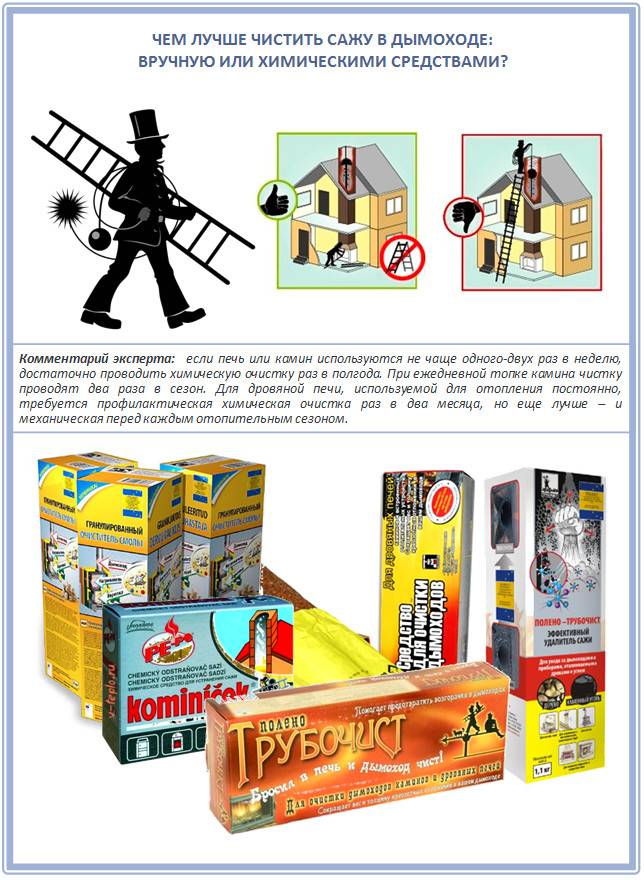

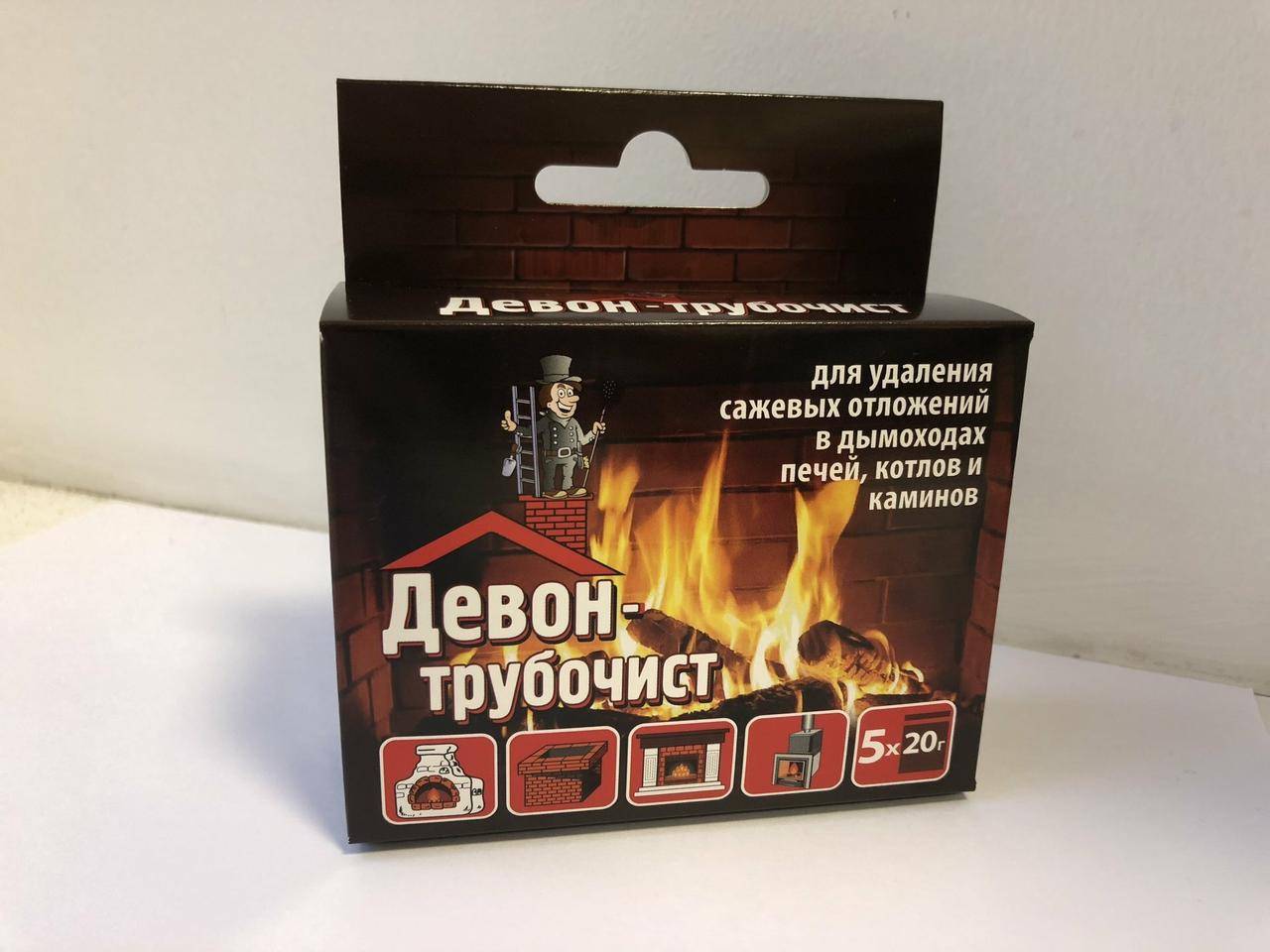


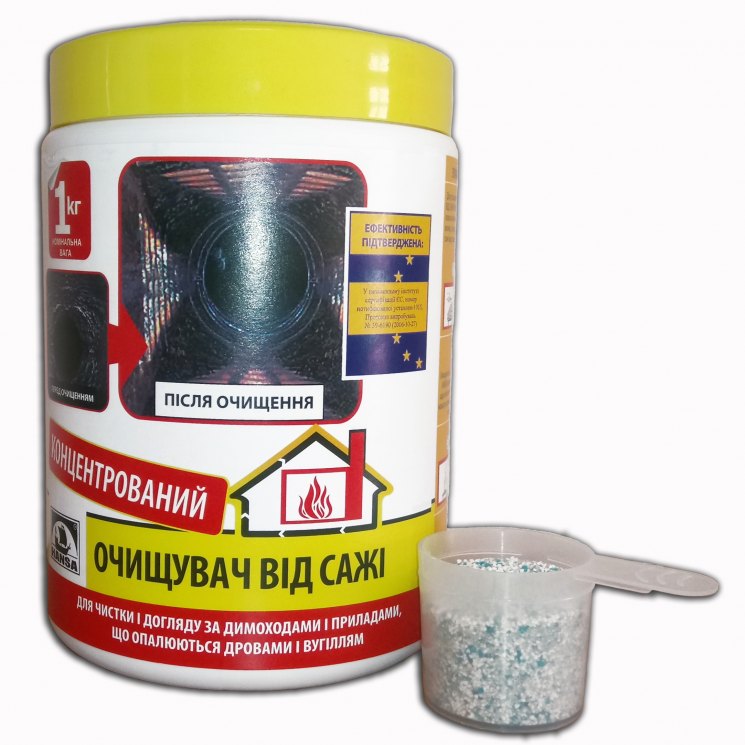
HANSA effectively protects the walls of the chimney from the formation of tar
For example, the known composition of HANSA is a fine crystalline substance. Part of it converts wood into resin and water vapor, and the second, reacting with the substance of the resin, contributes to its decomposition and combustion at the temperature in the furnace. Remains of resin on the walls turn into a brittle crystalline composition, crumbling into the furnace.
This composition is placed inside the burning furnace.The frequency of use at the beginning of the operation of the thermal unit is daily, then you can switch to use once a week.
Curved chimney cleaning
The bends of the smoke channel are always a forced measure caused by the structural features of the building. However, they need to be cleaned periodically. For this purpose, elements are provided in the design of the pipeline, using which this operation can be performed easily and simply. These are special hatches, when opened, it becomes possible to access the straight section of the bend. The length of the inclined sections is not recommended to be made larger than a meter. The number of bends on one pipe should not exceed two.
If there is no window for cleaning on the outlet elbow, then the chimney will have to be disassembled
How to clean a gas stove chimney
The reason for cleaning the chimney of the gas column is its banal clogging with a deterioration in draft. In a city apartment, this is all the more dangerous because the threat arises for many people at the same time. One of the signs of traction deterioration is the “popping” of the column igniter.
The process of cleaning the exhaust pipe from a gas unit is practically no different from such an operation with conventional chimneys. The same ruff is used. Recently, vacuum cleaners of a special design are often used, which reliably clean the surface of the pipe and collect pollution products. In difficult cases, when the layers cannot be removed with a brush or vacuum cleaner, special chemicals are used to soften and remove them. Considering that the use of prophylactic agents on the column pipe is impossible, urgent measures should be taken if signs of clogging are found.
It must be admitted that the success of using solid fuel furnace equipment to the greatest extent depends on the correct operation of the units and the careful selection of fuel for it. In addition, it is necessary to regularly use preventive measures and know how to get rid of problems with clogged chimneys. Then stoves and fireplaces will delight you with fertile warmth in the house for a long time. I wish you success!
Why does the chimney get clogged and what does it lead to
Combustion is a rather complex process. During the combustion of fuel, various reactions occur, in which the fuel decomposes into many components, most of which in the form of hot gas go outside through the chimney, maintaining traction. Unburned, non-decomposable substances settle on the walls of the chimney.
This happens for various reasons, including the use of resinous wood for the firebox, burning garbage, the design of the chimney using a large number of bends, or subject to condensation.
Soot, mixed with oils and resins contained in wood, is combustible in itself. When it ignites, the temperature of the fire can reach 1000 degrees. Therefore, the formation of a large soot in the pipe can lead to the most serious consequences both for the house and for the health and life of its inhabitants. These consequences include:
- Formation of reverse thrust. The accumulation of soot prevents the free passage of smoke. At a certain moment, such a phenomenon as tipping over of thrust may occur, which is fraught with the ingress of smoke and carbon monoxide into the room.
- Decreased oven efficiency.Due to the reduction in draft, the furnace becomes much more difficult to kindle, as the combustion process is slower.
- Danger of masonry destruction. If the house has a brick stove, then a thick layer of soot provokes the destruction of the chimney. Old soot in the pipe cokes, turns into solid deposits that are difficult to remove.
- Fire safety violation. Soot at high temperatures can ignite, provoking the appearance of an open fire directly from the chimney. Sparks flying out of the chimney can cause a fire even in neighboring houses.
You can tell when your stove's chimney needs cleaning by looking at the smoke from the chimney or the fire. The darker the smoke, the more soot. The color of the flame approaching orange also signals pollution.
In order not to get into a dangerous situation, you need to regularly monitor the condition of the chimney. Very often, special inspection windows are provided in the pipes, through which the condition of the chimney can be assessed.
It is necessary to monitor the condition of galvanized pipes of heating boilers at least once a year. If the chimney is made of brick, then the audit must be carried out 2-3 times a year, with the change of seasons.
Cleaning the chimney with a regular brush
Before proceeding directly to cleaning the chimney, the furniture in the bath should be covered with plastic wrap, and the windows should be hung with a thick cloth. You also need to prepare protective equipment for yourself: wear gloves, goggles and a respirator. Then you should inspect the oven and find out if it has special inspection doors that provide easier and more convenient cleaning. First you need to wait until the stove has completely cooled down, then remove any remaining wood or any other combustible materials from it.
After that, you need to remove the damper at the entrance to the chimney. Holding the brush firmly by the handle, insert it into the chimney opening. With confident movements of the brush in a variety of directions, you must try to reach the most inaccessible places in the chimney. As you move the brush further up, you should clean the highest places in the pipes. Then you need to remove all the soot that has spilled out, close the chimney, and rinse the brush with plain warm water.
It is necessary to remove not only soot from the chimney, but also cobwebs, accidentally flown debris, etc. Even after a high-quality cleaning of the chimney, a second cleaning will be required in a couple of months (especially in the summer), since cobwebs and dust can form in the chimney during this time and soot.
If you don’t have a regular high-quality brush for cleaning the chimney at hand, you can do it yourself. To do this, you will need an ordinary synthetic round broom, a steel cable, the length of which is equal to the length of the entire chimney, clamps, two “ears”, a stud with an 8 mm thread and washers of different diameters. It is necessary to straighten the pile in different directions. This will not be so easy to do, as it is quite hard and resilient. The result is something that looks like a bouquet.
If it is difficult to straighten the pile, then it is recommended to first lower it into boiling water. Then you need to take the hairpin and wind the “ear” from one end, then put on the washer and insert it into the hole from the bottom of the brush, then put the washer back on. In diameter, they will fit the holes of the broom. Pressing on the base from above, you should carefully screw the second fastener. The more you have to twist, the more the bristles of the brush will spread to the sides. Then you need to turn the brush over and pull the “ear” of its attachment to a suitable size.After that, it is necessary to fix the cable on the brush with a bracket, measure the chimney opening and cut the lint exactly to the size of the chimney pipe.
Here you should be careful, because with smaller sizes such a brush will not clean. And for accuracy, it is recommended to initially try on and cut out a template from cardboard. And finally, you need to adapt the load - it can be a regular weight from 2 kg.




What is soot and how is it formed?
The combustion process is an oxidation process with the release of heat. Fine particles rise with the air upwards, forming smoke. Some of them stick to the rough walls of the pipe. The process of formation of a layer of soot is accelerated due to the appearance of moisture inside the pipe - condensate from a temperature difference. Warm inside, cold outside.
Chimney cleaning is the process of removing a dense layer of soot from the walls. You can loosen it, make it porous and separate from the brick by raising the combustion temperature and increasing the speed of air movement. For example, burn aspen firewood. They give off more heat when burned than other woods. Some components of the soot will decompose. The rest of the mass due to this will become more porous, loose and less sticky. With a small amount of plaque, it can fall off without additional effort.
The process of soot formation depends on the quality of firewood and additional substances burned in the furnace. To minimize the formation of harmful plaque on the walls, you should:
- heat only with dry firewood;
- try to use less coniferous wood;
- insulate the pipe so that condensation does not form;
- Don't scorch trash, especially plastic.
More about chimney prevention
Any problem with the chimney, including the formation of burning, is best eliminated at the initial stage of occurrence, otherwise you will have to spend a lot of time and effort to eliminate the trouble.
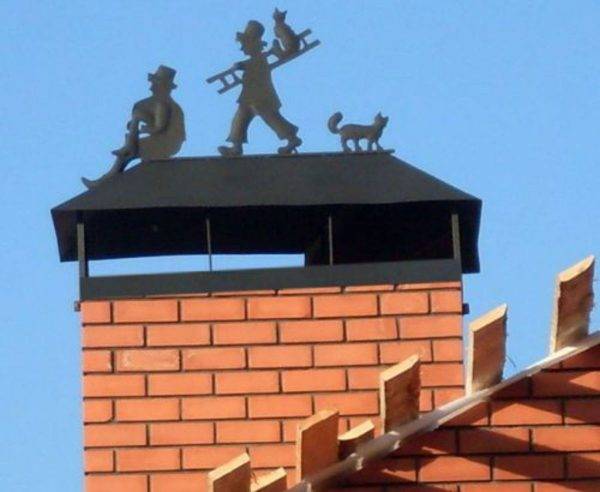
Any chimney requires regular maintenance to protect against the formation of soot.
As for prevention, it can be like this:
- check the chimney for settlement by birds or rodents;
- constantly remove wet fallen leaves from the chimney (if tall trees grow above the chimney);
- clear blockages as they form. Often the owners do not pay enough attention to this issue, so the layer of soot is constantly increasing, and it becomes difficult to remove it;
- do not burn household waste in the oven - it is wiser to dispose of it, for example, in a container;
- do not burn damp or soaked wood.
Not everyone knows, but soot in the chimney is extremely dangerous. Carbon monoxide will eventually cease to go outside completely, part of it will remain in the room.
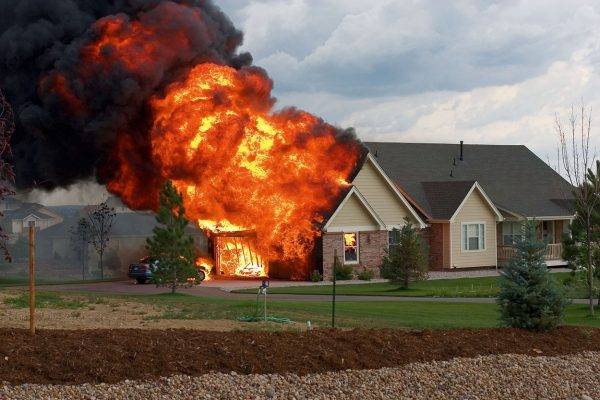
Soot in the chimney can cause a fire, so you need to be very careful and clean the chimney regularly
Carbon monoxide is terrible for people. Even ten minutes of inhaling it can be fatal. Soot can start a fire when bits of it fly out of the chimney due to the force of the smoke. An ember will easily fly to a neighboring building - a fire will be inevitable.
Any, even a rarely used chimney, sometimes needs to be cleaned of soot. You can do the procedure yourself. To do this, you can use a mechanical, chemical or folk method.Ways to deal with soot can be combined, but it is not recommended to use all three at once - this is simply not necessary. The more often the stove is heated, the more often the chimney needs to be cleaned. Each owner should have a core and a brush to get rid of carbon deposits from the pipe. They are sold in a store or made independently from improvised materials (old shovels, mops, brushes).
How to make self-cleaning tools
Special devices for cleaning the chimney from soot are sold in a regular building supermarket or specialty store, or you can make it yourself.
Let's compare a metal brush with a plastic one. Let's start with the fact that a metal brush, of course, will retain its working shape longer, but with particularly intensive cleaning it can scratch the chimney from the inside. Modern plastic brushes are soft, scratch the chimney much less, although they do not last long and at the same time easily break, losing their working shape. That is why there is an unspoken rule among summer residents: for a brick chimney, take a metal brush, and for a metal one, use a plastic one. Basically, these are the following devices:
Plastic brush: short-lived, but gentle on the chimney
Making a plastic brush is as easy as shelling pears:
If you are going to build such a brush for cleaning the chimney, then all the work will take you no more than 15 minutes.
So, the usual chimney brush is a strong base with a brush, threaded through a metal wire with a load on the chain. To all this, you will need a rope along which the brush will need to be lowered into the chimney. Instead of weight and rope, it is also quite enough to use a special holder.At least then the brush will not get stuck in the chimney and will not have to be pulled out later.
Plastic bottle brush: at no cost
Moreover, you can even make a homemade ruff from an ordinary plastic bottle (at least a few). Just 2-3 of these brushes is enough for one season. So, here's how to make such a bottle brush:
- Step 1. Make round holes in the center of the lid.
- Step 2. Cut the walls of the bottles into strips along, about 1.5 or 2 centimeters wide.
- Step 3. Make a hole in the bottom of the bottle with a heated nail and thread a 5 mm thick wire through it.
- Step 4. Now just insert one bottle into another through the cut strips and attach a thick wire to one end.
- Step 5. Put two plastic bottles on, press and fix them so that it is convenient to tie them with plastic wire.
- Step 6. Spread the cut strips of plastic evenly in a circle and secure the steel cable as it is done.
Hard round brush: the use of improvised materials
Another great option is to make such a brush from a disc brush for a grinder. Such a brush is much stronger than the previous options and will cope even with the soot itself.
It is only important that the diameter of the brush is equal to the diameter of the chimney, because its bristles are hard and bend poorly:
To clean the chimney with such home-made devices, you need to do this:
Step 1. Climb onto the roof, remove the damper from the chimney and lower such a brush into the chimney to the very end.





Step 2. Start pulling the brush back now.
Step 3. Lower the brush down again and pull it out again.
Step 4All this must be done within a few minutes, keep in mind that below, inside the room, soot will pour abundantly and it must also be removed.
As you can see, everything is simple!
Asymmetrical wire brush: for difficult sections of the chimney
If your chimney does not have a large length, knees, bends and is not very clogged (for example, we are talking about a chimney in a seasonal bath), then such simple devices are also suitable for its one-time cleaning:
Telescopic brush: for work from the room
Usually, as a gesture, flexible meter sticks go well, which are twisted into each other and are also called telescopic, in other words, prefabricated. Working with it is quite simple:
Step 1. Screw the brush onto the first handle, stick it straight through the heater, push it through and clean one meter.
Step 2. The next step to the end of the handle that you are still holding and which is sticking out of the chimney, screw the second one and push the brush another meter up the chimney.
Step 3. Repeat this whole process until you have completely cleared the entire chimney.
See how easy it is in practice:
The telescopic brush is able to penetrate the chimney very deeply:
Such a brush is significantly more expensive than the previous option, but the advantage is that such sticks usually do not break and serve for a long time. In addition, with the help of such a rigid handle it is easier to push the blockage in the chimney. In addition, this method is quite difficult to clean the soot in the knees of the chimney bends.
As for the choice of the size of the brush, everything is simple here: you need to select one according to the diameter of the chimney, preferably equal to it or 12 cm larger, so that the brush can easily catch on, and not slide along the walls, slightly not reaching them:
Safety
In the process of cleaning the pipe from the roof, you should always remember the safety measures:
- do not work on the roof in rainy or windy weather;
- be sure to use insurance;
- in the absence of a safety system, you can tie yourself around your belt with a strong rope;
- before work, it is forbidden to take any medicines that can reduce the reaction rate. It is strictly forbidden to drink alcohol.
How to clean the chimney, an example in the video:
Various animals can often live in the chimney pipe - birds like to build nests there, wasps build their combs, etc. If it is possible to get a nest, then it is better to remove it through the top of the pipe. If it is deep, then it is better to push it down.
Wasp nests should be handled with care. If a colony of wasps lives in it, then it is better to play it safe once again and put on a special beekeeper suit.
Chimney cleaning technology
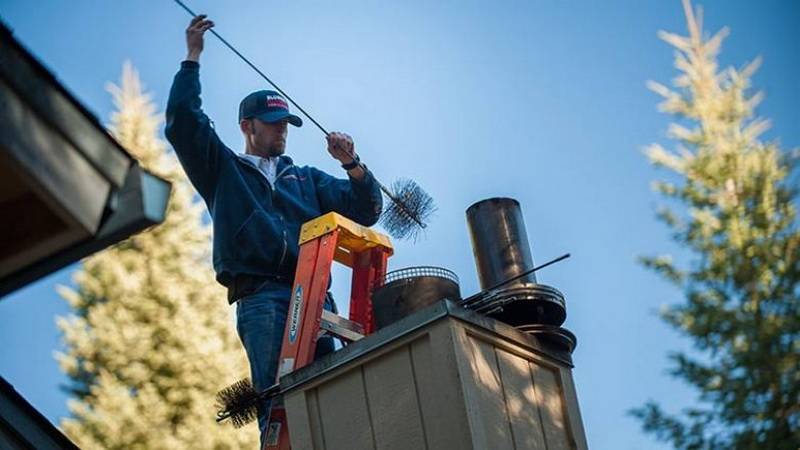
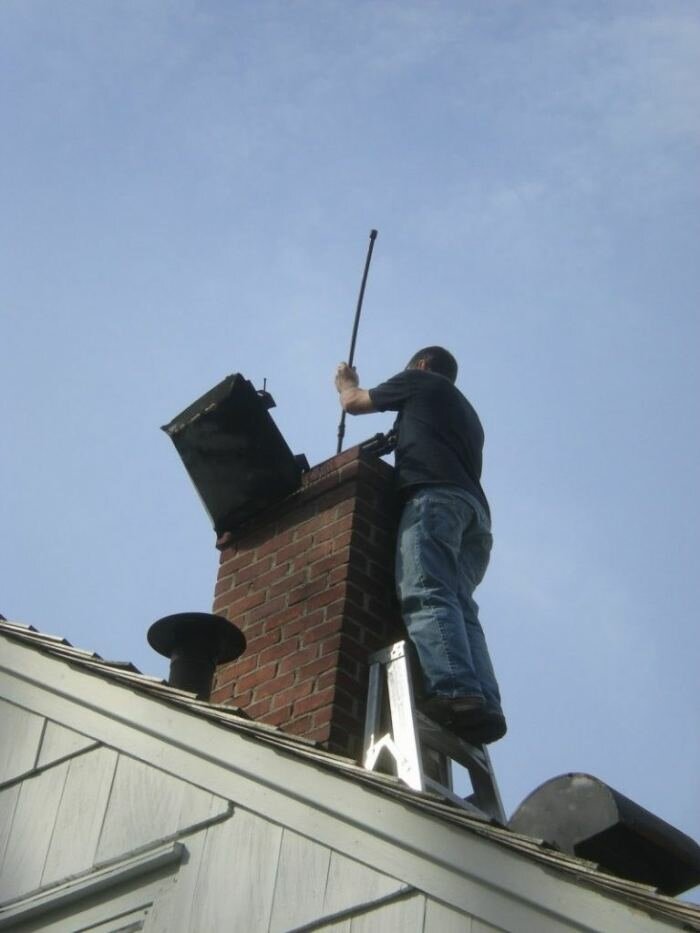
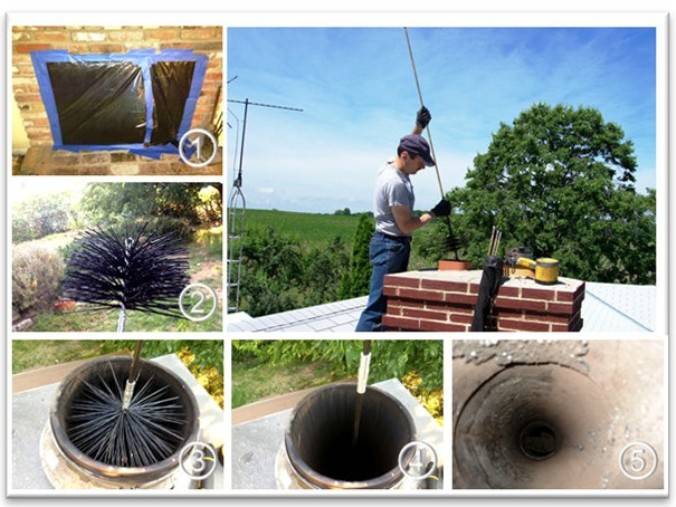
1. Before taking on the role of a chimney sweep, take care of your own safety. It is necessary to install a convenient ladder on the roof and take care of insurance that will not allow you to fall. When cleaning the chimney, use a respirator.





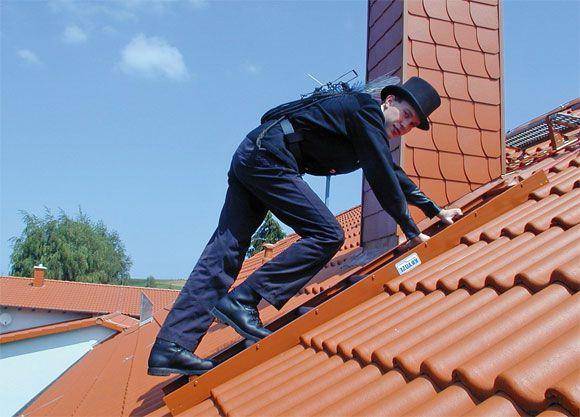
Work Safety Measures
2. The dampers are open, otherwise soot will accumulate on them, which can lead to even more clogging.But the doors - furnace, ash and cleaning - must be tightly closed so as not to stain furniture and floors with soot. It is better to hang open fireplace inserts with a damp cloth, which is not a pity to throw away - most likely it will not work to wash it off.
3. Cleaning starts from the top, from the chimney. Before cleaning, remove the head from the pipe, remove soot with a scraper or a stiff brush at an accessible distance. The tool can be extended with an extendable handle.
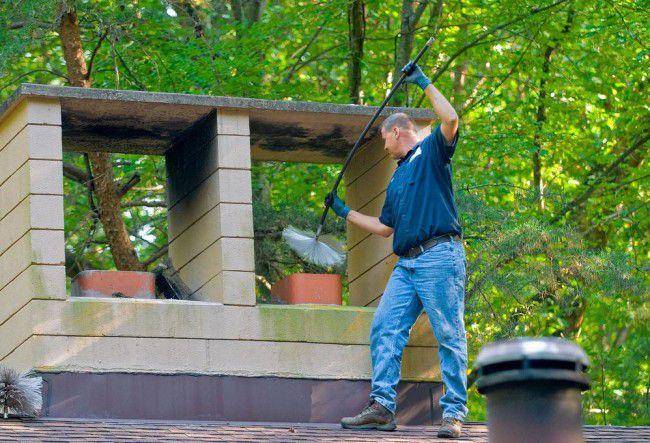
Cleaning starts with a pipe
4. Inaccessible parts of the chimney are cleaned using a flexible brush - a cable with a nozzle at one end and a handle for rotation at the other. The diameter of the nozzle should exceed the diameter of the pipe by 1.2-1.3 times. The cable is inserted into the chimney and begin to gently advance by turning the handle.
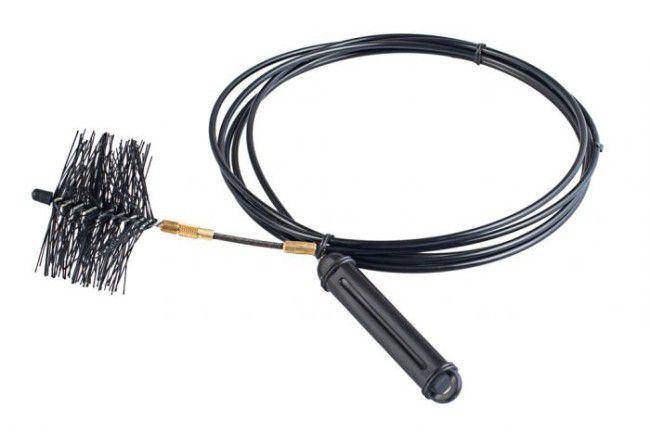
Flexible brush for cleaning pipes from soot
5. If the ruff gets stuck, it means that a serious blockage has formed in the chimney, and it can only be broken through with the help of a core. The core on the cable is sharply lowered into the chimney, trying not to touch the walls so as not to chip the brick. Having eliminated the blockage, continue cleaning with a ruff.
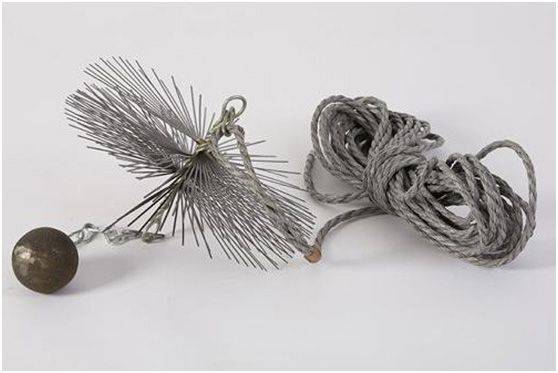
Pipe cleaning core
6. After cleaning the pipes, they begin to remove soot through the cleaning doors. In a complex furnace, as a rule, there are several of them, and they are located in the places where the smoke channel turns. First, the soot that has fallen from above is raked out, then the smoke channel itself is cleaned with scrapers and a ruff. At the same time, they move from top to bottom, to the firebox. In fireplaces with a direct chimney, there may not be any cleaning doors at all, and all the soot immediately falls into the furnace.
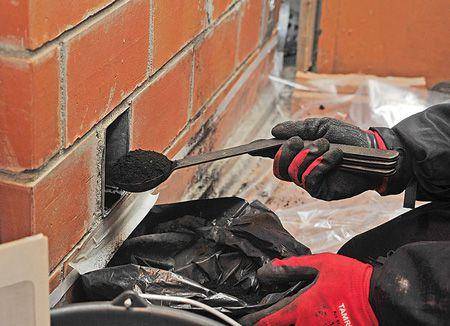
Cleaning of smoke channels from soot
7. The furnace and ash pan are cleaned last. Final cleaning can be done with a vacuum cleaner.If your vacuum cleaner is equipped with a fabric dust bag, it is better to buy a disposable paper bag for this purpose, since it is impossible to clean it of soot.
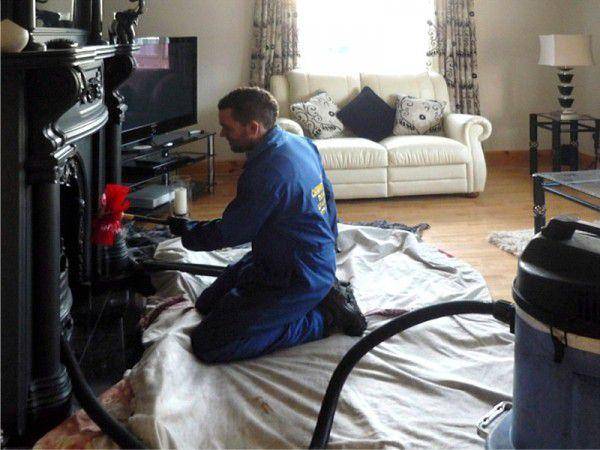
Removing soot from the furnace with a vacuum cleaner
8. Melt the stove and check the draft. If cleaning has eliminated the blockage, then after the furnace has cooled down, the head is put back on. If the draft has not improved, the smoke channel in a hard-to-reach place may be clogged, and you can no longer do without the help of a qualified stove-maker.
9. In the future, when using the stove, do not neglect the prevention of blockages using the folk or modern methods described above.
Helpful Hints
To prevent the chimney from overgrowing with soot, you must follow a few simple rules:
- It is better to use dry firewood from deciduous trees as fuel, and at the end of the firebox, periodically place aspen or preventive measures in the furnace.
- Do not burn garbage in the oven, especially plastic, polyethylene, wrapping paper.
- To reduce moisture condensation, the chimney must be insulated, especially if it is made of metal. Usually, ready-made double sandwich pipes with a layer of non-combustible insulation are used.
- It is imperative to put a cap on the pipe to protect it from accidental ingress of debris or precipitation.
With proper use of the stove, the question "how to clean the chimney from soot" will arise very rarely, and you will be able to fully enjoy the bright flame and heat.
Causes of soot
The combustion of fuel is accompanied by an oxidation reaction, which occurs under conditions of high temperature and a stable supply of oxygen. If at least one of these conditions is not met, soot is formed: this substance is the result of insufficient oxidation of carbon.A visual sign of the appearance of soot is the black color of smoke coming out of the chimney. This indicates the presence of soot particles in its composition, the main part of which settles in the chimney (most often on corners). Sometimes people don't understand why is the oven smoking. And often, the appearance of smoke from the furnace causes soot in the chimney.



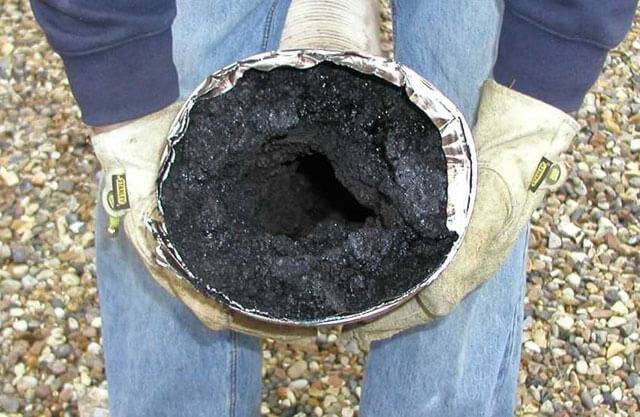
This process is activated in the following cases:
- Not enough dry firewood. If the firewood loaded into the firebox has a high moisture content, it will dry out during the first time of the firebox. This is accompanied by the consumption of additional energy, which reduces the operating temperature by an order of magnitude. As a result, due to the undercooling of carbon, a large cloud of black smoke is formed. If such cases are a stable trend, the chimney will gradually become clogged.
- Getting into the furnace of plastic garbage and plastic bags. It is advisable not to allow this. A lot of soot is formed by scraps of plywood, chipboard, OSB, which contain glue. Its combustion is accompanied by the release of dense smoke, which leads to a rapid clogging of the chimney.
- Weak traction. Sometimes they go to reduce the air supply to increase the burning time: firewood in this mode slowly smolders. Another reason may be the insufficient height of the chimney. In addition, the accumulation of significant soot layers in the pipe leads to a decrease in thrust.
The chimney can also become dirty when using certain types of firewood. This is especially true of spruce and pine, which contain a large amount of resin. There is not always finance for expensive oak or other hardwoods. However, any homeowner is able to take care of the proper dryness of firewood. A good option is to get a roomy firewood.This will make it possible, first of all, to select the most seasoned and dried firewood. Fresh logs at this time will be able to dry to the proper condition.
Chimney Blockage Prevention Tips
Particular attention should be paid to the smoothness of the inner surface of the chimney. It will be difficult for soot to catch on it, and it will either fly out or fall down
At the design stage of the furnace, you can consider the option of using a sleeved chimney. In it, brickwork creates a pipe frame, and a separate sleeve made of galvanized steel, stainless steel or ceramics is inserted into the inside.
For an already built chimney, it is useful to do the following:
- if possible, hardwood firewood;
- do not put polyethylene, plastic and household waste in the furnace;
- do not use raw firewood;
- at the end of each firebox, burn 2 - 3 aspen or alder logs for the prompt destruction of fresh soot;
- carry out mechanical cleaning before the start of each heating season;
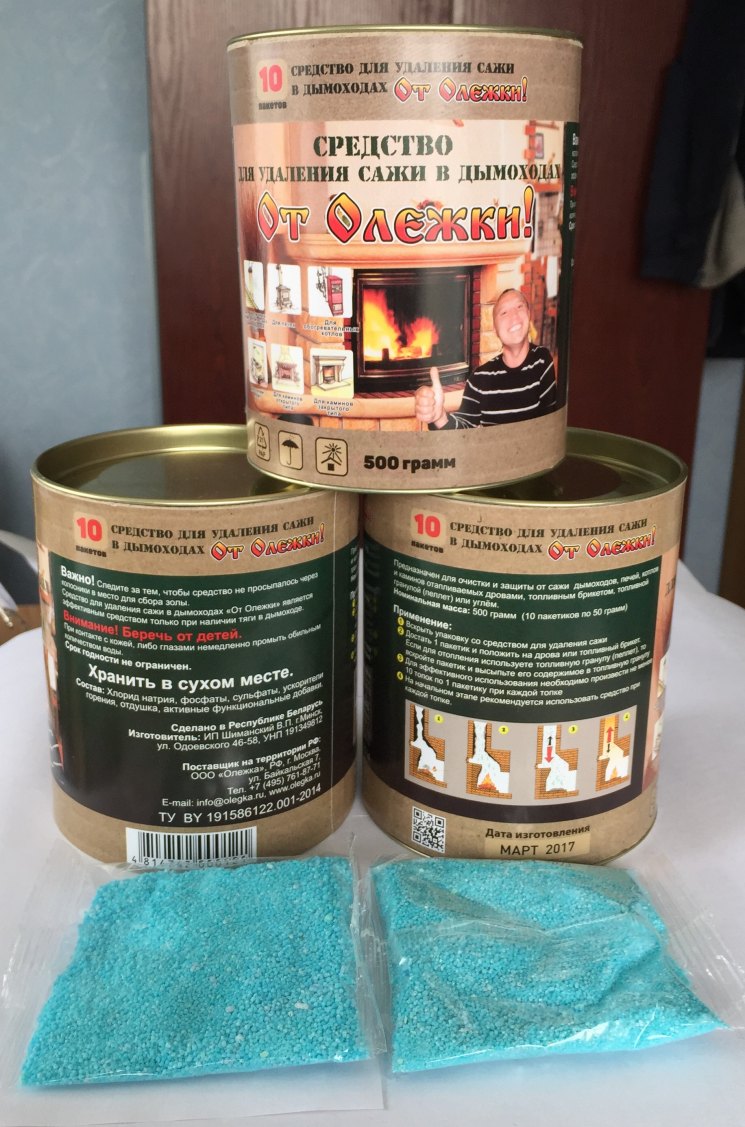
- If the oven is used continuously, use chemicals every month.
If there are signs of a clogged chimney, it is important not to postpone cleaning, but to immediately call a chimney sweep or start independent work. Removing old soot will be both more difficult and more expensive.



