
- When to clean your chimney
- Special cases of cleaning the chimney
- How to clean a chimney pipe in a private house
- Video: how to clean a chimney in a private house
- Bath chimney cleaning
- Cleaning the chimney pipe from tar
- Curved chimney cleaning
- How to clean a gas stove chimney
- Chimney cleaning methods, tools and fixtures
- Mechanical cleaning method
- Chemical cleaning method
- Folk methods for cleaning chimneys
- Mechanical way to clean the chimney
- What is ersh?
- How to clean a chimney with a ruff:
- Is it possible to clean a complex winding chimney with a ruff?
- How can you get rid of the accumulated soot?
- With a special brush - a simple and proven method
- Potato peelings - the old-fashioned method
- Aspen wood - with fire from the chimney
- Aluminum cans - unusual, but effective
- Hose - what is already at hand
- Chemical cleaning - unpopular and unpleasant
- Mechanical and manual cleaning
- Tools and materials
- How to make a ruff with your own hands?
- Roof side cleaning
- Cleaning the chimney from the stove
- How to check the status
- visual inspection
- Special video systems
- Indirect signs
- Slow kindling
- The smoke penetrates
- Bad traction
- Black smoke
- soot flakes
- Arbitrary attenuation of the flame
- Unpleasant odor while burning
- Why does the chimney get clogged?
- Frequency of cleaning
- How NOT to clean your chimney
- Consequences of uncleaned chimneys
When to clean your chimney
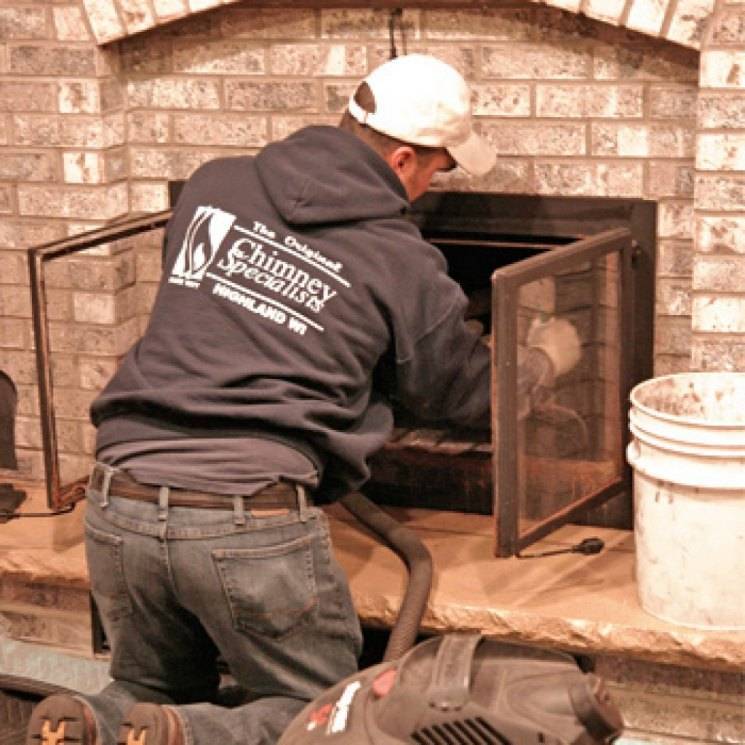
Regardless of the quality of the stove, the chimney will still need to be cleaned someday. It is the matter of time. At proper laying of the stove or a fireplace, you can do without this procedure for many years, especially if you use dry firewood and refrain from burning household waste. Firewood before consumption should lie for at least a year and a half. The type of wood is also important. When using pine or spruce wood, cleaning will be required faster (due to the presence of resin).
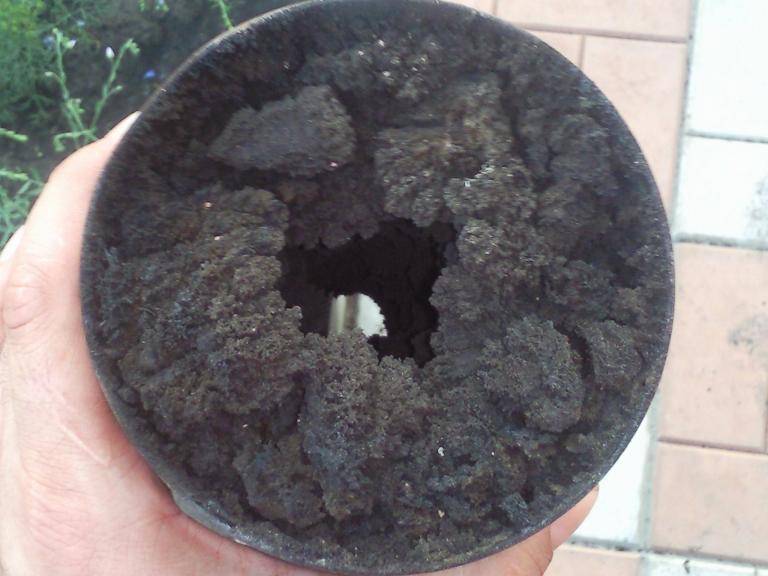
The first signal of clogging of the stove (chimney) chimney is dark smoke from combustion products. If hardwood firewood or pellets are used, the smoke is clear, sometimes white. Its darkening indicates the accumulation of soot, soot and dirt. The second sign is that the firewood does not make noise during combustion, the flame becomes dark orange. When these signs appear, it's time to think about calling a chimney sweep or prepare yourself for cleaning.
But, before you clean the chimney yourself, it is still better to examine the pipe first.
Stoveman's note: in any chimney at the bottom there must be a cleaning pocket through which dirt and debris are removed.
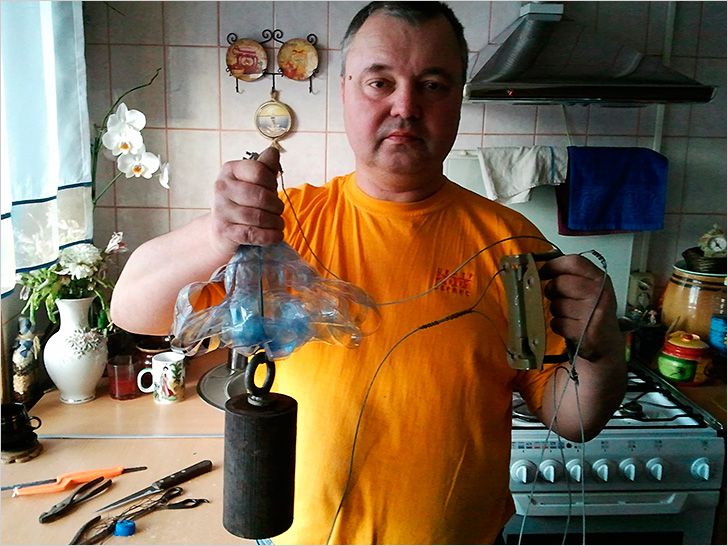
A cleaning weight with a diameter corresponding to the size of the chimney should be in every home. If it easily passes into the pipe, then the reason for the poor performance of the stove is something else. If the weight stops in one place, then the pipe is clogged and the duties of a chimney sweep cannot be avoided.
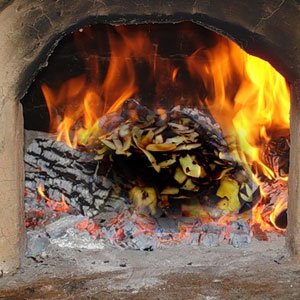
The most ancient folk way is to put raw potato peelings (or chopped raw potatoes) into the heated oven.
When they burn, starch is released, which softens the soot deposits. One part of the deposits flies out through the pipe, the other falls into the stove (fireplace).To prevent the formation of soot deposits, it is also possible to burn rock salt at the same time as firewood.
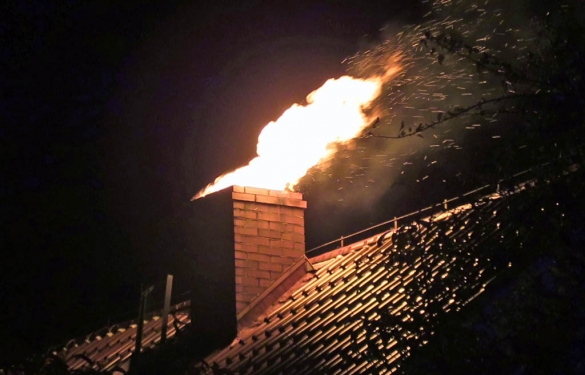
The most reliable, but also dangerous method is to put a good armful of aspen logs into a heated stove without closing the door. The stove will begin to hum, the soot will light up, a flame will appear from the chimney. This method can be used if the chimney is really very reliable.
Special cases of cleaning the chimney
Some chimney cleaning situations require separate consideration.
How to clean a chimney pipe in a private house
Briefly, the entire process of cleaning the chimney has already been described above. To what has been said, it is only necessary to add that with a strong clogging of the smoke channel, the first operation is to break through the soot with a core without additional devices. Only then are brushes of different sizes and designs consistently used.
When performing work, care should be taken to create a safe working environment.
When working at height, be sure to buckle up with a safety cable.
Video: how to clean a chimney in a private house
Bath chimney cleaning
The chimney in the bath is usually simpler. And most often it is made of stainless pipes, which requires special attention to its cleaning. In order not to negate its main advantage - the high quality of the inner surface - it should be cleaned only with soft plastic or brushes made from natural materials. The easiest way to manage is with straight pipelines, and if there are knees - we recall that there should be no more than two of them - you may have to dismantle the chimney if it does not have special windows for cleaning during installation.
Otherwise, preventive measures and cleaning are carried out in the same way.
Cleaning the chimney pipe from tar
Considering the composition of flue gases, you need to pay attention to two main components - this is water vapor from the fuel and a vapor of difficult-to-ignite creosote. Mixing and settling on the walls of the smoke channel, they form a resin that is difficult to remove due to its viscosity and good adhesion to various types of surfaces.
The only effective way to deal with tar deposits is to prevent its formation. For this, various means are used that are produced specifically for this case.
HANSA effectively protects the walls of the chimney from the formation of tar
For example, the known composition of HANSA is a fine crystalline substance. Part of it converts wood into resin and water vapor, and the second, reacting with the substance of the resin, contributes to its decomposition and combustion at the temperature in the furnace. Remains of resin on the walls turn into a brittle crystalline composition, crumbling into the furnace.
This composition is placed inside the burning furnace. The frequency of use at the beginning of the operation of the thermal unit is daily, then you can switch to use once a week.
Curved chimney cleaning
The bends of the smoke channel are always a forced measure caused by the structural features of the building. However, they need to be cleaned periodically. For this purpose, elements are provided in the design of the pipeline, using which this operation can be performed easily and simply. These are special hatches, when opened, it becomes possible to access the straight section of the bend. The length of the inclined sections is not recommended to be made larger than a meter. The number of bends on one pipe should not exceed two.
If there is no window for cleaning on the outlet elbow, then the chimney will have to be disassembled
How to clean a gas stove chimney
The reason for cleaning the chimney of the gas column is its banal clogging with a deterioration in draft. In a city apartment, this is all the more dangerous because the threat arises for many people at the same time. One of the signs of traction deterioration is the “popping” of the column igniter.


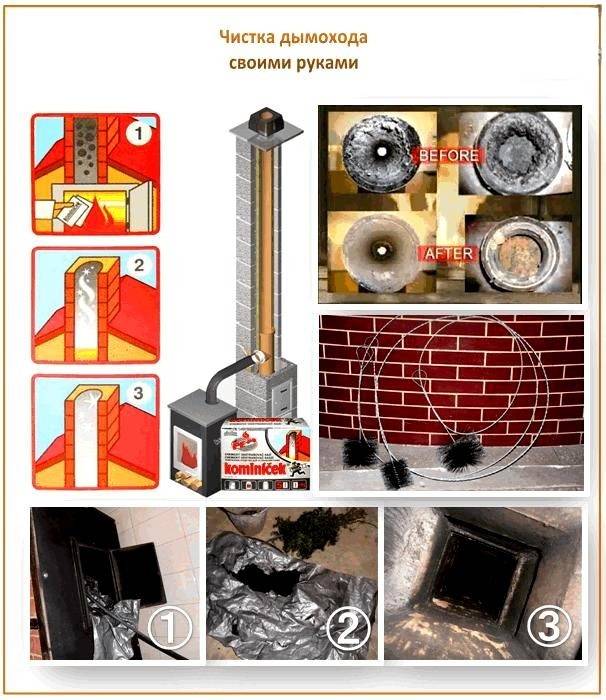


The process of cleaning the exhaust pipe from a gas unit is practically no different from such an operation with conventional chimneys. The same ruff is used. Recently, vacuum cleaners of a special design are often used, which reliably clean the surface of the pipe and collect pollution products. In difficult cases, when the layers cannot be removed with a brush or vacuum cleaner, special chemicals are used to soften and remove them. Considering that the use of prophylactic agents on the column pipe is impossible, urgent measures should be taken if signs of clogging are found.
It must be admitted that the success of using solid fuel furnace equipment to the greatest extent depends on the correct operation of the units and the careful selection of fuel for it. In addition, it is necessary to regularly use preventive measures and know how to get rid of problems with clogged chimneys. Then stoves and fireplaces will delight you with fertile warmth in the house for a long time. I wish you success!
Chimney cleaning methods, tools and fixtures
There are several cleaning methods chimney pipes in private houses. All these methods, as a rule, do not cause difficulties for independent application.However, we do not advise you to clean the chimney yourself if you are not sure of your abilities, or the condition of the chimney leaves much to be desired due to wear and tear.
Mechanical cleaning method
The mechanical method is the most effective and time-tested method. Remember how in the old days they portrayed a chimney sweep? The main tool of his labor is a long stick with a brush at the end. In our time, no fundamental changes have occurred, except that the tools and devices are adapted to real conditions.
Cleaning is desirable to carry out in the warm season, in the absence of wind. Before directly cleaning the chimney, close all the openings of the stove in the room, so soot will not enter the room. An open hearth or fireplace is enough to completely cover with a wet rag. On the roof, be sure to secure yourself with a safety cable. Feet must be firmly supported.
Tool used for cleaning:
- Scraper, which is used if the soot layer is too thick.
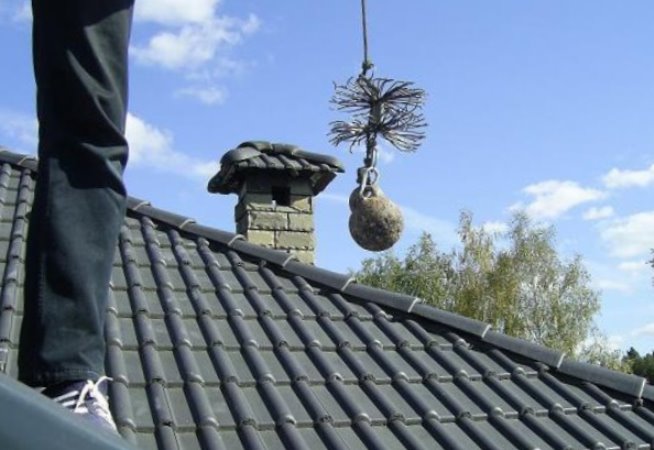
- Metal ruff. They lower it into the pipe with the help of a cable, sometimes a weighting agent in the form of a core is attached from below. Such a device (total weight of at least 9 kg) passes through the entire pipe, cleaning off soot.
- Stiff bristle brushes with flexible holder. Used for square and rectangular pipes.
- Core or weight. Use if a blockage has formed due to accumulated debris or collapsed masonry.
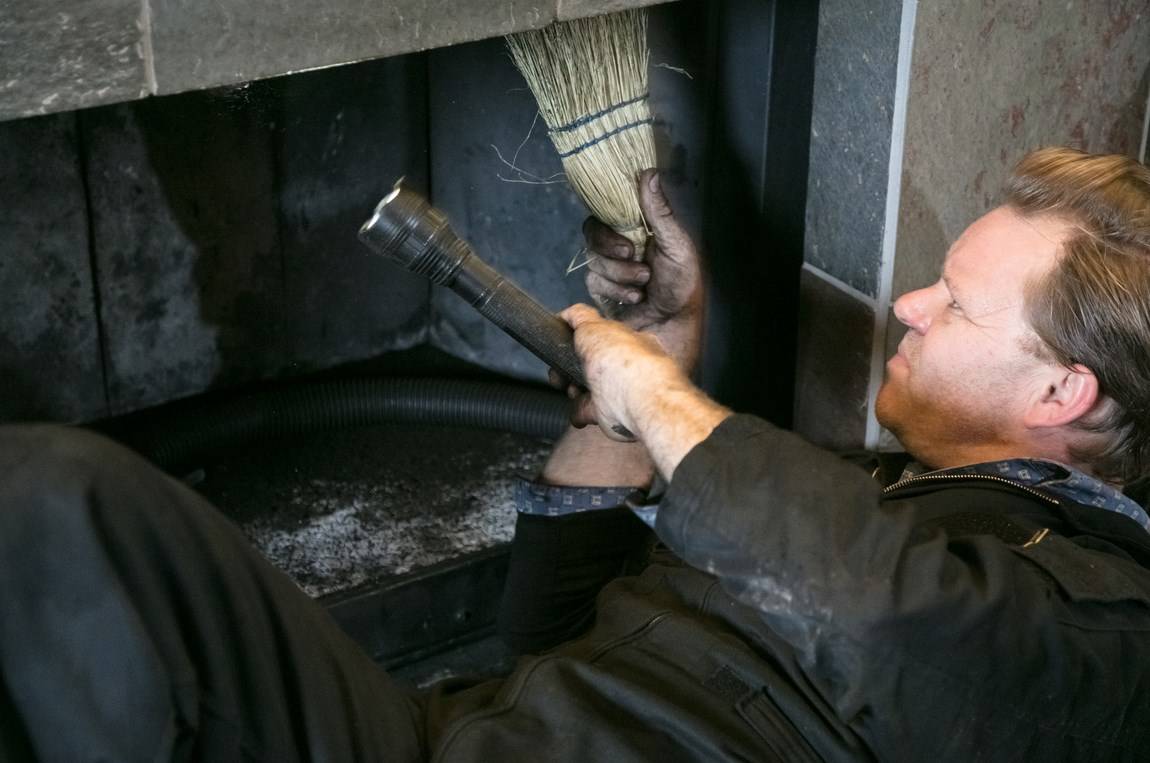
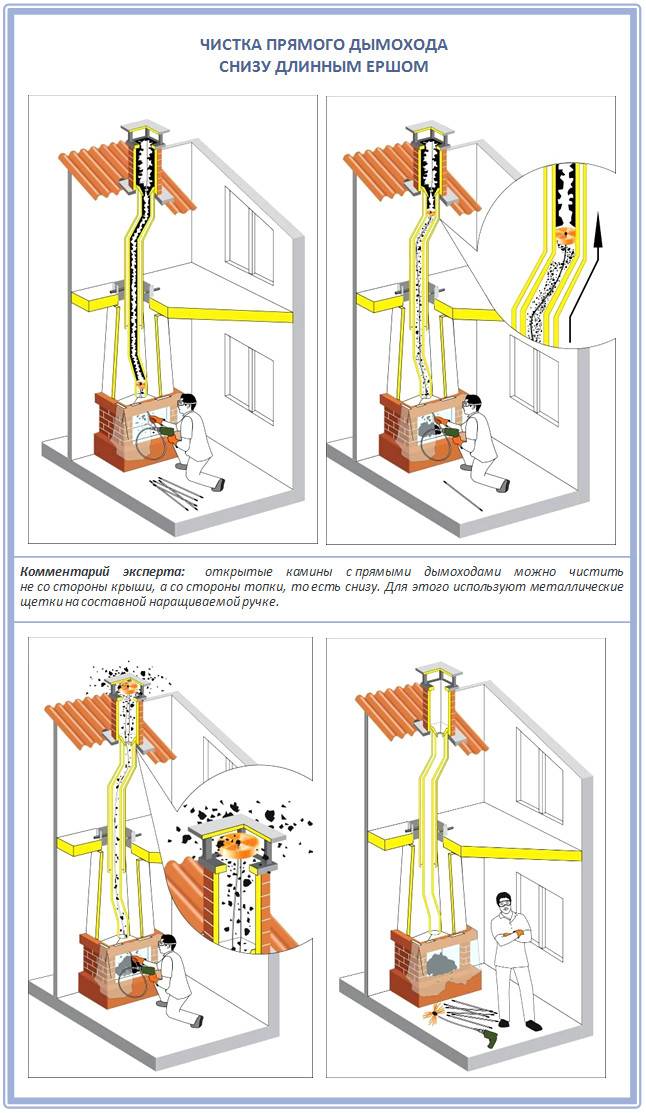
It is also possible to clean the pipe from the inside of the room, if the design allows, and the entrance to the roof is difficult. Of the tools, a ruff on a flexible holder is used. The disadvantage of this method is that the soot falls down and it is necessary to protect the furniture and surfaces with a tarp.Professional chimney sweeps in such cases use a special "vacuum cleaner" to collect soot. Also, cleaning from the inside of the room is used in the presence of bends in the chimney.
If there are no special tools for cleaning in the arsenal, you can make them yourself. So, for example, you can make a full-fledged brush from an ordinary plastic bottle. The video provides detailed instructions:
Chemical cleaning method
It is used to prevent contamination of chimneys. Agree that it is better to use this method once or twice a year than to bring the state of the chimney to a deplorable state.
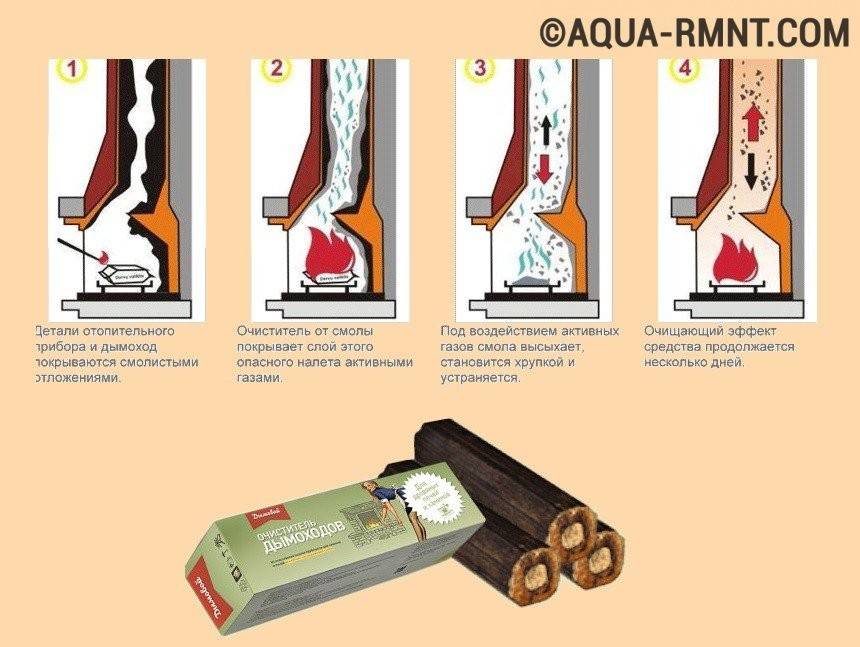
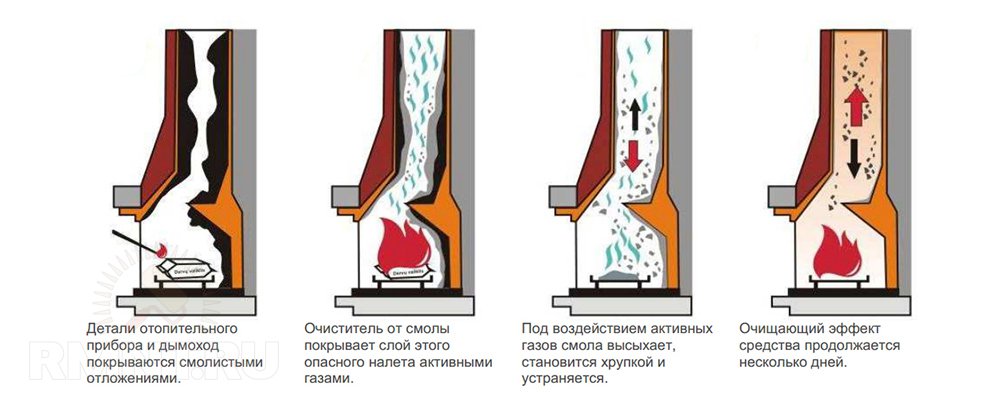
Chemical cleaning agents are a special powder or briquette, which, when burned, forms a specific gas that destroys soot. The soot accumulated in the chimney simply crumbles from the walls and is removed along with the ash. These methods are very effective for ceramic chimneys or stainless steel pipes.
Chemistry can be divided into three groups:
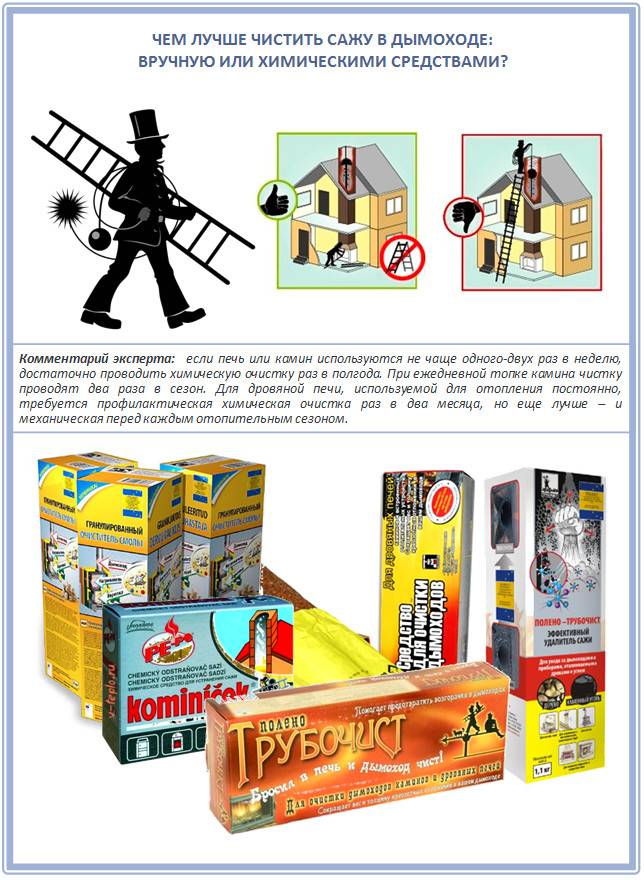
- Paper bags with granulated substances of Czech production. Laid together with firewood. Remove dirt up to 2mm thick.
- Briquette in the form of a log. Can be used with firewood or burned separately. Softens soot and facilitates mechanical cleaning.
- Powder, analogue of the Czech cleaner, but Russian-made.
Chemical cleaning methods will be ineffective if the deposit is already too large and can only be removed mechanically. Therefore, as mentioned above, such funds are effective only as a preventive measure.
Folk methods for cleaning chimneys
If the pollution is not too great, then you can use one of the popular methods for cleaning the chimney.It will not be possible to remove old deposits, but as a preventive measure, these methods have proven themselves on the positive side.
- Salt. Once a week, add regular table salt (100-200g) to the firewood. It interacts with water in burning wood and releases an acid that binds soot and prevents it from settling on the walls. Do not use if you have a metal pipe as this will corrode it.
- Starch. When burning potato slices and their peels, starch is released, which decomposes soot, but "potato raw materials" must be burned at least a bucket at a time. You can also use other products containing starch (peas, beans).
- Alder, aspen or walnut shell. Aspen, alder or walnut shell firewood burns very hot. The high temperature simply burns the soot formed. With good draft, black flakes will fly out of the pipe, and then crumble into the furnace for several days. This method is effective, but can cause a fire.
Mechanical way to clean the chimney
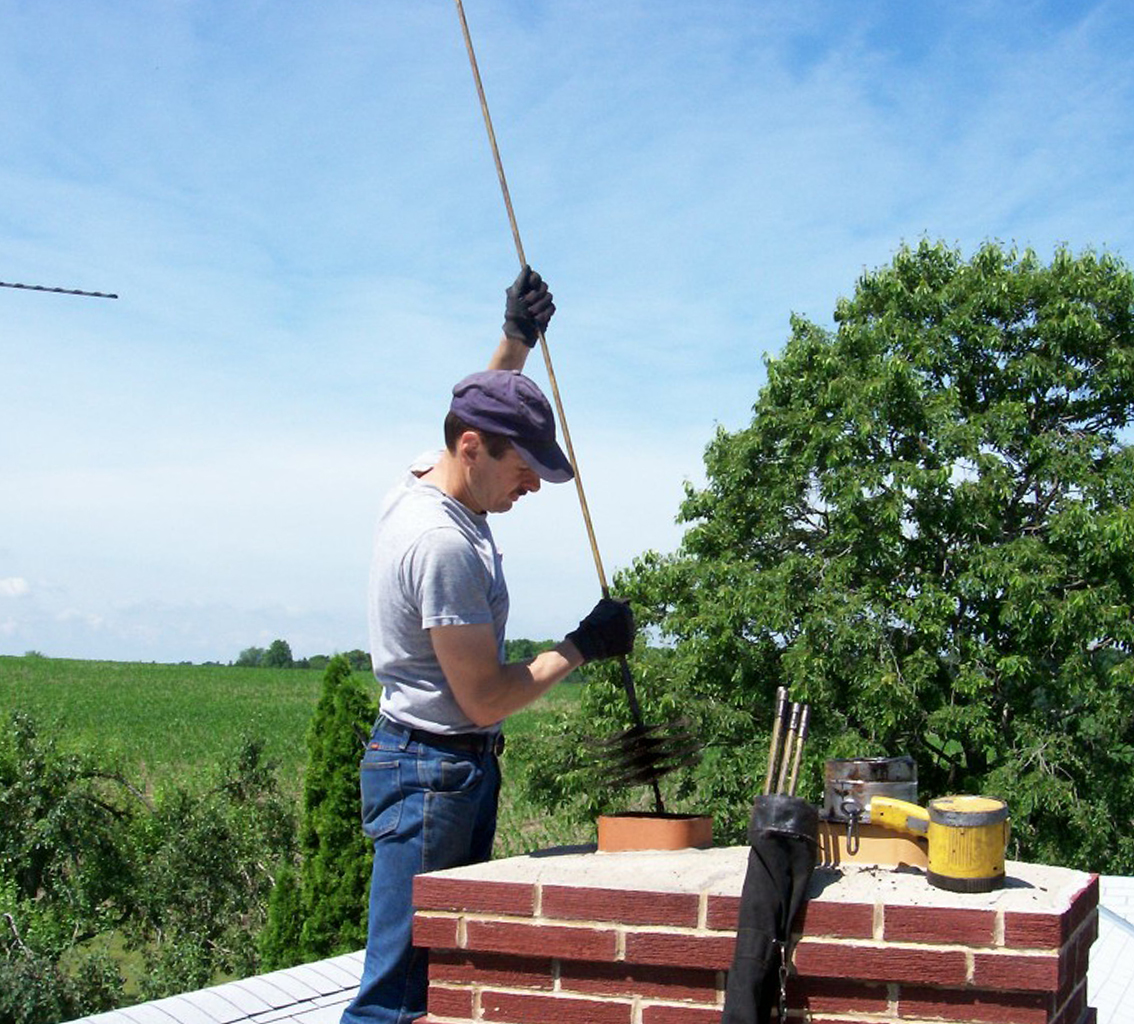
Mechanical cleaning consists in removing soot using a metal ruff, which is inserted into the chimney and, making rotational and translational movements, scrape off the soot from the surface of the chimney. The method has several advantages: it is effective against blockages and hard deposits, it is cheap and quite simple, and does not require special knowledge and skills. At the same time, manually cleaning the chimney through the pipe is a rather dangerous task, because you have to climb onto the roof.
What is ersh?
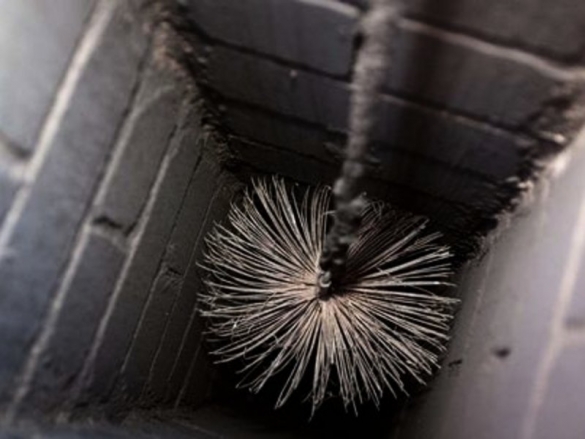
This is a twisted cable with steel wire, equipped with a twisting handle on one side and a wire or plastic nozzle on the other. The length of the cable can be different and depends on the length of the chimney.The ruff is introduced into the pipe forward with a nozzle, while rotating its handle. In this case, the rotation is transferred to the nozzle, and it mechanically scrapes off the soot layer from the pipe walls.
Chimney brush
How to clean a chimney with a ruff:
Fully open all latches and vents that block draft in your stove or fireplace. Place a container for soot under the chimney at the mouth of the stove or in the fireplace insert - there will be quite a lot of it. In order not to stain the furniture and floors in the room, an open fireplace insert can be curtained with an unnecessary cloth.
Observing safety precautions and using a safety belt, climb to the roof. Remove the cap from the pipe
Carefully insert the cleaning cable into the pipe and try to push it some distance. Rotate the handle on the cable at the same time
If the length of the chimney is more than 3 meters, it is more convenient to do it together - one person directs the cable into the pipe, the second rotates the handle, standing at a certain distance.
If the cable does not pass through the gap of the pipe in any place, it is necessary to determine where it is stuck - at a bend in the pipe or in a straight section. If the pipe in this place does not have turns, most likely, a serious blockage has formed there. It can be pierced with a weight tied to a rope, lowering it into the pipe rather sharply.
It is necessary to clean the chimney using this method until the moment when soot stops pouring from the chimney into the furnace. After cleaning, check the draft with a lit newspaper - it should improve significantly.
It is necessary to clean the chimney using this method until the moment when soot stops pouring from the chimney into the furnace. After cleaning, check the draft with a lit newspaper - it should improve significantly.
It is sometimes impossible to clean a Russian stove with a complex chimney, including several turns at an angle of 90 degrees, with a ruff through a pipe from the roof - the length of such a chimney is quite large, and the ruff stubbornly does not want to go through the turns. In this case, it is possible to combine pipe cleaning with mechanical cleaning of the chimney.
Is it possible to clean a complex winding chimney with a ruff?
Of course you can, to do this, follow these instructions clearly:
-
Inspect the oven carefully. On its side and back walls you will find doors designed for cleaning the chimney. They may be smeared or painted over, but they will need to be opened. Place a bucket or other container under each door.
-
Change the standard nozzle on the ruff to a plastic bottle, cut in half and slightly notched around the circumference so that you get a "chamomile". You can fix it like this: the ends of the wire, acting as a ruff, must be collected in a bundle, passed through a cork with a hole previously made in it and bent. Screw the cork onto the bottle. The plastic brush is much softer than the metal brush and goes through the turns better, and by using different bottle sizes you will be able to gradually clear all the turns.
-
Enter the resulting device into the chimney from the side of the firebox and push it as deep as possible, rotating and from time to time extracting it along with the soot that has fallen into the bottle. Clean the chimney until the amount of soot is reduced to negligible. Also clean the chimney from the side of all doors.
- Open all dampers and clean the chimney from the roof as described above. If you do this before cleaning the chimney, you can seriously clog it, as there is simply nowhere for soot to fall.
- Once again, clean the chimney from the side of the firebox. Sweep away soot with a brush, including from latches and views. Close all doors on the rear and side walls and check the draft with a newspaper or a torch. With good draft, light the stove with a small amount of wood. If the doors for cleaning the chimney are smoking, cover them with a solution of clay and sand.
Sometimes, instead of doors for cleaning the chimney, stove-makers install removable bricks. It is not recommended to remove and install them yourself without special skills; it is better to contact specialists to clean such an oven.
How can you get rid of the accumulated soot?
Sometimes, than hiring a non-professional, it is much easier and safer to do your own bath from soot - with the help of brushes, modern chemicals for cleaning chimneys and even "grandfather" methods, and without necessarily climbing onto the roof!
Let's look at the most popular options for cleaning soot from the chimney and how to do it.
With a special brush - a simple and proven method
Of all modern mechanical and chemical means, the brush is the simplest and safest.
It is only important to choose the one that suits your chimney - both in diameter and in length, so that you do not worry about how to clean your chimney from soot along its entire height
A nylon brush with a stiff bristle is especially good, which is easy to clean the chimney of any material. The nylon bristle is flexible and adapts well to any pipe shape, while at the same time coping with the most stubborn deposits. But at the same time, it does not scratch or damage its inner surface.


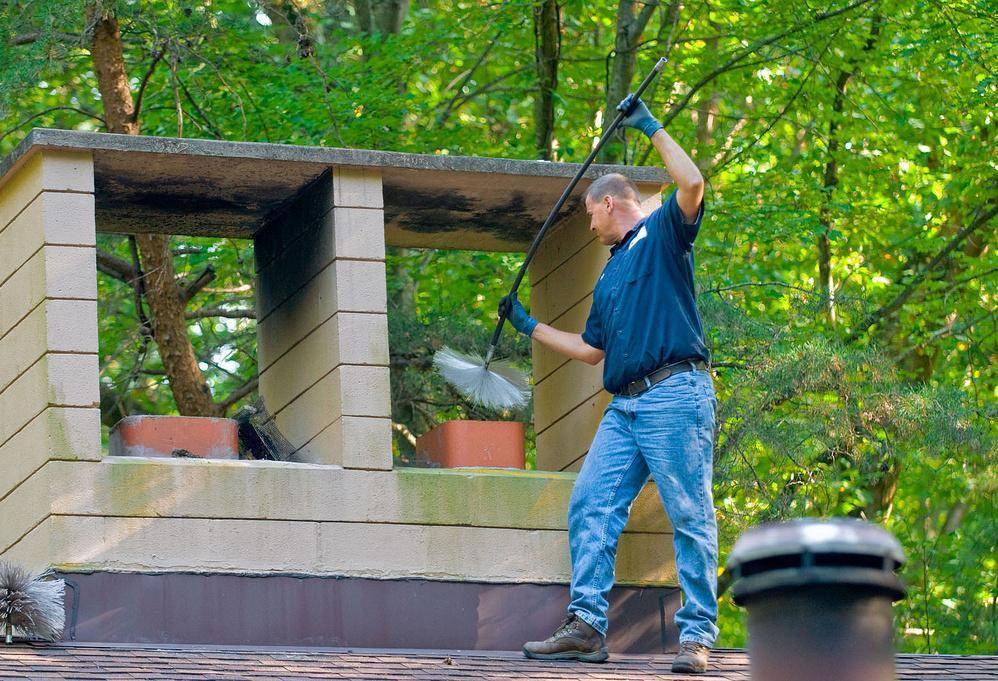


The most difficult thing is to find a good brush for the chimney bends. It is there that the soot settles, and it is not so easy to get it.Just for this, nylon bristles are most suitable - it will easily penetrate into the most inaccessible places, while hard brushes will simply scratch the folds. And more scratches - less smoothness - soot clings more.
It is also important what kind of handle the brush has - it must have sufficient flexibility so that it can crawl into the most invisible nooks and crannies and at the same time be easy to control your movements.
Potato peelings - the old-fashioned method
Here's how to clean the chimney in this way: we throw a bucket or half a bucket of fresh potato peelings into a well-melted oven - this is how much it will fit into it already. During their combustion, starch will be released, and it decomposes soot. Within two or three days, it will almost completely fall off the walls of the chimney and partially fall out. After that, tie a rod ruff to the brick and clean the chimney from above in the classic way - it will be easy!
Aspen wood - with fire from the chimney
Chimney cleaning with aspen wood is as old as the world. But this method cannot be called safe - let's figure it out.
We put aspen firewood in the stove and kindle it well. They burn well and give a very high temperature. At this time, all the doors and valves of the stove should be open, and do not forget to add more firewood. The result - the soot itself lights up, the stove begins to hum strongly. If you go outside at this moment, you will see how fire plows from the chimney on the roof of your bathhouse! And the surrounding area will quickly be covered with large white flakes. But the chimney will be cleaned, and cleaned well.If only it survives this test - after all, not every chimney is designed for 1100 ° C, and soot will burn in it at this mark.
Aluminum cans - unusual, but effective
Banks need to be burned once for ten fireboxes - this is enough, and very little soot will be collected. The only condition: the fire must be made hot, with a large amount of solid coal - so that the jars really burn, and do not lie on the wood and change color. Normally, one can should burn out in five minutes.
Hose - what is already at hand
Some attendants don't bother with the newfangled methods and clean the chimney with a regular watering hose. The whole procedure looks like this:
- Remove the glass from the bottom of the chimney.
- We put a hose from below (preferably from above), preferably hard.
- A few cleaning movements - all the soot is already at the bottom.
On the tip of the same hose, you can additionally attach a chopped bottle or a brush - and you will see how easy it is to clean the chimney efficiently and without cost!
Chemical cleaning - unpopular and unpleasant
Chemical cleaning of chimneys is more of a preventive measure than a real cleaning. The bottom line is that after it the soot will fall off in places, but you still have to use an additional brush. Plus, the smell in the bath can last for several days. And therefore, if potato peelings are not available to you, you can purchase some kind of Kominichek or Chimney Sweep Log.
Mechanical and manual cleaning
For mechanical cleaning of chimneys, the same tools are used today as 200 years ago. The technology itself has not undergone major changes either. Cleaning is carried out from the side of the roof and from the side of the oven.
Tools and materials
To perform cleaning from the side of the roof, use:
- rope or steel cable;
- hard metal brushes and weight;
It is important that the load has the correct center of gravity. Otherwise it might get stuck
It is ideal to use a round metal core as a load. It is they who break through the blockage. And only then the brushes come into play.
If there is no suitable brush at hand, you can make it yourself from an old plastic bottle. Step by step instructions below.
How to make a ruff with your own hands?
- Take a plastic bottle and cut off 150 mm from the top. Make cuts along the top in 15 mm increments. The length of the notch is selected depending on the diameter of the pipe. If the pipe diameter is 100 mm, then the brush diameter should be 130 - 140 mm.
- Drill a hole in the center of the cork. Screw the cork into place and bend the petals.
- The first brush is ready. Now do the same for the second one.
- Find the right cargo. Its weight must be sufficient for the brush to pass through the chimney.
- Tie the load to a strong cord or steel cable. Thread the other end of the cord into the brushes. The brushes should be facing each other.
- Take the rest of the bottle. Cut off the bottom. It turns out a cylinder. Cut it lengthwise. Insert it between the brushes. The length of the cylinder should be about 150 mm. Give it a diameter equal to half the diameter of the brush. Fix with a stapler.
-
Tie a knot over the plug of the top brush. The tool is ready.
The process of making a brush with your own hands
There is another option for making a brush with your own hands:
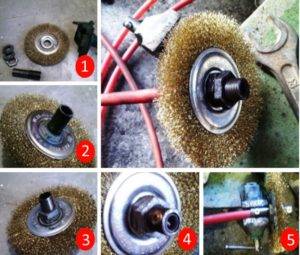
Brush in the form of a brush with your own hands
Roof side cleaning
The whole process consists of 6 steps:
- Prevent soot from entering the room. To do this, hang a firebox with a wet cloth and close all hatches.
- Prepare in advance and use all the necessary equipment for its intended purpose, comply with all safety requirements when working at height. You will need: safety glasses, closed non-slip shoes, gloves, insurance. It is forbidden to carry out work in the rain and strong wind. And also under the influence of drugs, alcohol and other drugs.
- Remove the cap, inspect the channel. If necessary, remove debris with a broom.
- The first pass is done with a load. From cleans the chimney from large contaminants.
- After that, install brushes and clean the walls of the channel from soot. It's not worth rushing. It's not complicated, but it's a messy and time-consuming process.
- The last step is cleaning the revision chambers.
Cleaning the chimney from the stove
The previous method will allow you to clean the channel only up to the first turn. Further, another tool will help to clean the stove from soot without disassembling it. You can't use gravity.
The furnace must be provided with special hatches for cleaning. To do this, use another tool. A section with a length of 3 - 5 m will help to clean a special brush with a rigid but flexible fiberglass cable. Such a set is sold in hardware stores.
There is also a more specific tool:
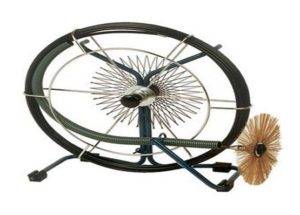
Chimney cleaning tool
Such a device allows you to clean a longer area. The easiest way to clean the outer chimney. But only if it is properly assembled.
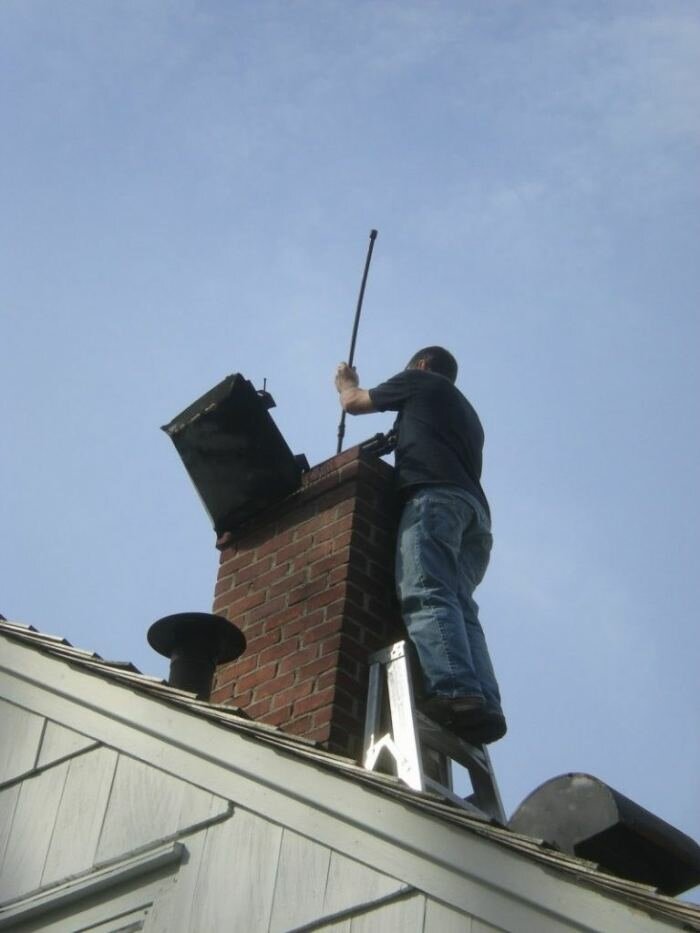


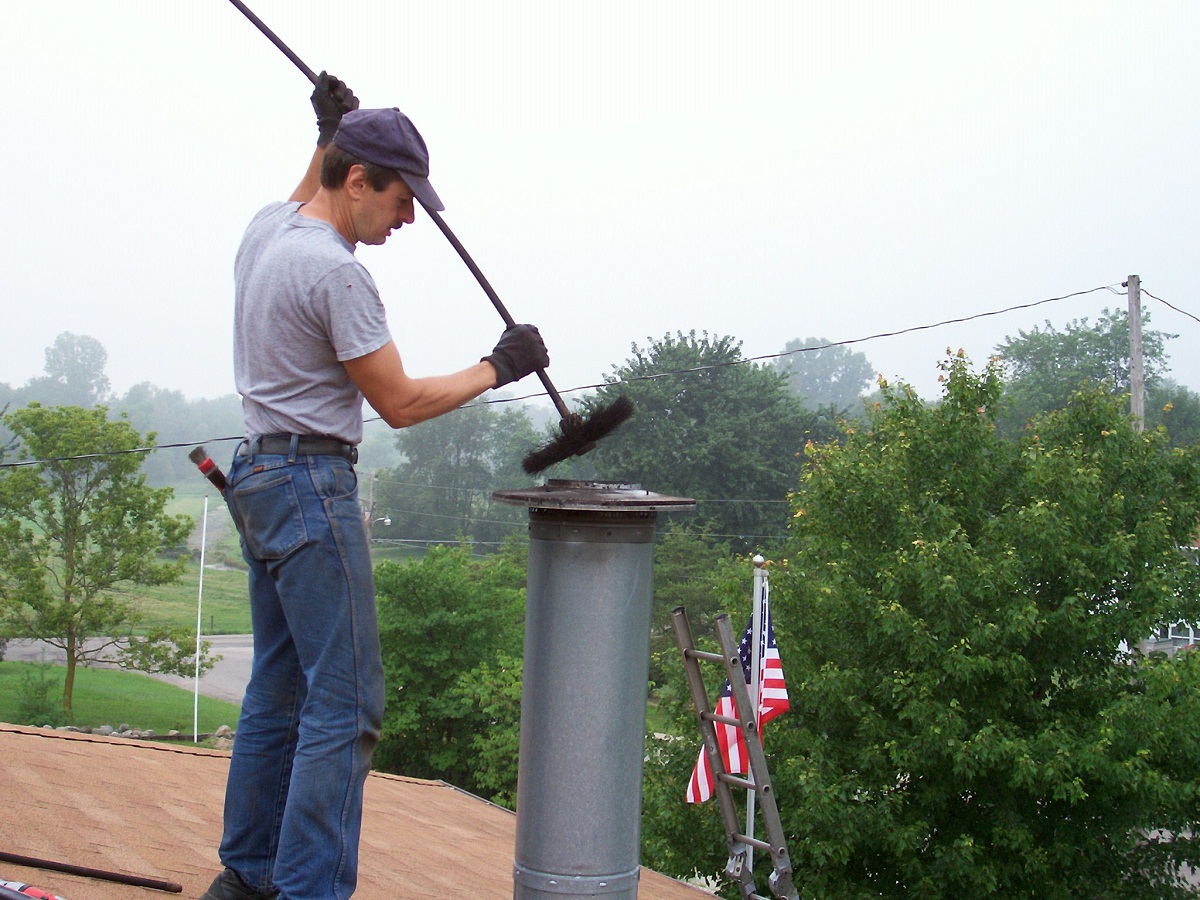



Step-by-step instruction:
Unscrew the plug. Clean it of dirt, soot and debris.
If the pipe is made of stainless steel, then the use of a metal brush is strictly prohibited.
We attach a suitable brush and perform cleaning, gradually moving the brush up.
Similarly, cleaning is carried out from the furnace itself.Flexible but rigid support allows you to push the brush far enough.
The collected soot is removed. And carry out minor repairs to the chimney
It is important not to forget to install the pipe head in place.
How to check the status
In the case when the furnace began to function intermittently, it is necessary to determine the cause of the malfunction. For this use:
- visual inspection;
- special video systems;
- are guided by indirect signs, signaling a clogged chimney.
visual inspection
The most affordable way that does not require owners to have certain tools or skills. Enough:
- remove the pipe
- check its insides for blockage.
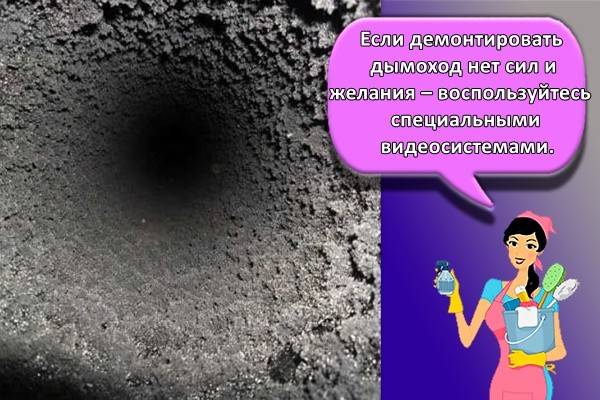
Special video systems
If there is no strength and desire to dismantle the chimney, use special video systems. They are placed inside the chimney and look through it for blockage along its entire length. This option requires significant financial costs, but you will know the current state of the furnace with 100% accuracy.
Indirect signs
If there is no money for a video system, be guided by indirect signs that appear when there are problems with the pipe. These include:
- penetration of smoke into the room during ignition;
- firewood flares up slowly;
- soot flakes fly in the air;
- during operation, the oven emits unpleasant odors;
- fire extinguishes randomly.
Slow kindling
Due to poor ventilation inside the chamber, smoke quickly fills its entire volume, and firewood flares up more slowly than usual. If this is happening to your oven, it's time to think about cleaning it. It’s not worth delaying with this, since the chimney is already in critical condition, and will soon completely fail.
The smoke penetrates
In the event that smoke begins to penetrate through the damper in the stove, ignition must be stopped and the chimney cleaned as soon as possible. In this case, the situation is extremely deplorable, since the chimney hole is completely clogged with combustion products.
Bad traction
Pay attention to the color of the fire in the firebox while the stove is running. With good draft, the flames are directed upwards and have a bright color.
If the flame is dim and the tongues constantly fluctuate, then the draft is not sufficient, and the pipe needs preventive cleaning.
Black smoke
Black smoke escaping from the chimney speaks of:
- poor quality firewood;
- pipe clogging.
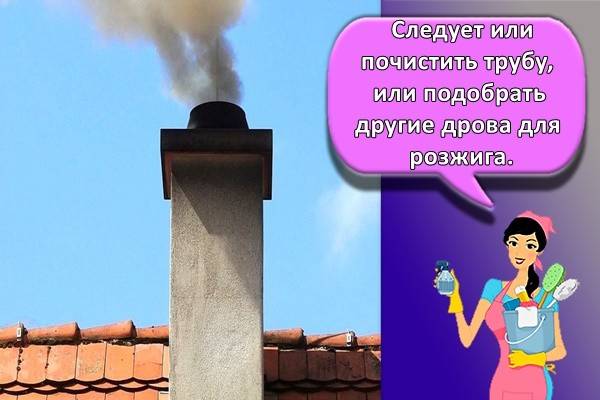
You should either clean the pipe, or pick up other firewood for ignition.
soot flakes
Soot flakes flying in the air during kindling indicate that the pipe is heavily clogged. If this is not corrected, the chimney will be completely overgrown with soot, it will be much harder to clean it.
Arbitrary attenuation of the flame
Often there are cases when the flame in the furnace goes out abruptly. This is due to a lack of oxygen in the furnace, since the draft is minimal or completely absent. It is not worth continuing to use such an oven, since nothing good will come of it.
Unpleasant odor while burning
The smell is caused by carbon monoxide. It is not removed through a clogged chimney, but goes inside the room. In the event of such a situation, it is necessary to immediately stop the ignition and ventilate the room.
Why does the chimney get clogged?
Chimney clogging is a natural process that occurs as a result of combustion.Only part of the fuel, breaking up into fractions, acquires a gaseous form and goes out into the atmosphere as an emission.
Other fragments with a heavier, denser structure take the form of soot deposits and settle on the inner surface of the pipeline, over time significantly worsening its throughput.
The chimney coming out of the roof must be closed with a special windproof cap. Then, during the period of seasonal downtime, a bird or wasp nest will not be built there, and in winter leaves, branches, ice and other foreign elements will not get inside
The use of firewood from coniferous trees provokes clogging of channels. Viscous resinous substances, contained in excess in the composition, form a powerful adhesive base and help retain soot deposits on it.
Such contamination is difficult to prep clean and requires careful removal by means of mechanical devices.
Household garbage, packaging containers, remnants of old furniture, textiles and other items that are not a fuel resource by definition emit caustic ether complexes, heavy carcinogens and resinous compounds during combustion.
Therefore, burning in the furnace or fireplace of such human waste adversely affects the operation of heating equipment of any class.
All of them in the form of a dense, viscous sediment cover the inner surface of the pipes and create conditions for retaining soot, soot and soot. The channel through which the gaseous elements escape into the atmosphere narrows to a minimum, the draft overturns, and part of the smoke enters the living room.





The temperature in the room drops and the use of heating equipment becomes dangerous due to the risk of carbon monoxide poisoning.
They accelerate the clogging of the chimney channel with deposits of firewood from a recently sawn, damp forest.
If the current moisture content of a log exceeds 12%, it is strictly forbidden to throw it into the firebox immediately. It is necessary to dry it thoroughly in a warm room for at least 1 week.
A damp log reduces the level of heat transfer by 35%, contributes to the rapid clogging of the smoke exhaust system, and eventually disables it.
The soot, which covers the inside of the pipe in a thick layer, is highly flammable and can suddenly ignite. This is fraught with a fire in the room and the spread of fire to neighboring houses and nearby outbuildings.
Sometimes an active accumulation of soot inside the pipe is provoked by errors that are accidentally or due to inexperience made in the process of laying the firebox and arranging the chimney for a fireplace or stove.
It could be:
- incorrectly calculated angle of inclination of the pipe;
- too thin walls of the drainage system;
- improperly selected chimney pipe;
- increased volume of condensate formed due to insufficient thermal insulation;
- excessive number of bends and turns of the chimney path;
- roughness on the inner surface of the outlet channels.
It is these reasons that accelerate the pollution of chimneys and several times reduce the efficiency of stoves, boilers and fireplaces. Homeowners are advised to be very careful in choosing stove-makers and contact only those who have already confirmed their skills and high qualifications.
Otherwise, with enviable regularity, the question will arise of how to clean a home chimney, giving you a lot of trouble and requiring constant financial costs.
Frequency of cleaning
Regardless of the intensity of use of the stove, the chimney must be prepared for the heating season.It is mandatory to remove soot and debris caused by the wind over the summer. Prevention is carried out in late summer or early autumn, depending on the region and weather.
The frequency of intermediate cleanings is affected by:
- fuel quality;
- chimney design;
- downtime;
- usage intensity.
Determine the need to clean the exhaust duct from soot can be determined in various ways:
- preventive examination;
- by the color of the flame;
- on smoke change.
You can climb on the roof with a strong flashlight and look. It will be more convenient if the partner shines into the fireplace from below or the hatch for cleaning in the furnace.
When a sufficient amount of air is supplied, the flame is light, slightly yellow. The worse the condition of the chimney, the darker the fire. If it is a rich orange tone, similar to an orange, you need to clean the soot.
Flying outside, hot air captures soot particles from the furnace. The more it is, the darker the smoke. If a gray cloud hangs over the chimney, it's time to tackle the chimney.
 Dark smoke from the chimney
How NOT to clean your chimney
Many suburban residents think that cleaning the chimney on their own is as easy as shelling pears. And really, what is there to know? People talk like this:
“Let's take a rag, wrap it around a stick, climb onto the roof and go! Why pay money to chimney sweeps? Weird. The chimney is not cleaned due to dense and thick soot deposits? No problem! We hang something heavy on a rope or cable and break through the blockage. One-two, one-two... Oops, stuck. And now, what to do something?
In order not to create problems for yourself out of the blue, listen to the advice from the participant under the nickname Aleshin Nikolay. So, how NOT to clean chimneys:
1. "A sledgehammer in the chimney." The phenomenon is unpleasant, but not rare.Everyone has seen the tool of chimney sweeps - a weight and a ruff on a rope, so people are trying to repeat it. Only everything that is at hand is used - sledgehammers, hammers, trimmings of metal pipes. As a result, all this "household" remains in the chimney.
AleshinNikolay
Never insert a load into the chimney if it is at least in one place larger than the diameter of the pipe. I give 100% guarantee that it will get stuck. If the load is stuck, do not try to push it down with a second weight. Jam it even more. Dismantle the pipe and push out the stuck load from below.
BabayUser
Here is a good example of what is shoved into the chimneys. In my case, they didn’t put a sledgehammer, but a crowbar. I swear I didn't do it!
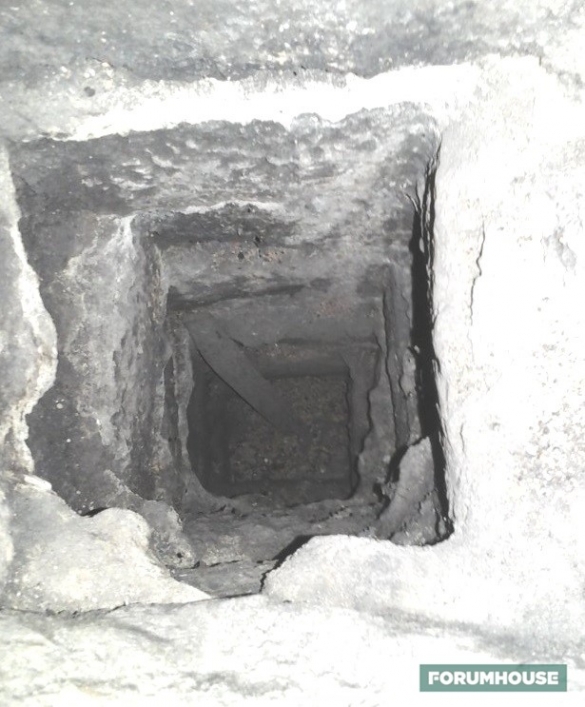
2. Fake tool. Do not buy a chimney sweep tool if:


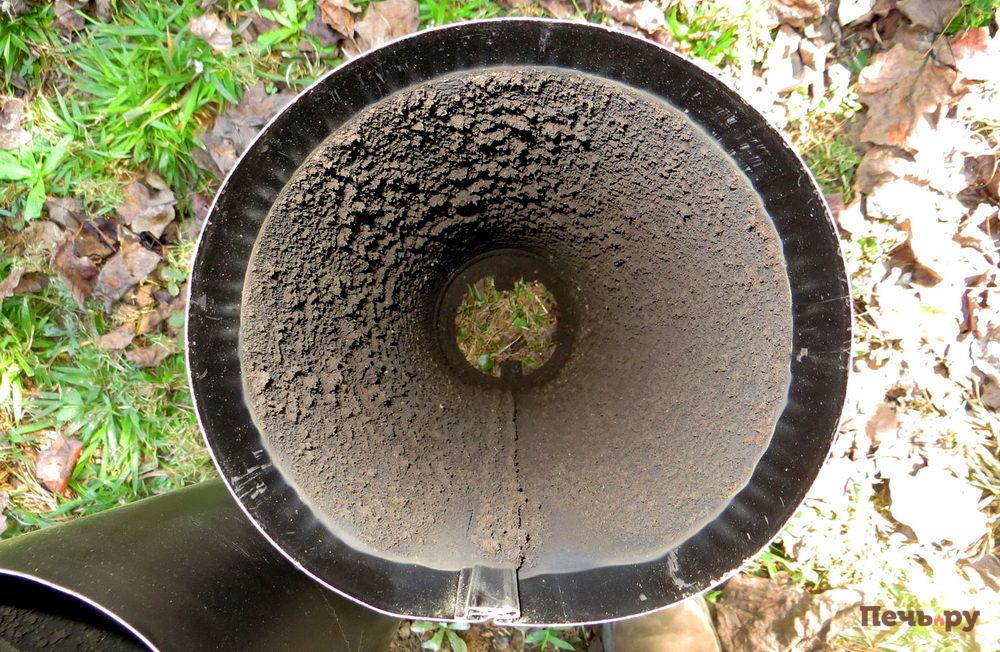
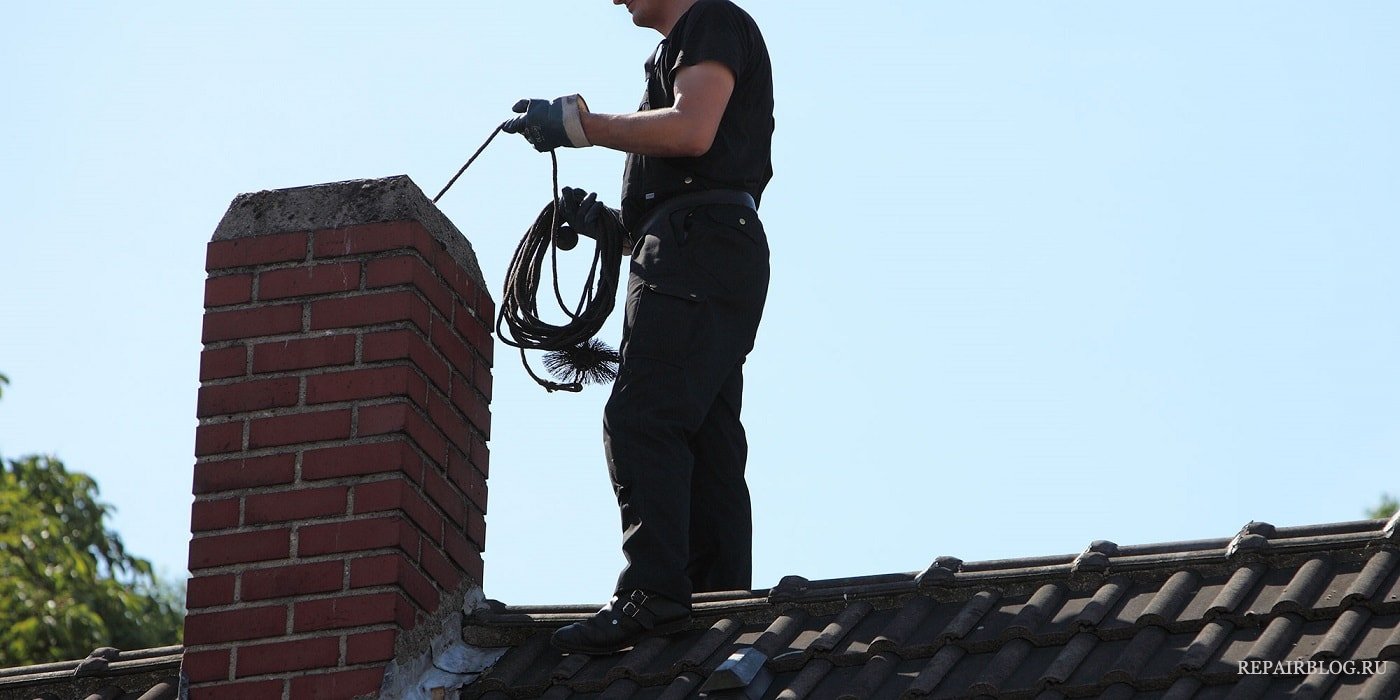
- The kettlebell and eye are not made of cast iron.
- The thickness of the rope is less than 8mm.
A carelessly made tool will break when cleaning the pipe, and what to do next, see point one.
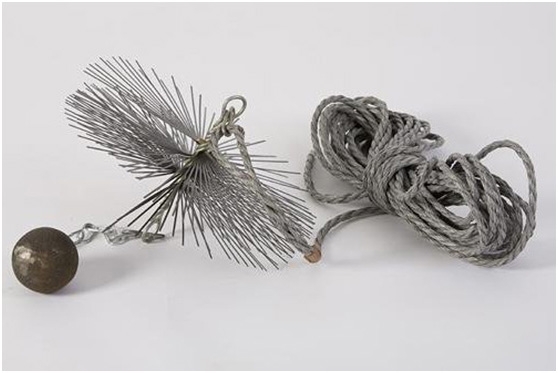
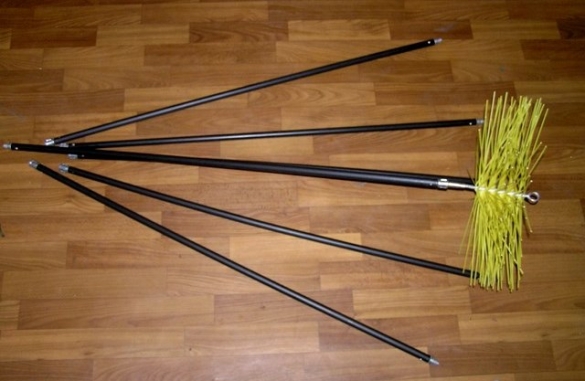
3. Ruffs for cleaning the chimney on a flexible threaded rod. Remember that you can not twist the rod in the direction of unwinding the connection. If you forget, the tool will “self-disassemble” in the pipe and hello point one.
4. Soot burning. Neighbor's advice: "soak a rag with kerosene or gasoline, put it in the chimney, set it on fire and let everything burn out properly" is harmful. Don't listen to him or you'll burn down the house.
5. Chemicals as a panacea for clogged chimney - a myth. Do not listen to the seller in the store, who says that our product will “break through” even a chimney heavily clogged with soot. Will not help in 80% of cases.
AleshinNikolay
"Chemistry" will most likely bring down soot, and it will clog the chimney somewhere in the middle. These funds are only suitable for prevention.
Plus, such funds - their effect lasts several days after use. Before buying, be sure to read the instructions for use!
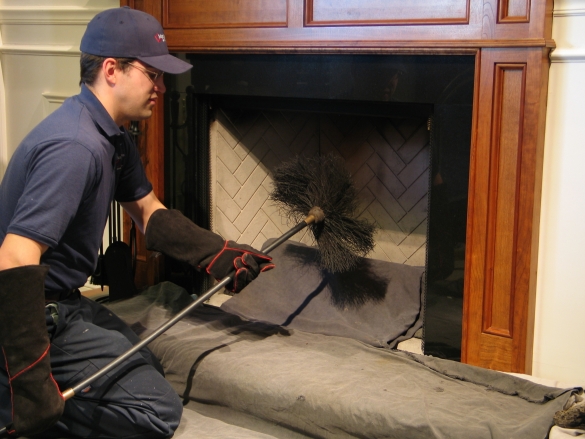
6. If the pipe is heavily clogged, do not clean it from above.
AleshinNikolay
Soot, and most likely to say coke, will fall down. This will create a large traffic jam, which is almost impossible to break through from above. coke absorbs shock very well.
If the pipe clearance is clogged by more than 40-50%, then you need to start cleaning the pipe from below. Before climbing on the roof, clean the stove or boiler. In most cases, the blockage is there, and not in the vertical part of the chimney. Chimneys should be cleaned at least once a year - in the fall.
Consequences of uncleaned chimneys
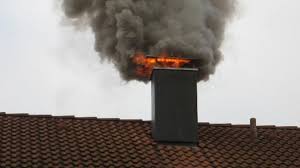
A fire in a chimney can destroy a building if soot is not removed in time.
The stove or fireplace is a potential fire hazard. For this reason, when working with such heaters, it is imperative to observe safety precautions, which include periodic cleaning of pipes.
The main consequences of uncleaned chimneys:
- Fire. With a large accumulation of soot, a fire may occur in the ventilation pipes.
- Reduced efficiency of the heating system. Plaque leads to a decrease in the heat capacity of the pipe and a weak smoke output. As a result, the house will be poorly heated and there is a risk of smoke entering the room.
- Health problems in humans and pets. With poor cleaning, soot and other dust particles accumulate in the pipes, which enter the respiratory and vision organs. They can cause serious illness in the residents of the house. In addition, chimney channels clogged with soot poison all people and animals in the room with carbon monoxide.
- Explosions.Soot tends to explode when accumulated heavily, so it must be removed periodically.



