
- Electrical communications
- How to make the correct sewer entry through the foundation
- The main types of communication in a private house.
- Water supply
- Sewerage
- Electricity
- Gasification
- Ventilation
- Trenchless laying of utilities
- Wiring diagram
- Common installation errors
- Replacement
- Laying methods - hidden and open system
- Installation of a new riser
- How to connect pipes
- The choice of material when replacing sewer pipes
- Ceramics
- Polymers
- Metal
- Diameter selection
- Where to start ↑
- Step-by-step instructions for wiring a water supply system
- Installation of ball valves
- Installation of meters for hot and cold water
- Mounting of gearboxes
- Manifold installation
- Installation of water pipes
- Installation of a heating system in a sandwich panel house
- Qualified installation and ventilation installation in a timber frame house
Electrical communications
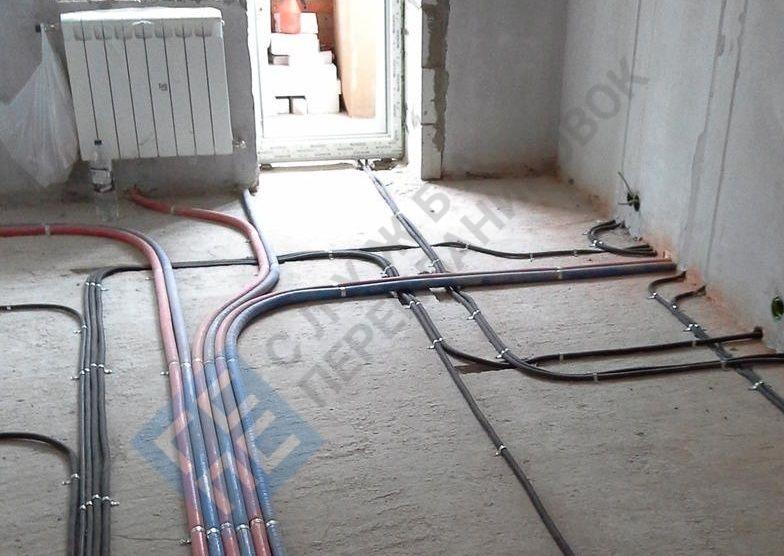
Residents face the problem of how to hide electrical communications during the period of major repairs, which are accompanied by the replacement of electrical wiring. In modern construction, wiring is laid through cavities in ceilings or along the floor, followed by closure with a screed. Wires leading to sockets, lamps and other consumers are placed on the wall surfaces in specially prepared strobes.After finishing work and checking the performance of the home network, the strobes are sealed with plaster.
The most rational solution to the issue of arrangement concealed wiring find if the entire home electrical network is divided into two groups. One group, laid in the screed, will power the sockets, the other, launched along the ceiling, will supply wall and ceiling lamps. Such a scheme for supplying electricity to consumers has a number of advantages.
Firstly, it will help to improve the electrical and fire safety of housing.
Secondly, given the peculiarity that it has recently been customary to place sockets in rooms at a height of only 0.3 meters from the floor, this will significantly save on the length of the wire.
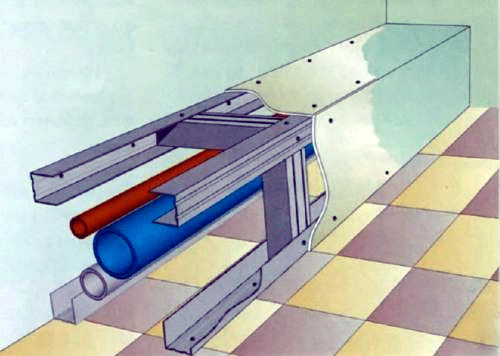
You can not ignore low-voltage equipment, which includes the Internet, television, fire and burglar alarms. Often one has to face the problems of laying the wiring of these systems at a time when a major repair has already been completed or is not expected soon, that is, there is no point in violating the integrity of the walls and flooring.
As the simplest and most affordable option, you can use floor plinths, the design of which provides for a cable channel. The most effective way to get rid of the wiring of low-voltage equipment is to use the Internet signal transmission, as well as fire and burglar alarm sensors via a Wi-Fi system.
A piece of advice for anyone looking to improve their home. Before proceeding with the closing of communications, it is necessary to draw up, if possible, an accurate wiring diagram.For better clarity, it is better to make the diagram in color indicating the type of communications and the distances of their laying from the selected landmarks. If there is no possibility or desire to draw up diagrams, you need to take a photo using a mobile phone camera, which, as a rule, is always at hand.
How to make the correct sewer entry through the foundation
In order for the sewerage and water supply system laid in the UWB to work properly for many years, you need to choose high-quality pipes that are resistant to the loads exerted by the foundation slab. For this, “sleeves” are used, which are hollow pipes of large diameter, into which sewer pipes are inserted. In addition to protection, such a “sleeve” is also good because, if it is necessary to replace a failed sewer pipe, it can be easily replaced with a new element. Similar "sleeves" are recommended to be installed when bringing other communications to the house, for example, water supply, electrical cables. In this case, the sewerage and water supply systems must be laid in separate sleeves.
The sewer pipe at the outlet of the UWB slab is connected to the main line leading to the septic tank using the "bell" method or using fittings. As for the drainage system, which will be hidden under the foundation, it, like all other engineering communications in a country house, requires mandatory maintenance. To do this, drainage receiving wells are installed, which are located in such a way that it is possible to reach a special hose from one well to another - a nozzle for a high-pressure mini-washer and flush the system.
By reading my blog, you are probably doing repairs. Add this page to your bookmarks.All useful home improvement stores are located here.
slope violation. A decrease violates the self-cleaning of the pipe, an increase will increase the noise when using the drain.
the lack of insulation on the pipes is also one of the causes of noise.
pipe connection in the floor - in case of a leak, you will need to dismantle it.
poor ventilation of the sewer riser - you are guaranteed an unpleasant smell.
The main types of communication in a private house.
Consider the main communications that are necessary in a private residential building for each person:
- Water supply.
- Sewerage.
- Electricity.
- Gasification.
- Ventilation.
Water supply
If there is no water supply on the site, and it is not planned to be carried out, connecting a centralized water supply will be very expensive. In this case, you can make your own well or well. The geological features of the area and the depth of water should be taken into account. To do this, you need to call a specialist and decide where and how such a point will be equipped. And how exactly will the water flow into the house.
Sewerage
In the absence of a common sewerage system, a few years ago people dug cesspools, and special equipment pumped out human waste products on call. This system is fading away. Currently, special septic tanks are being installed for rapid decomposition, biological treatment and wastewater filtration.
Electricity
One of the main elements of engineering networks is the availability of electricity. Quite often, people have to install the poles themselves, call an electrician to conduct electricity to the site, and then to the house. However, without electricity, it is almost impossible to do anything in construction.
Gasification
In many remote areas in summer cottages, gasification is absent. People use gas cylinders for cooking and sometimes for heating. However, it is quite dangerous, costly and inconvenient. But, if there is no electricity, and in remote areas it is often turned off, gas bottle in the house just needed.
Centralized gasification is a very expensive pleasure. In addition to introducing a gas pipe into the house, it is necessary to pay for the wiring of communications inside the premises according to a certain scheme. And also buy a gas boiler, conduct hot water and heating according to an agreed project. Not many in their summer cottage want such problems for themselves. For permanent residence, gas is, of course, much more profitable than solid fuel or electricity.
Ventilation
The house requires passive and often active ventilation. You should think in advance where the air ducts will be located and where to hang the hood and air conditioner correctly, if necessary. Experts can help you deal with these issues.
In conclusion, it should be noted that it is necessary to choose a site not only by its location, but also taking into account where the required communications pass. This will allow you to spend less time and personal funds on construction.
Trenchless laying of utilities
It is possible to lay pipelines without excavation without causing damage to the environment. Method horizontal directional drilling over time, it will become the main one when laying engineering networks.
The laying of external engineering networks by the trenchless method implies the installation of a HDD installation at the starting point. A pilot well is punched in the direction of the exit point along a predetermined trajectory.Pipe-cases are laid along it with a special machine, pipes or cables are pulled into them. With a track length of up to 10 m, the puncture can also be done manually.
Advantages of trenchless laying:
- process automation;
- high speed;
- the possibility of laying networks at a depth of up to 20 m eliminates damage to the landscape, allows you to pass under objects where digging trenches is unacceptable;
- lack of expenses for restoration work significantly reduces the total cost;
- no need to interrupt normal life activities at the work site;
- emergency situations, damage to previously laid networks become fundamentally impossible.
Wiring diagram
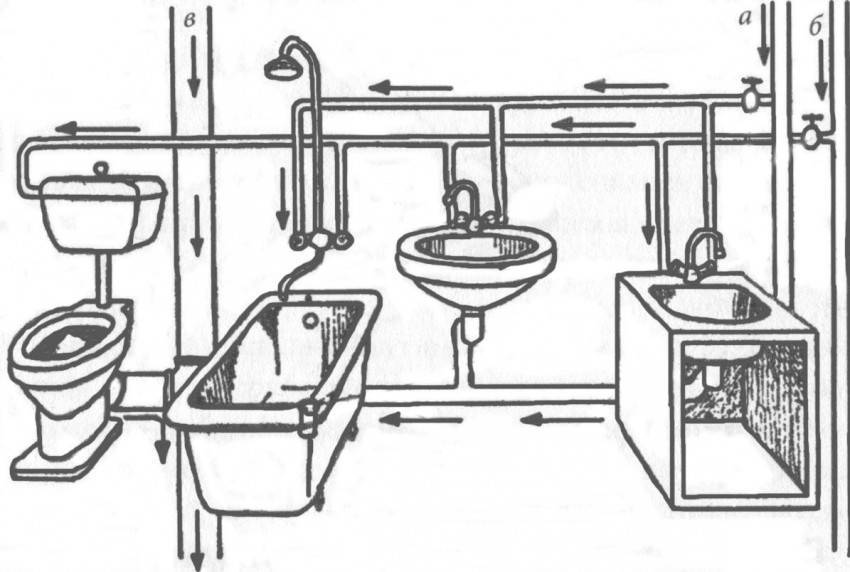
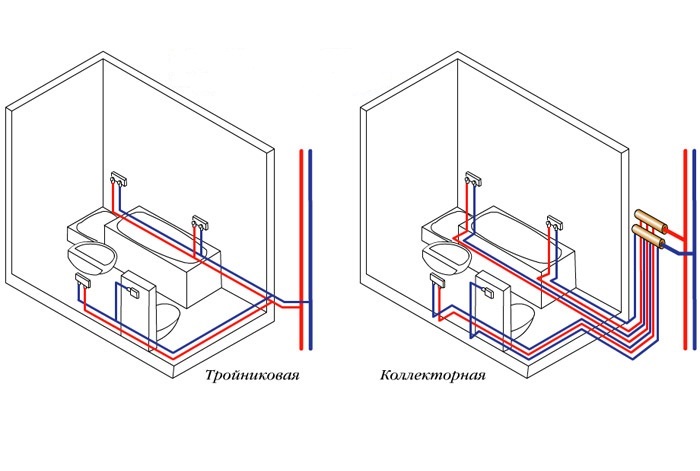
- What is the difference between tee and collector wiring of water supply?
Tee involves a series connection of points of water intake to a common pipe. In the case of collector (beam) wiring, each device is connected to a common collector with its own supply.
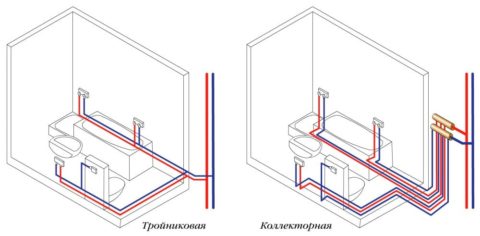
Serial and collector wiring
- Which layout is more practical?
If we forget about the large material consumption and the need for hidden wiring of a large number of pipes - collector. It removes the problem of pressure drop on all devices when parsing water through one of them.
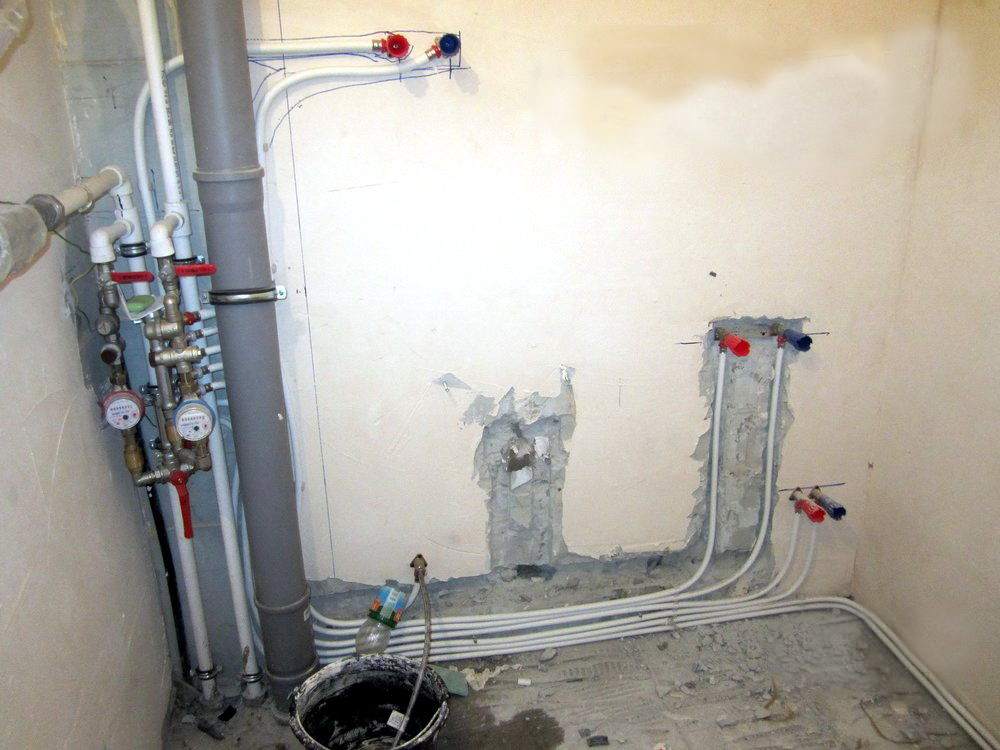


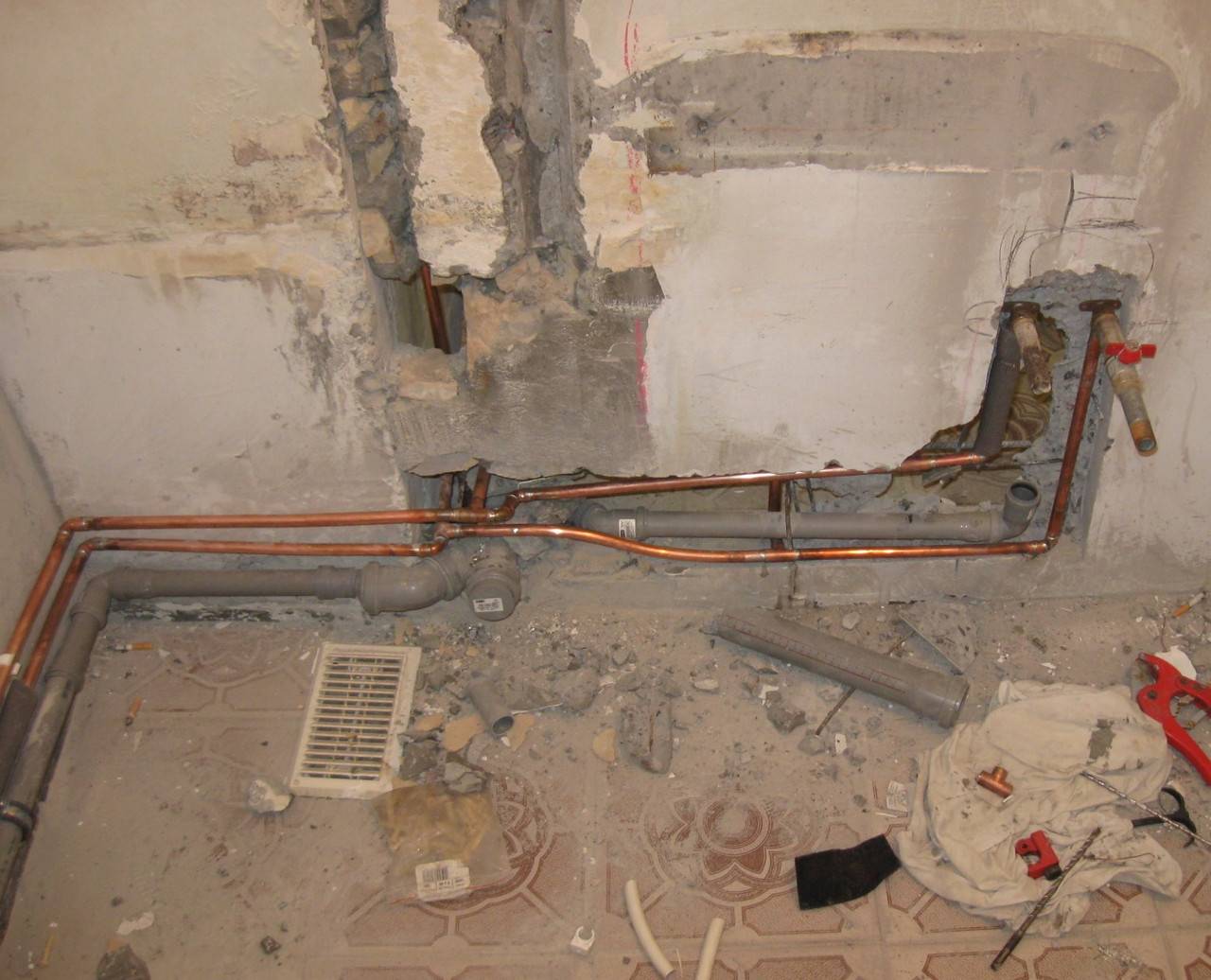




If you open a cold water faucet in the kitchen, the cry of a spouse scalded with boiling water will not come from the bathroom, full of bitterness and pain.
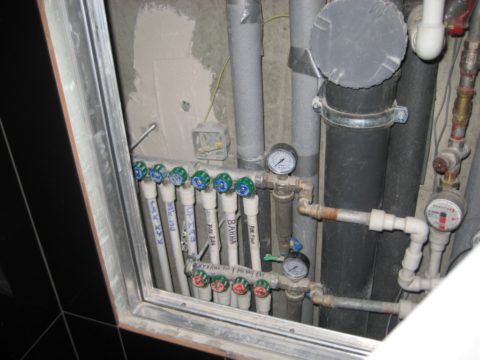
Water supply manifold
The video in this article will more clearly acquaint you with how the layout of the apartment's water supply is carried out.
Common installation errors
The drafting of a plumbing system, both collector and tee, is best entrusted to professionals who are familiar with building codes and are able to perform hydraulic calculations. But even the best project will be useless if mistakes are made in its implementation.
Stopcocks are part of any water supply scheme: both sequential and manifold. They are installed at the entrance to the plumbing system, as well as in front of each plumbing fixture.
For example, some unfortunate craftsmen, driven by the thought of unreasonable savings, neglect the requirement to insulate hot water pipes that are laid under the floor or in the thickness of the walls.
As a result, part of the thermal energy is transferred to the materials surrounding the pipe, which degrades the quality of the water. In addition, condensation from the surface of pipes without thermal insulation can damage the finish of the room.
During installation work, experienced craftsmen recommend closing the ends of pipes that have not yet been installed so that debris does not get into them. The absence of this protective measure can lead to the fact that immediately after installation, the water supply system will have to be thoroughly and for a long time flushed or even repaired.
When soldering polypropylene water pipes, remember that small dirt or moisture at the soldering point can significantly impair the quality of work.
If soldering of plastic pipes is necessary, all work should be carried out in a clean room to avoid contamination. It is also unacceptable to solder pipes on which even a small amount of moisture is present. A drop of water or debris at the soldering point can significantly weaken the connection and degrade its quality.
It is not necessary to design the plumbing system in such a way that all pipes pass through the ceiling through one common hole. This may degrade the performance of the plumbing. Professional designers never make such mistakes.
When drawing up a wiring plan, it is necessary to ensure that the pipes do not block access to the joints. This will greatly facilitate the repair in the event of a leak.
An insufficient number of locking devices can also cause a lot of trouble during installation work. Such fittings must be present in front of each device to which water is supplied, as well as for each riser. If the house has not one, but several bathrooms, you can install a shut-off valve for each of them.
Simultaneously with the plumbing system, sewers are usually designed and arranged. It must be ensured that pipes and risers of individual systems do not overlap each other. In the future, this will facilitate maintenance and repair work.
Replacement
We must not forget that in addition to the right of ownership, there is also the so-called burden of the owner, which lies in the need to maintain their property in working condition and pay for its repairs. Including for: water; sewerage; gas; other blessings of the world.
And here an important question is brewing, and who is considered the owner of those pipes and their branches, which are no longer located inside each private territory, but connect it with utilities that supply fluid, heat and light to the structure itself? They, as it became clear, are classified as property of a general type, which belongs to everyone.
The obligations of the owner according to the rules, making decisions about the need for current and even more complete repairs, lies with all apartment owners. Owners of housing and common property must: ensure the stable technical condition of common communications; make the decision to update them when the need arises.
Read more: Violation of the procedure for felling forest plantations
But the owners themselves can only repair the equipment that directly serves their housing. After all, it is their personal property.
To repair common communications, a part of the personal duties is transferred to the management company, which eliminates all complex problems for them. This agreement is official, that is, it implies the transfer of a specific amount on a monthly basis.
Such financial transactions are also the responsibility of the landlord. In return, he is provided with quality service for the entire economy.
Responsibilities of the utilities. The performance of all repair work that is required to maintain the risers in the apartment, sewerage, heating and others in working technical condition, all this is considered the responsibility of the housing maintenance office. Or another company with which a formal contract has been drawn up.
The basis for the implementation of the manipulation will be: a plan for their implementation; an act saying that any part of the riser needs to be updated to prevent an accident; leakage or other problem. If you have something leaking, you should repair the housing and communal services in any case.




Laying methods - hidden and open system
Pipes in the water supply system can be laid in a closed and open way.The choice of one of the methods does not affect either the quality of the connections or the functionality of the entire system and depends only on personal preferences.
It would seem that it is not difficult to decide and the closed method is preferable as more aesthetic and allows you to save up to 10 cm of usable space. Why is an open pipeline still used in the installation of a water supply system? Let's try to give an answer.
Hidden wiring allows you to hide pipes and not spoil the aesthetic perception of the interior of a house or apartment. The hidden method is used when assembling a water pipe from PP pipes. They hide the contour behind a decorative wall, for example, made of drywall, or ditch the walls and lead the pipes into the formed niches, sealing them with facing material or plaster along the grid.
The pipeline should not be tightly adjacent to the surfaces - always leave a small gap for possible repairs. When installing a pipeline in a monolith, it is recommended to place them in a casing, inserting a pipe into a pipe.
The disadvantage of the method manifests itself when it becomes necessary to repair or replace the hidden elements of the system - the plaster or tiling has to be opened and then re-decorated.
In addition, in the event of damage and leaks, the problem may not be detected immediately and lead first to the loss of operational technical characteristics of structures, then to flooding of the premises.
It is better to proceed with the installation of the water supply system with a pre-drawn scheme - otherwise, errors in calculations or assembly will lead to the fact that you will have to ditch new grooves and re-mount the pipes
To avoid such difficulties, when installing the wiring, only whole sections of the pipe are hidden, placing the docking fittings in open areas. In places of installation of shutoff valves, invisible doors are made. This gives access for maintenance to pipe connections, which are the weakest links in the system.
It should also be noted that pipes made of not all materials can be hidden under a layer of plaster - only products made of polypropylene, metal-plastic or copper are suitable for this.
Pipe laying in an open way is carried out after finishing is completed. The method involves the uncovered laying of pipes and water supply elements. It looks ugly, reduces the usable area of the room, but at the same time this method is very convenient for maintenance, repair and dismantling of elements.
Redevelopment and rearrangement of plumbing in the house with such a plumbing device will also not cause difficulties.
Open wiring makes it possible to quickly detect a leak and eliminate the cause of breakage or damage to system elements
Installation of a new riser
Work begins with the installation of a vertical pipe. If a crosspiece remains in the concrete floor, consider the possibility of installing new communications, but taking into account the material of such products. First, a rough installation is made. Products are placed in their places, taking into account the previously drawn up drawing. This will avoid errors when working with communications, as well as reduce material consumption, since errors are detected at this stage.
How to connect pipes
In the apartment, the wiring is carried out in a bell-shaped way.To do this, use pipes with a broadening at one of the ends. This measure makes installation easier. Smooth-walled communications easily enter the broadening at the end.
The choice of material when replacing sewer pipes
Regardless of where the installation is carried out (in a private house or apartment), you can use products from:
- ceramics;
- polymeric material;
- metal.
In order not to have to face problems during operation in the future, at the selection stage it is necessary to compare the properties of the available types of communications.
Consider criteria:
- smoothness of the inner walls;
- diameter;
- the degree of strength of the material and susceptibility to mechanical stress;
- linear expansion;
- the weight.
All these factors affect the cost. The complexity of installation, service life is also estimated.
Ceramics
Advantages of ceramic products:
- smooth inner walls, due to which the drains move faster, the likelihood of clogging is reduced, since pollution is less intensively retained on the surface;
- resistance to aggressive media, as a result, the pipeline retains its original appearance and properties for a long period.
On one side there is a socket, which facilitates installation.
Polymers
Pipes for sewerage.
When it is planned to replace the sewer, PVC pipes and PP analogues should be considered first of all. Such products also have a broadening at the end to simplify installation.
Advantages of polymer communications:
- smooth inner surfaces;
- resistance to chemicals;
- long-term operation (PVC or PP pipes serve 30-50 years, sometimes longer);
- the ability to withstand the influence of high temperatures, according to this criterion, PP products are superior to similar products from other materials;
- light weight;
- ease of installation;
- high strength, resistance to mechanical stress.
The disadvantage is the tendency to linear expansion. During the operation of communications under the constant influence of high temperature, its differences, an increase in the length of the pipe is noted. After installation, this feature will lead to bending of the pipeline.
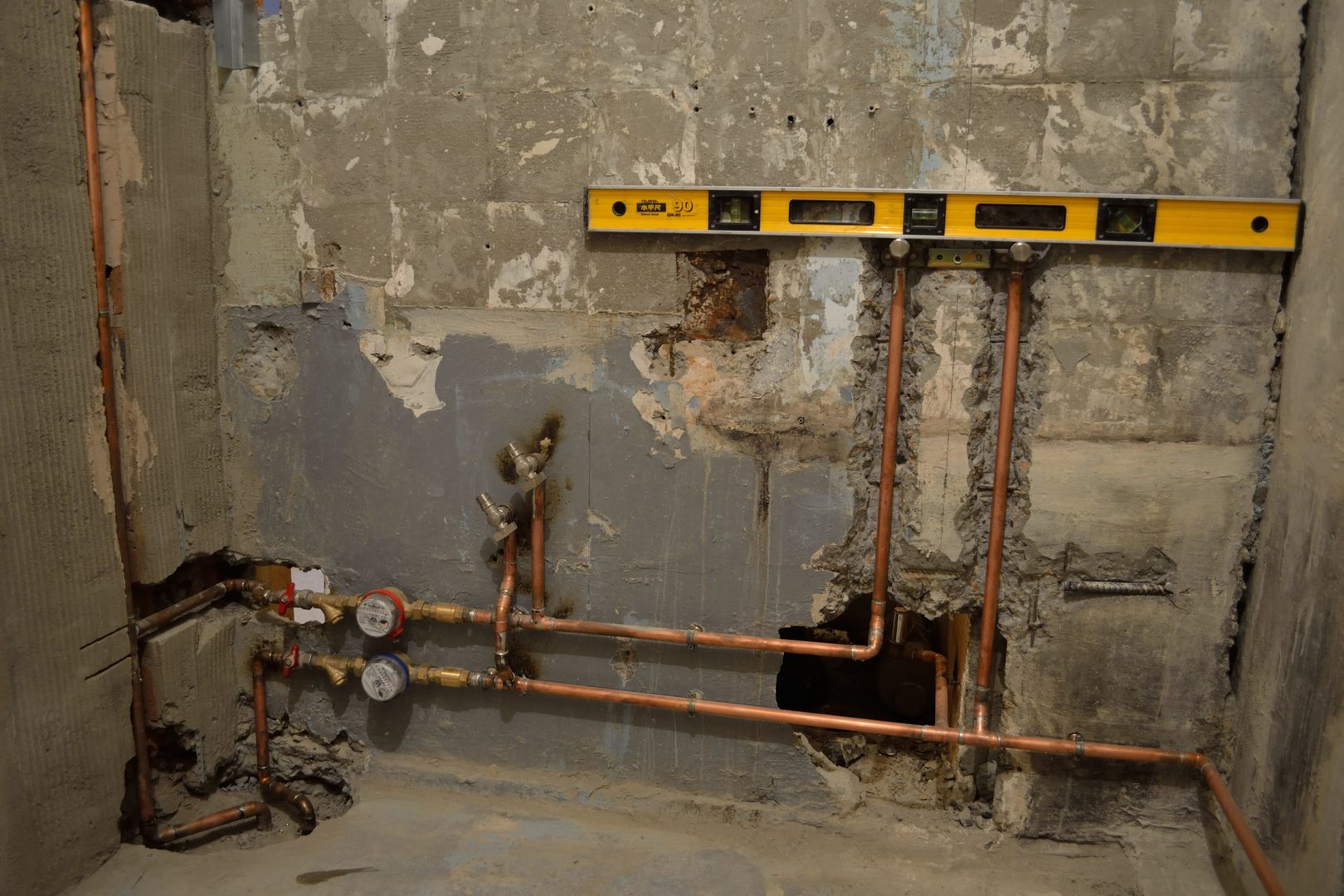


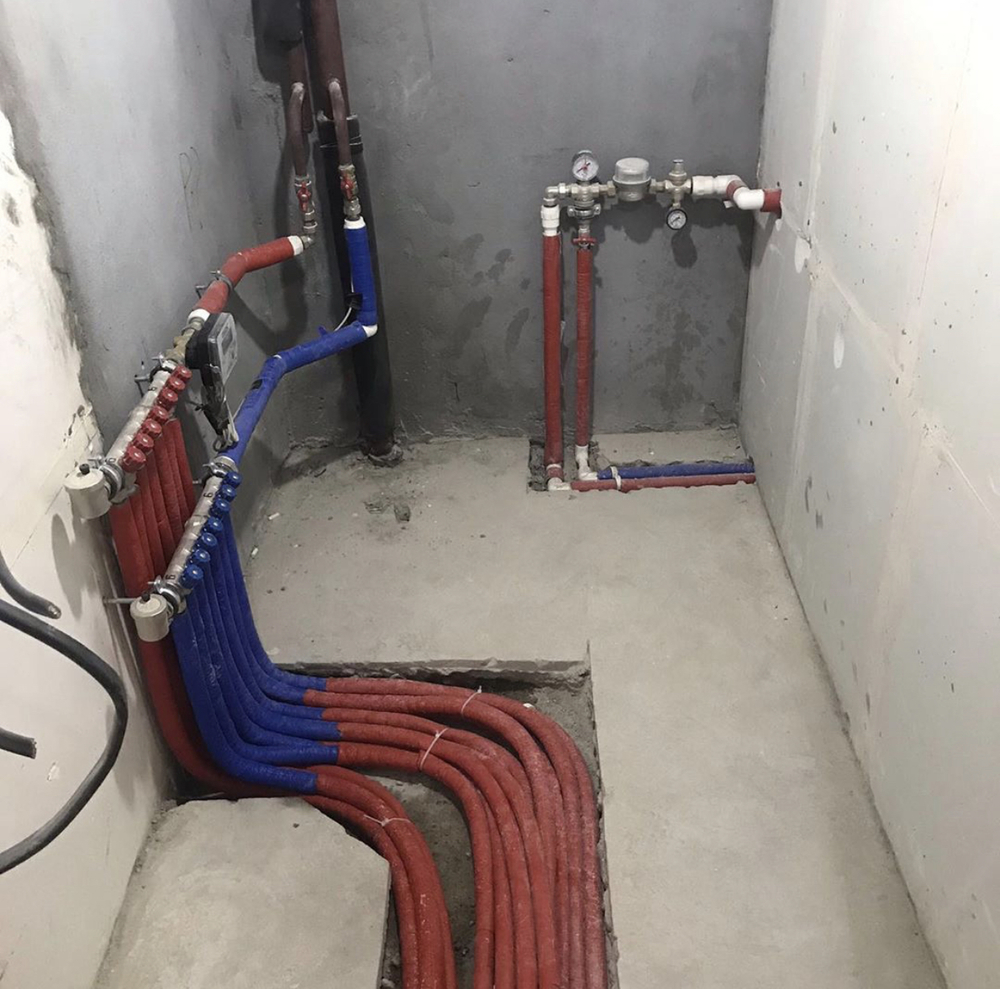
Metal
Steel communications are unstable to the influence of chemicals, but they tolerate high temperatures well. The disadvantage of the product is the possible development of corrosion.
As a result, the lumen of the pipeline narrows, and the risk of formation of a hard-to-remove blockage, which is formed from rust flakes, increases. In addition, steel has a significant weight - when used in apartment buildings, the load on concrete floors increases.
Cast iron pipes for sewerage.
Cast iron communications also weigh a lot. If you plan to purchase pipes with a diameter of 100 mm or more, it is difficult to install them yourself. The inner walls are not smooth enough, as a result, the risk of plaque formation increases, which later develops into a cork. Such pipes are more expensive than steel pipes. They better resist corrosion, thereby increasing the life of the pipeline.
Diameter selection
The apartments use communications of standard sizes. The riser is installed using a product with a diameter of 110 cm. The standard size of cast-iron pipes is 100 cm. This is enough to drain wastewater containing large fractions of contaminants.To make the wiring in the apartment, use products of a smaller section. An option with a diameter of 50 mm is suitable, but other communications are often found: 32 and 40 mm.
The choice of section also depends on the material, since communications made of metal, PVC or PP are produced according to different standards. In addition, the configuration of the site where the pipeline is planned to be installed plays a role. The smaller the space, the more preferable is the installation of PVC or PP pipes, since they differ in the smallest section.
Another selection criterion is the structure of effluents that will pass through communications. The more contaminants they contain, the higher the diameter value should be. For example, it is recommended to divert communications with a diameter of 32 mm from household appliances (washing machines and dishwashers). For washing in the kitchen and in the bathroom, pipes with a diameter of 50 to 70 mm are considered.
Where to start ↑
Decide on the location of the plumbing. With a typical bathroom, you can’t really accelerate, the place won’t allow it. But more rooms have a choice. General recommendations:
The toilet is recommended to be placed first from the sewer riser. It is desirable that the outlet of the toilet bowl goes through the fitting directly into the riser or has a minimum number of turns. It will be right if the drains from plumbing fixtures located further than the toilet will spill through it.
A shower, the typical drain height of which is small from the floor, should also be placed closer to the riser so that there is no problem with the slope. The drain is quite low. But the washbasin, kitchen sink, washing machine can be placed away.
Most washbasins, bathtubs, toilets are connected to pipelines in a similar way: at the same height, the axes of sewer outlets, supply water pipes, are located.But there are non-standard solutions. It is advisable to select all the equipment in advance, take the communication connection schemes from the seller, strictly follow them
We recommend paying special attention to the toilet bowl scheme: the drain can be directed in different ways, and at different angles. 90% of domestic devices are equipped with an inclined horizontal outlet, but there are other options. If you are going to install a large corner bath, which does not have legs, but a supporting frame, take the frame diagram: it is not always possible to “untie” the bathroom drain in the usual way.
If you are going to install a large corner bath, which does not have legs, but a supporting frame, take the frame diagram: it is not always possible to “untie” the bathroom drain in the usual way.
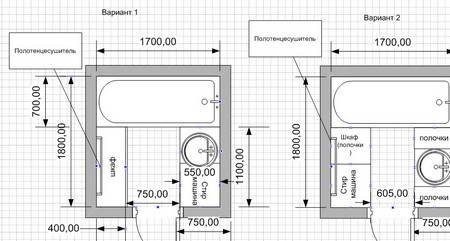
Having arranged the plumbing, you should outline the location of the pipelines: start with communications.
Step-by-step instructions for wiring a water supply system
Do-it-yourself water supply wiring in an apartment always begins with drawing up a detailed water supply scheme on paper. It should provide for the smallest nuances, since it will be the basis not only for the work, but also for the acquisition of the required amount of materials.
Attention! The scheme should be drawn up with a minimum number of joints, connections and bends - this will significantly increase its operational reliability. If the space of the room allows, then the best option is the collector wiring of water supply pipes, an example of which is shown in the figure below.
If the space of the room allows, then the best option is the collector wiring of water supply pipes, an example of which is shown in the figure below.
The referenced positions refer to the following elements:
- 1,2,3 - ball valves at the inlet of the washing machine, sink and bath mixer;
- 4.5 - collectors for cold and hot water;
- 6 - check valves;
- 7.8 - hot and cold water meters;
- 9 - reducers for pressure normalization;
- 10 - filters providing rough cleaning.
- 11 - emergency cranes.
- 12 - cold and hot water risers.
The most acceptable option for organizing a do-it-yourself plumbing system is to use plastic pipes. They are easy to install and can be used for a long time. The optimal pipe diameter is selected according to the total length of the pipeline in order to provide the required pressure. To do this, you can use special tables that can be found on the Internet or consult with experts.


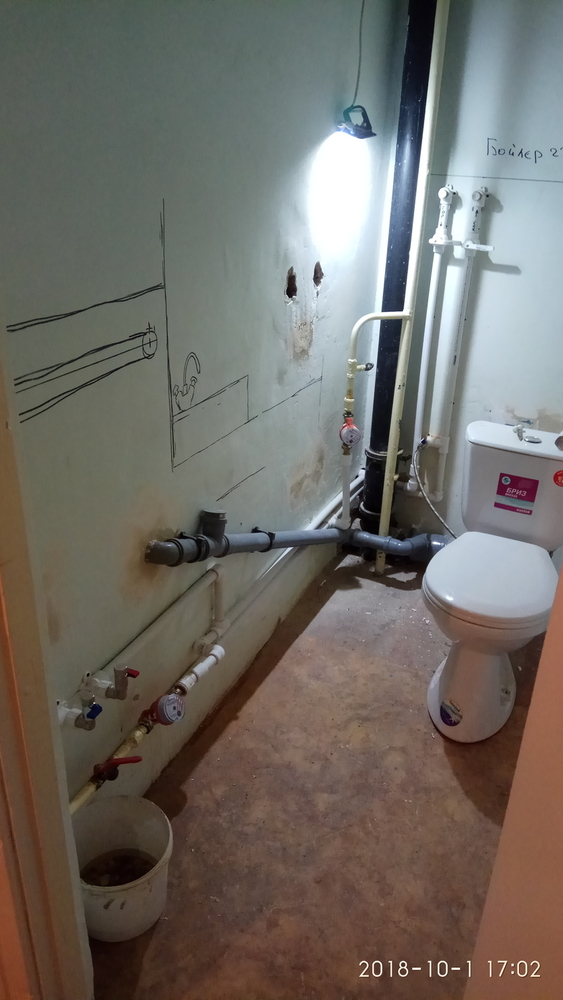
Attention! If the distribution of water pipes is carried out in an old house, then you should pay attention to the condition of the main riser. It may first need to be replaced, and this event should only be carried out by specialists.
Installation of ball valves
Installation of emergency ball valves at the inlet from the main risers and installation of filters. The taps at the inlet to the water supply system have been reassigned to quickly turn off the water supply when a leak is detected.
Be sure to turn off the water before starting installation. It is recommended to use ball valves that operate at pressures up to 60 atmospheres and temperatures up to +150˚С. Coarse filters are connected to the installed ball valves.
Installation of meters for hot and cold water
As a rule, union nuts are included with the meter, which allow, if necessary, to disconnect the meter without violating the integrity of the system.
Important! When installing the meter yourself, you need to pay attention to the directional arrows that are placed by the manufacturer on the device. They indicate the direction of water movement.
Remember! After starting the system, the installed devices must be registered with the water supply organization.
Mounting of gearboxes
Installation in the water supply system of reducers that will prevent damage to pipelines in the event of pressure drops. It is imperative to install these devices if the water pressure in the riser significantly exceeds the throughput of plumbing devices. It is good if, under excess pressure, excess water will be drained into the sewer, so if possible, a special drain should be provided.
Basic rules for installing the gearbox:
- The pressure regulator gauge must be mounted vertically;
- During installation, shut-off valves must be provided;
- Be sure to take into account the direction of the water in accordance with the indicated arrow on the device.
Manifold installation
As a rule, these devices are equipped with a maximum of four outputs. Therefore, to connect a larger number of consumers, it is necessary to install several collectors.
Important! Ball valves should be installed at the inlets of all consumers to be able to turn off specific devices in case of an accident.
Installation of water pipes
Direct installation of water pipes. To do this, purchased plastic pipes must be cut to size in accordance with the wiring diagram.The joints are welded using a special apparatus, which is quite easy to handle. This technology is described in detail in the article Polypropylene pipes - do-it-yourself installation.
You can start operating a self-installed water supply system only after checking, which is best done with an assistant. This will quickly shut off the water supply if a leak is detected due to poor assembly.




Installation of a heating system in a sandwich panel house
Installation and installation of a system for heating a house using frame technology can be implemented in the same way as the installation of a water meter unit. All pipes of the required diameter are installed in the space between the walls. They are attached to the vertical racks of the wooden frame and the beams of all floors with specialized clamps. In order not to lose some of the heat, the heating pipes that are installed in a cold room are perfectly insulated.
All lines of the exhaust and supply and exhaust ventilation systems and related equipment (these can be filters, various fans and heaters) are usually located in the attic or between floors. The power of this equipment is calculated by professionals, and this is, for example, if the ventilation system is forced.
Heating circuit in a privatized house
Qualified installation and ventilation installation in a timber frame house
The air duct passing in the unheated space of the attic space must be especially well insulated from huge heat losses.In order to make competent communication in a wooden frame house with your own hands, all places for fastening ventilation and its equipment to the ceiling must be sealed to eliminate the occurrence of leaks. That is when all mechanical ventilation will be at its best.
Ventilation scheme
Installation and installation of indoor electrical wiring in a sandwich panel house
The largest number of questions will appear during the installation and installation of electrical wiring in wooden frame houses, since it is difficult to arrange the wiring in the space between the walls. Based on the requirements of SP-31-110-2003 "Design and installation of electrical installations of residential and public buildings", the rules and regulations for the installation of all electrical installations, as well as the rules and regulations of fire safety in the Russian Federation (PPB-01-03), read that it is allowed to install and install all electrical wiring only in specialized iron pipes.
All pipes for electrical wiring in wireframe wooden house must be stainless or black steel.
Corrugations for wiring in a wooden house
Due to this, all distribution boxes must be made of steel. For each electrical outlet and switch, specific iron clips should be installed, which will be necessary for the sockets.
Instead of casings for indoor electrical wiring in wireframe wooden house, you can use wavy copper or stainless steel sleeves, or sleeves coated with a specific fire-resistant enamel, in other words - profile pipes.
But the use of profile pipes will be allowed under conditions of complete sealing of all wiring components.If we assume that a wire will burn in the middle of this pipe, then this fire will be considered local due to the lack of air and it will not spread further.
During installation and installation electrical wiring in iron pipes, specialized welding work would have to be carried out, but based on fire safety regulations, any welding work in prefabricated panel houses is strictly prohibited. Although, until a wooden box is sheathed with internal or external panels, it cannot be called a house, thanks to this, the installation and installation of pipes made of metal will be a feasible option. When welding, first of all, follow all fire safety rules.
No other legal types of installation and laying electrical wiring in a frame house made of wood, no.
Electrical wiring, which is made in PVC corrugated hoses, is a gross violation of existing norms and rules.
All work related to the process of installing power lines should be carried out only by experienced specialists who have all the necessary permits and specific licenses. After the installation is completed, they are required to issue you a certificate of services rendered, which will indicate legal data and a list of all relevant documents of the company that carried out the work related to the installation and the installation process of your electrical wiring.
The cost of hidden electrical wiring, made in accordance with all norms and rules, will be much higher than the prices of wiring in special wire-channels by 50-60%.



