- Features and principle of operation
- Advantages and disadvantages
- Operation features
- How to choose a balloon
- Precautions and rules of operation
- Video: how a do-it-yourself potbelly stove works
- Simple and convenient "ash pan"
- Maintenance of pyrolysis ovens
- What you need for work: tools and materials
- The main types of oven
- Vertical potbelly stove
- Horizontal design
- Design features and principle of operation
- Chimney
- Positive and negative parameters
- Calculation of the main parameters: drawing and recommendations
- We make a long-burning stove with our own hands
- Conclusion
Features and principle of operation
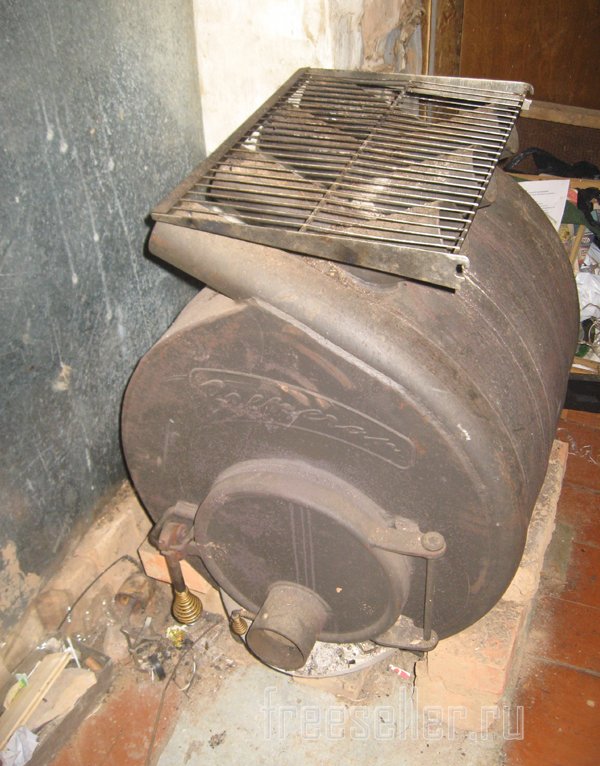
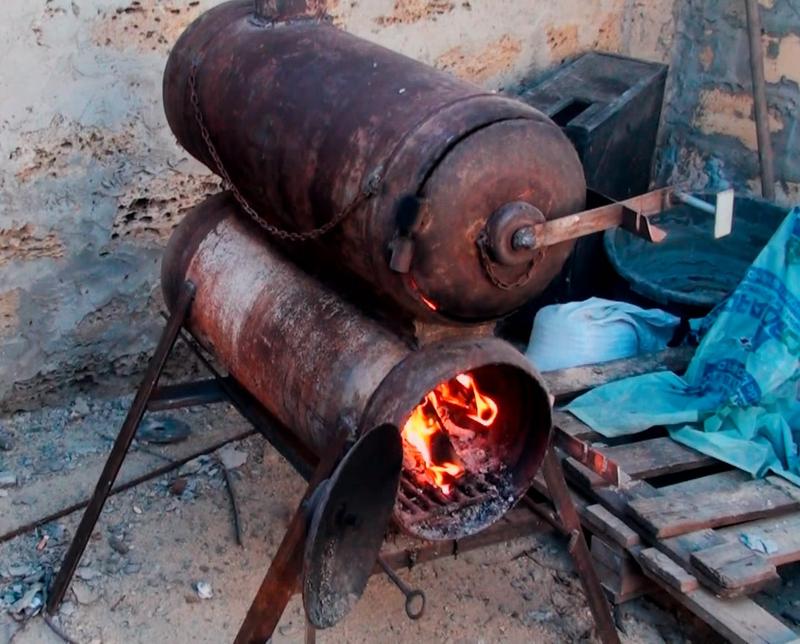
It implements the principle of long-term combustion, based on the physicochemical phenomenon of pyrolysis - the smoldering of fuel with a lack of oxygen and the combustion of the gases released during this. One load of firewood is enough for 4-8 hours of burning.
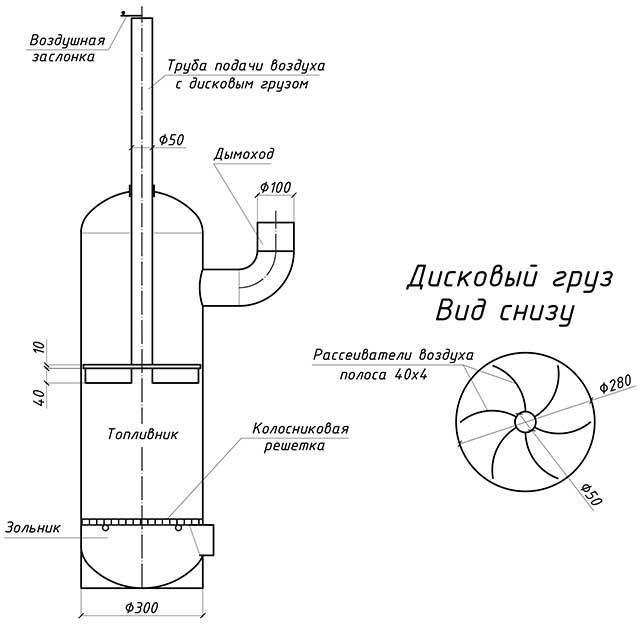
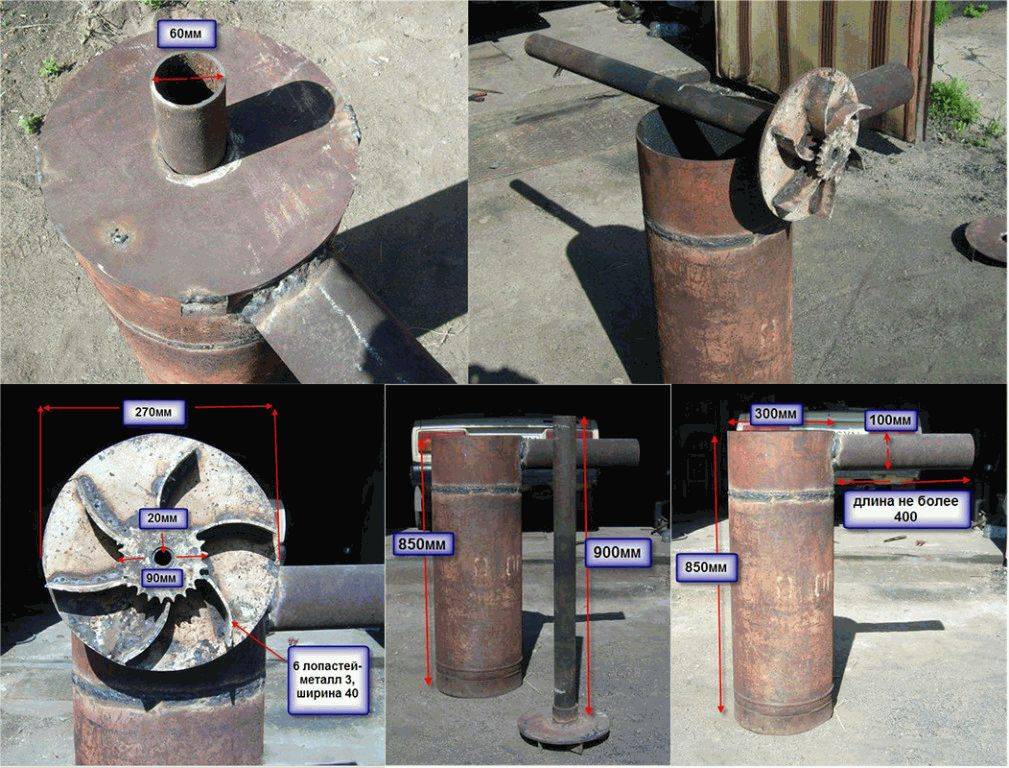
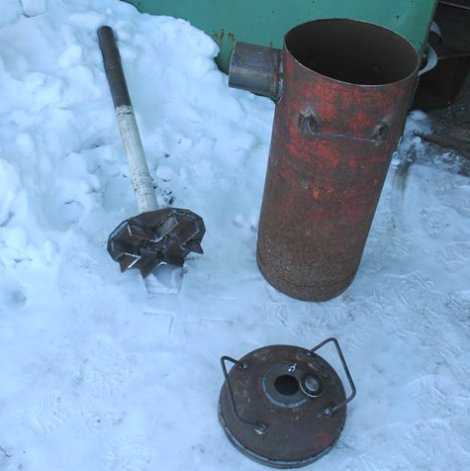
The pipe has vertical mobility. A massive disk with guides for the gas flow is fixed at its lower end. The chimney is welded to the top of the stove on the side. Firewood is loaded vertically into the oven, the disc presses it against the grate.As the lower layers of the fuel burn, the disc lowers and the combustion air is supplied to the upper layer of the fuel to be pyrolyzed.
Advantages and disadvantages
The advantages of the bubafon top burning stove are as follows:
- High fuel efficiency. Heat does not escape into the chimney.
- Ease of manufacture and operation.
However, the design also has disadvantages:
- It is impossible to replenish the supply of fuel in the stove until it is completely burned.
- It is impossible to interrupt the combustion process.
- When the draft of the sand is reduced, it smokes.
- Not suitable for rapid heating of cold rooms.
Necessary materials for the manufacture of the furnace bubafonya
The necessary materials are the same gas cylinder, grate fittings, a 90-degree branch pipe, a metal pipe a meter and a half long and a heavy disk, slightly smaller in diameter than the inner diameter of the gas cylinder.
Operation features
During operation, it is important to remember the following: Firewood in layers should be of the same length, they should be loaded carefully and evenly, avoiding distortions
Scheme of a long-burning stove bubafonya
For the initial warm-up and exit to the pyrolysis mode, the stove takes an hour or more, while up to one-fifth of the fuel is consumed
How to choose a balloon
The 5 liter domestic gas cylinder is too small to heat the room. Yes, and the fuel will fit in it only in the form of briquettes or chips. A cylinder of 12 liters will allow you to develop a thermal power of up to 3 kW. Such a stove can warm a small lodge or tent. Gas cylinders of 27 liters give up to 7 kW, we can talk about heating a small garden house, greenhouse or garage.
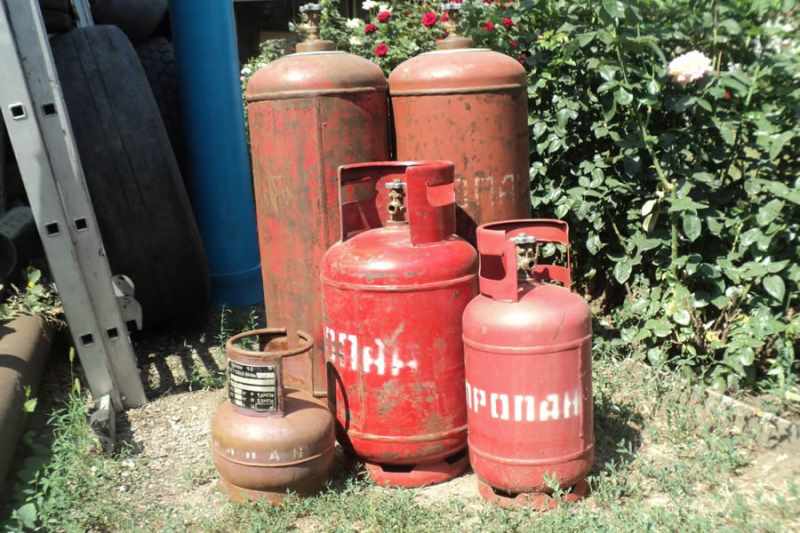
Gas bottle options
And finally, the king of household gas cylinders is a 50-liter giant.This is the best option for creating a potbelly stove with your own hands, suitable for heating a country house. 40-liter industrial gas cylinders are too small in diameter and thick walls. It is better to cut and shorten them. Thick walls will warm up longer and keep heat longer. This stove will also last much longer.
Precautions and rules of operation
During firing, the stove gets very hot.
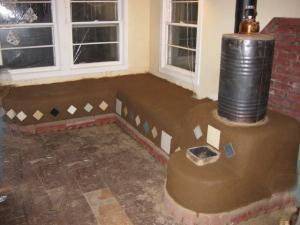
Safe use of stove
It is desirable to make a reflector, in addition, it will improve the distribution of hot air flows. To increase heat transfer, you can overlay the stove with stones or bricks. I recommend installing on the foundation. You can make from bricks and mortar. Flammable materials must be kept at a safe distance. The stove almost does not give ashes, so you will have to clean it very rarely, using a dustpan with a short handle. Over time, the metal of the body can burn out. It will have to be replaced with a new one.

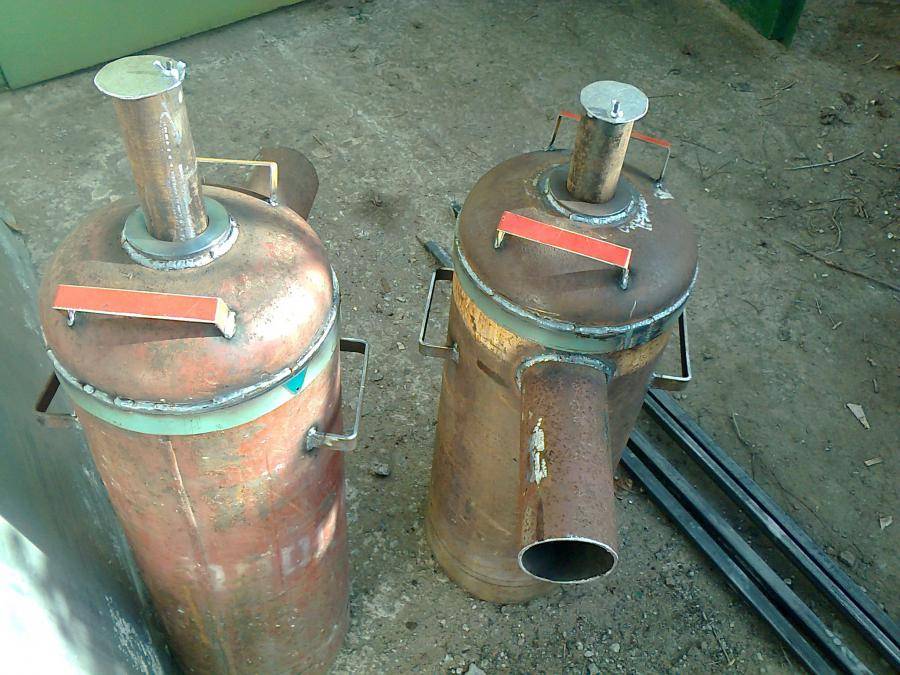

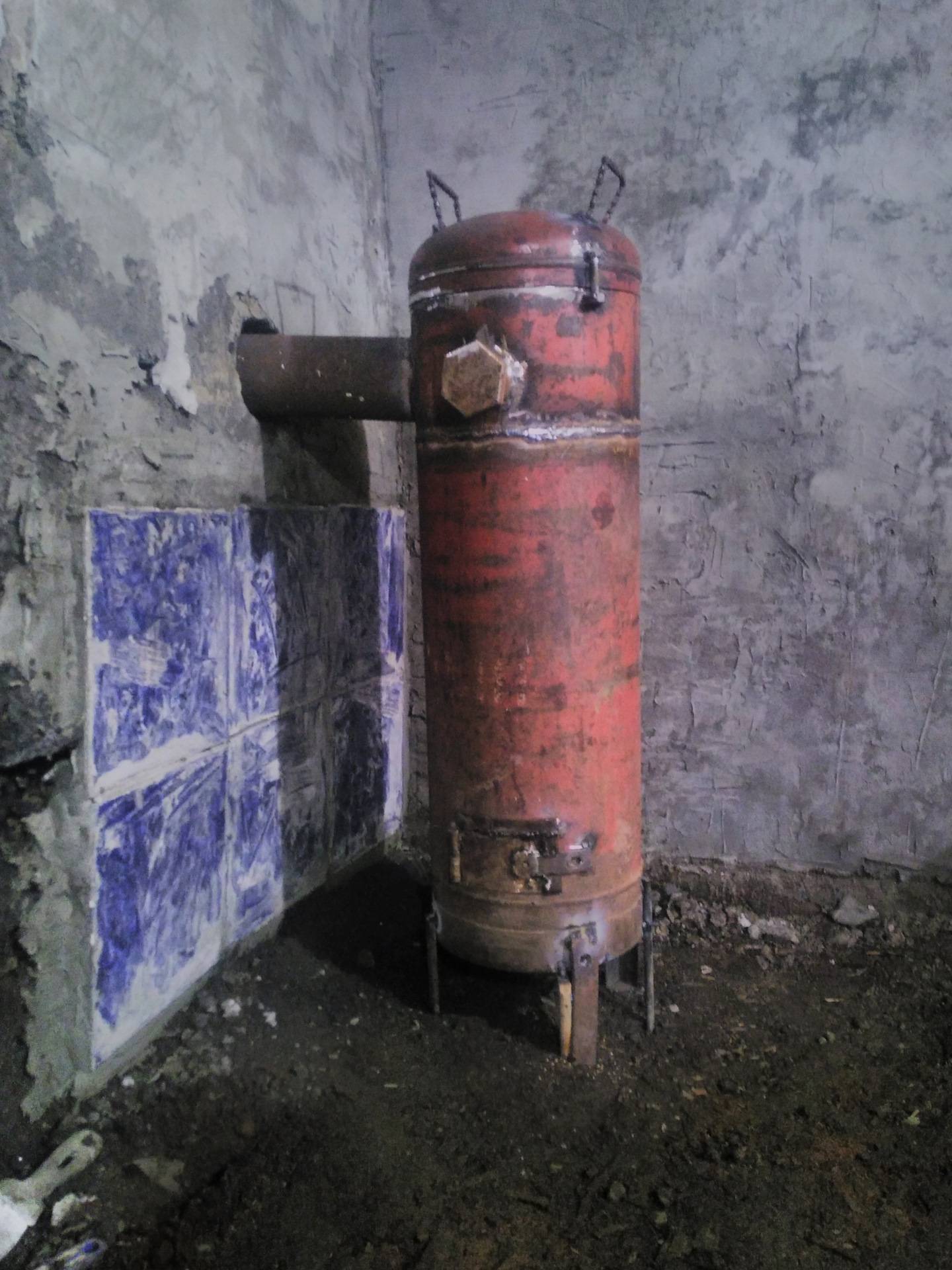

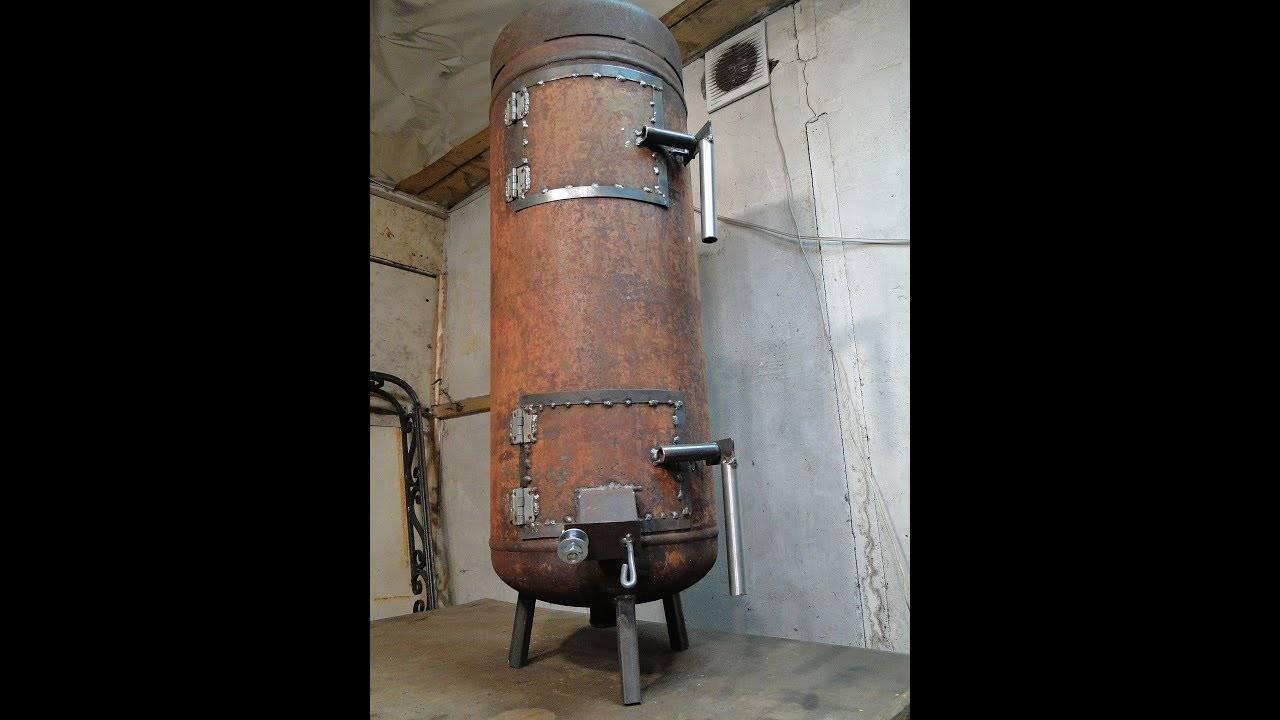

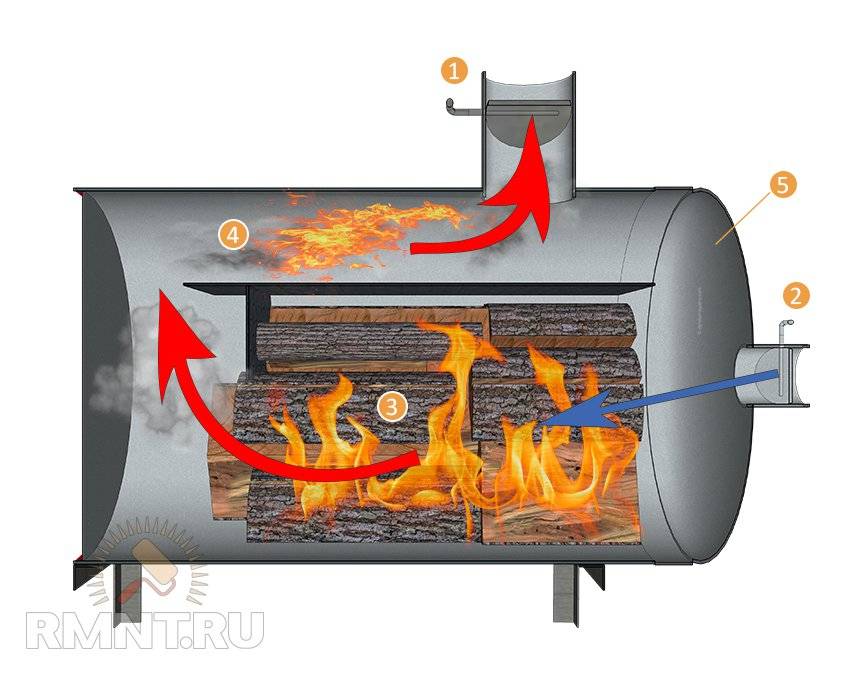
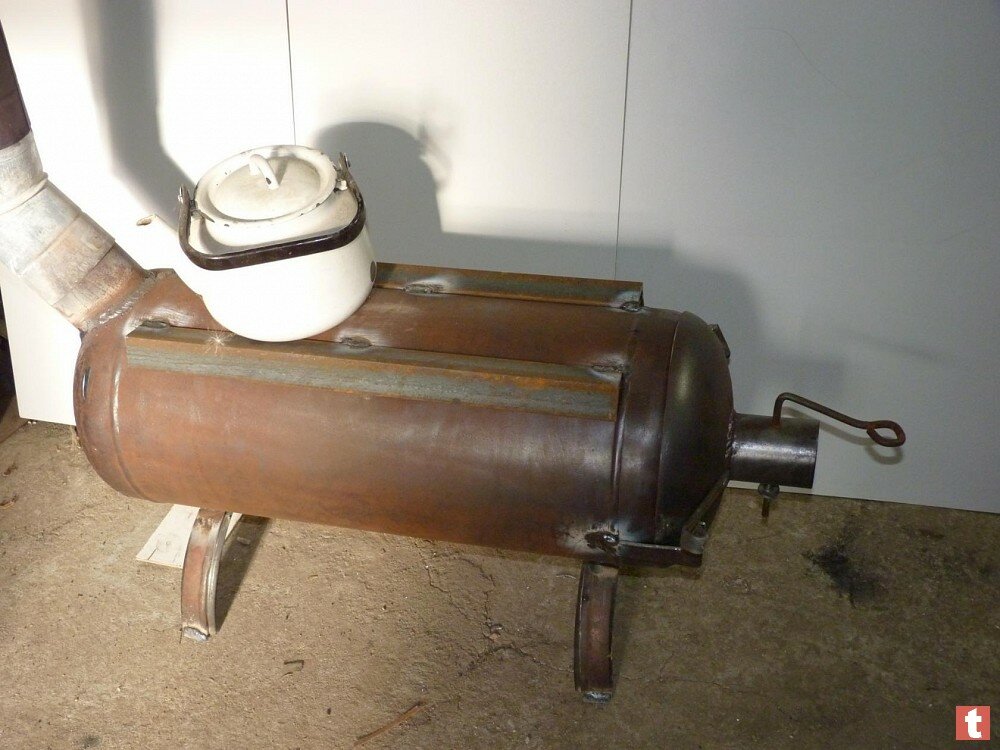

Pyrolysis ovens can only be fired with firewood (chips, sawdust). Liquid fuel will not give the effect of prolonged burning. In addition, toxic substances are emitted into the air, polluting the atmosphere. Before kindling, remove the cover and remove the piston. Firewood is laid on top, then wood chips and paper are placed. Ignite through a pipe supplying air. Open the damper and throw lit paper or a rag inside (matches go out due to strong draft). When the firewood flares up well, close the air supply. The combustion process goes from top to bottom.
Video: how a do-it-yourself potbelly stove works
The task is simple - to make a stove with your own hands. Purposefulness in achieving the goal and a little creative ingenuity.Follow the technology, be persistent and the fruit of your labor will serve for many years, creating a warm atmosphere.
Simple and convenient "ash pan"
In a potbelly stove for long burning, an ash pan is not needed, a small amount of light ash after combustion remains directly in the furnace. But it is still possible to adapt the stove for easier cleaning, especially if you plan to add coal to the firewood.
1. Stops from the corner. 2. Grate above the "ash pan"
With a horizontal position of the potbelly stove, you need to cut out the same plate that was used to form the upper chamber. Instead of a partition, it has the usual 35 mm corner welded transversely. In the front part, a handle is made from a thin rod. The plate is mounted on two guide angles welded along the body. To tightly adjoin the plate and exclude strong air leaks, it is recommended to do this:
- weld the corners under the bottom of the plate with the shelves up on small tacks that are easy to beat off;
- insert the plate into the body and weld the corners to the walls, filling the thick weld well;
- insert scrap into the lower chamber and undermine the plate, if possible, clean up traces of welding.
Through small gaps, the minimum of oxygen necessary for combustion will enter the chamber.
1. Disk. 2. Reinforcement holder. 3. Side of the "ash pan"
For a vertical potbelly stove, you need to cut out another flat disk and weld a piece of thick steel reinforcement to it in the center. Along the perimeter of the circle, a side of a steel strip is bent and welded. In both cases, the removal of ash is carried out after the potbelly stove has cooled down: the ash pan is removed, cleaned and installed in place before a new bookmark.
Maintenance of pyrolysis ovens
Pyrolysis ovens require much less attention compared to conventional devices. This is due to the fact that there are practically no solid particles that form soot in the flue gases. The presence of water vapor in the exhaust predetermines the formation of condensate on the walls of the chimney. Therefore, it is necessary to install a condensate collector with a drain cock, which must be used regularly as it accumulates.
This statement is true for perfectly balanced furnaces, where complete decomposition of the fuel occurs. But a breakthrough of conventional furnace gases cannot be ruled out, therefore regular inspection of the inner surface of the chimney is necessary. If necessary, it must be cleaned. Inspection is carried out at least twice a year.
On long-burning furnaces, an insulated stainless steel pipe is mandatory.
Waste oil stoves should be cleaned regularly as carbon deposits and slag deposits form in the fuel bowl. In the first combustion chamber of the fuel, normal combustion occurs with the release of solid particles. The design of the furnace allows you to visually monitor the condition of this unit.
With the independent manufacture of a furnace for heating, there are no trifles. Each circumstance must be carefully weighed and thought out. Otherwise, all efforts will be in vain. I wish you success!
What you need for work: tools and materials
This model of a "long-playing" stove can be made in just a few hours. All that is needed for this is a great desire and the correct organization of the workflow.You will also need to thoroughly understand the design of the unit and prepare everything you need in advance.
Of the tools you will need:
- welding machine - a small, lightweight inverter with the ability to adjust the current strength up to 200 A is best suited for these purposes;
- angle grinder (colloquially a grinder or "grinder");
- cutting and grinding discs designed for metal work;
- drilling machine or electric drill;
- set of drills;
- hammer with a medium-sized striker;
- blowtorch;
- chisel;
- sledgehammer;
- tape measure and metal ruler;
- core (device designed for applying marks to facilitate drilling);
- scriber for marking on metal surfaces.
As for the materials, there is no need to follow the list exactly. The beauty of homemade structures lies precisely in the fact that any iron that can be found in the backyard or in the corners of the garage (workshop) will do for them.
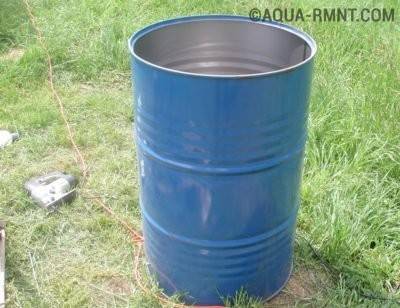
For the manufacture of the furnace body, any overall container is suitable, for example, an unnecessary metal barrel
So, the list of necessary materials:
- steel pipes with a diameter of 80 to 250 mm, which will be needed for the manufacture of an air supply riser and a chimney;
- a suitable metal container with a diameter of 300 to 600 mm with a wall thickness of at least 2.5 mm (you can use a gas cylinder that has served its time, a fuel barrel or a pipe length of at least 120 cm);
- a metal sheet with a thickness of at least 4-5 mm, from which the air distribution piston will be made;
- strong metal hinges that will be needed to fasten the furnace and ash doors;
- asbestos cord (it is needed to seal the loading window and other operational openings);
- corners with a shelf from 50 mm, channels and profile pipes - for the manufacture of air distributor blades, support legs and other structural elements;
- a round metal pancake with a thickness of at least 5 mm and a diameter of 120–150 mm (you can take any suitable gear or sprocket from automotive equipment);
The main types of oven
A vertical stove is made more often, as it takes up little space and has a neat appearance.
The horizontal design is appreciated because of the large cooking surface area. The dimensions of the ash pan and the hole for laying firewood in any device are 10 × 20 and 20 × 30 cm, respectively. Their markup is applied both to the drawings and to the balloon itself - it is easier to cut it out. The locations of the holes are chosen arbitrarily, depending on the type of stove.
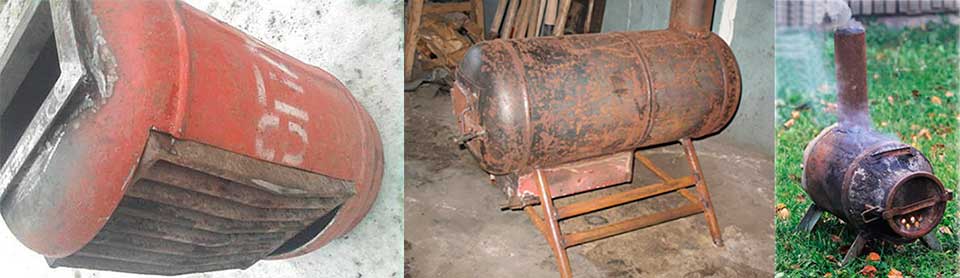
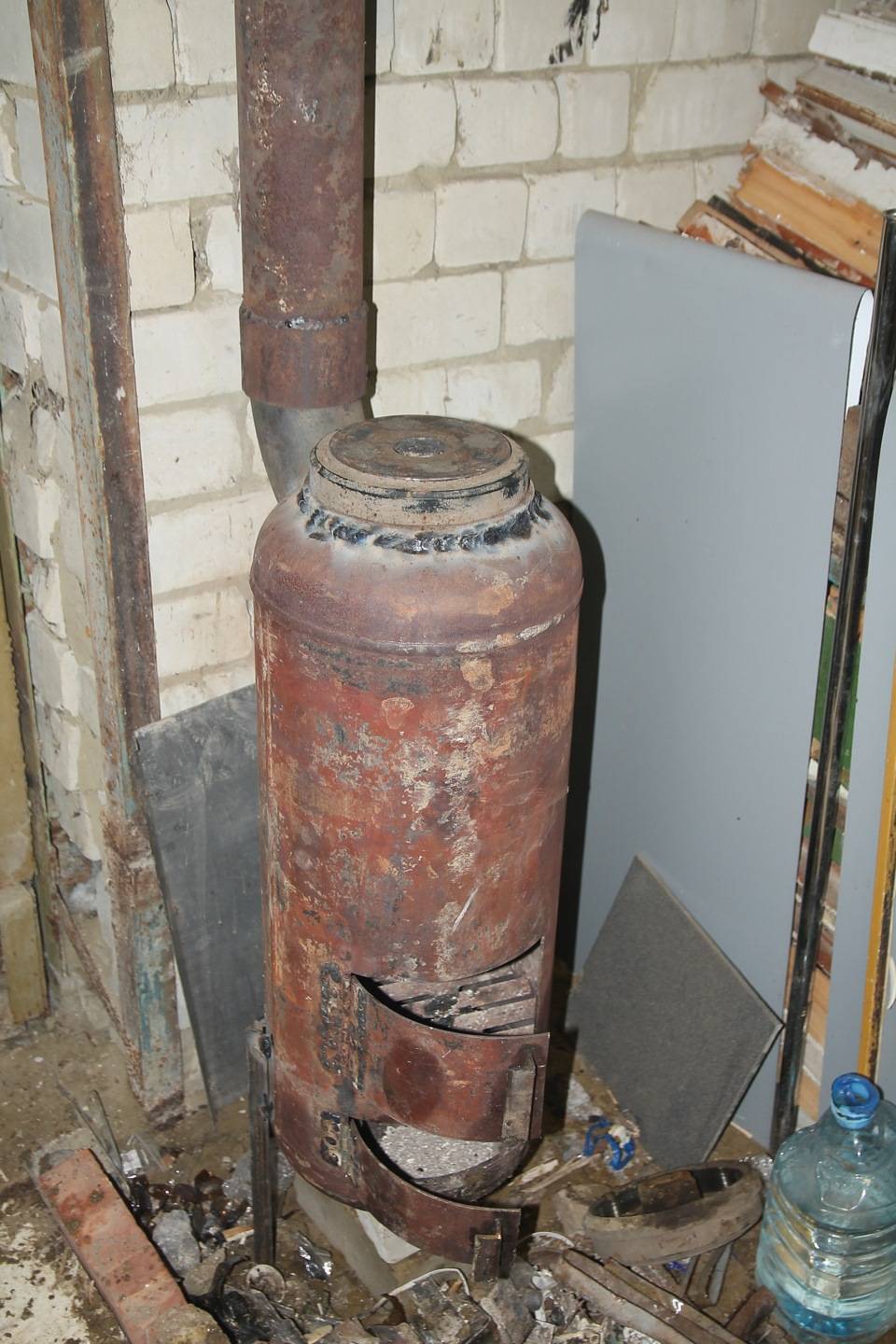
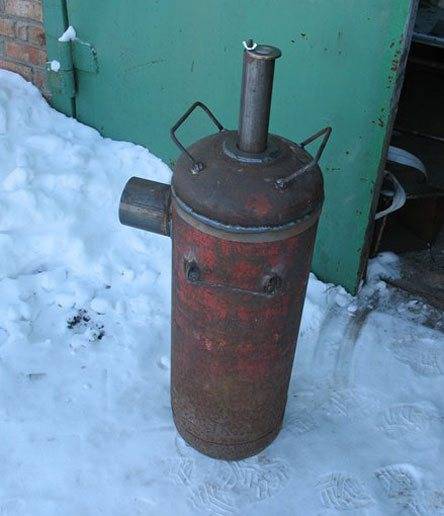

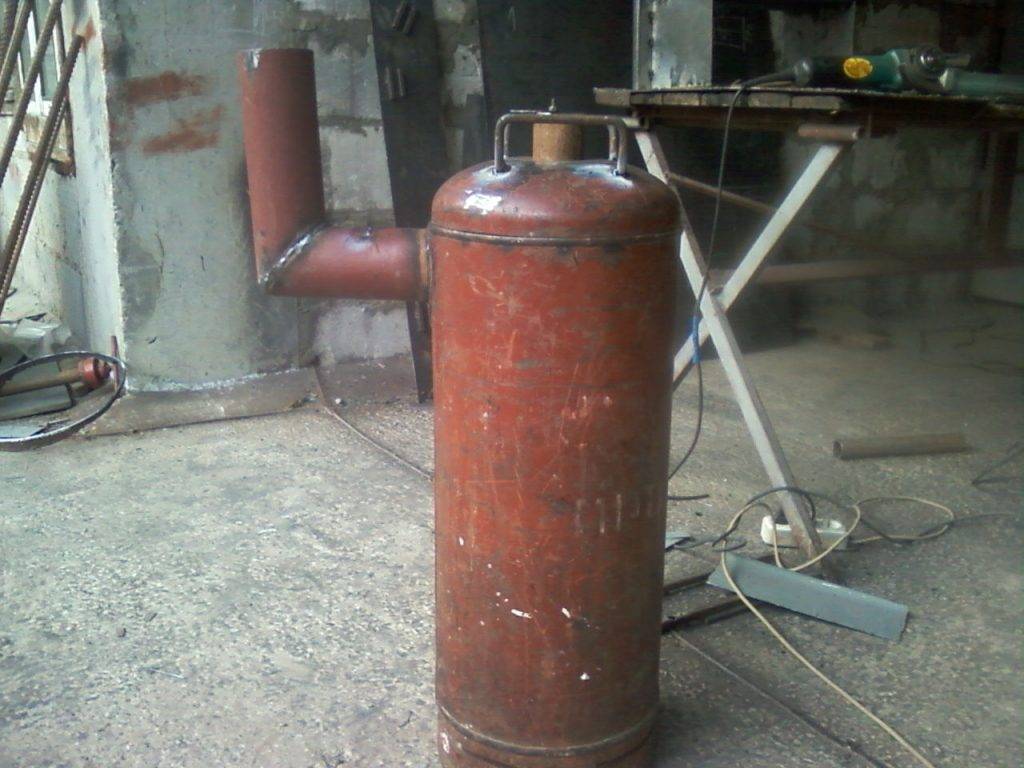
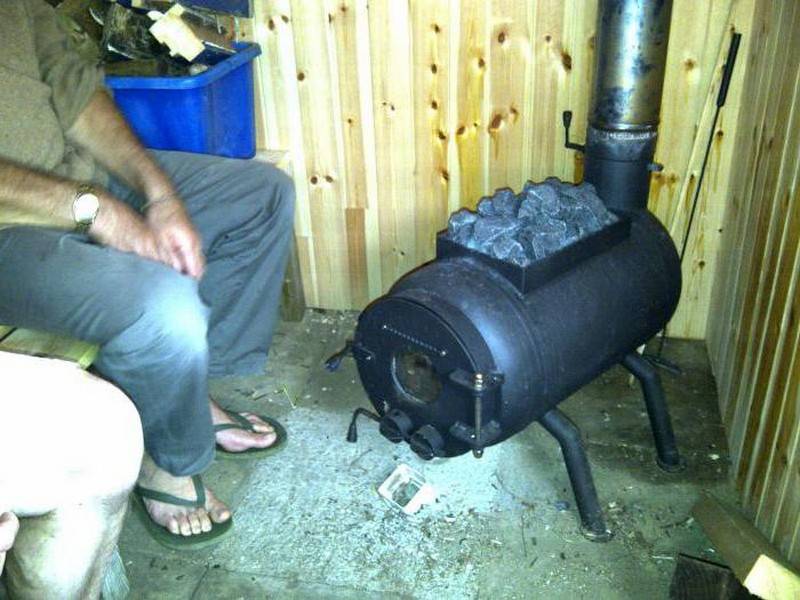

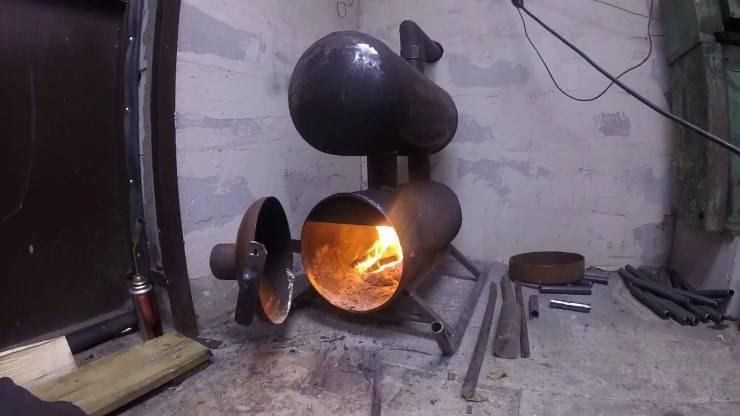 With the help of such a stove, you can heat the room and even cook food on the street.
The chimney is made of a steel pipe, cutting it into different segments and welding them together. Additionally, you need to insulate it with mineral wool and foil. You can use the finished potbelly stove indoors or outdoors. If the stove is used for outdoor cooking, then it is enough to attach a low pipe to let the smoke out.
Vertical potbelly stove
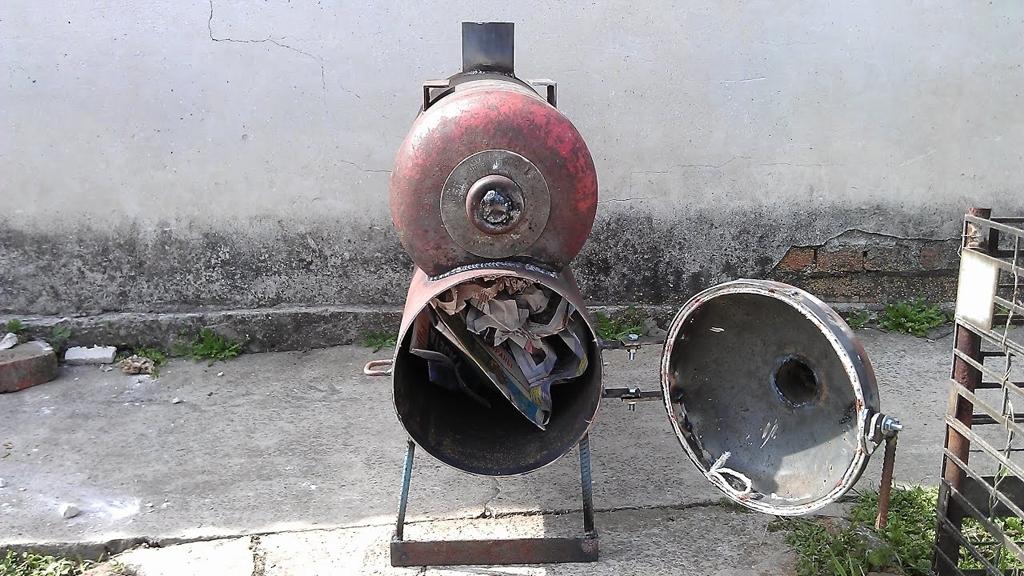
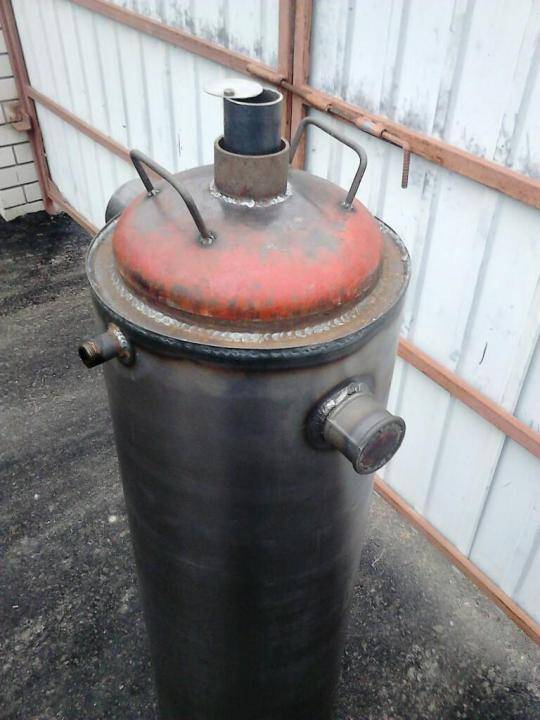
To create a vertical furnace from a propane cylinder, it is placed vertically. It is necessary to cut off the neck, draw the markings of the ash pan, chimney and firebox with a marker. Holes are cut with a grinder or cutter. Reinforcing bars are cut in equal pieces, forming grates. They are welded to the body in parallel rows or with a snake.Hinges for doors are attached, doors are cut out of steel sheet or cast iron. A sliding mechanism or heck is welded to them.
See also: modern types of bourgeoisie.
The hob is necessary if the stove will cook food or heat water. To create it, you need to cut out a part of a suitable size from metal and weld it to the top of the cylinder. After that, all joints and seams are checked for tightness and strength, cleaned and polished.
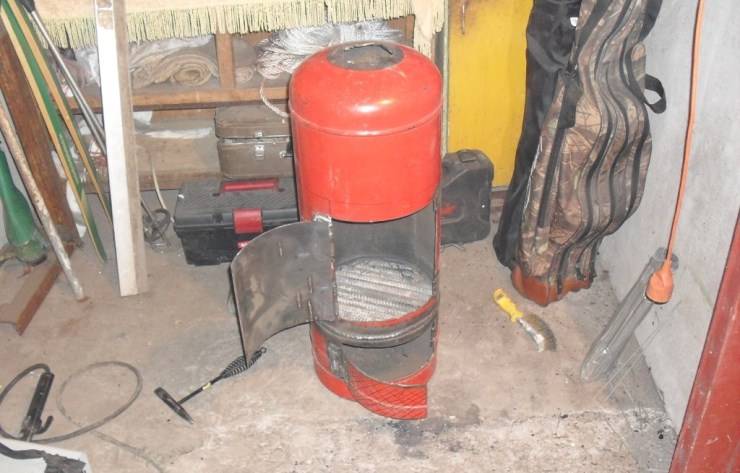 The vertical oven is more popular as it takes up less space
The hole for the chimney should be located at the top of the cylinder or on the side, sometimes the pipe passes through the central opening. In the side part, the knee is first attached, then the chimney itself. Smoke and combustion products come out through the chimney. A metal stand or strong legs are attached to the bottom of the cylinder. Additionally, you can prepare the foundation for the potbelly stove.
Horizontal design
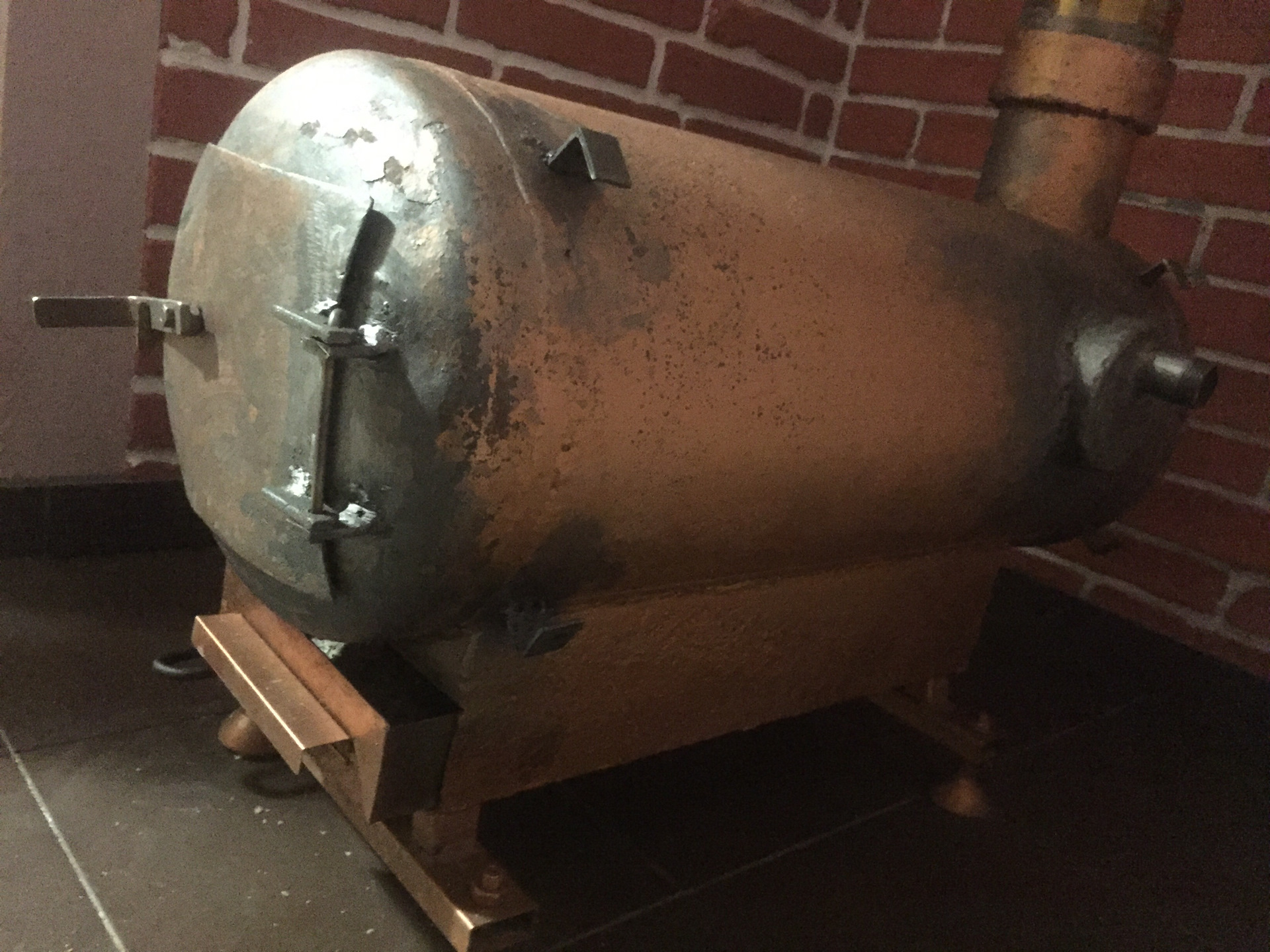
The first step is to create a solid base. It is made of metal, the legs are welded, and then the body of the finished stove. A marker on the cylinder marks the places of the blower, chimney and fuel holes. Openings are cut with a chisel, grinder or cutter. A drill drills holes in the bottom of the case. An ash box is attached from above, it is made of strong heat-resistant metal. A damper is welded to the opening, which will act as a blower.
The door is prepared from the cut out part of the cylinder. It must be scalded and attached to the body with loops. Although you can make a cast-iron door with a latch and weld it.The chimney should exit from the top rear of the potbelly stove. A steel sheet is laid and fixed on top of the body to create a flat hob.
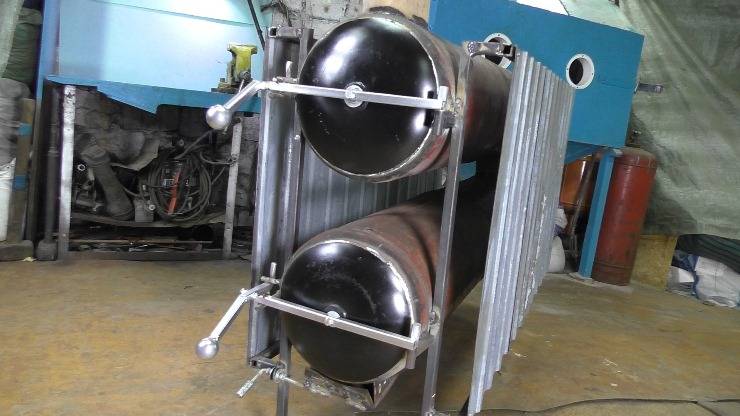 For a horizontal stove, you will need more space - this is its main disadvantage.
Design features and principle of operation
Those who wish to build a potbelly stove with their own hands should first understand the features of its design. In appearance, this is a very simple stove, but despite its simplicity, it is quite effective in heating rooms.
The main highlight of the device is the pipe, more precisely, its diameter. Therefore, during manufacture, it should be remembered that the capacity of the chimney pipe must be lower than the performance of the furnace in terms of flue gas generation. It is necessary that gas distribution be ensured by accurately calculating the diameter of the pipe. For example, if the volume of the firebox is 40 liters, the diameter of the chimney should be made equal to 106 mm.
Device design
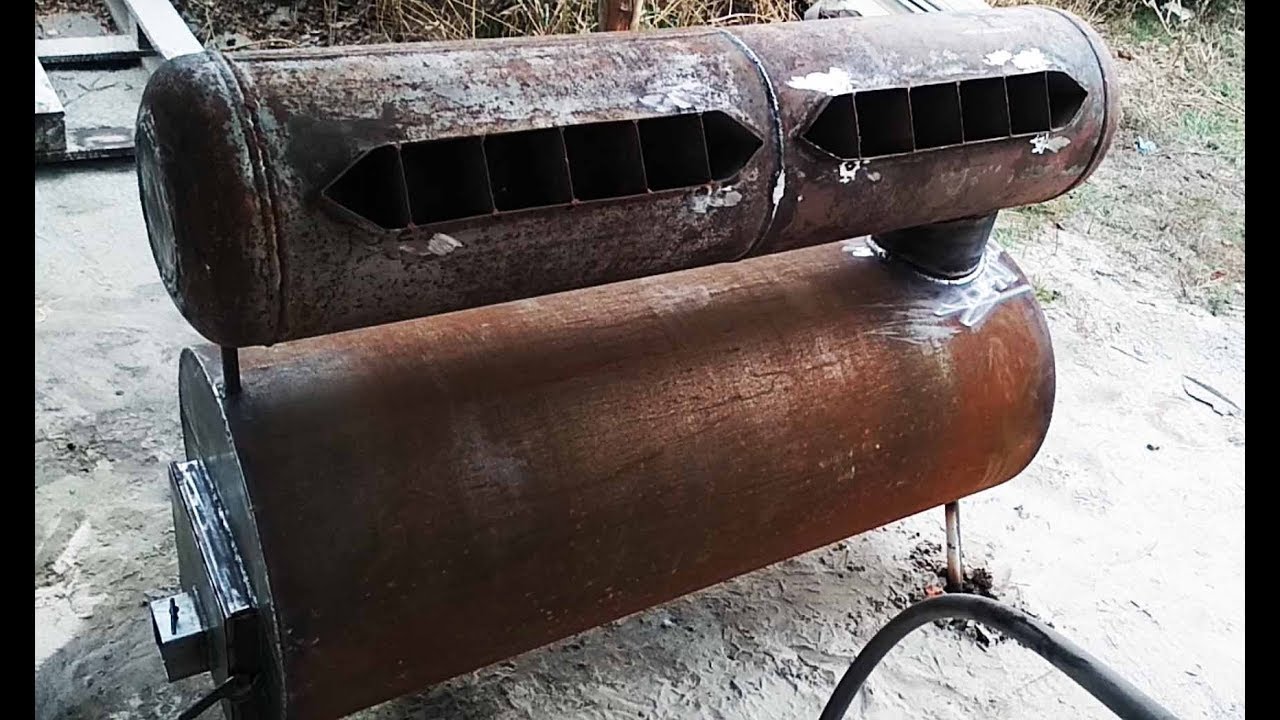
Hot gases cool too quickly, so it was invented that the fuel burned in the partial pyrolysis mode. The secret lies in the presence of a metal screen on three sides - behind and on the sides of the structure. These plates should be spaced 50mm away from the furnace body to reflect back 50% of the IR radiation. This makes it possible to achieve the desired temperature inside the furnace and reduce the risk of fire of enclosing structures, as well as avoid burns during the operation of the stove.
A potbelly stove, working on dry wood or coal, emits a lot of heat at the beginning of combustion
Therefore, even if you melt the stove a little, it will fly out into the chimney, which means that when creating a structure with your own hands, great attention should be paid to convection.It is necessary not only not to let the warm air disperse in different directions, but also to keep it near the stove. The bottom of the stove heats up moderately compared to the walls, but also radiates heat down
The performance of the potbelly stove does not decrease from this, but you should think about safety - avoiding a fire, especially if the stove is installed on a wooden floor. In this regard, it should be placed on a metal sheet with an offset of 350 mm along the contour of the structure. The sheet is laid on a layer of asbestos or other non-combustible material. This will further increase the efficiency of the potbelly stove.
The bottom of the stove heats up moderately compared to the walls, but also radiates heat down. The performance of the potbelly stove does not decrease from this, but you should think about safety - avoiding a fire, especially if the stove is installed on a wooden floor. In this regard, it should be placed on a metal sheet with an offset of 350 mm along the contour of the structure. The sheet is laid on a layer of asbestos or other non-combustible material. This will further increase the efficiency of the potbelly stove.
Chimney
Chimney installation
Another important element in the device of such a furnace is a chimney. It must be constructed as follows - a vertical part is installed, having a height of at least 1.2 meters. At the same time, it is desirable to wrap it with heat-insulating material, for example, basalt cardboard.
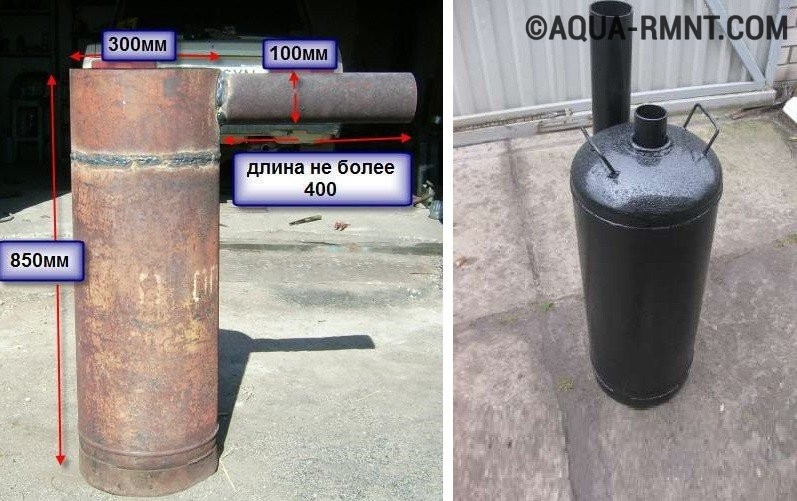




The next part of the chimney is a hog, which is a horizontal or slightly inclined pipe of the same diameter. It is in this compartment that the remnants of flue gases burn out, and from here up to a quarter of all heat is released into the room. The length of the hog is at least 2.5 meters, and ideally 4.5 meters.
According to the safety requirements, there must be at least 2.2 meters from the bottom of the hog to the floor covering so that a tall person does not touch the red-hot pipe with his head. It is desirable to surround the device with a special protective fence in the form of a metal mesh or a cylinder.
Positive and negative parameters
The use of a gas cylinder to form this design has certain advantages:
- You can get a long burning stove without spending a lot of money, since you will need standard and inexpensive elements and materials.
- You can do all the processes with your own hands.
- You can use the resulting equipment for home, bath or other structures.
- On the Internet you can find video instructions for creating a design.
- It is easy to use such stoves, there is no danger.
- You can make different types of ovens.
The disadvantages of this equipment include the fact that all work must be carried out according to the drawings. Without them, you can violate the basic principles of the design of stoves and make serious mistakes.
Calculation of the main parameters: drawing and recommendations
For the manufacture of an optimally efficient potbelly stove, an all-metal cylinder with a volume of 50 liters is suitable.
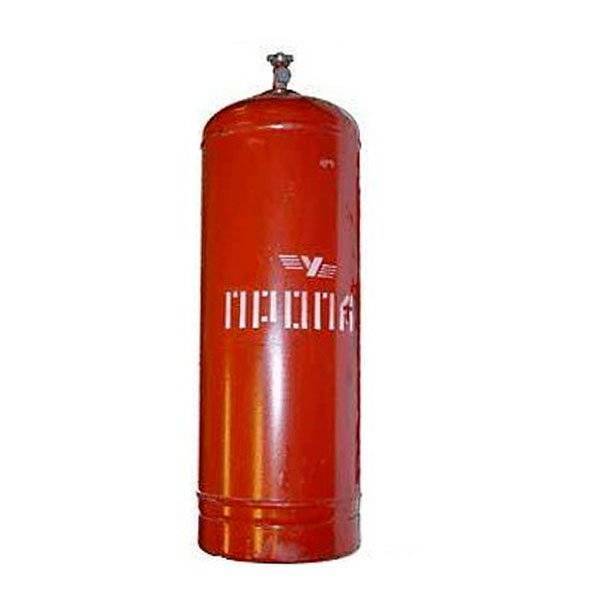
A standard 50 liter bottle will suffice
Finding such a balloon is usually not difficult. They are often used in the economy and industry.
To equip such a furnace with a chimney, a pipe with a diameter of 100–125 mm and a thickness of at least 3 mm is used to make a chimney pipe. The chimney itself should be placed vertically, but deviation from the axis is also allowed (a slope of not more than 30 degrees). The slope is made for greater efficiency of heat transfer from the chimney pipe.Although the location of the pipe directly depends on the local conditions for installing the potbelly stove.
For ease of use, the compartments of the furnace and ash pan are equipped with doors with a locking mechanism. When the doors are closed, the combustion process improves and the risk of fire hazardous particles falling into the room is reduced. And also by adjusting the gap with the ash pan door, you can adjust the intensity of air supply to the furnace.
Doors are made of arbitrary shape. The main thing is to take into account the standard size of firewood and the convenience of loading it.
An important detail of the potbelly stove is the grate. The grate serves to support fuel (firewood) and at the same time helps to separate loose combustion products. The combustion process takes place on the grate
Therefore, the metal from which the grate is made must be strong enough and resistant to high temperatures. It is better to make a grate from reinforcement bars with a diameter of at least 12 mm. Such rods are cut according to the dimensions of the inner part of the cylinder (width) and assembled into a lattice with a gap width of 10–15 mm. Rods are connected by welding
The combustion process takes place on the grate. Therefore, the metal from which the grate is made must be strong enough and resistant to high temperatures. It is better to make a grate from reinforcement bars with a diameter of at least 12 mm. Such rods are cut according to the dimensions of the inner part of the cylinder (width) and assembled into a lattice with a gap width of 10–15 mm. The rods are connected by welding.
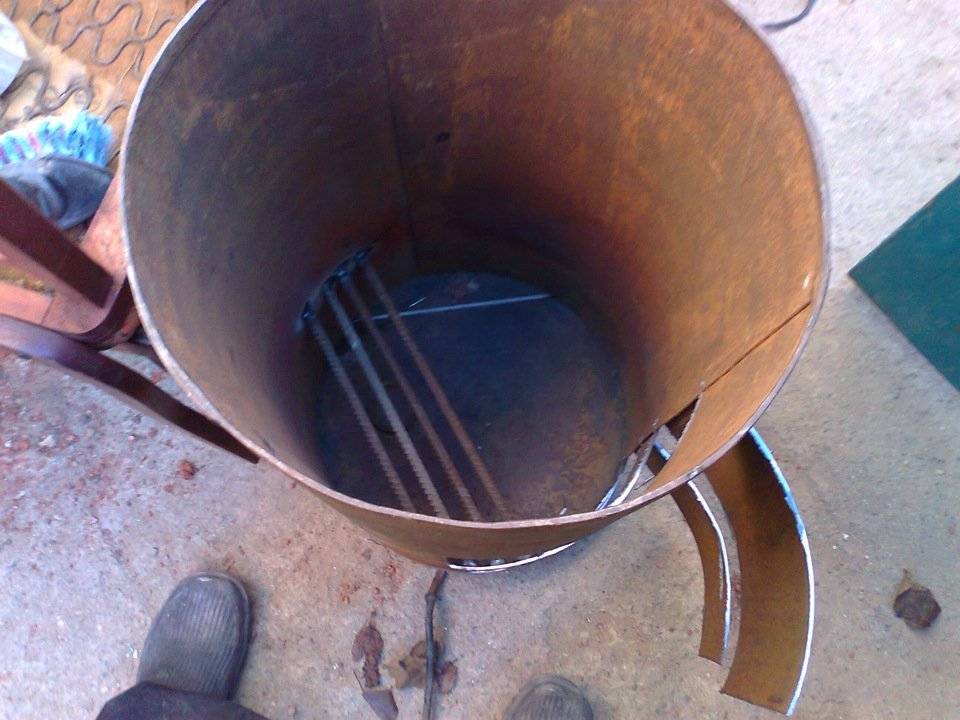
Potbelly stove from a balloon
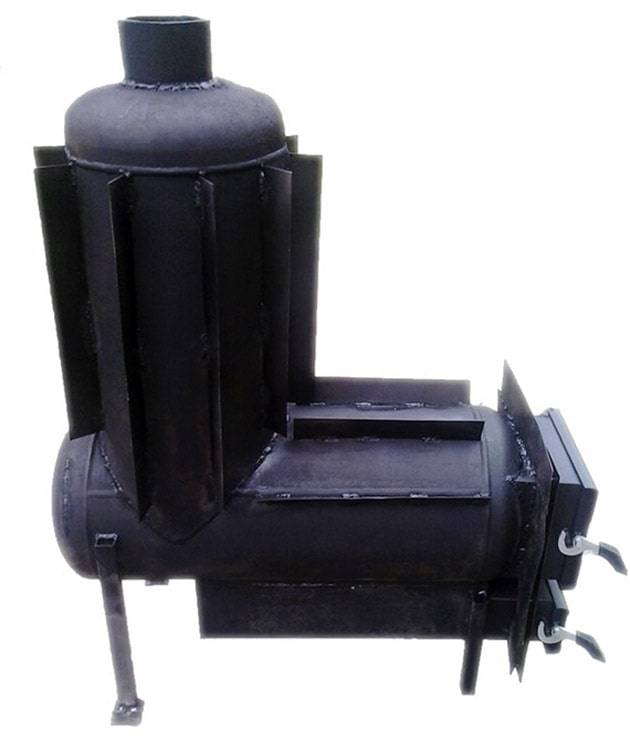
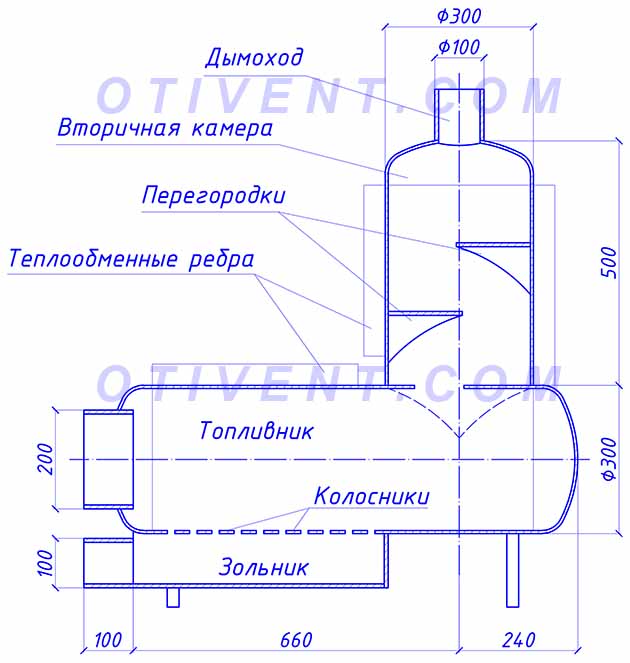
The approximate assembly diagram of a horizontal solid fuel stove is applicable to a gas cylinder.
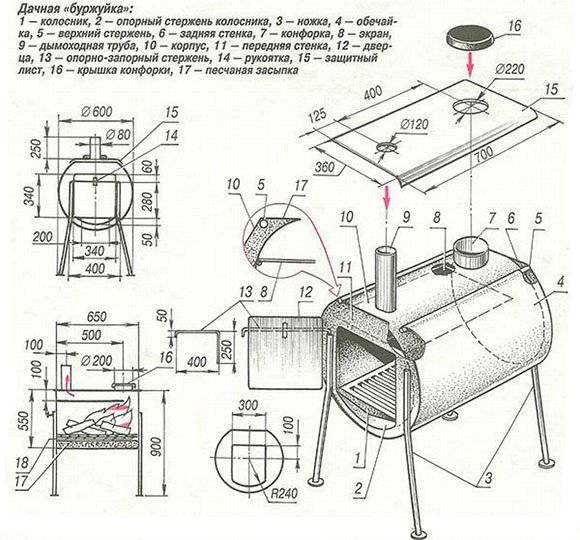
The scheme is applicable for a gas cylinder
We make a long-burning stove with our own hands
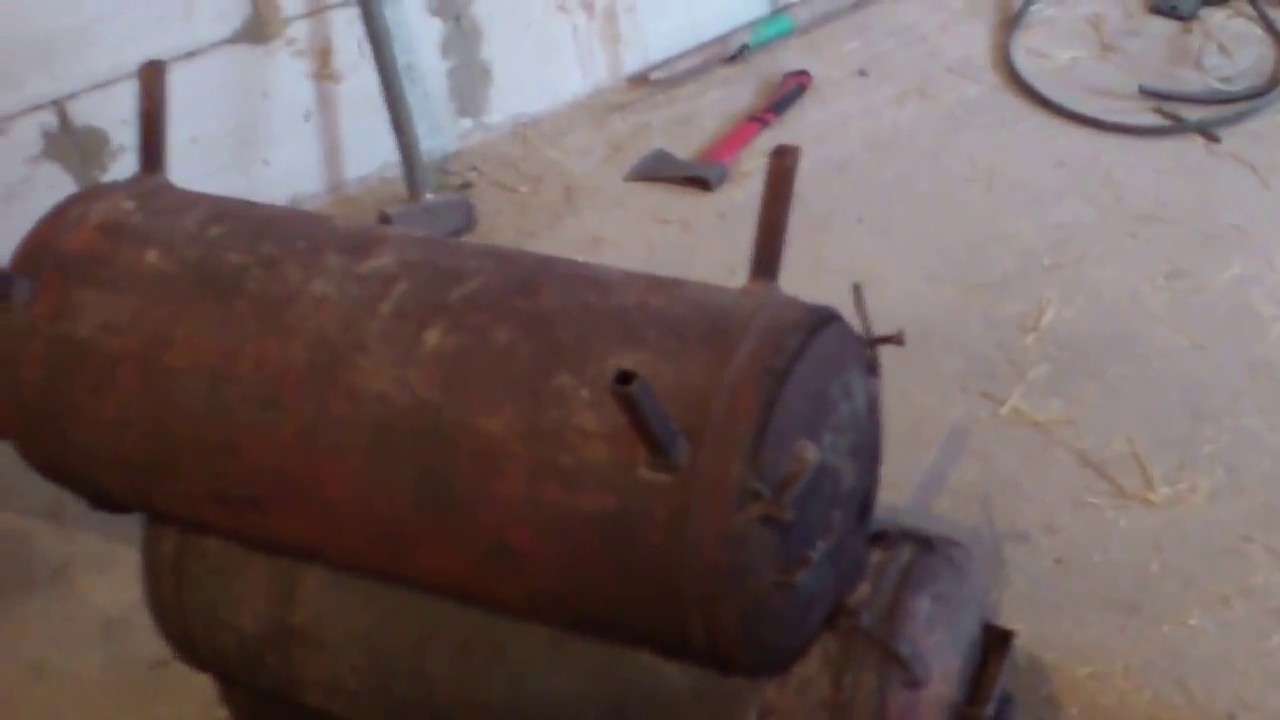
The first step is to decide what the body of the stove will be made of. It is advisable to choose a thick metal so that it does not burn out longer. Most often, such a potbelly stove is made from a gas cylinder with a volume of 50 liters. You can use a thick-walled pipe with a large diameter or a steel barrel with a volume of 200 liters, but its walls are thinner.
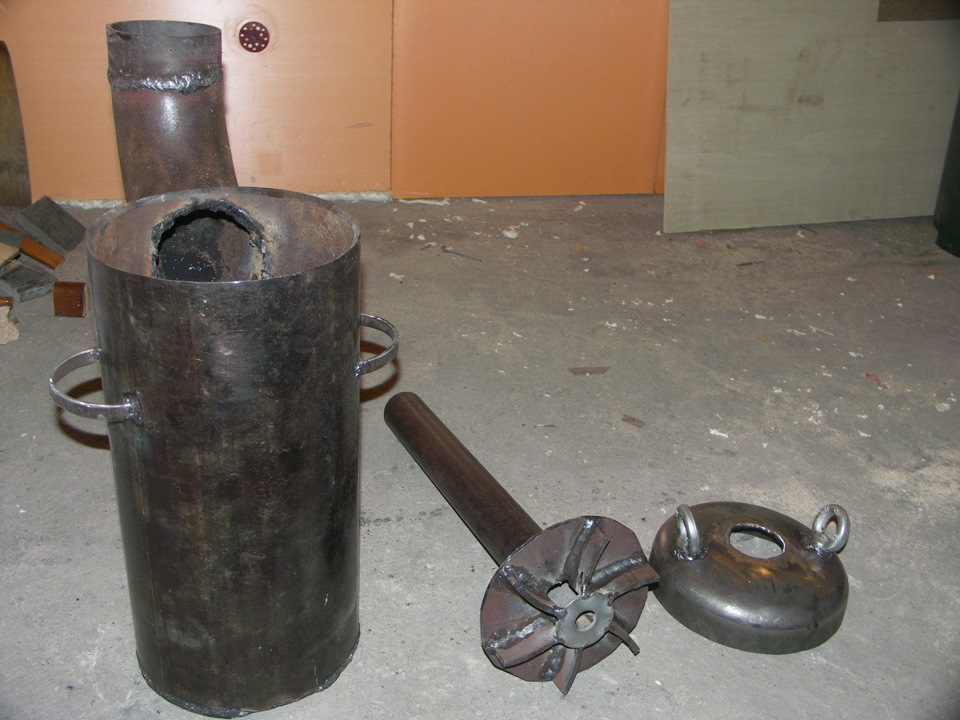


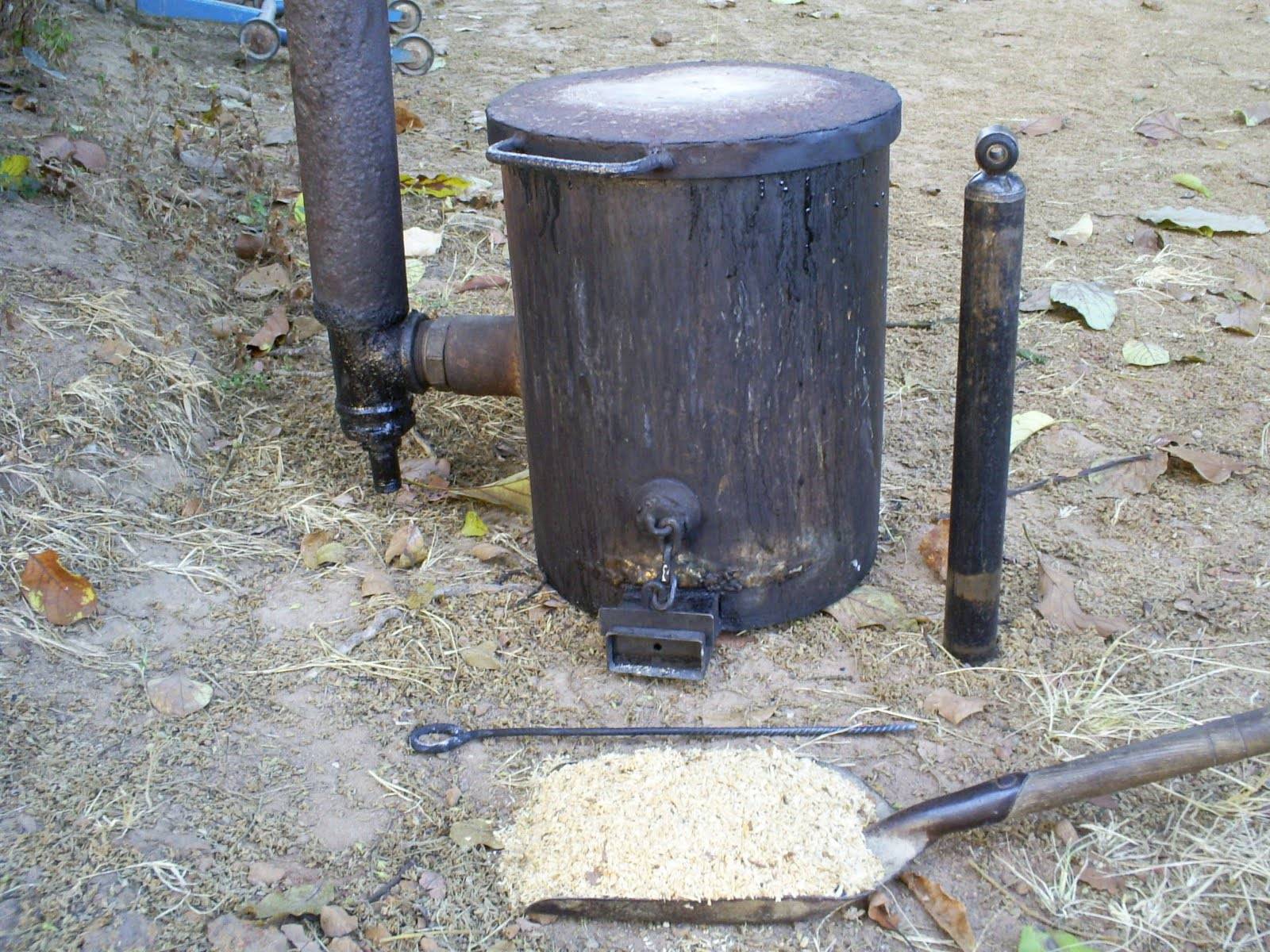



You will also need:
- steel pipes;
- metal profile;
- a tool for cutting metal (grinder, gas cutter, etc.);
- welding machine with electrodes;
- Sheet steel.
Let's consider in detail how to make a potbelly stove with your own hands. It is preliminary recommended to sketch a design diagram and determine the dimensions of the elements.
Frame. When manufacturing a body from a gas cylinder, it is necessary to carefully cut off the upper part of it (the cut line is 1 cm below the weld). If desired, the body can be extended by welding the cut off part of another cylinder. At the barrel, the upper part with the lid is also cut off. And if a pipe is chosen for the body, a round or square bottom made of thick sheet metal should be welded to it.
Housing options
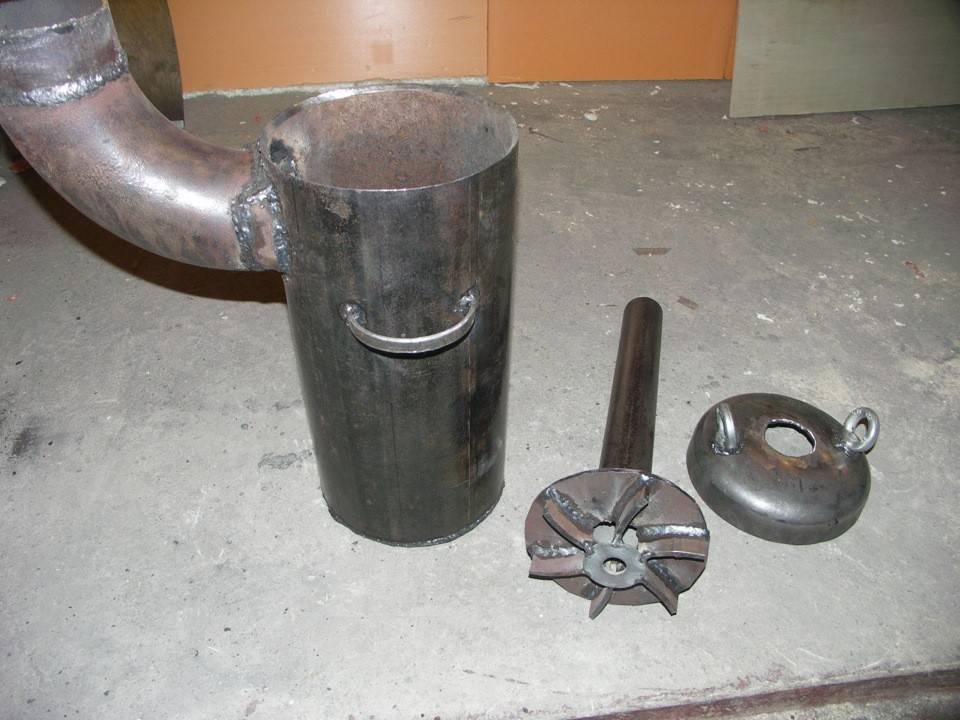
Lid. In the cut off top of the gas cylinder or in the barrel lid in the center, a hole should be cut that matches the size of the pipe from which the piston will be made
The lid is scalded with a steel strip - it is important that it fits snugly on the body. For a pipe housing, the cover will have to be specially made from sheet metal. Chimney pipe
On the side of the stove, a couple of centimeters below the put on cover, a hole is cut and the chimney pipe is welded
Chimney pipe.On the side of the stove, a couple of centimeters below the put on cover, a hole is cut and the chimney pipe is welded
It is important that the removable chimney elbow fits snugly, without a gap.
Chimney. The lower, horizontal section of the chimney must be longer than the diameter of the stove. The chimney can be made broken to increase the surface area that gives off heat to the room
It is important that there are no angles less than 45°. A pipe with a diameter of 10-15 cm is suitable for installing a chimney
Piston. The length of the air duct must exceed the height of the body by 100-150 mm. It is necessary to weld a steel circle with a hole in the center to its lower part and equip it with five or six blades from the bottom side (arranged in a circle, rays from the center).
The blades may be:
- pieces of steel corner;
- segments of the U-shaped profile;
- wave-curved strips of metal (welded with an edge).
In the middle, a small steel circle with a hole in the center is welded onto the blade. If the platform with the blades is made of steel less than 6 mm thick, it deforms over time from overheating. To prevent this from happening, stiffeners are welded on top - a triangle made up of segments of a corner. On the upper cut of the pipe, attach a steel plate with a bolt to adjust the intensity of combustion.
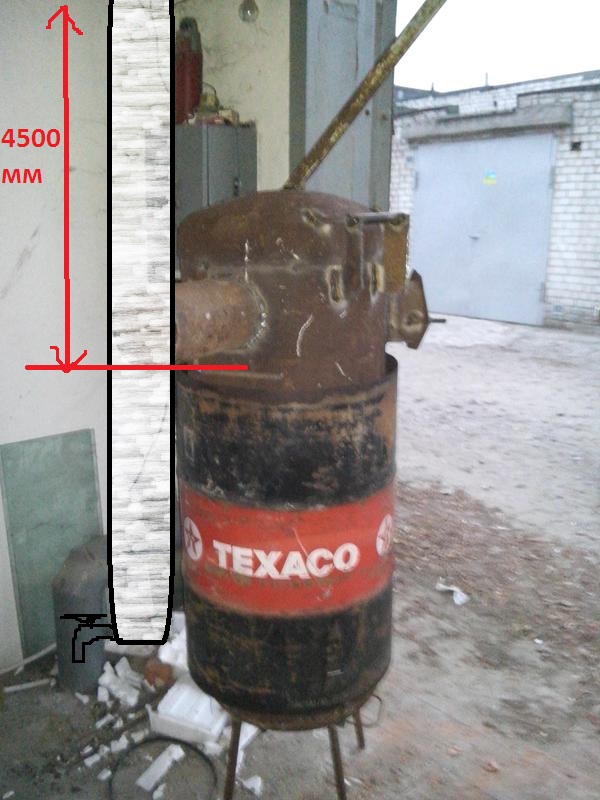




Assembly. Install the top burning stove, check the tightness of the chimney connection. Insert the piston into the oven, put on and close the lid. Make sure the cap fits snugly and that there is minimal clearance between the piston and the hole in the cap.
Commissioning. Homemade potbelly stoves of long burning can be placed on an earthen or concrete floor.If the floor in the room is wooden, lay out a platform of bricks, using mortar for laying stoves, and cover it with steel sheet. Instead of a brick, a sheet of refractory material can be laid and also covered with sheet metal. It is advisable to lay out the walls next to the self-made stove with bricks, which will accumulate heat and give off to the room.
Firewood is placed in the installed stove, filling the firebox by about 2/3 or a little more. Paper is placed on top and set on fire. After making sure that the wood is busy, you can install the piston and put on the lid. The next laying of firewood is possible only after all the fuel has burned out and the stove has cooled down.
Conclusion
"Bubafonya" is not the most efficient long-acting homemade stove. Craftsmen are developing various options for a wood-burning “rocket” stove, but its manufacture requires accurate calculations, hand-made drawings and good skills in working with various tools.
"Bubafonya" can also be upgraded, for example, to mount a device that simplifies the unloading of ash.
Related videos: