- Equipment for automatic water supply
- Types of pumping equipment and features of choice
- Options for arranging water supply from a well
- Choosing a place for the well
- The most popular methods for finding an aquifer are:
- Well construction rules:
- Operation and frequent system malfunctions
- How to deliver water to the house from a well or well?
- Possible arrangement options
- Basic summer water supply schemes
- Demountable surface system
- Stationary underground utilities
- Types of pumps for a well
- Water supply system
- Main elements of the system
- Pipeline laying
- System installation
Equipment for automatic water supply
In order for water to be uninterruptedly supplied from autonomous water supply systems, pumping equipment is used. Separate pumps - submersible or rotary and pumping stations.

Pumping station
Before buying, you need to consider the following characteristics:
- Water consumption;
- Minimum water supply column;
- The highest point of water consumption;
- well depth;
- Nominal pressure (indicated in the passport);
- Productivity (m³/hour).
Types of pumping equipment and features of choice
The following types of pumps are used for the well:
- Submersible or deep pump. One part of it is suspended on a cable in the water.The pump is connected to the ground by a water supply hose and a power cable. Most often I use it for agricultural needs, less often for water supply to housing.
- Surface pump or pumping station. Located on the surface (can be stored even in the house). A hose with a filter is installed at a depth, above them there is a check valve. It does not allow water to flow back. If the pump is turned off, it is easier to pump water.

Submersible pump
When buying pumping equipment, consider the following:
- source depth;
- the maximum amount of water consumption;
- the minimum size of the water column;
- total fluid flow;
- technical characteristics of the equipment: pump head and water flow.
IMPORTANT! An autonomous system will work smoothly if there is a stable water pressure in the pipes. To maintain pressure, the pump must run constantly.
Therefore, it is recommended to buy high-quality pumping systems that are designed for heavy loads and long operating times.
The pumping station must be located so that it does not freeze in winter. Usually it is placed in the basement, in the kitchen or in the basement of the house.
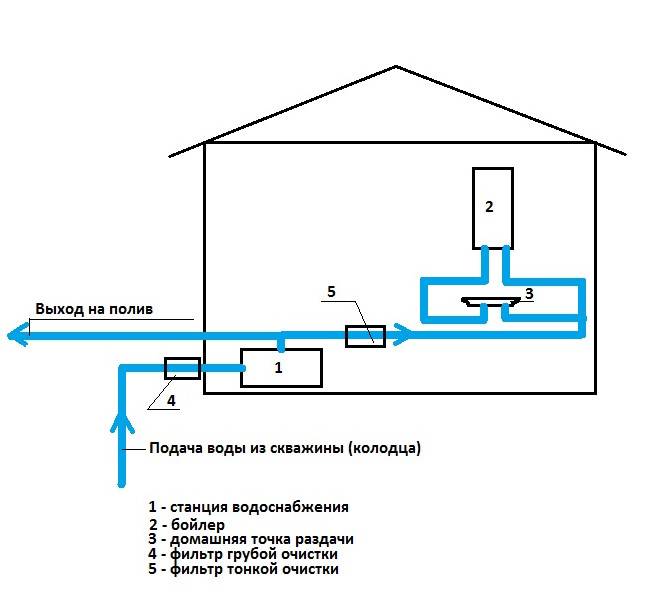
The water intake source is connected to the pumping station using a pipe (there must be a brass fitting at the end, with an adapter). A tee and a drain cock are attached to the fitting. This is necessary in order to repair the water supply and turn off the water supply in case of failures.
Connect the check valve. It will not let the water move in the opposite direction. If you need to turn the pipe, which is directed to the station, set the angle to 90º.
Then the following elements are connected:
- ball valve that turns on and off the water supply;
- mesh filter, for coarse cleaning;
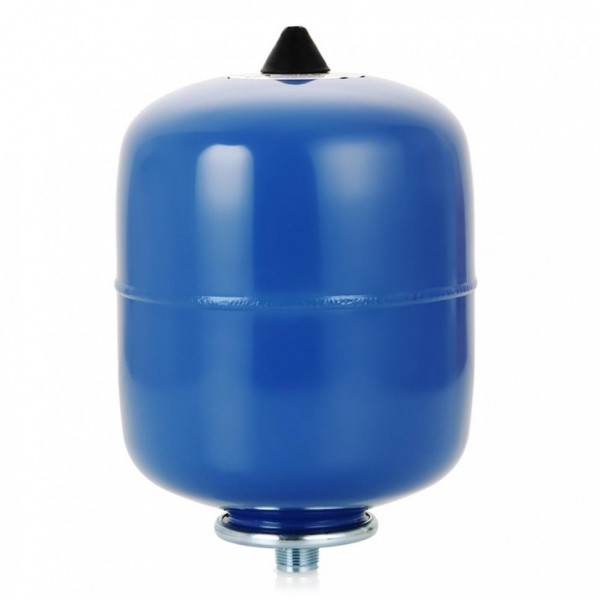
- if the pump is located at the source of water intake, a damper tank or a hydraulic accumulator must be connected at the bottom of the pipe, and a pressure switch at the top (these elements must be included with the pumping station);
- a sensor that will protect the pump from idling;
- fine filter;
- change to inch pipe.
Options for arranging water supply from a well
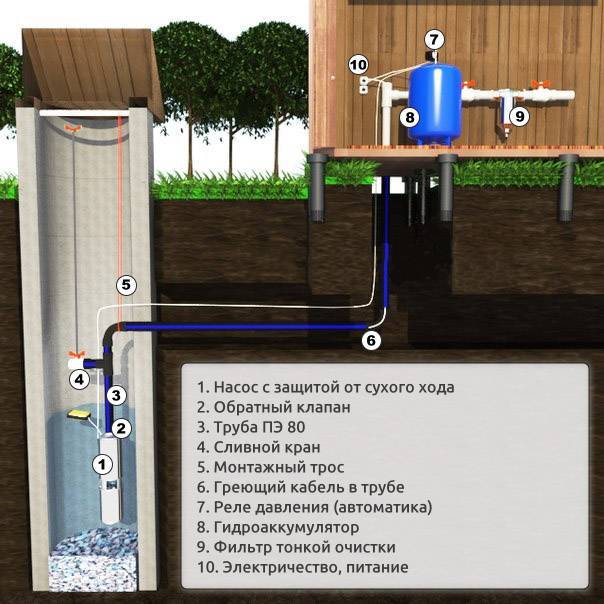
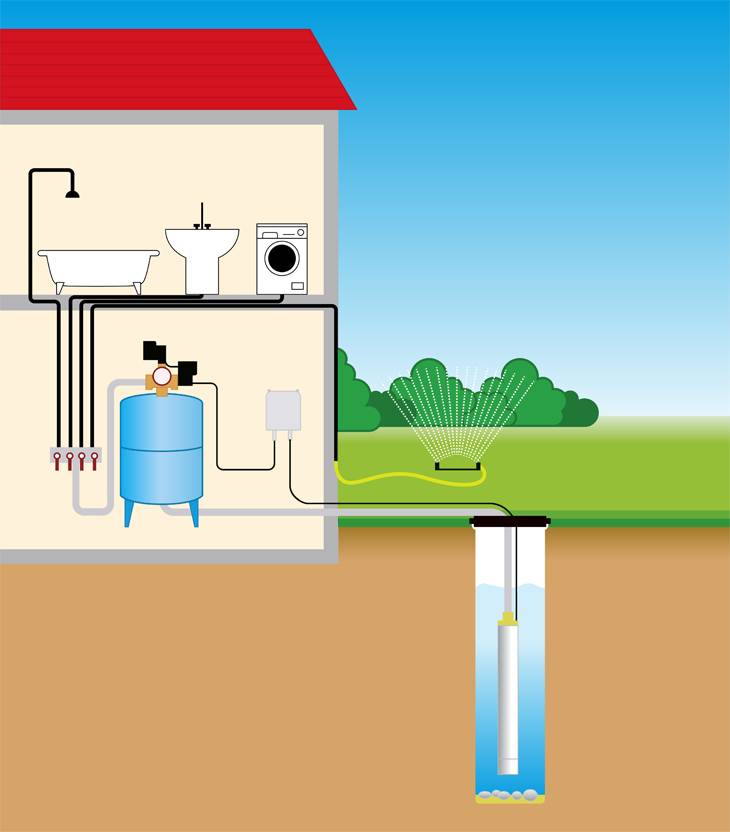
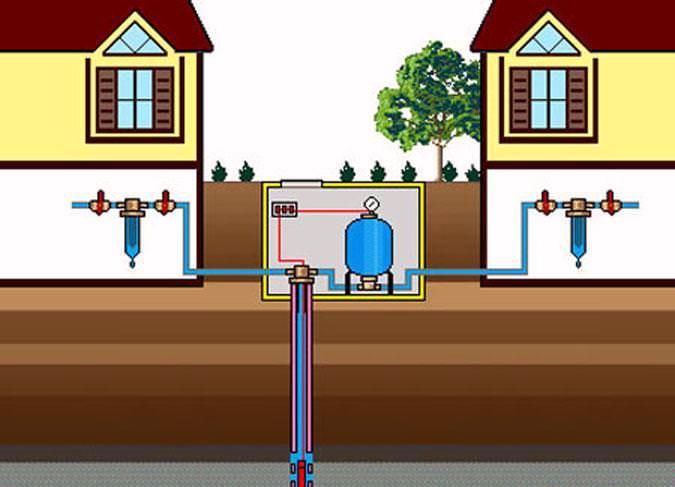
Method number 1 - eyeliner with an automated pumping station. If the site has a shallow well, and if its water level allows, you can install a hand pump or a pumping station. The principle of operation of this system is that with the help of a submersible pump, water is pumped into a hydropneumatic tank, its capacity can be from 100 to 500 liters.
While working with a shallow sand well, one of the best options is to equip an automated water supply system that ensures uninterrupted water supply to the house.
The storage tank itself has a rubber membrane and relays that regulate the water pressure inside the tank. If the tank is full, the pump is turned off, at the moment when water begins to be consumed, the relay sends a signal to the pump to turn on and it starts pumping water from the well.
This means that such a pump can work both directly, supplying water to the system, and after the pressure in the system drops to a certain level, in order to replenish the “reserve” in the hydropneumatic tank.
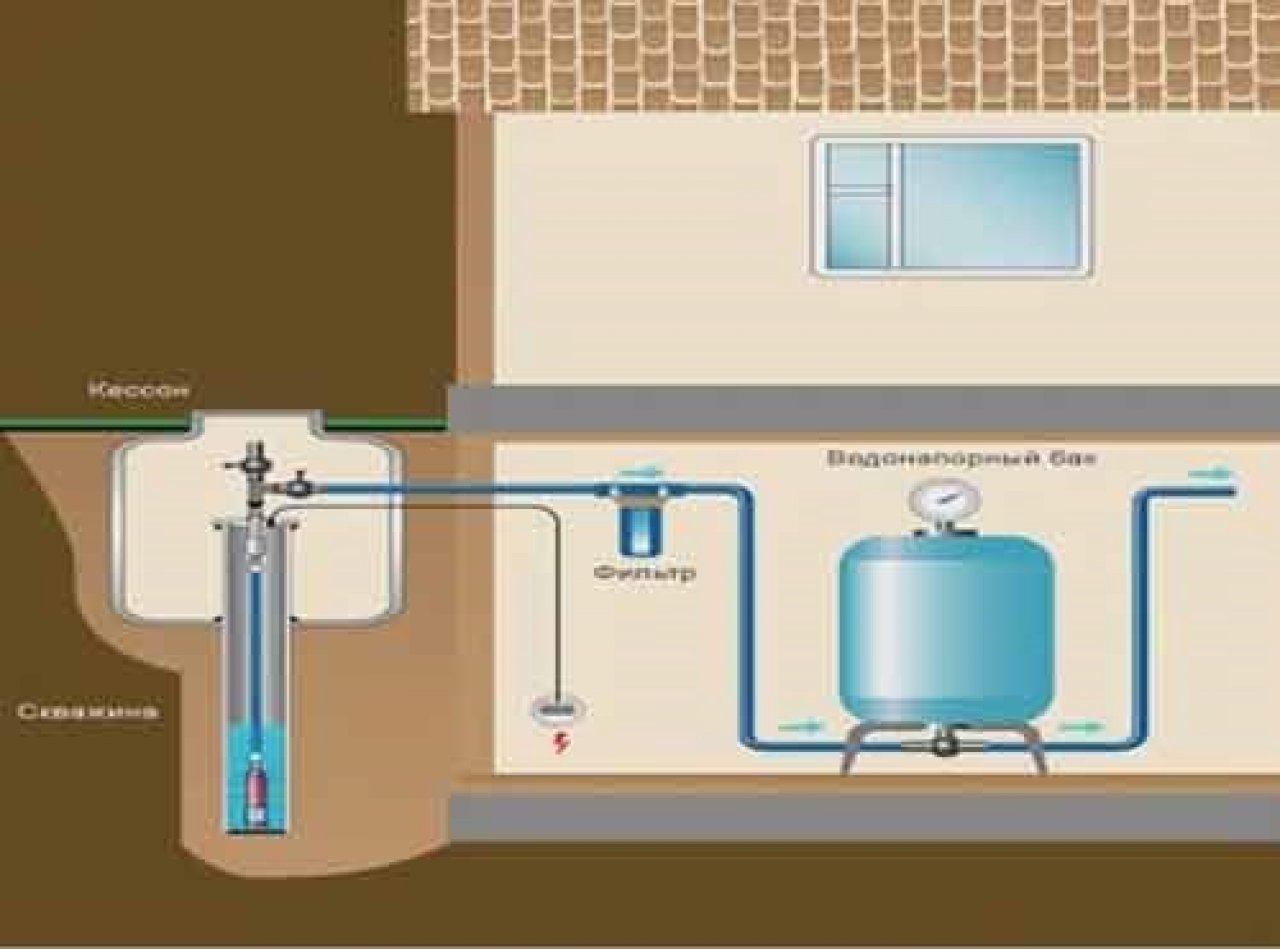
The receiver itself (hydraulic tank) must be placed in any most convenient place in the house in order to bring the pipeline, usually this is a utility room.From the caisson to the place where the pipe enters the house, a trench breaks out, to the bottom of which a water pipe and an electric power cable for the pump are thrown.


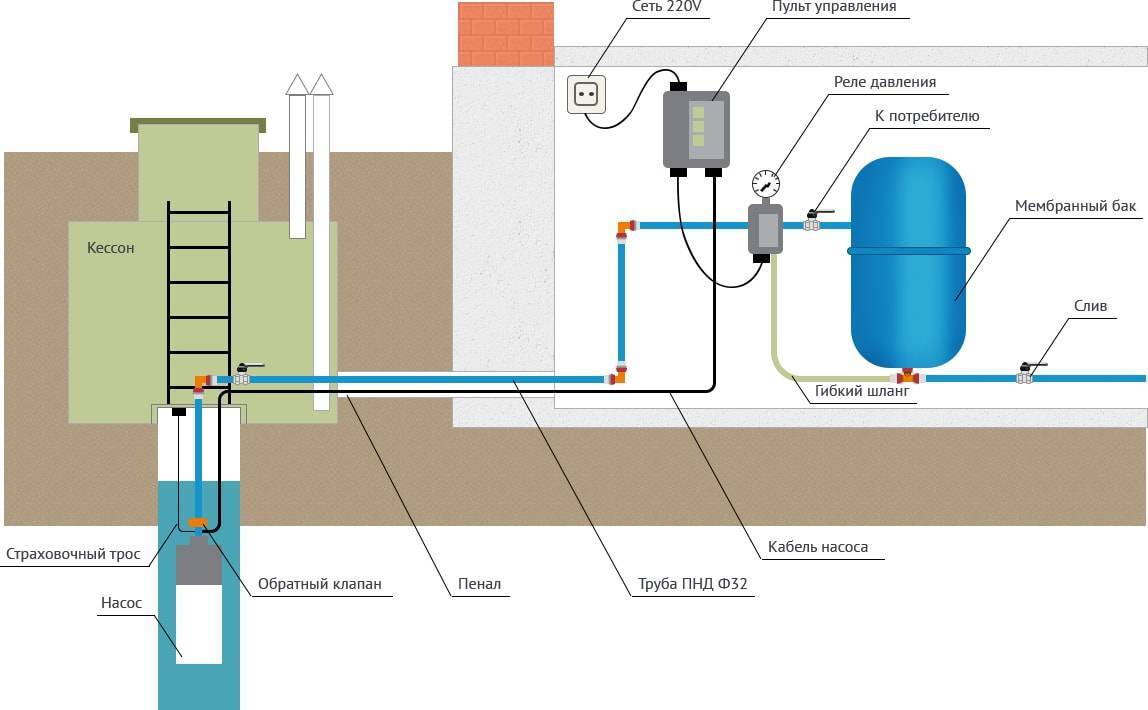
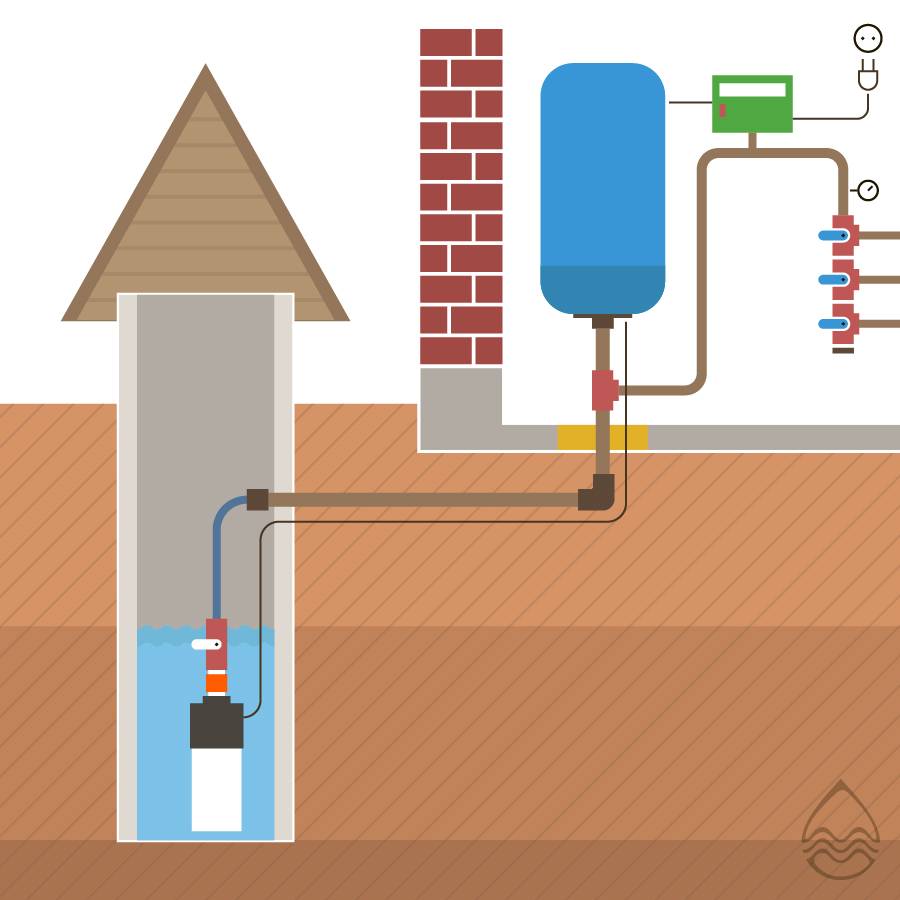

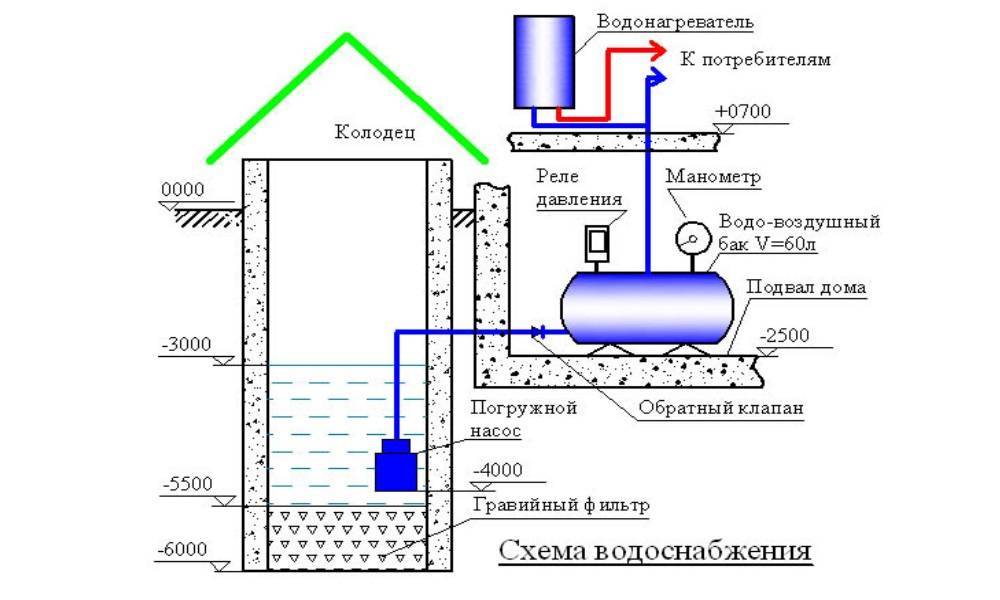
Method number 2 - with the installation of a deep pump. During this method of water supply, the task of the deep pump is to pump water from the well into the storage tank, which is located at the highest point of the house. As a rule, for the arrangement of the storage tank, a place is allocated in the attic or on the second floor of the house.
If a decision is made to place the tank in the attic, it is necessary to insulate its walls, which will prevent water from freezing in it in winter. Due to the location of the tank at a high point, the effect of a water tower is created, during which, due to the height difference between the hydraulic tank and the connection points, pressure arises, in this case 1 m of water column equals 0.1 atmospheres.
Deep well pumps are used when the distance to the water level in the well is more than 9 meters. When choosing a pump, it is necessary to take into account the productivity of the well. Despite the fact that only the rate of accumulation of the water storage tank will depend on the power of the device, it is better to be guided by the mark of the maximum water consumption in the house during the acquisition.
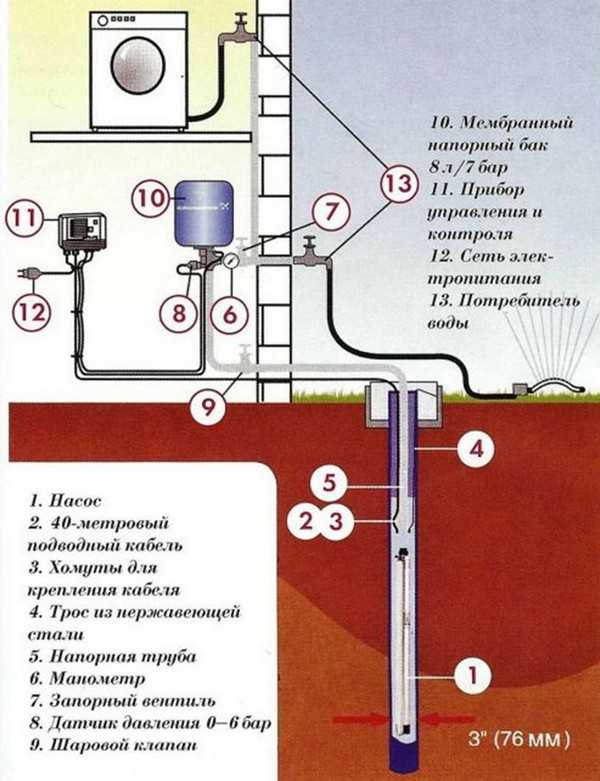
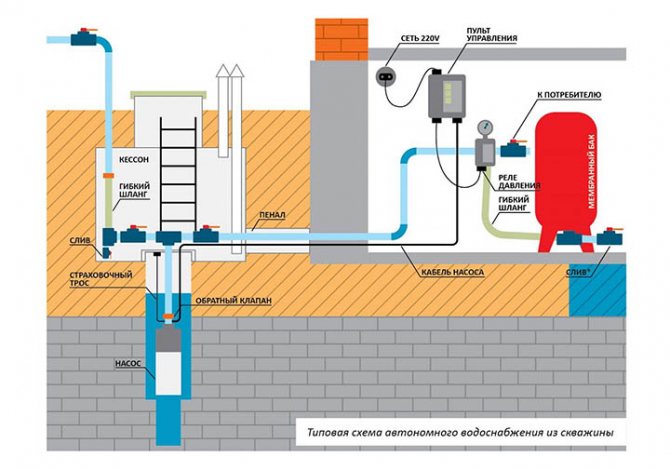
The deep-well pump, together with the pipe and electric cable, is lowered into the well, hanging it with a winch on a galvanized cable; the winch must also be installed inside the caisson. In order to maintain the required level of pressure inside the system and so that water is not pumped back into the well, a check valve is mounted above the pump.After all the elements of the system are installed, it is only necessary to check the internal wiring to the connection points, and then connect the equipment to the control panel.
Choosing a place for the well
Many believe that water in a suburban area can be anywhere in its area. There is logic in this, because indeed, it is, in fact, everywhere and the question is only in the depth of its occurrence. There are many ways to find it. They can be used individually or in combination to achieve maximum results.
The most popular methods for finding an aquifer are:
-
Research using L-shaped frames.
-
Drilling for exploration purposes is also called random drilling. The method is laborious and long.
-
Search using barometer.
-
Observation of the summer cottage at dawn or dusk - the place where the fog swirls is aquifer.
-
Visual method - in the area where there is a water-resistant layer, there will be a depression surrounded by hills.
-
The use of dehumidifiers. Silica gel is poured into a vessel with a narrow neck and corked with a coarse cloth, after weighing the container. The vessel is buried 50 cm deep into the earth for a day. Then it is weighed and the results are compared.
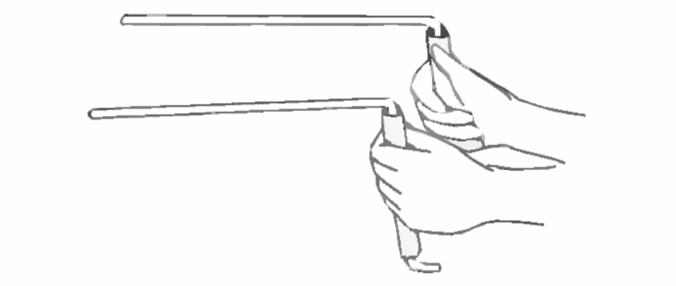
Finding water with frames
Well construction rules:
-
Sources of pollution must be at least 50 meters away from the water source;
-
If the site has an autonomous sewage system without a bottom, then the installation will have to be abandoned or the sewage system should be converted, because sooner or later the feces will fall into the groundwater, and with them into the well.
-
Water supply to a private house where there is no running water can be arranged if neither the owner nor his neighbors have sewage cesspools, manure heaps and toilets within a radius of 50 meters.
Operation and frequent system malfunctions
For the normal operation of the water supply system, the installation of the pipeline inside the building must be carried out in easily accessible places. Most often you will need to change filters and pump up air pressure in accumulator, so that these parts should be located in the maximum accessibility. Filter flasks, in the heat, often flow due to the resulting condensate, so it is necessary to provide a container for collecting water.
If you use water in the winter, and you have part of the plumbing equipped with a heating cable, then it is better not to turn it off all winter. The cables have an automatic shutdown system and consume very little power.

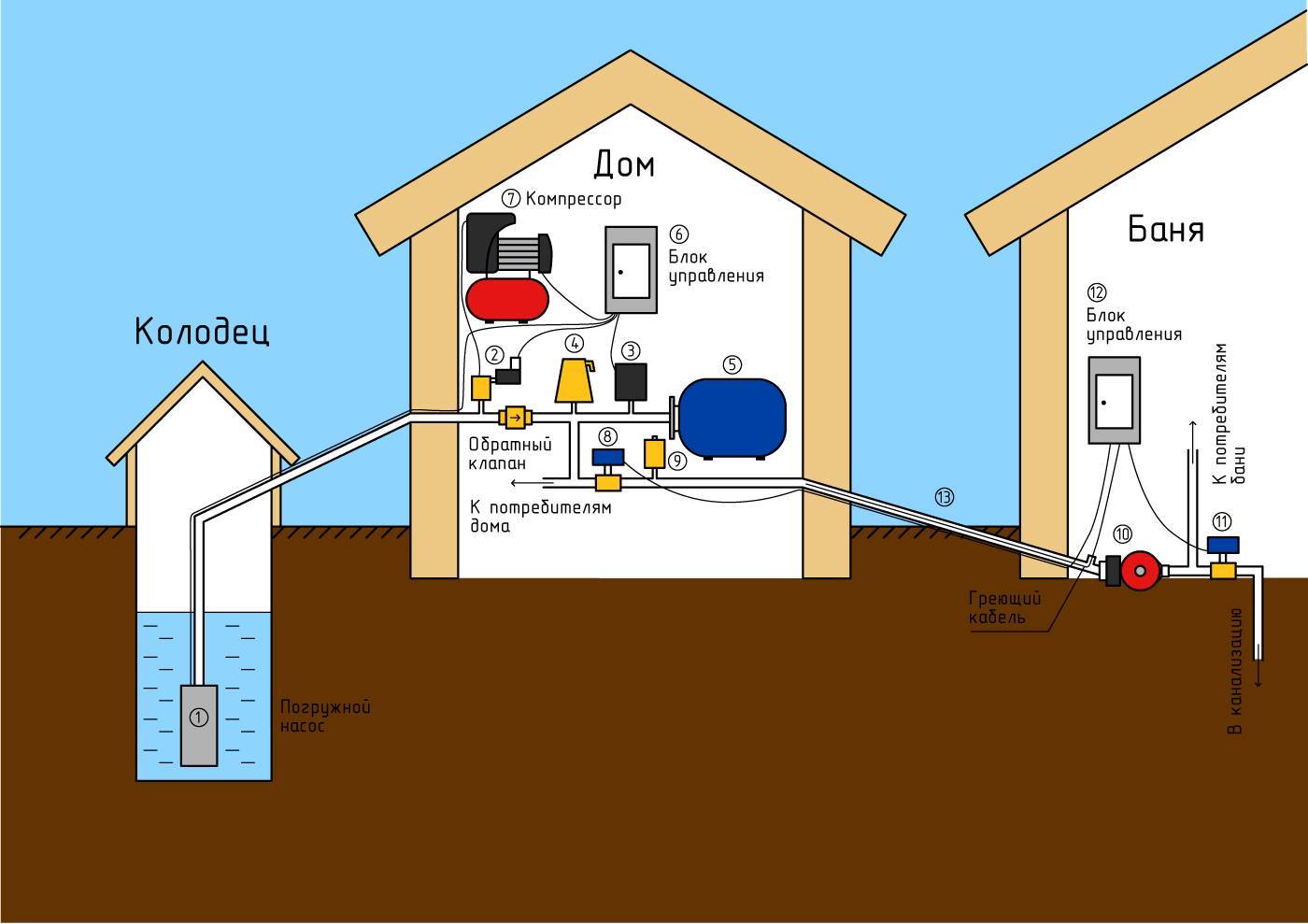
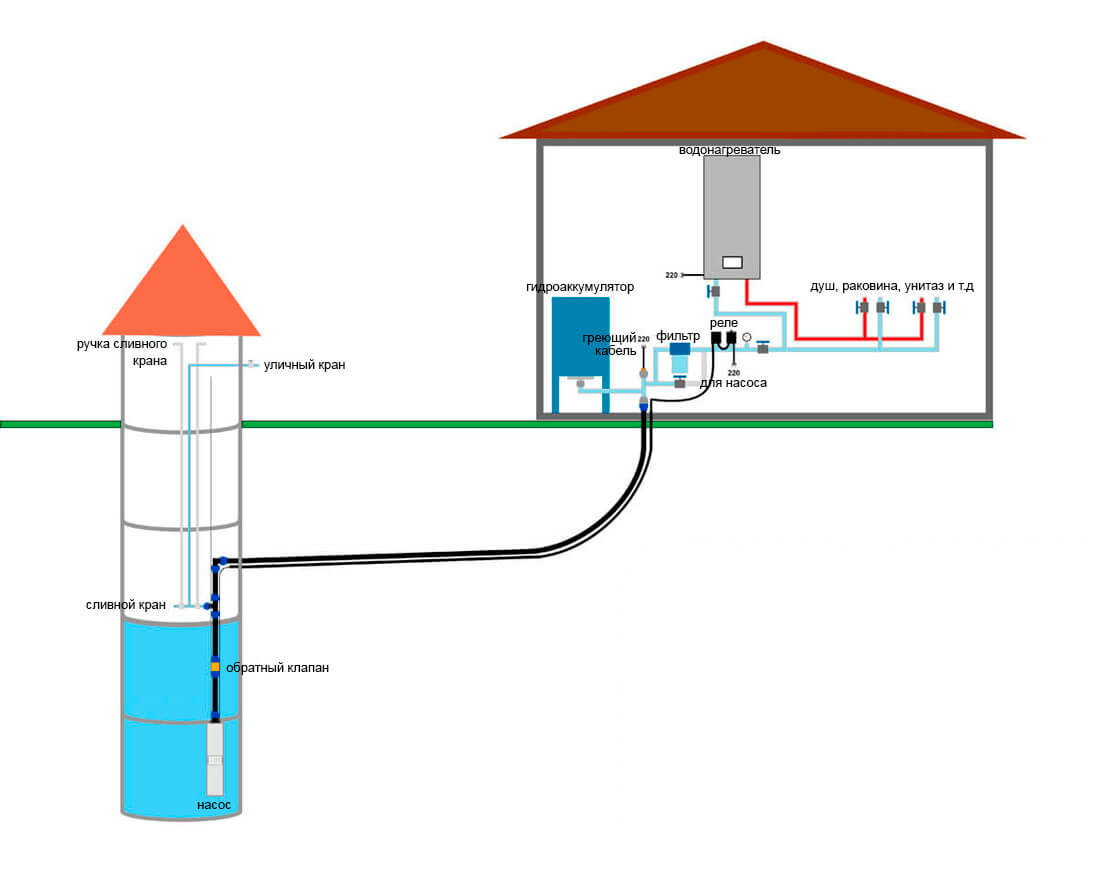

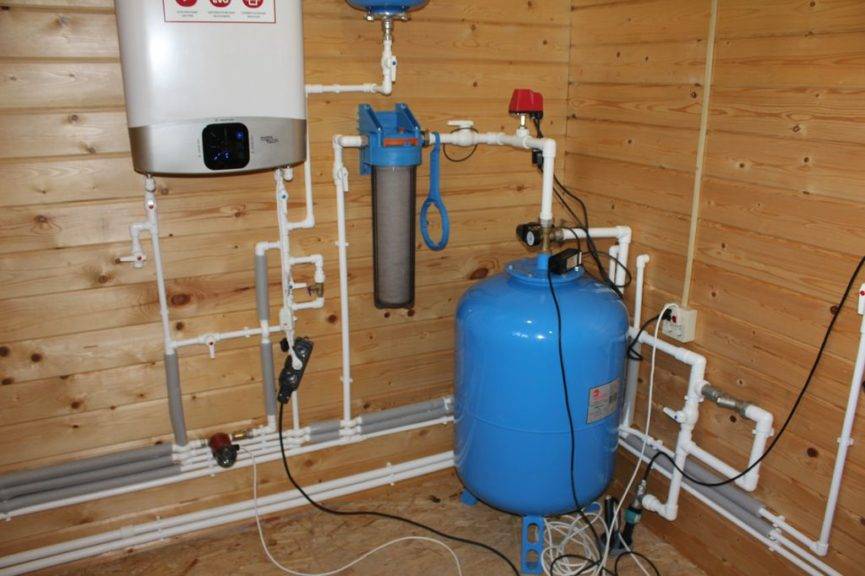
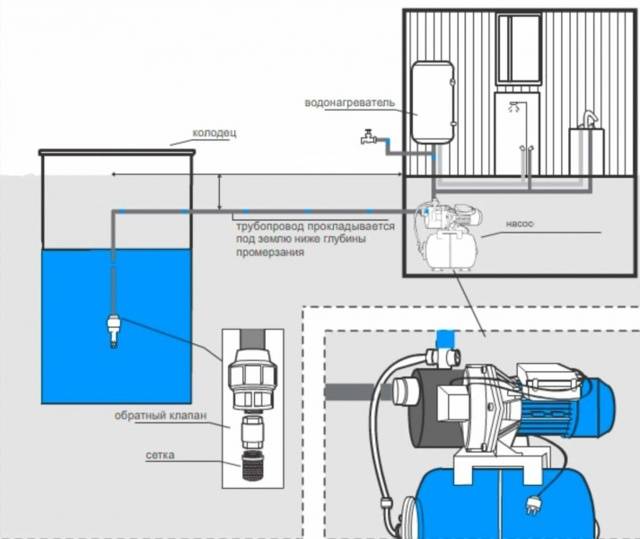
It is quite possible for the owner of a private house to create an autonomous water supply system from a well with his own hands. The recommendations discussed above are not a dogma, these are only the main framework for the construction of a water supply system.
How to deliver water to the house from a well or well?
For the owner of his own well, the most acceptable option for arranging water supply in a private house would be to use a pumping station. This system consists of a centrifugal pump, a hydraulic accumulator, an electric motor, a pressure switch, etc. With the help of a pumping station, you can set up automatic switching on and off of the pump so that there is always enough water in the hydraulic tank and at the same time it does not overflow.
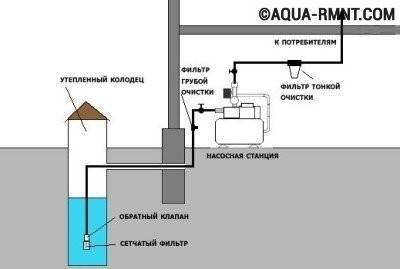
When organizing the water supply of a private house water from a well you can use a pumping station or a pump complete with a tank in which a float water level sensor is installed
A properly adjusted pumping station allows you to get a sufficiently high water pressure in the system so that you can use, for example, a hydromassage shower or other benefits of civilization available to citizens.
For a pump or pumping station, a place is prepared in the house or a separate room is built. The pipe through which water will flow is lowered into the well. The edge of the pipe, covered with a mesh filter, is placed approximately 30-40 cm from the bottom. A special pin is mounted in the concrete bottom of the well, to which a water pipe is attached to fix its position.
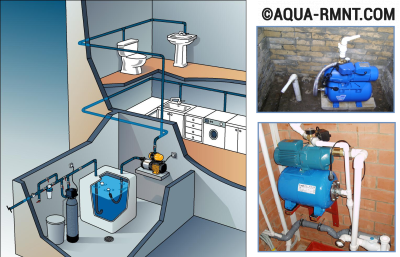
The pumping station can be successfully placed in the basement of a private house. In this case, the noise from the operating device will not disturb the residents.
When choosing a pumping station, you should focus on the characteristics of the well. A standard pumping station can lift water from a depth of nine meters to a height of up to 40 meters. However, if the well is located at a sufficiently large distance from the house, it would be wiser to use centrifugal self-priming pumpequipped with an external ejector.
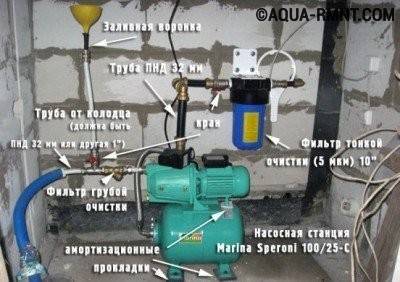
The pumping station allows you to organize autonomous water supply in a private house as efficiently as possible. At the same time, it is possible to provide the same good water pressure as in the city water supply.
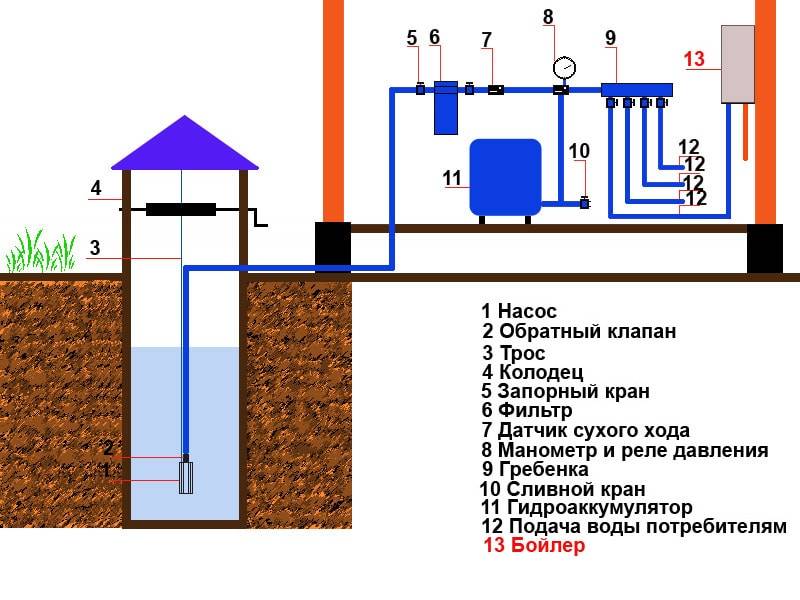
Put in front of the pump check valve and filter rough cleaning. The fine filter is placed after the pumping station. Then install pressure gauge and pressure switch. The pumping station is connected to the control panel and to the water supply system of the house.
Instead of a pumping station, you can use a submersible pump, the operation of which is controlled by a float sensor installed in the water storage tank.
In the same way, the water supply system of a private house is installed using water from a well. If the pumping station will be installed in a separate warm room above the well, then the procedure for its installation is approximately the same as when organizing the delivery of water from a well.
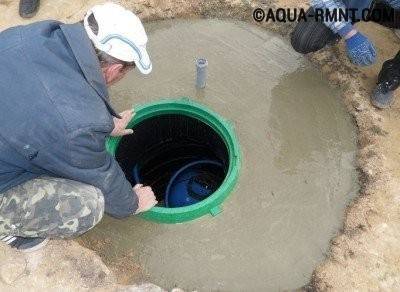
When constructing a caisson over a well, it is necessary to dig a sufficiently spacious hole, concrete the bottom, install the caisson and fix it correctly him in the ground
However, you can set pumping station and right above the well, in a special container, which is called a caisson. For this you need:
- Dig the pipe to a depth of about 2.5 meters. The diameter of the pit should be twice the diameter of the caisson.
- Lay a layer of concrete at least 20 cm thick at the bottom.
- Install the caisson in the prepared hole.
- Cut the pipe so that it rises 50 cm above the edge of the caisson.
- Dig a trench for the water pipe. The depth of the pipes is 1.8-2 m.
- Install the pump in the caisson and connect it to the well pipe.
- Pour the caisson around the contour with a layer of concrete of about 40 cm.
- After the concrete has dried, fill the remaining space with a sand-cement mixture, not reaching the upper edge of the caisson by about 50 cm.
- Fill the remaining space with soil.
- Install a hydraulic accumulator with a pressure switch, pressure gauge and other devices in the living room.
- Connect all elements of the system, connect them to the power supply and to the internal plumbing system.
After that, it remains only to check the performance of all elements of the water supply system, make sure that there are no leaks at the junctions, eliminate the identified shortcomings and enjoy your new water supply, the characteristics of which may turn out to be even better than in centralized city systems.
Possible arrangement options
The water supply system from the well can have several options. If you decide to equip it with your own hands, you should choose exactly the method that will be easier or more convenient to implement.

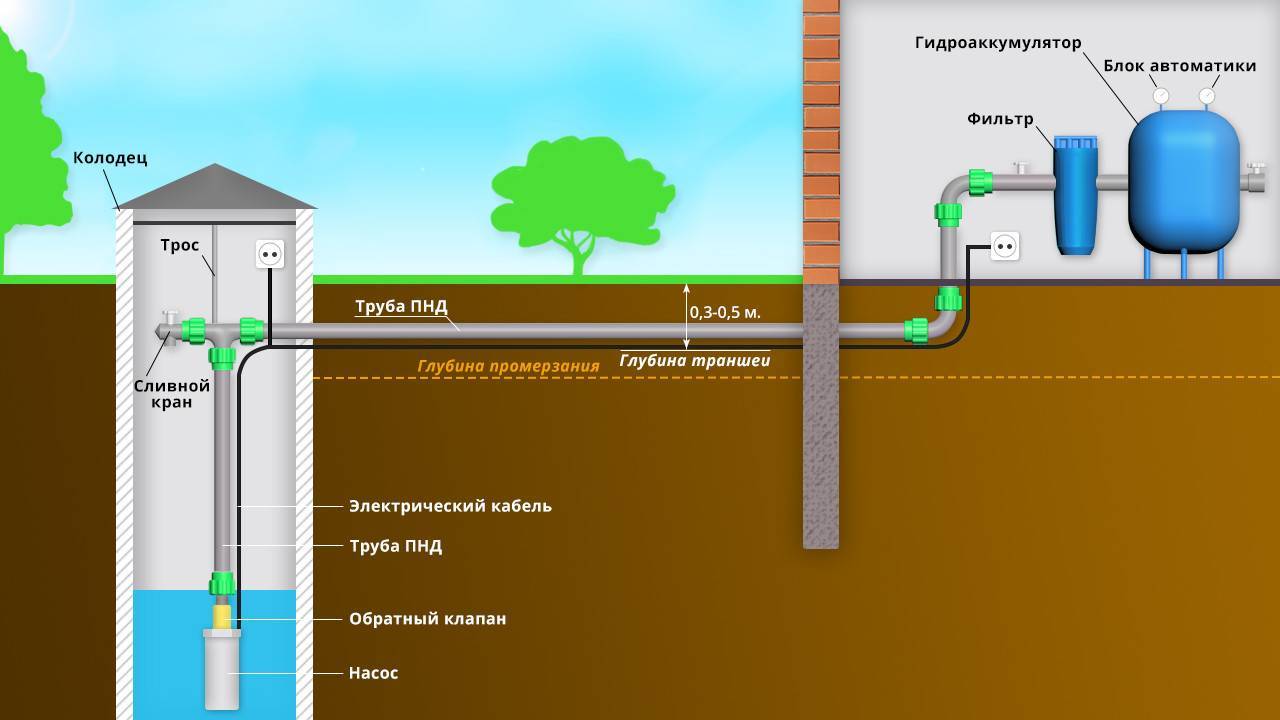
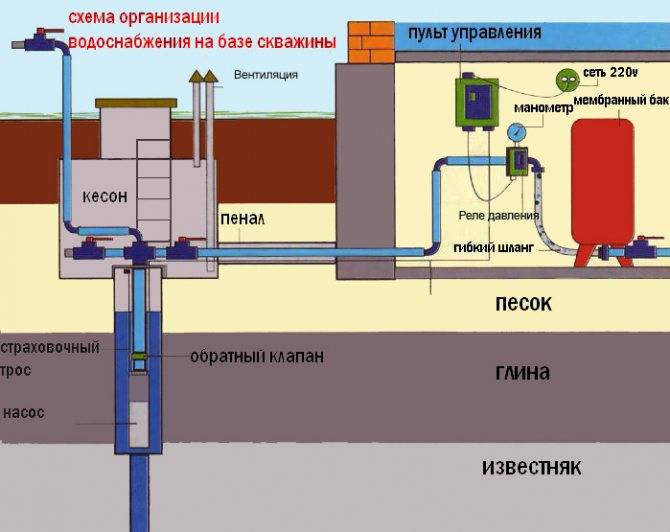


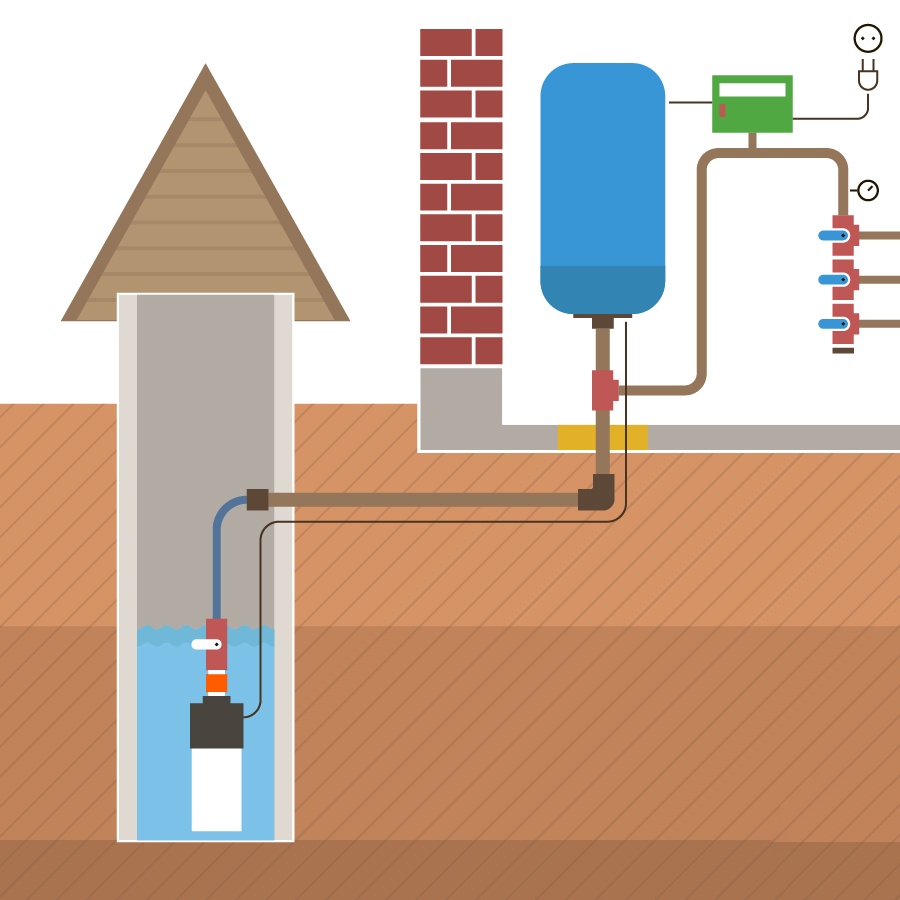
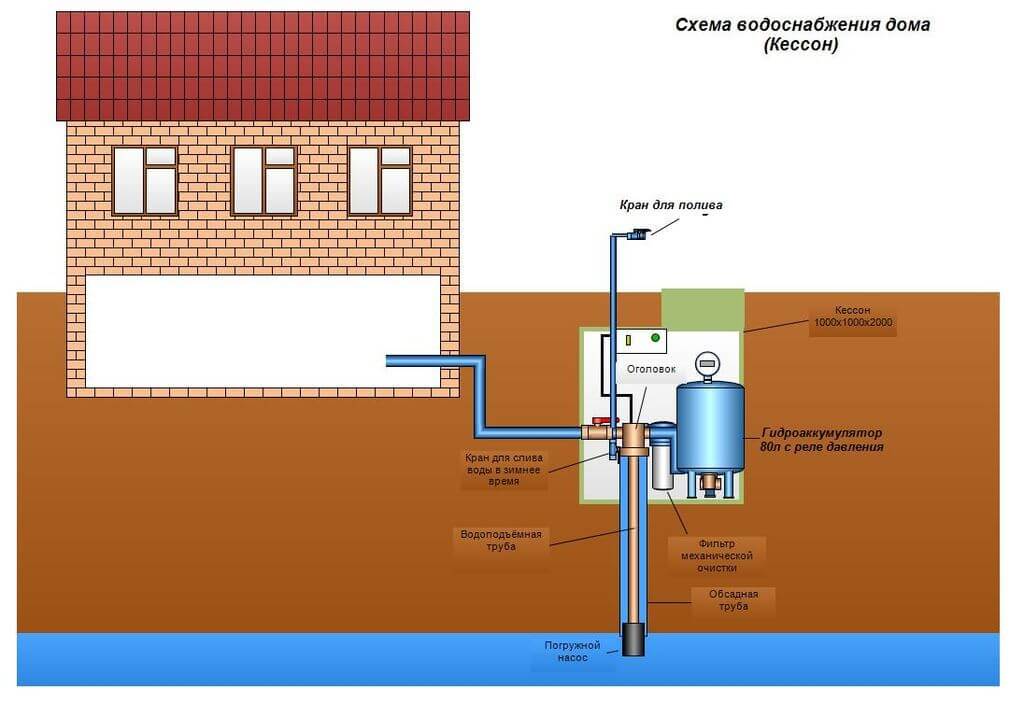
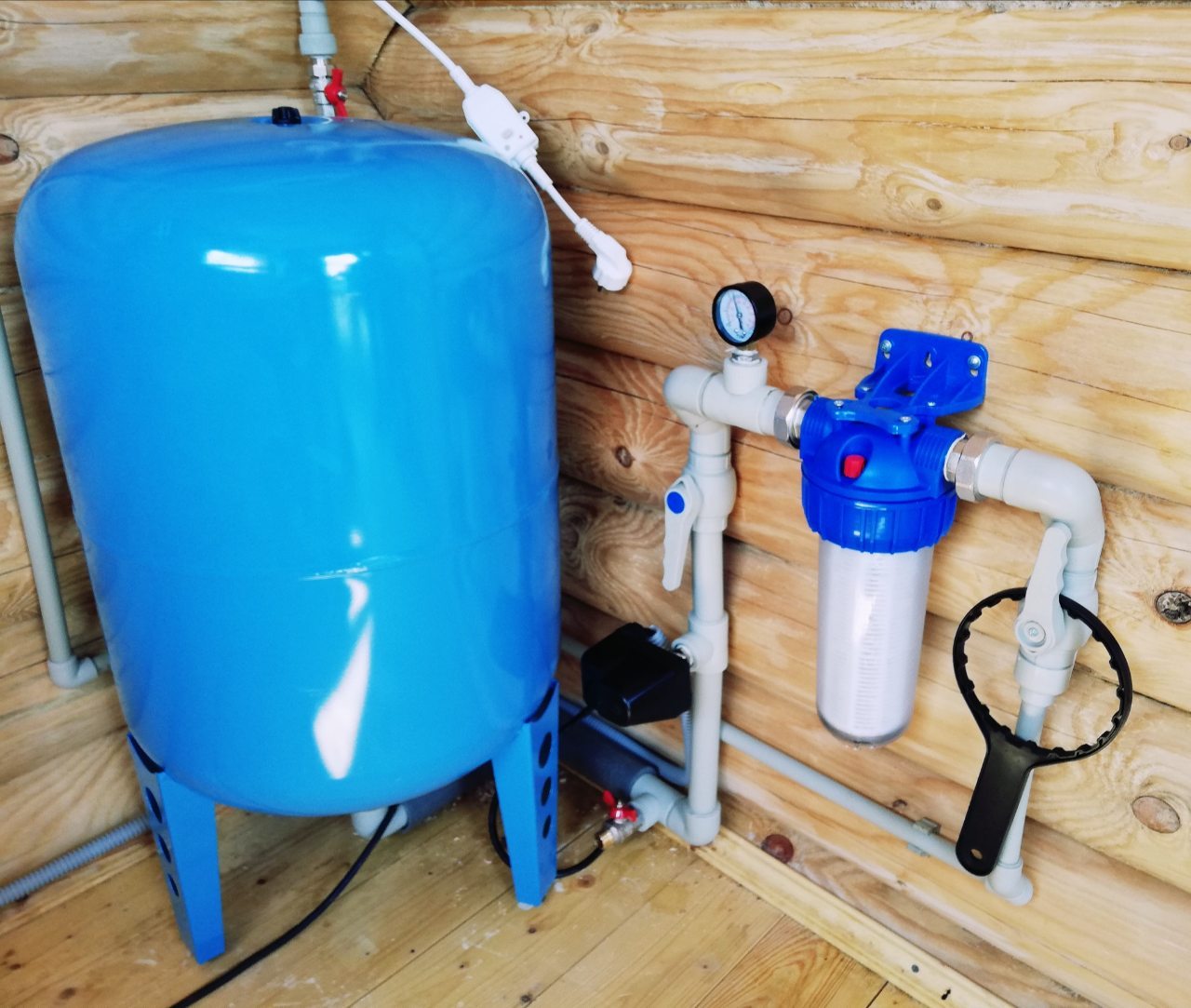
Popular water supply schemes from a well:
- With the help of a pumping station - this option assumes the presence of a device with a pump, a hydraulic accumulator and an automatic relay that controls the pump. In this case, the equipment is turned on only to fill the hydro-storage tank, if the water level in it reaches the minimum mark. After filling the tank, the device turns off, which is very convenient and does not load the system once again.
- Using a storage tank - in this case, a special container is used that receives water pumped from a well, after which the liquid enters the water supply. It is best to install such a tank at the highest point of the house (on the top floor or attic). If the device will stand in an unheated room, then the tank should be insulated, otherwise the water in winter will simply be covered with ice. You will also need to buy pumps.
The water pump can be placed both indoors and outdoors
The storage tank option is good because it allows you to create an additional water reserve, which may be needed if there is a sudden power outage. In case of such a pumping station there is no way, and you have to carry water manually.
Basic summer water supply schemes
Specific construction activities (for example, the need to dig a trench), pipe installation methods, the choice of technical equipment, etc. depend on the choice of the scheme. We must not forget that summer improvement includes communications leading to a summer kitchen, beds or garden plantings - places that are not included in the winter water supply project.
All varieties of seasonal systems can be divided into two categories: collapsible (removable) and permanent (stationary).
Demountable surface system
This design can be safely called ground, since all its parts lie on the surface of the earth. In some cases (for example, due to terrain features), pipes and hoses have to be raised above the ground.
The longest part of the system consists of interconnected pipes or hoses made of elastic materials that can withstand exposure to bad weather and ultraviolet radiation. To connect individual segments, steel or plastic fittings, coupling fasteners, adapters, tees are used.
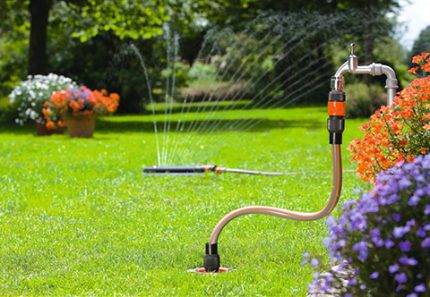
Temporary and stationary irrigation systems include the installation of hydrants and a variety of watering equipment: hoses, sprinklers, sprayers. The difference is only in the underground or ground communications
Given the demand for collapsible structures, plastic pipe manufacturers began to produce products with snap fasteners, which are fixed with a slight pressure. During disassembly, cutting at the joints is not required - the sleeves are removed as easily as they are put on.
The advantages of the temporary system are obvious:
- simple, quick installation and dismantling that do not require special knowledge;
- lack of earthworks;
- the possibility of prompt repair of malfunctions and elimination of leaks, since the entire system is in sight;
- low total cost of pipes, hoses and pumping equipment.
The main disadvantage is the need for assembly and dismantling, which are mandatory at the beginning and end of the season, but difficulties arise only for the first time. Re-installation is much easier and faster.
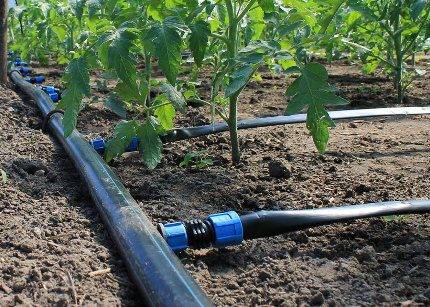
One of the popular summer plumbing options for watering the garden - drip system, consisting of a set of elastic hoses with small holes, metering the flow of moisture to the roots of the plant
When laying ground communications, it is necessary to monitor their location relative to footpaths, playgrounds, places for outdoor activities, as pipes can interfere with movement, and people, in turn, can accidentally damage the pipeline.
And another unpleasant moment is the risk of losing convenient equipment. Try to position the net so that it is not visible from the road or neighboring property.
Stationary underground utilities
Everyone who is not interested in the hassle of assembling and disassembling chooses a permanent option - a water pipe buried in a trench at a shallow depth (0.5 m - 0.8 m). There is no goal to protect the structure from the effects of winter frosts, since at the end of the season the water is drained through special taps installed at the lowest points. For this, pipes are laid with an inclination towards the source.
Ideally, during the drain, the water should go back into the well or into the drain hole equipped near it.If you forget about the drain procedure, in the spring you can run into trouble - water frozen in frost will break pipes and joints, and the water supply system will have to be changed completely.
To connect polypropylene pipes, welding with a special apparatus or fittings is used. In difficult areas, if bending is required, thick-walled flexible hoses can be used (they are intended for indoor use, therefore, to perform "street" functions, elastic fragments must be protected from moisture and insulated).
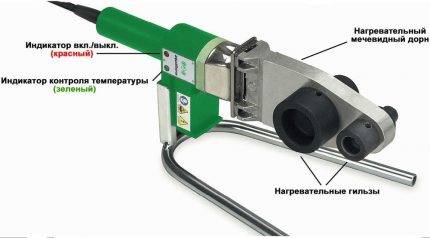 For welding polypropylene pipes, a special soldering iron is used - a device with heating elements and welding nozzles. Tight connection is possible when the working elements are heated to a temperature of +260ºС
Advantages of a stationary design:
- pipe laying and equipment installation is carried out once, only consumables (gaskets, filters) are subject to replacement;
- communications do not interfere with the movement of vehicles and people around the site, in addition, the soil is additional protection for them;
- underground pipes are difficult to steal;
- if necessary, the conservation process is fast enough.
The only disadvantage of the underground network is additional work, respectively, increased costs. If you rent equipment or invite a team of workers to dig a trench, even more money will be spent.
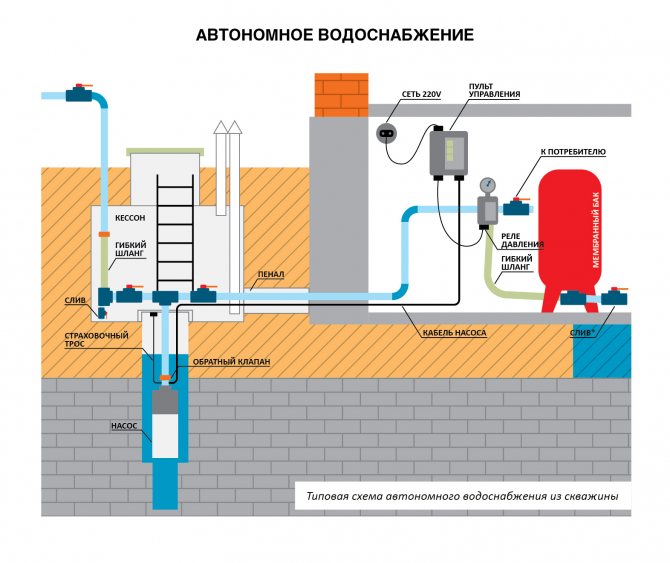
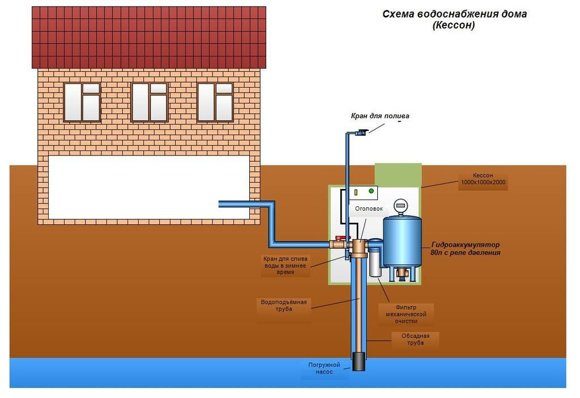


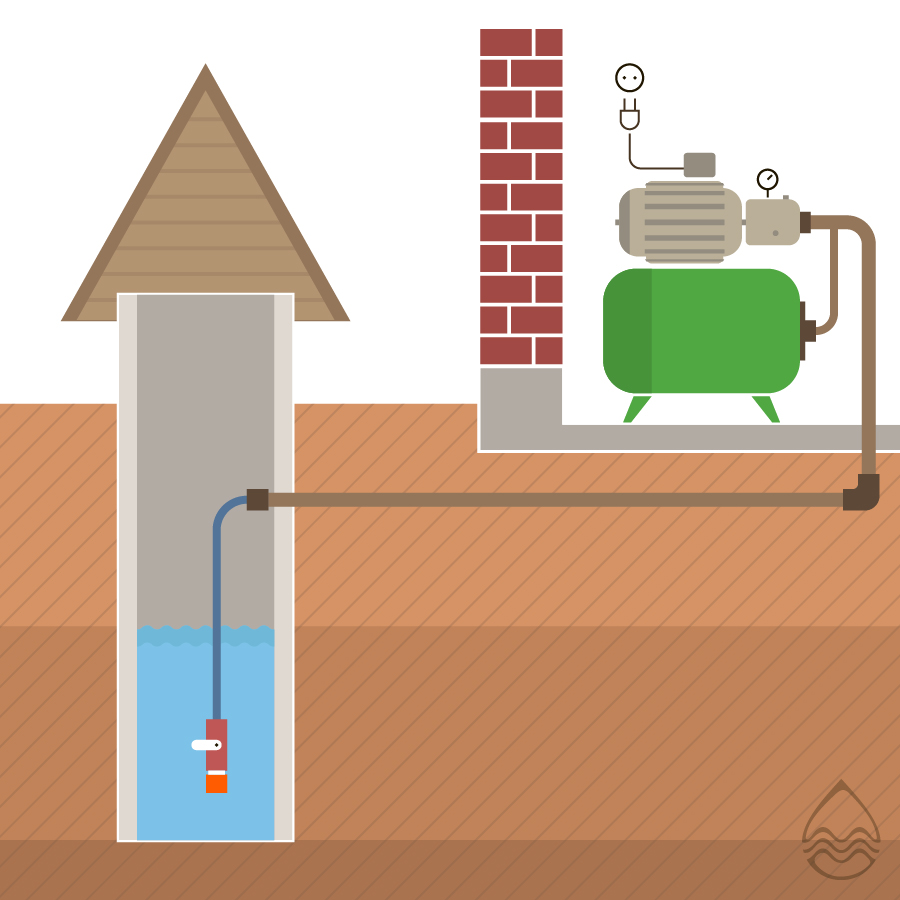
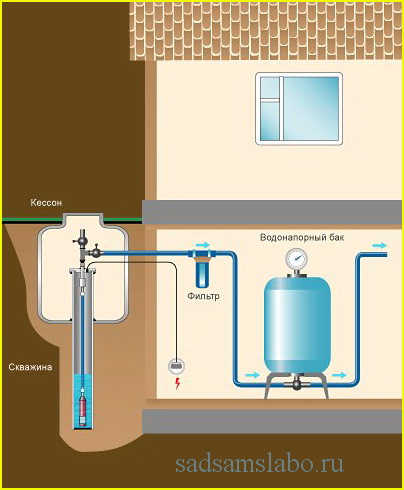
Types of pumps for a well
According to the installation method, there are two types of pumps for wells:
- superficial;
- submersible.
There are also semi-submersible pumps, which are installed in the form of a "float" on the water surface. But considering air type cooling unit and rather stringent requirements for operating temperatures that cannot be provided in the unventilated volume of the well shaft, they are not used for these purposes.
Surface (suction) pumps for water supply of a private house from a well are installed if the height of the water rise does not exceed 7-9 meters. You can increase this figure by using an external ejector, but this will reduce the performance of the equipment.
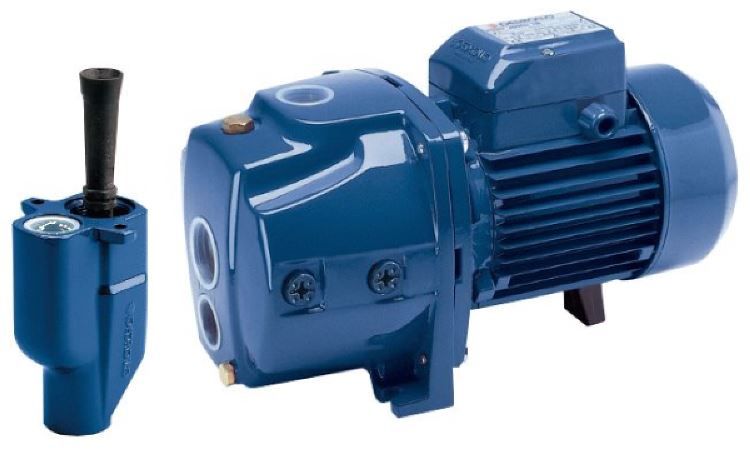
Self-priming pump with remote ejector
There are natural restrictions on operating temperatures - usually this figure starts from + 4 ° C. Therefore, a surface pump for a well for water supply at home is used either as part of a summer water supply system, or it is installed in a caisson or basement of a house (but no further than 10-12 m from the source). By the way, if the caisson is made correctly, and its “working” surface is below the freezing level, then this allows you to win an additional 1.5-2 m of water rise. But this advantage makes sense if its own pumping station is responsible for the further supply of water to consumption points.

Water supply scheme with a "boosting" pumping station after the storage tank
Submersible well pumps are capable of lifting water to a height of up to 100 m. This does not mean that there are wells of such depth, just a reserve is needed to raise water to a storage tank, which is located as high as possible, for example, in an insulated attic of a house. And the most powerful models can be used for the collective use of one source by several houses or cottages (if the flow rate of the well allows it).

Submersible well pump
When using such powerful equipment, there is no need to install another pump for water supply, since it gets from the accumulator to the points of analysis due to the constant high pressure in the system.
The well differs from other sources in its versatility - borehole pumps can also be used to supply water. They differ from wells in smaller diameter and longer length with the same other characteristics. But the price of such equipment is higher.
Water supply system
Main elements of the system
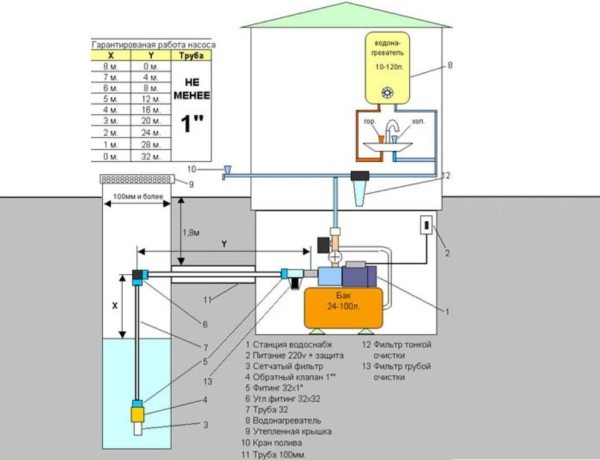
Details of the water supply system for shallow wells
As we noted above, in addition to properly installed and correctly operating water-lifting equipment, we will need many details to provide the house with water from the well.
Among them:
- The supply pipeline through which water from the well will flow to the house.
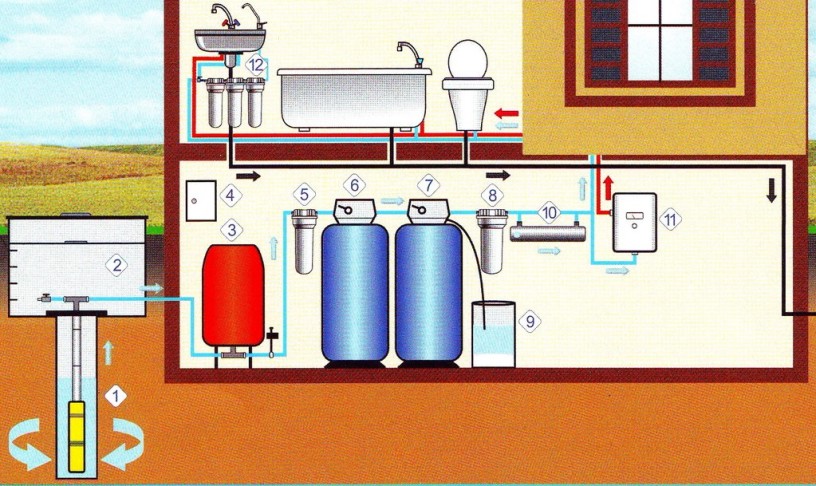
- A hydraulic accumulator, which is a water tank that maintains a stable pressure inside the system.
- A relay that turns the water pump on and off depending on the level of pressure in the tank.
- Dry running relay (if water stops flowing into the pump, the system is de-energized).
- Well filter system for cleaning and optimizing water parameters. As a rule, it includes filters for coarse and fine cleaning.
- Pipelines and shut-off equipment for wiring in rooms.
Also, if necessary, the water supply scheme from the well to the house includes a branch for the water heater. This makes it possible to provide hot water.
Pipeline laying
If you have certain skills, the system itself can be assembled by hand.
We do it like this:
- To lay a pipe from the mouth of the well to the house, we dig a trench. It is desirable that it passes below the freezing level of the soil.
- We lay a pipe (preferably polyethylene with a diameter of 30 mm or more). If necessary, we wrap the pipeline with heat-insulating material.
- We lead the pipe into the basement or underground space through a special vent. This part of the pipeline must be insulated!
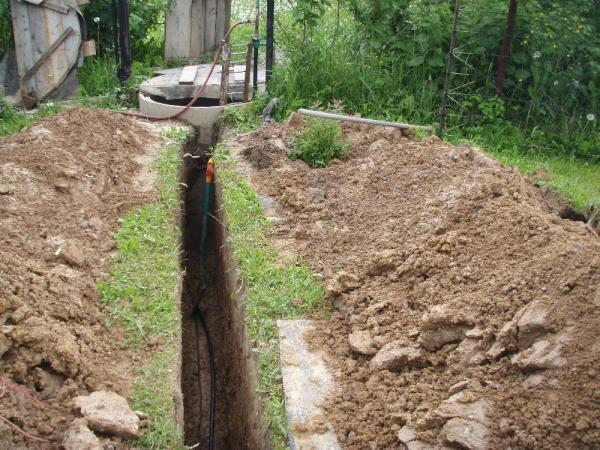
Trench from well to house
System installation
Next, we proceed to the construction of the accumulator:
- We install the hydraulic accumulator (a plastic container with a volume of up to 500 liters) as high as possible - this will provide us with a natural pressure adjustment. At the inlet we mount a pressure switch, which, when the tank is filled, will turn off the water supply.
- In some cases this is not enough. Then we additionally install an automatic pumping station - a complex of several relays, pressure gauges and a membrane receiver tank.
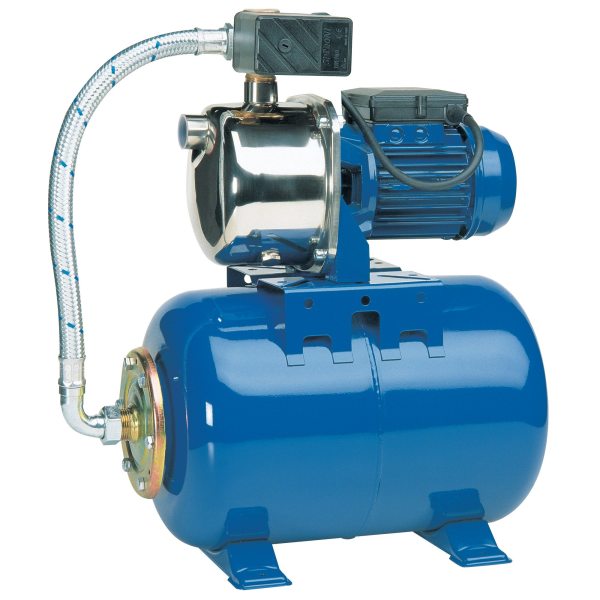
Pumping station with a receiver that can be used instead of a hydraulic accumulator or together with it
The receiver, equipped with a separate pump, provides a smooth change in pressure in the accumulator, which has a positive effect on the performance of all systems. Without this part, the downhole pump motor starts up with each turn on of the crane, which, of course, leads to its early wear.



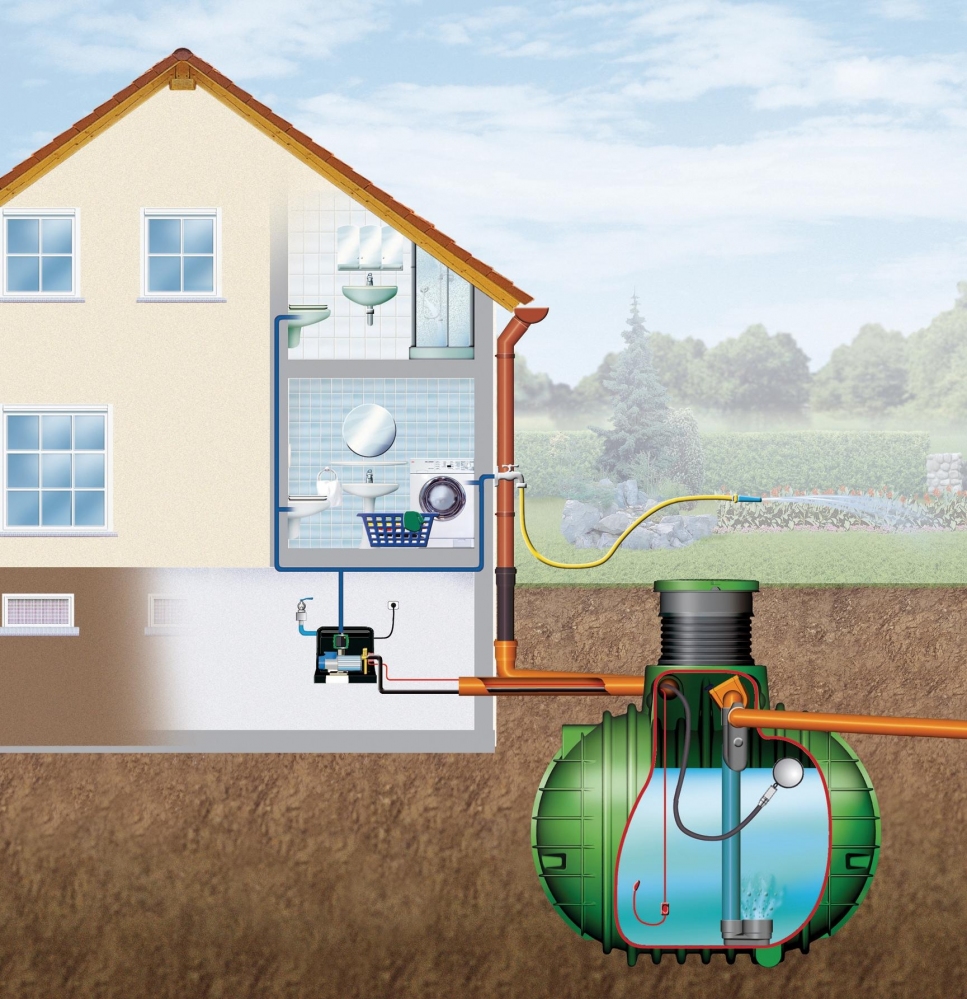
- After assembling the system from a hydraulic accumulator and a pumping station, we proceed to the installation of piping. For it we use polyethylene pipes. When water supplying a cottage or a country house, a diameter of 20 mm is enough.
- We cut pipes using special devices. To connect them, we use a soldering iron with a set of bushings.The use of this technology allows to achieve maximum tightness.
- Alternatively, steel or multilayer pipes can be used. They are distinguished by greater mechanical strength, but it is more difficult to mount them. Yes, and detachable connections are still inferior in tightness to soldered seams.
We bring the pipe wiring to the points of consumption and attach it to the taps. To ensure safety, we fix the pipes on the walls with clamps.
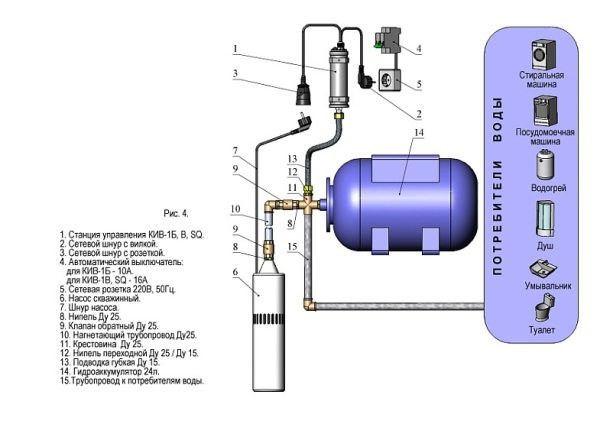
The most common scheme
Separately, it is worth taking care of the drainage system.
When designing it, it is important to place a cesspool or septic tank in such a way as to completely eliminate the filtration of runoff into aquifers. First of all, this applies to sand wells, which are characterized by shallow water.