- Instruments and devices used in summer water supply systems
- Plumbing
- How to do piping
- How to provide hot water
- Storage tank - purpose and placement options
- Water supply organization
- Well device
- Plumbing
- Pressure switch
- How it works
- A special case
- Which pipes are suitable
- HDPE products
- PVC materials
- Polypropylene Products
- Types and methods of water supply of a private house
- Centralized water supply at home
- Connecting the house to the central water supply
- Autonomous water supply at home
- Using the container (water tank)
- Using the automatic water supply system
- 1. Water from open sources
- Device
- The principle of operation of an autonomous water supply system
- Well water supply
- General requirements for the area for drilling an artesian well:
Instruments and devices used in summer water supply systems
To make the water supply system more practical, use the following devices:
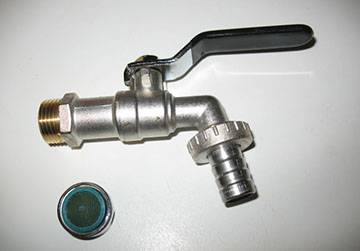
- The union for fast accession of a hose to the crane. On the one hand, it has a spring grip, on the other, a “ruff”, which is inserted into the hose.
- Corrugated hoses that take up very little space when folded.
- Hoses and special accessories for drip irrigation.
- Sprayers and watering guns with special couplings (aquastop) that automatically shut off the water when replacing the watering device (the tap does not need to be closed).
- Irrigation and watering heads.
- Devices for organizing automatic irrigation - a timer or soil moisture sensors.
If there is no centralized water supply near the site, and it is planned to use a well or a well as a water source, a pump will be needed.
Plumbing
How to do piping
Water supply at home can be based on any source, but the efficiency of the system depends on how correctly we lay the pipes. For a country house, products made of metal-plastic, polypropylene or polyethylene are usually used, which are connected either using fittings or by welding.
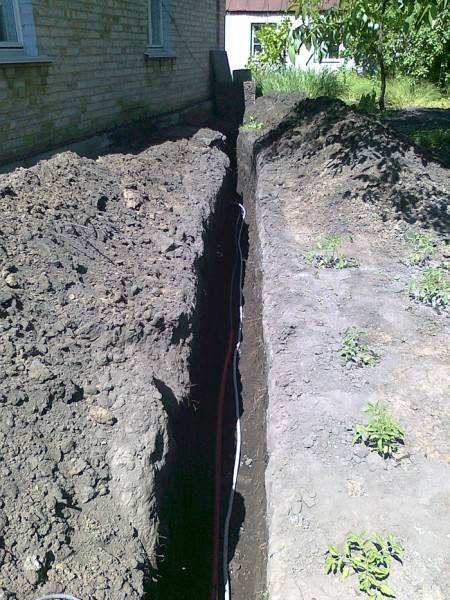
Trench with pipes
The general algorithm for laying pipes includes the following operations:
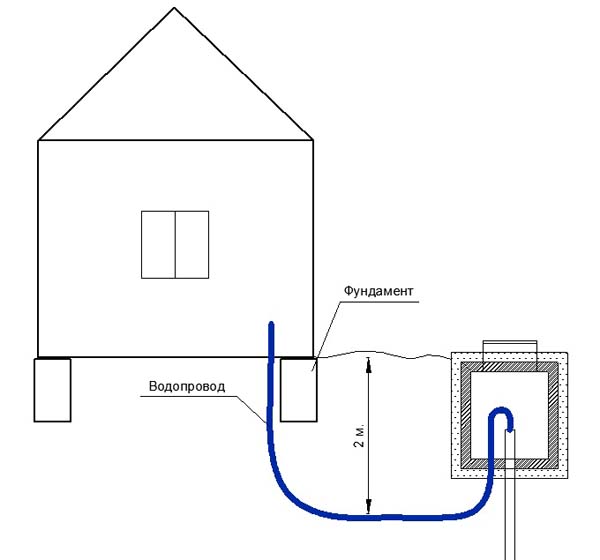
- Supply pipe installation. From the house to the pit, we dig a trench with the head of a well or a caisson with pumping equipment. The depth of the trench should be from 1.5 to 2 m, which will prevent the water pipe from freezing in winter.
- Registration of entrance to the room. We make a hole in the foundation or plinth, into which we insert a metal sleeve with a diameter greater than the diameter of the pipe. Through the sleeve, which will provide protection against deformation during subsidence of the building, we lead the pipe into the room. Carefully insulate the hole.
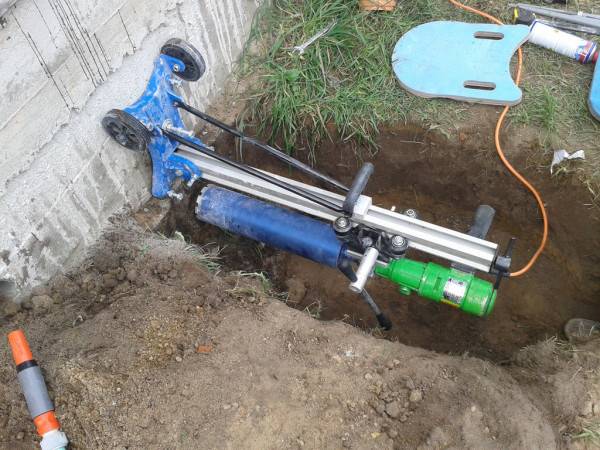
Drilling a hole in the foundation
- Preparing for plumbing installation. On the walls we apply markings for laying pipes. In case of open installation, we fix brackets on the bearing surfaces on which the pipes will be fixed.If hidden installation is planned, we make grooves in the walls using a wall chaser or a puncher with a chisel attachment. We also install brackets for pipes in the strobes.
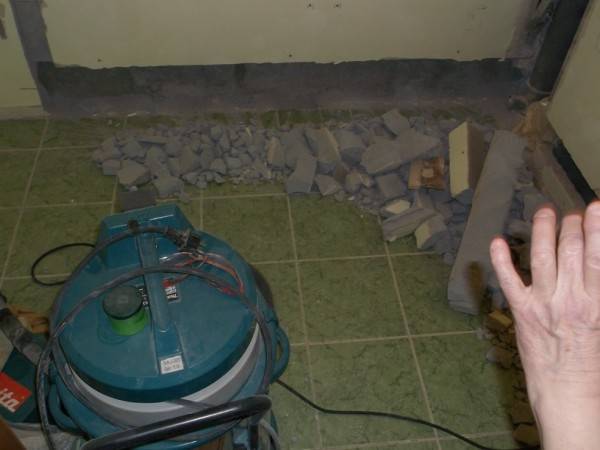
Photo strobe for hidden gasket
- Plumbing connection. At the entrance to the house, we install a ball valve, to which we attach a collector. We connect the pipes of the water supply system to the collector with our own hands, which we divide into several circuits. This installation scheme allows you to optimize the pressure: when one tap is opened, the pressure in other areas will not drop.
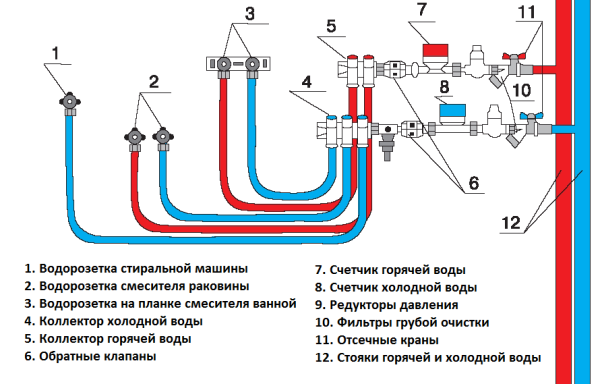
Collector Wiring Diagram
- System assembly. We connect metal-plastic pipes to each other using press fittings. We mount polyethylene and polypropylene products by welding, using a special soldering iron for connection. We fix the pipes on the brackets (open or in strobes). We connect stop valves, plumbing fixtures, faucets and other points of consumption.
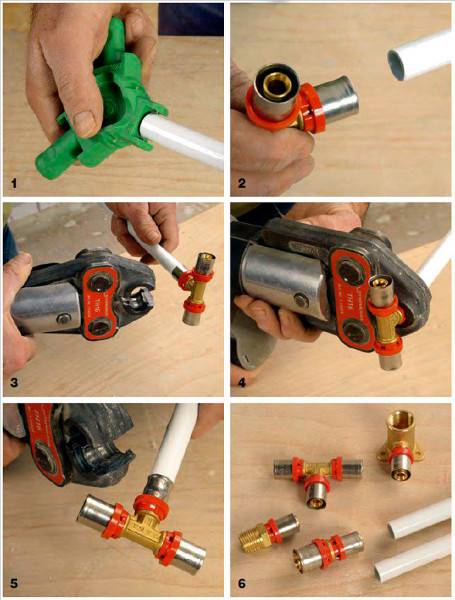
Installation scheme using press fittings
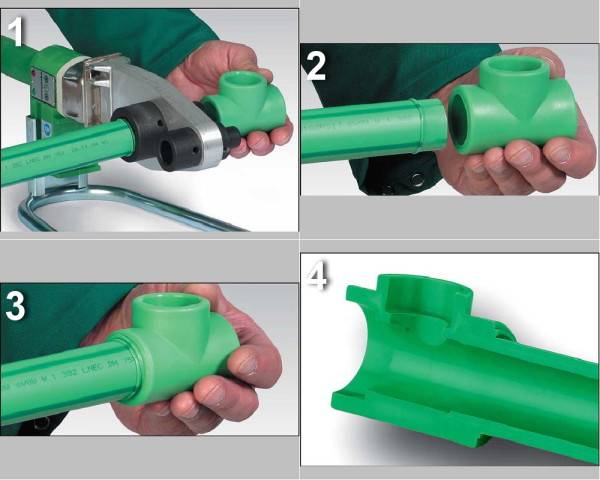
Scheme for soldering polypropylene pipes
Before sealing the strobe and performing finishing work, it is advisable to test the system. During the test run, we check the quality of the pipe connection, the operation of the control automation and the operation of the pump that pumps water from the well or well.
How to provide hot water
To ensure the proper level of comfort, it is worth considering the arrangement of a hot water supply system.
In order to be able to wash, wash dishes and take a shower with hot water, we can use a variety of devices:
- Hot water boilers - gas or solid fuel. They can be either single-circuit (only for heating water) or double-circuit (hot water supply + heating).To use the system, a separate pipe with cold water is diverted from the collector, connected to the boiler, and a separate hot wiring is already carried out from the boiler.
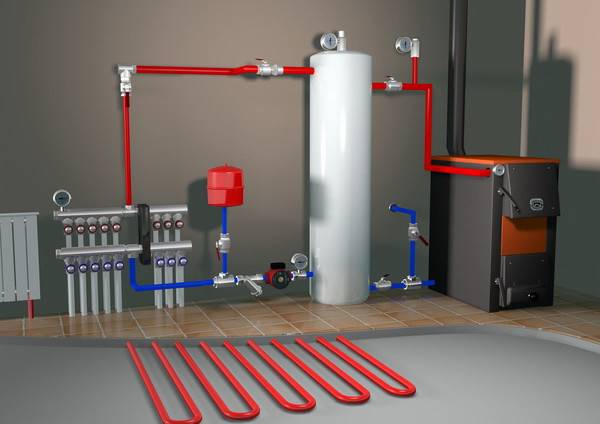
Heating and hot water supply system based on solid fuel boiler
- Storage water heaters. Such a heater is a container from 50 to 100+ liters, inside of which a heating element is located. Water enters the tank, is heated to the desired temperature, after which the heating element is turned on only to maintain the desired degree of heating. As you use the tank is replenished.
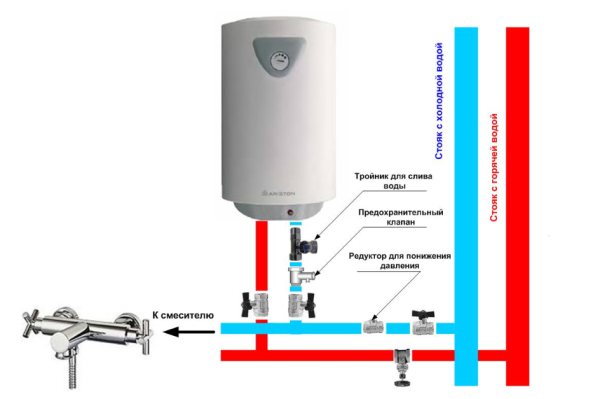
Scheme of installation of storage water heater
- Flowing water heaters. They are used either in the smallest country houses without a shower cabin, or in large cottages in separate sections of the piping. The flow heater is mounted on a cold water pipe directly in front of the point of consumption. Heating occurs when the liquid passes through the body of the device with an electric or induction element.
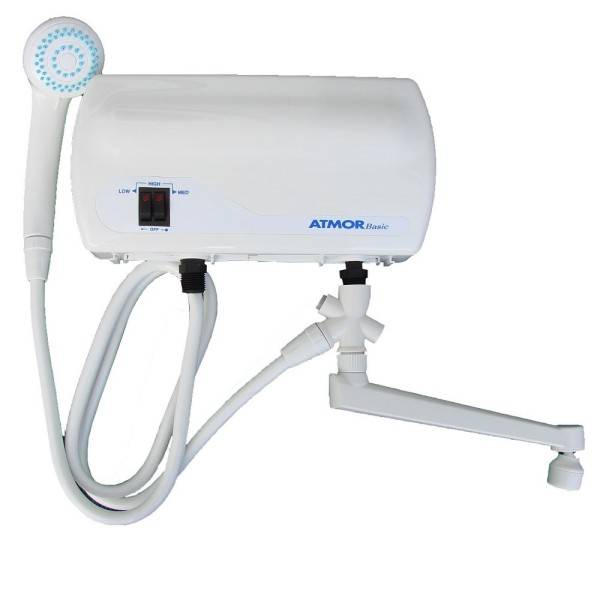
Flow heater
As a rule, a water heating boiler is installed in a house that is used throughout the year. Storage and flow devices are suitable for summer houses, as well as for buildings in which hot water supply was installed after the heating system was installed.
Storage tank - purpose and placement options
Apart from the cost of the well itself, the pump is the most expensive element of the autonomous water supply system. In fact, this is an electric motor, and for it the most “extreme” mode is start-up. Frequent stops and starts lead to a decrease in resource.


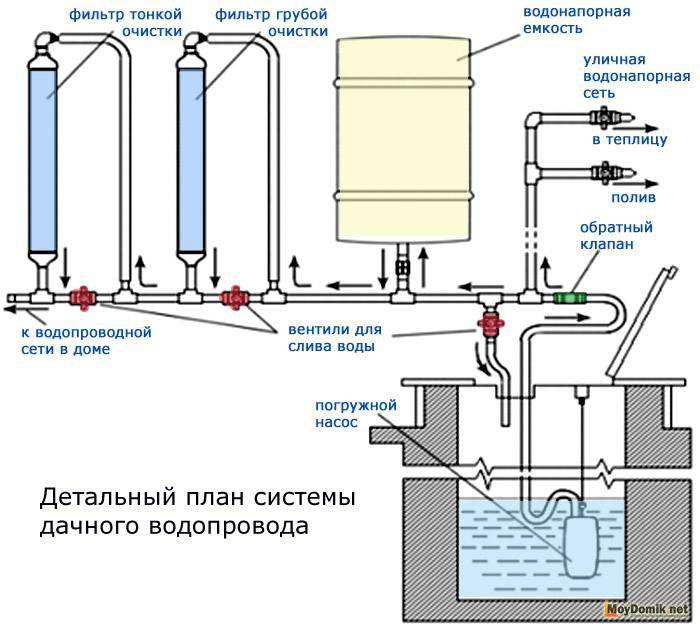
To reduce the number of operations and not turn on the pump every time the tap is opened, a storage tank is used.It accumulates an "operational" supply of water, and the automation turns on the pump when the level drops to the minimum mark and turns it off when the maximum is reached. To do this, you need a float switch (configured for two levels) or a pressure sensor that will control the start of the pump. Moreover, the control can be built on the principle of a frequency-controlled electric drive, with a smooth start and stop of an asynchronous electric motor.
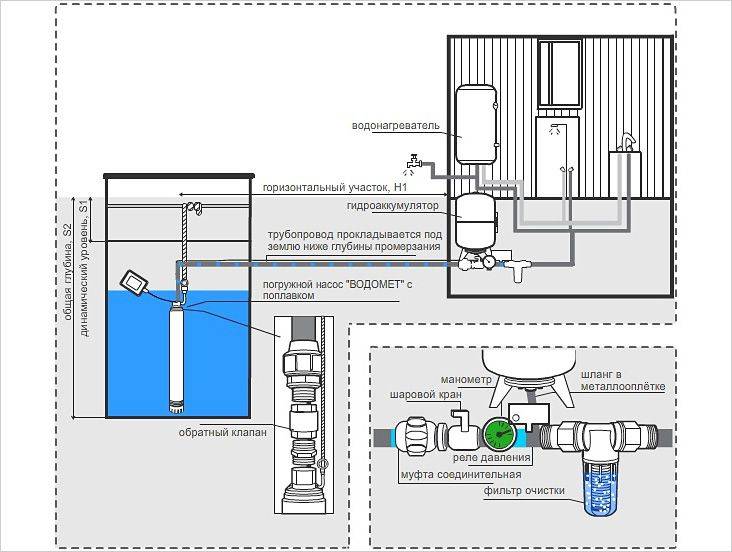
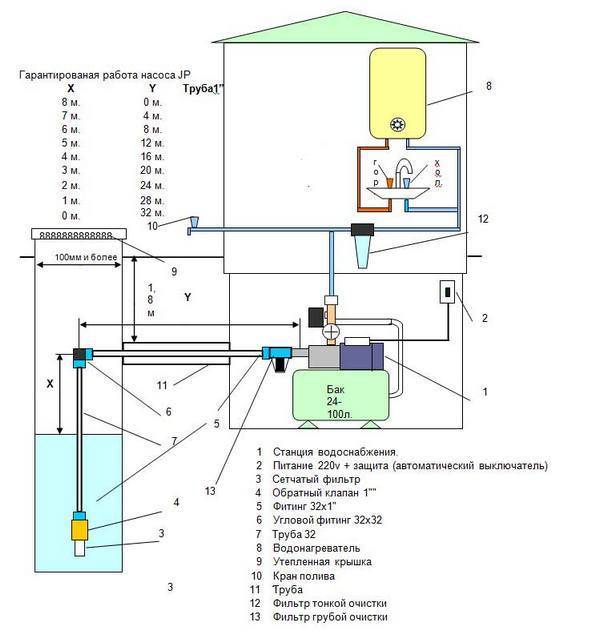
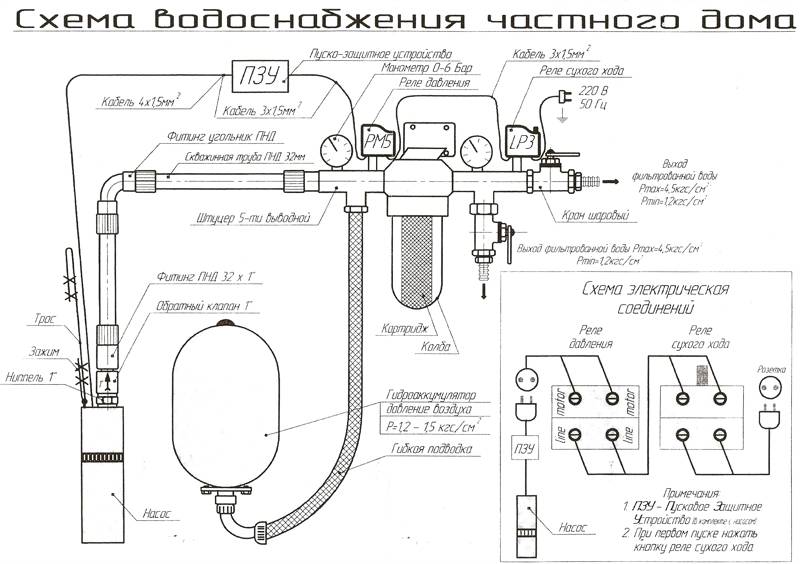
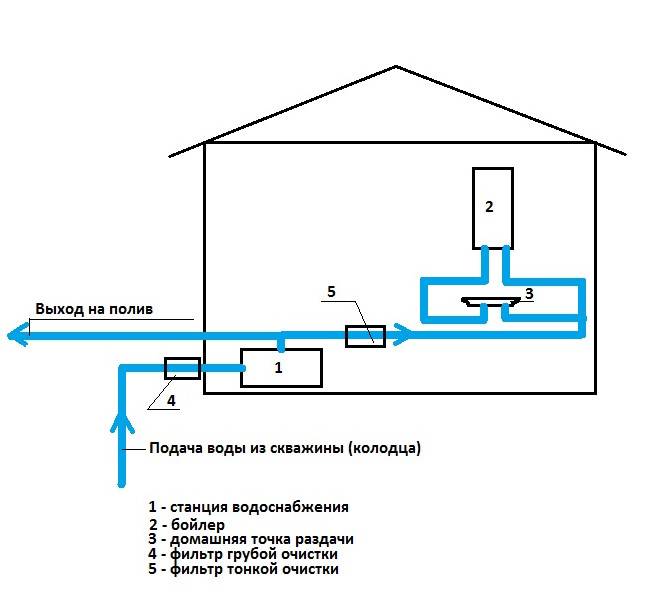
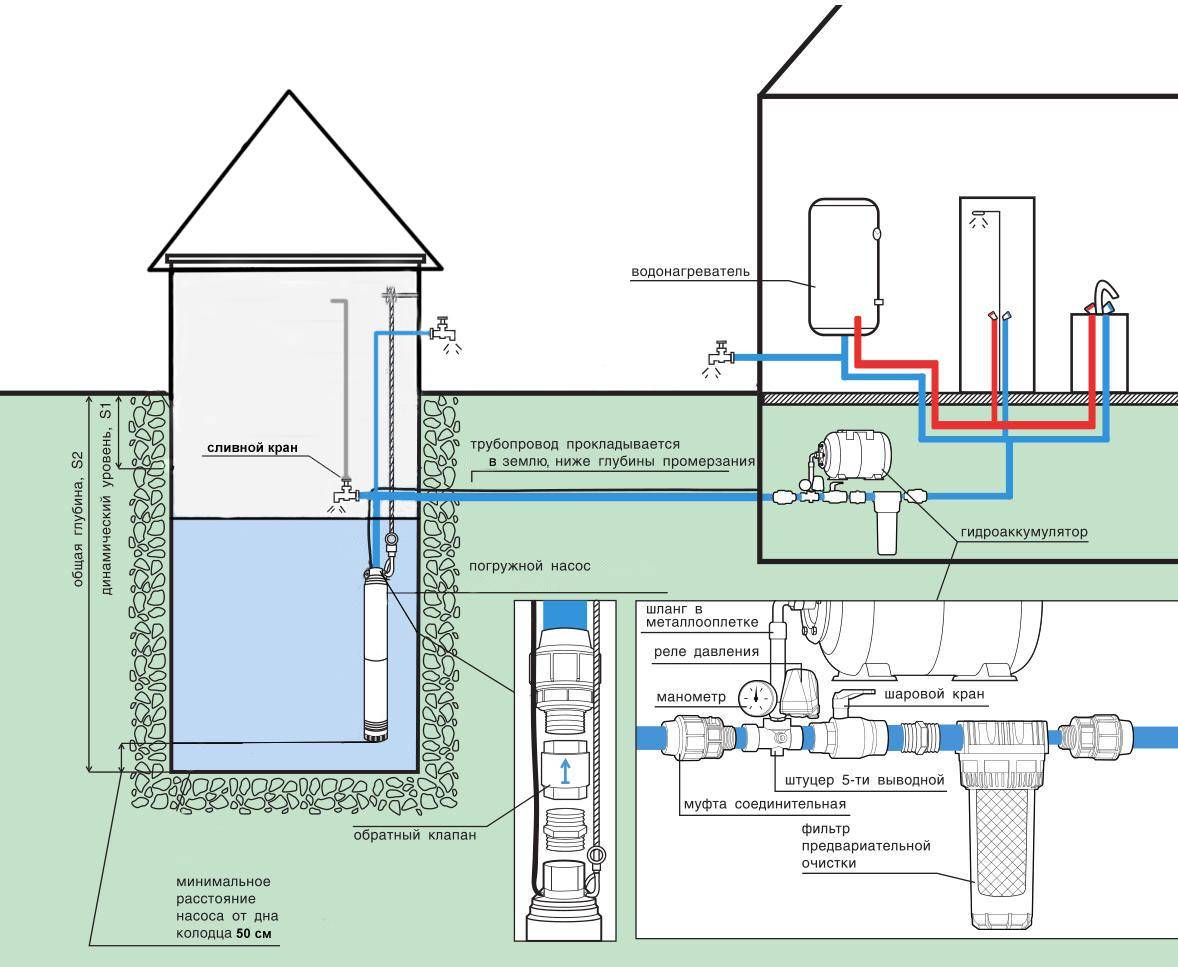

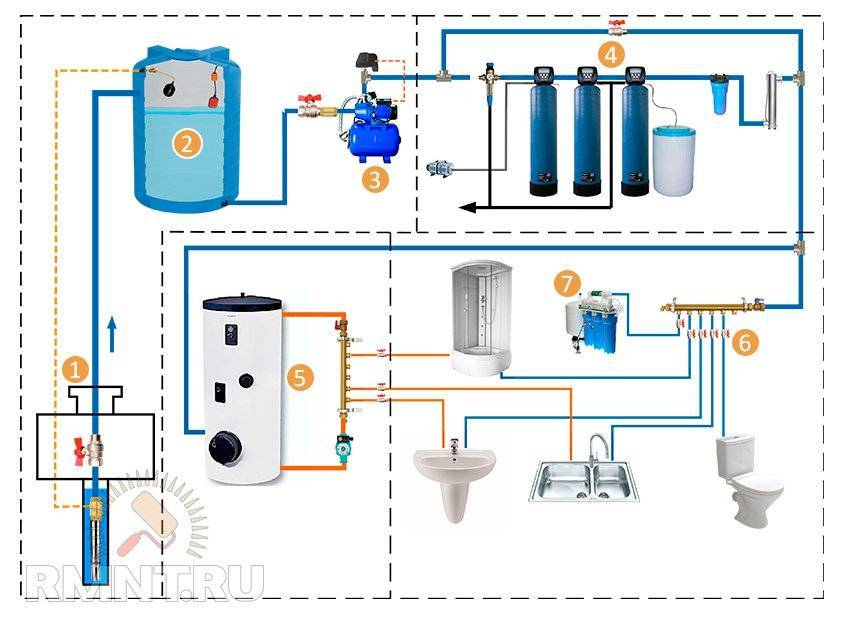
Scheme of the location of the storage tank on the same level with the head of the well. 1. Caisson. 2. Well. 3. Storage capacity. 4. External plumbing, laid below the freezing level. 5. Pumping station. 6. Internal plumbing
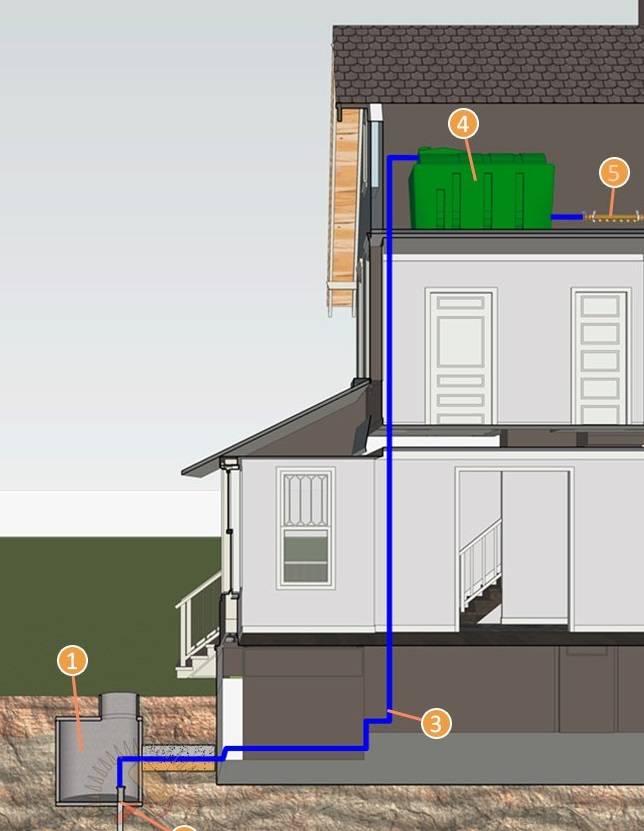
Scheme of the location of the storage tank in the attic. 1. Caisson. 2. Well. 3. Internal plumbing. 4. Storage capacity. 5. Internal plumbing
In the first case, to supply water, consumers need another pump, or rather, a pumping station, which turns on when the tap is opened and the pressure in the pipe decreases (there is a check valve and a pressure switch in the control circuit). The pressure in such a system is consistently high, but the operation of the internal water supply will depend on the mains.
In the second case, the water supply to the points goes by "gravity", but the water from the head will have to be raised a few more meters, and this is an additional load on the submersible pump. In addition, the pressure in the system will be low and depend on the water level in the tank.
Water supply organization
Proper organization of the water supply system of a country house includes the following steps:
- drafting a project - in it it is necessary to calculate the required performance, determine the points of consumption and draw up a water supply scheme;
- well drilling;
- laying of water pipes;
- connection of the pump and installation of additional equipment.
Before you start drilling, you need to correctly determine the location of the source. This is influenced by several factors - both geological and operational. You can read more about the rules for choosing a place in the article "How to determine a place for drilling a well."
For drilling, there are several technologies:
- shock-rope method;
- screw method;
- hydraulic drilling;
- rotary method;
- driving drilling.
The method of how to make a well in the country with your own hands is selected based on the type of source, the chosen location and geological conditions. Details about all existing methods are written in the article "How to drill a well for water".
Well device
The source for water is not just a hole in the ground. In fact, this is a complex structure that consists of the following elements:
- casing pipe - protects the source from soil collapse and serves as the main line for water supply, more details about the types of casing strings can be found in the article “Pipes for a well”;
- caisson - is a plastic or metal container that is installed in the upper part of the casing. It protects the source from freezing and serves as a place to install the necessary equipment;
- head - a cover for the casing pipe, a pump is suspended from it, and it also protects the pipe from dirt;
- pump - installed in the casing and pumps water into the plumbing system.The model is selected based on the dimensions of the casing string, you can learn about them from the article " Well dimensions".
Well device for a private house
One of the important stages in the arrangement of the source is the quality of the water. Therefore, immediately after drilling, you need to take a sample for analysis to the laboratory. And based on the results, a water purification system from a well for a private house is selected. This is a very important point in the organization of the water supply, because. For each type of sources, their pollution is characteristic.
Plumbing
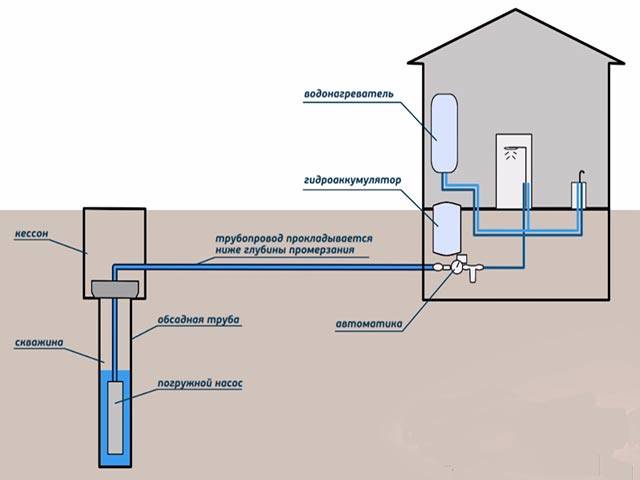
If year-round use of the well is planned, the pipes must be laid in trenches with a depth below the freezing level. In this case, their additional insulation will not be superfluous.
The street water supply system can be made from the following materials:
Naturally, it is better to choose plastic pipes - they do not corrode, and deposits do not form on the inner walls. In addition, they are much easier to mount than metal ones.
In the house, plumbing is carried through the foundation - this protects it from freezing. And it is connected to the casing pipe either through a caisson or using a downhole adapter.
Also, along with the pipe, an electrical cable is laid to connect the pump. It must be packed in a special corrugation so that there is no contact with the ground.
Entering the water supply into the caisson
Pressure switch
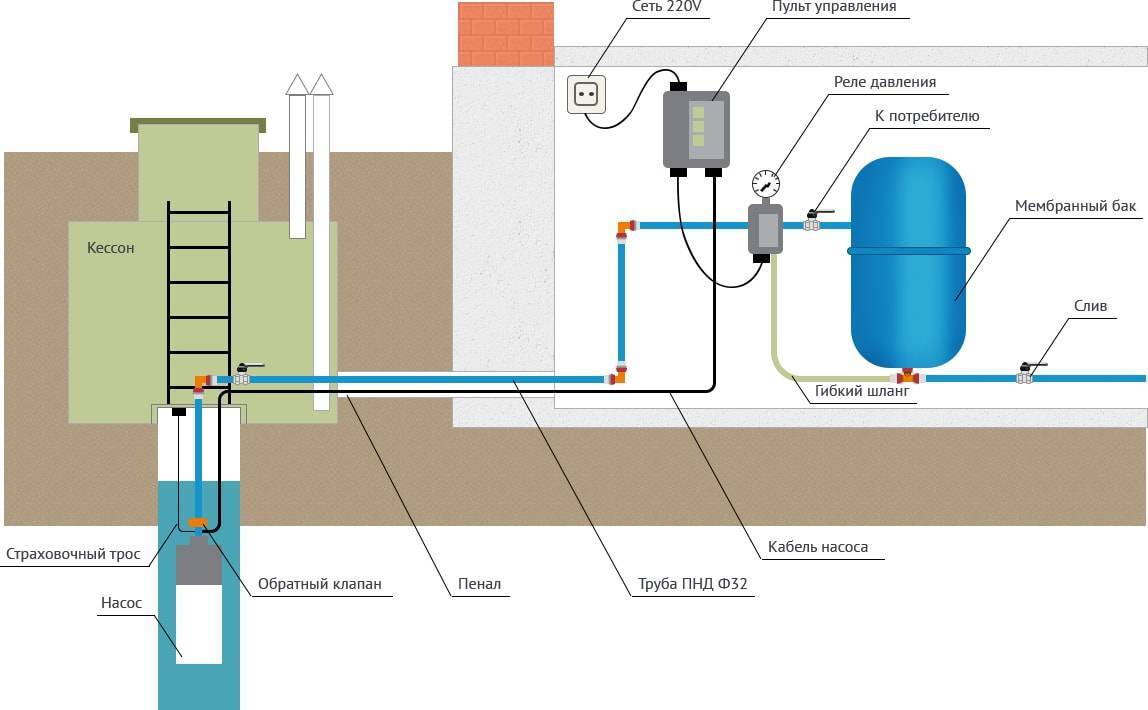
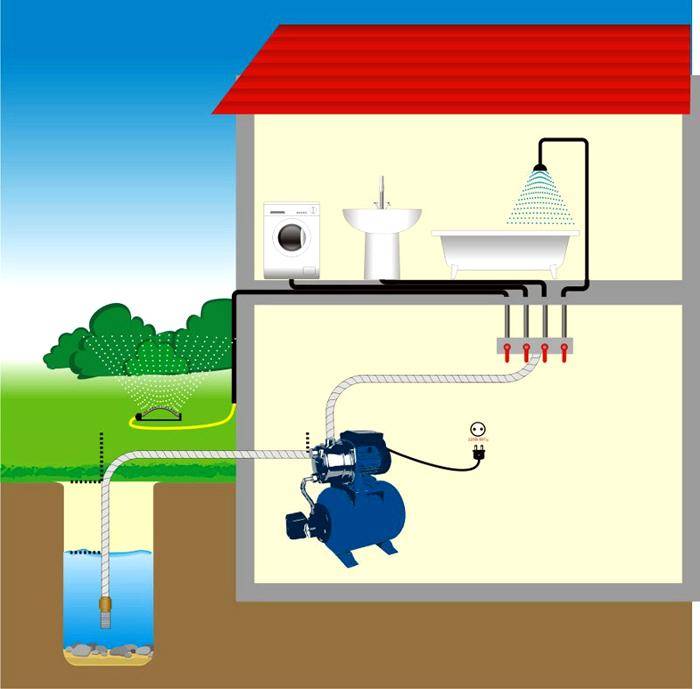
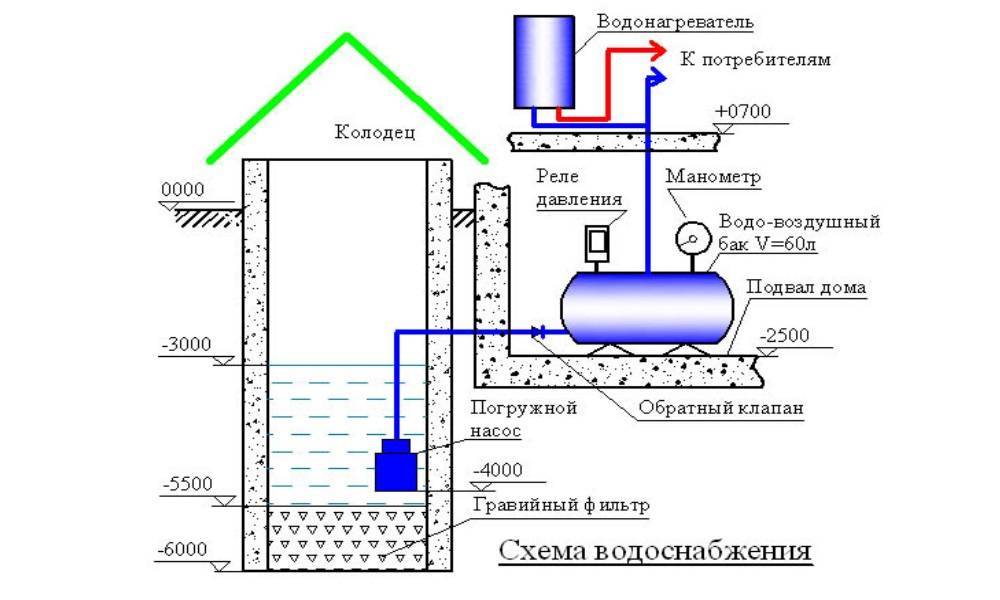
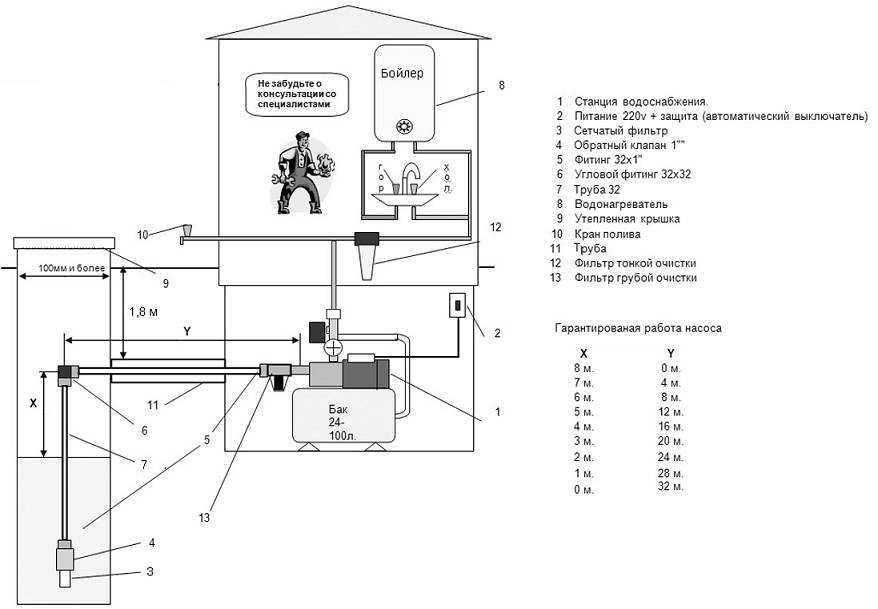
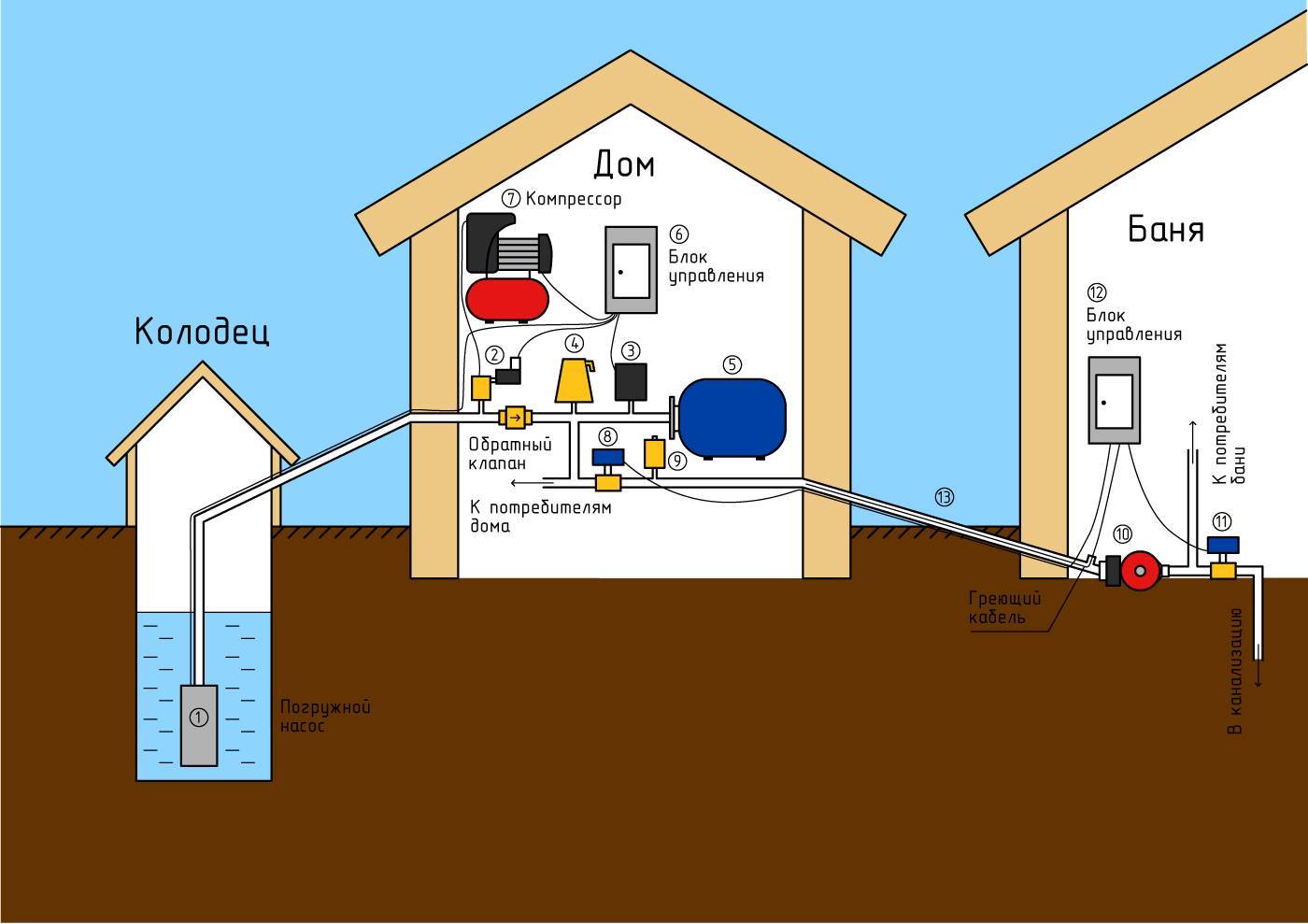
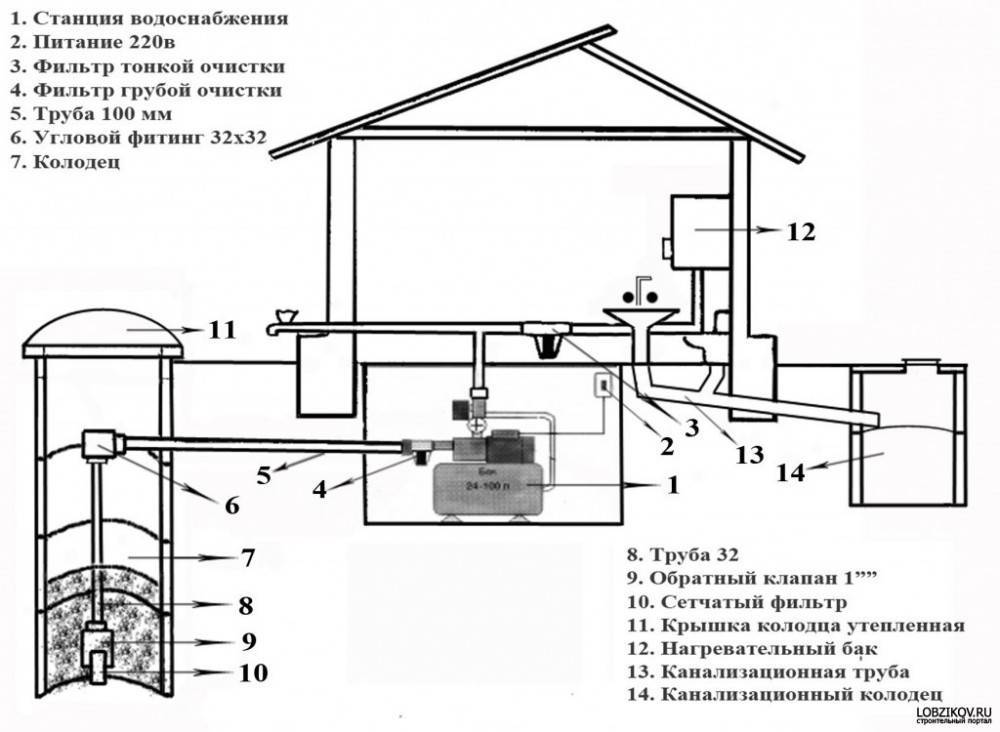
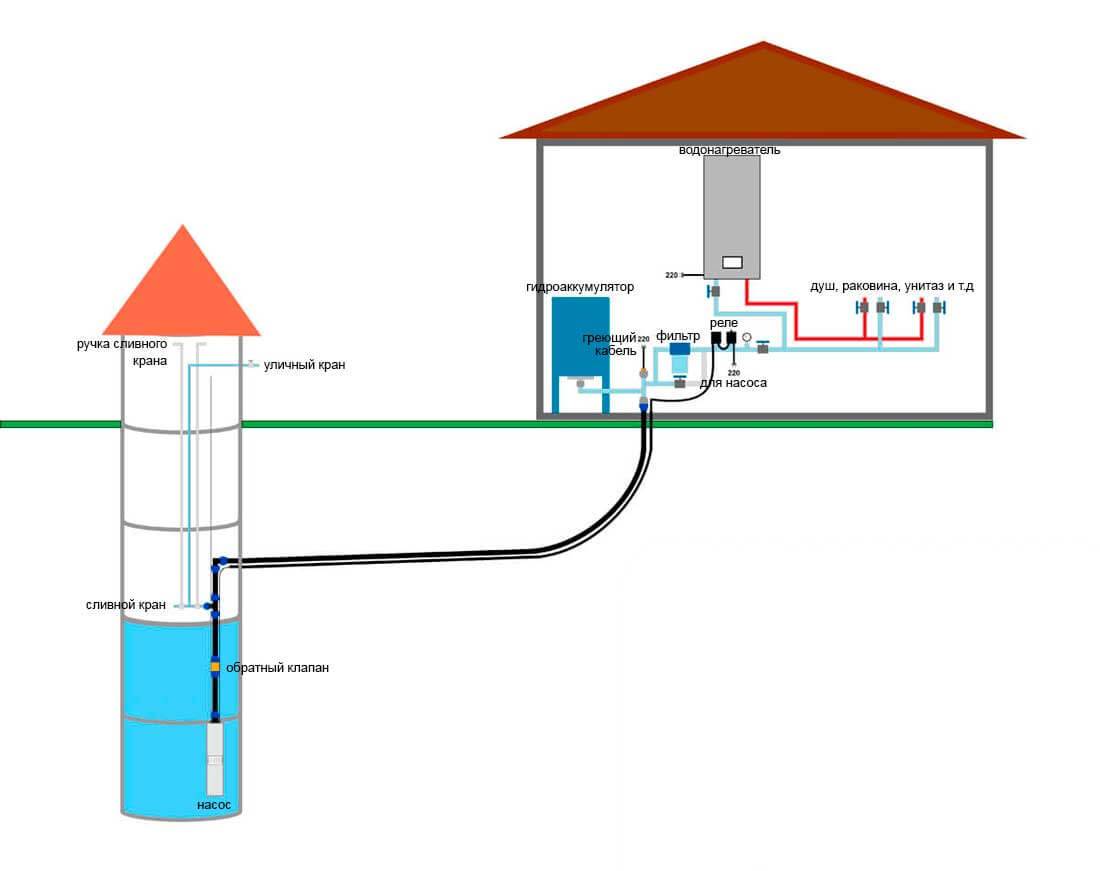
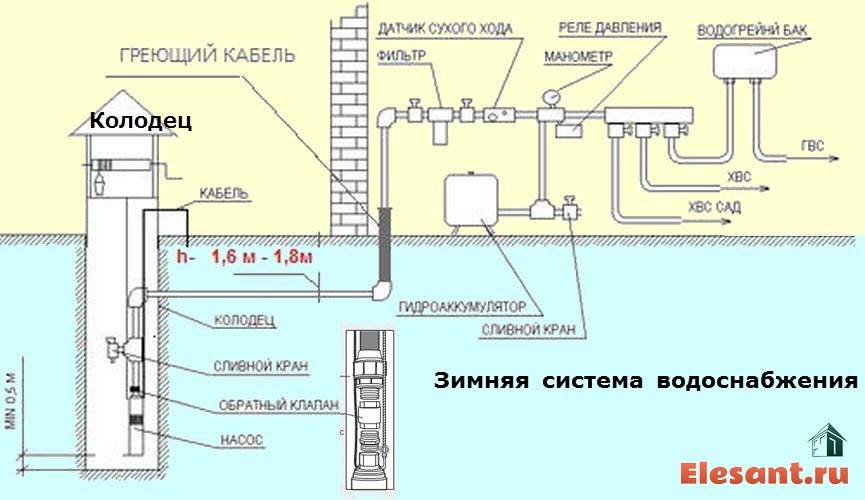
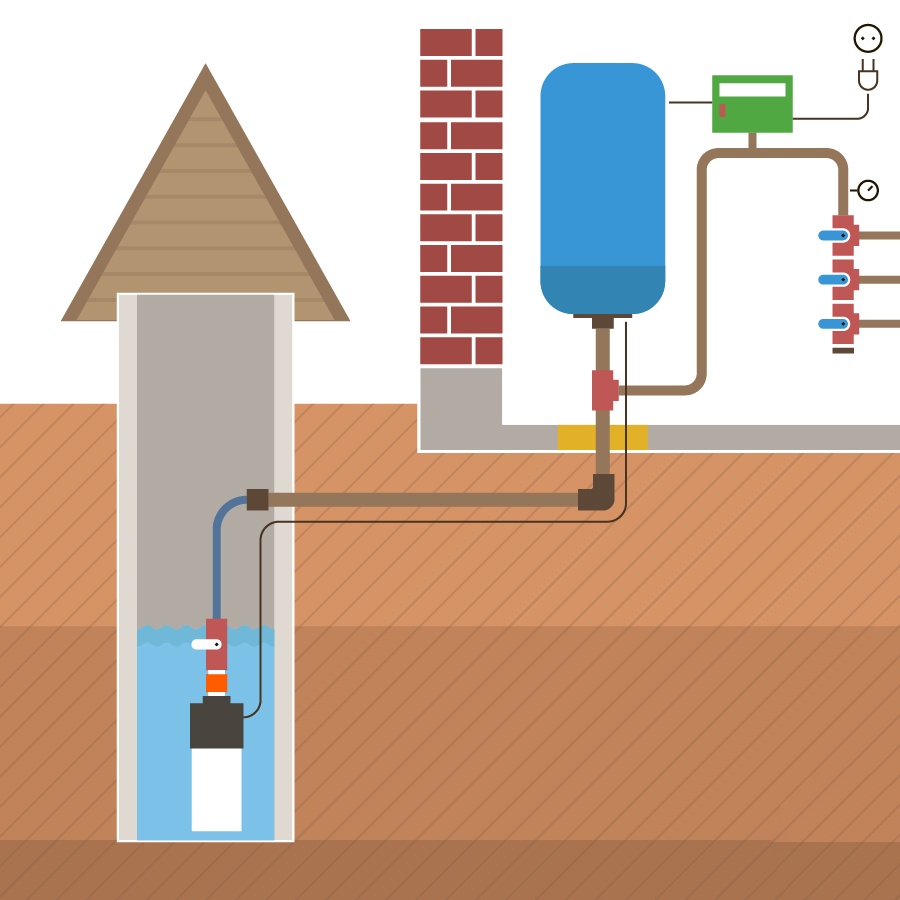
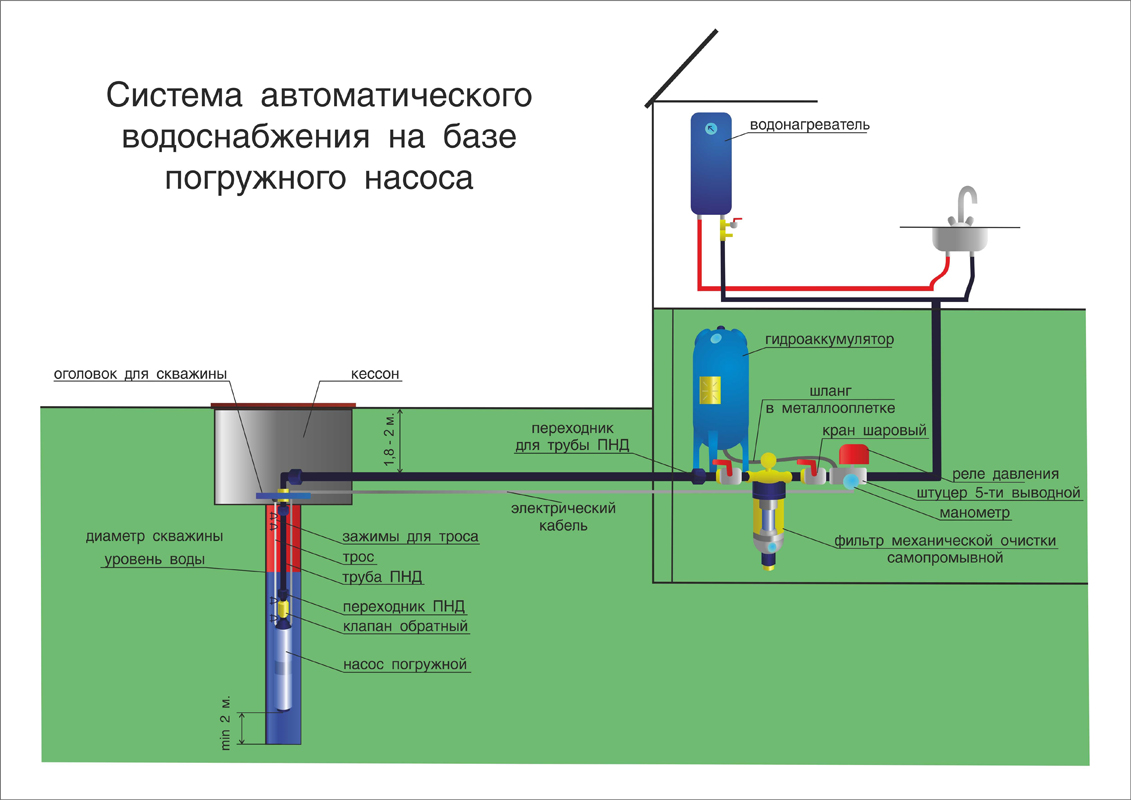
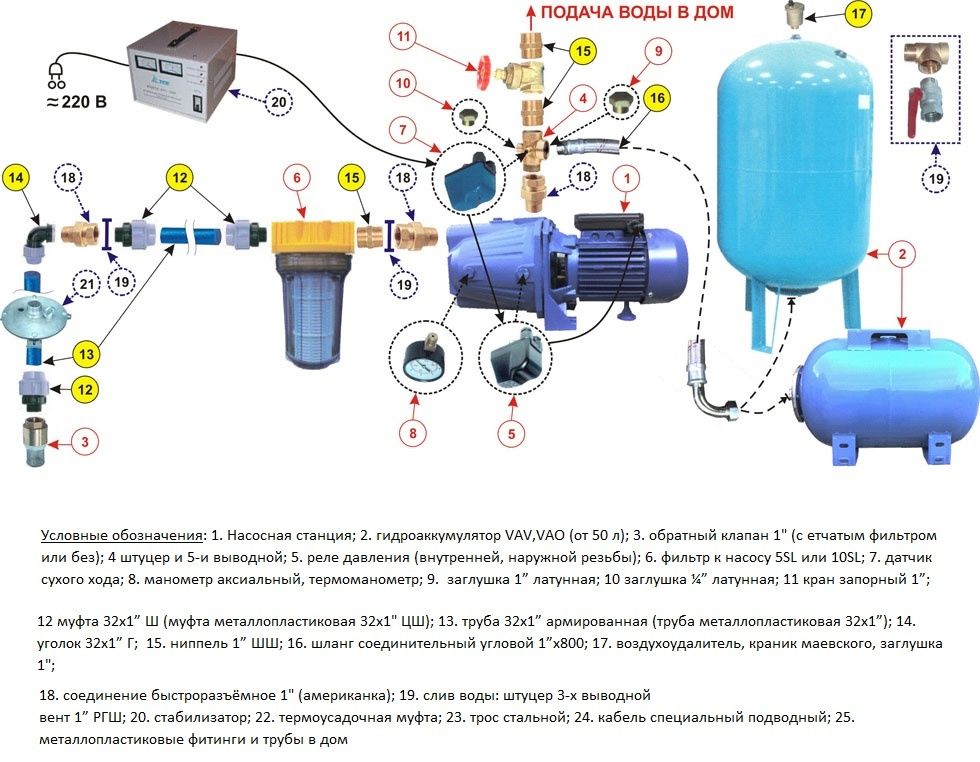
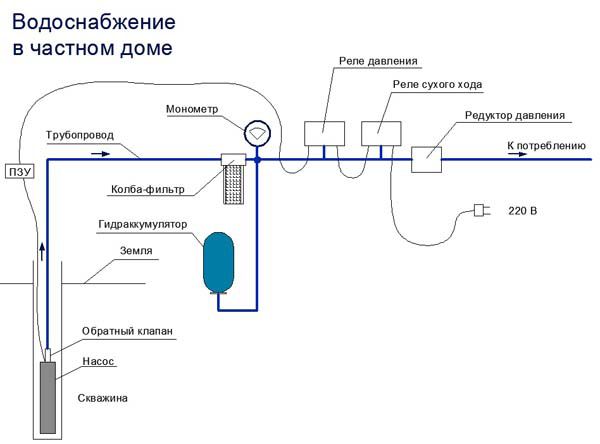
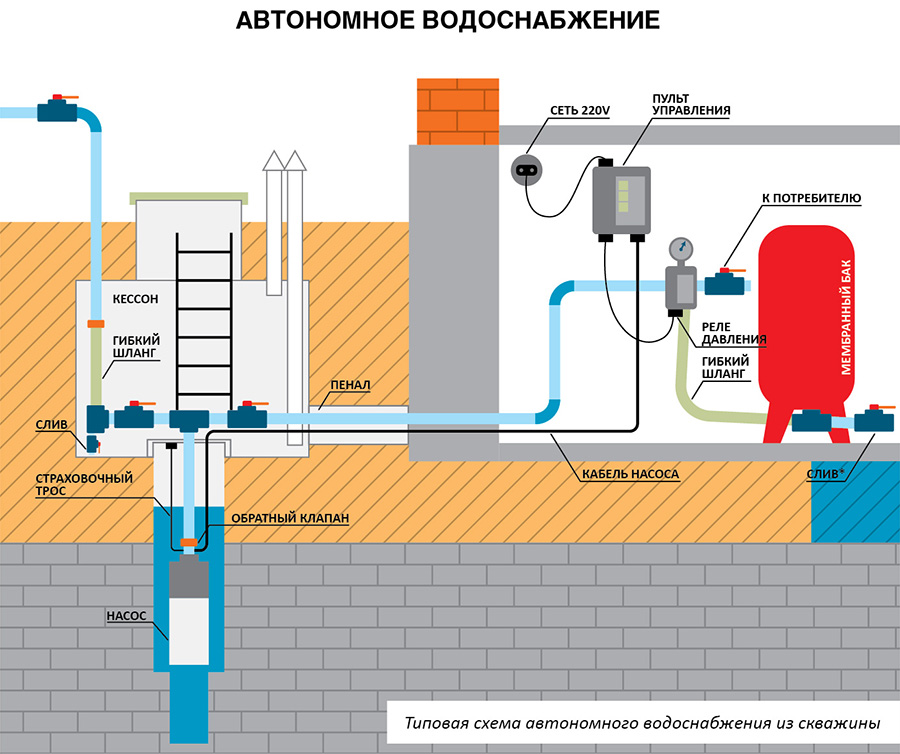
How is the automated water supply of a house from a well or a deep well arranged?
A submersible pump (membrane, vortex or multistage) is responsible for supplying water to the water supply system.Its task is not only to raise water from a depth, but also to compensate for hydraulic losses at the water supply inlet, shut-off and control valves and in the water supply system, and also to create the excess pressure necessary for the normal operation of sanitary equipment;
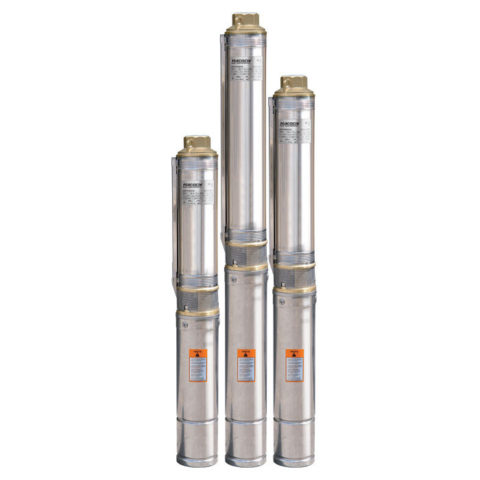
Pumps for deep wells and wells
The Atmor water heater turns on when the water pressure is at least 3 meters, which corresponds to a pressure of 0.3 kgf / cm2
The hydraulic accumulator allows you to make the pump starts more rare, compensating for the drop in pressure with a small flow of water. In addition, it smooths out pressure surges during pump starts;
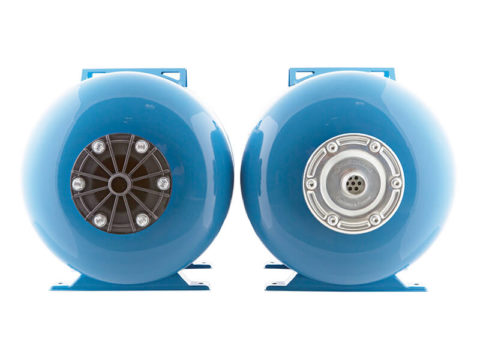
Membrane tanks of domestic production
There is a check valve at the pump outlet (usually spring-loaded - with a brass or plastic shutter and a stainless return spring). It locks water in the water supply and accumulator when the pump is turned off, preventing it from draining back into the well or well under its own gravity;
The valve is installed at the outlet of the submersible pump
Automation serving the water supply at home (pressure switch) starts the pump at a critical pressure drop and turns it off at the moment when the water pressure reaches the upper set point.
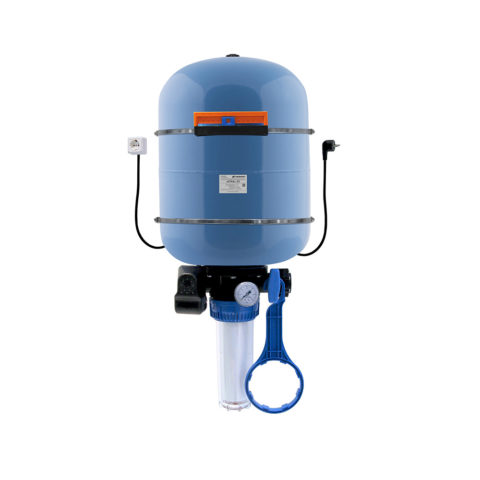
Automatic water supply system Gileks Crab 50 works with any pumps up to 1100 watts
How it works
The most common type of relay is electromechanical.

Domestic mechanical relay RD-5
They are extremely simple: the microswitches of the circuit supplying the pump are closed and opened by the movement of a spring-loaded piston during fluctuations in water pressure.
When the pressure drops, the circuit closes, when the upper bar set by the manufacturer or owner is reached, it opens.Adjustment of the upper and lower actuation limits is carried out by nuts that change the spring compression force.

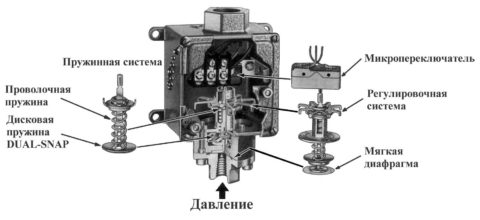
Mechanical relay device
A special case
Electronic relays are found on sale somewhat less often than electromechanical ones. The reason is obvious: with the same functionality, their price is much higher. If an inexpensive electromechanical relay will cost the buyer 250-500 rubles, then the cost of electronic devices starts from 2500 rubles.
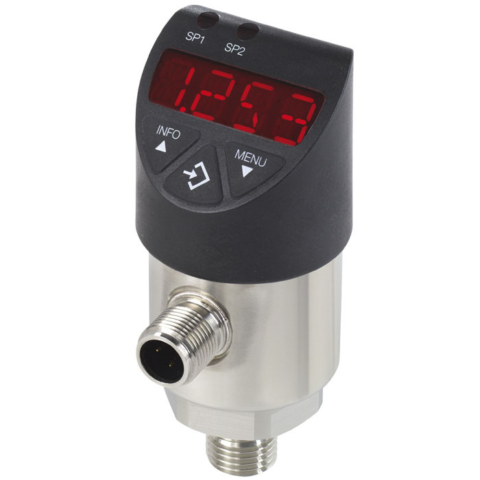
Relay with electronic control panel and indication
The basis of the electronic relay is a piezoresistive pressure sensor. When the piezoelectric element is mechanically deformed, a weak current at its contacts is processed by the control electronics, after which it turns the pump power on or off.
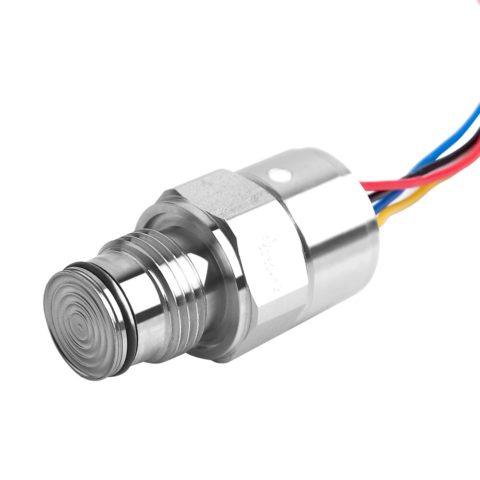
A piezoresistive sensor is responsible for measuring the pressure
Does the automatic house water supply system with an electronic relay any convincing advantages?
We will allow ourselves to give a list of the advantages of the Aquacontrol RDE device from the website of one of the sellers:
- Adjustment of the relay parameters (pump start and stop pressure) without opening the case, through the control panel;
- Protection against frequent switching on of the pump (for example, in case of a check valve failure);
- An electronic relay allows you to protect the water supply from bursting with excess pressure (if it does not fall to the lower specified threshold);
- In addition, it will prevent flooding of the house in case of leaks: the pump will turn off if the pressure in the water supply does not reach the upper threshold for a long time;
- Finally, the relay provides for operation in irrigation mode, without monitoring for possible pipe breaks or leaks.

Automatic water supply Water jet from Gileks with an electronic relay
Which pipes are suitable
Even 20 years ago, steel pipes were indispensable.Today they are almost never used: too expensive and impractical. Iron pipes rust very badly. Therefore, they came up with an alternative - plastic pipes. But plastic is different. Consider products from it.
HDPE products
The most popular material for pipes is low-density polyethylene. Their advantage is that they do not require additional installation. Fittings for HDPE assembly are threaded and twisted by hand.
The advantages of the material are as follows:
- The term of use is 50 years.
- Do not give in to corrosion and do not rot.
- If water freezes in them, the pipes will not burst; when thawed, they will return to their previous position.
- Smooth inner surface. This is necessary so that less pressure is lost during transportation and deposits do not accumulate on the walls.
- Convenient assembly.
HDPE, of course, has several disadvantages:
- Poor heat tolerance (except for XLPE pipes).
- Low strength - you can not walk on them.
HDPE pipes are welded with an “iron” - a special apparatus, you can still connect them using fittings. Tees, adapters, pieces of pipes are connected using threaded connections. Such a connection may seem fragile, but it is not.
Pipes differ in working pressure:
- L - light, up to 2.5 atm.
- SL - medium - light, withstand up to 4 atm.
- Medium - C, up to 8 atm.
- Heavy - T, from 10 atm and above.
For the installation of water pipes, classes SL and C are used. Pipe diameters are 32, 40 and 50 mm. Pipes also differ in density: 63, 80 and 100 PE.
PVC materials
Another type of pipe used for water supply is polyvinyl chloride. They are cheaper than HDPE pipes, they are connected by welding with glue.The seam at the same time withstands 12−15 atm. The service life is the same as that of HDPE.
Characteristics that the material has:
- It is used at temperatures from -15 degrees to +45.
- Does not tolerate freezing well.
- Moderately sensitive to ultraviolet light.
PVC pipes have several very important advantages:
- Easy pipe installation, flexibility.
- Smooth inner surface.
- Not affected by corrosion.
- Low flammability.
Like any material, PVC pipes have their drawbacks:
- Upper limit +45 degrees.
- It is difficult to dispose of, as it is harmful.
- Not strong.
Cracks and scratches greatly reduce the strength of PVC pipes, threaded connections are impractical. If piping around the site is a simple matter, then equipment piping is a difficult task. Due to this disadvantage, the use of material for external water pipes is limited, therefore, such pipes are used more often for internal wiring, where the risk of damaging the pipes is minimal.
Polypropylene Products
Another material that can be used as pipes is polypropylene. It also belongs to the category of plastic. Pipes are connected using couplings and soldering - there are special soldering irons that heat plastic on two elements, then connect them. It turns out a monolithic structure. You don’t even have to buy a soldering iron, you can rent it at a store that sells pipes and fittings for them.
The disadvantage of polypropylene pipes is one - expensive fittings.

Types and methods of water supply of a private house
From the standpoint of the dependence of the source of water supply on external factors, two fundamentally different types of water delivery to the user can be distinguished:
Centralized water supply at home
In fact, the same autonomous, but within the region.In this case, the user does not need to take care of arranging the source of water supply. It is enough to connect (crash) to the central water main.
Connecting the house to the central water supply
All actions are reduced to the phased implementation of a number of requirements, including:
appeal to the regional municipal organization MPUVKH KP "Vodokanal" (Municipal enterprise "Department of water supply and sewerage"), which controls the central highway;
obtaining the technical characteristics of the tie-in. The document contains data on the place where the user's pipe system is connected to the main and its depth. In addition, the diameter of the main pipes is indicated there and, accordingly, instructions for choosing home piping. It also indicates the water pressure indicator (guaranteed water pressure);
get an estimate for connection, which is developed by a utility or contractor;
control the execution of work. Which are also commonly performed by UPKH;
perform a system test.
Advantages of central water supply: convenience, simplicity.
Disadvantages: fluctuations in water pressure, questionable quality of incoming water, dependence on central supplies, high cost of water.
Autonomous water supply at home
It is possible to independently provide water supply to a summer house, private or country house using autonomous water supply. In fact, this is an integrated approach, which includes activities for the installation of a water supply system, starting with providing a source of water supply, ending with its discharge into the sewer.
An autonomous water supply system can be represented as two component subsystems:
water delivery: imported, groundwater, from an open source;
supply to consumption points: gravity, using a pump, with the arrangement of a pumping station.
Therefore, in a generalized form, two water supply schemes can be distinguished: gravity (storage tank with water) and automatic water supply.
Using the container (water tank)
The essence of the autonomous water supply scheme at home is that water is supplied to the tank using a pump or filled manually.
Water flows to the user by gravity. After all the water from the tank has been used, it is refilled to the maximum possible level.
Gravity water supply system - water supply scheme from the storage tank
Its simplicity speaks in favor of this method, it is suitable if water is required from time to time. For example, in a dacha that is not often visited or in a utility room.
Such a water supply scheme, despite its simplicity and cheapness, is too primitive, inconvenient and, moreover, creates significant weight on the interfloor (attic) floor. As a result, the system has not found wide distribution, it is more suitable as a temporary option.
Using the automatic water supply system
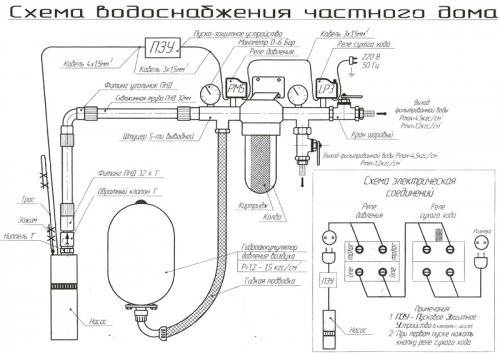
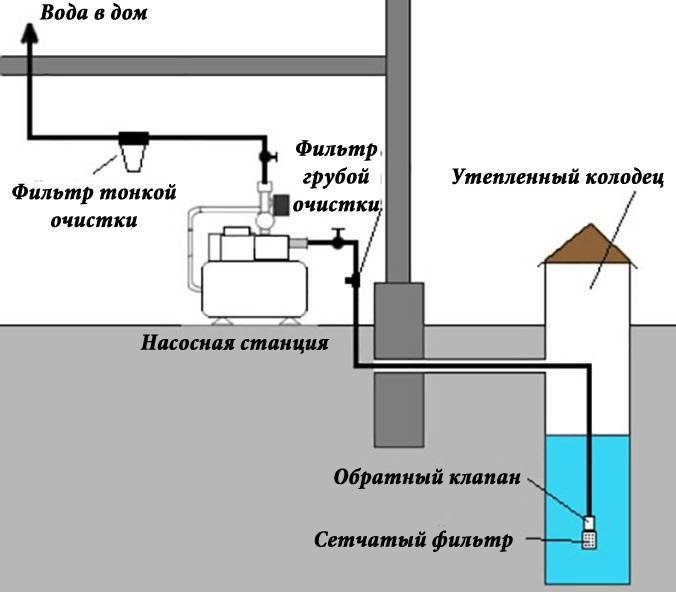
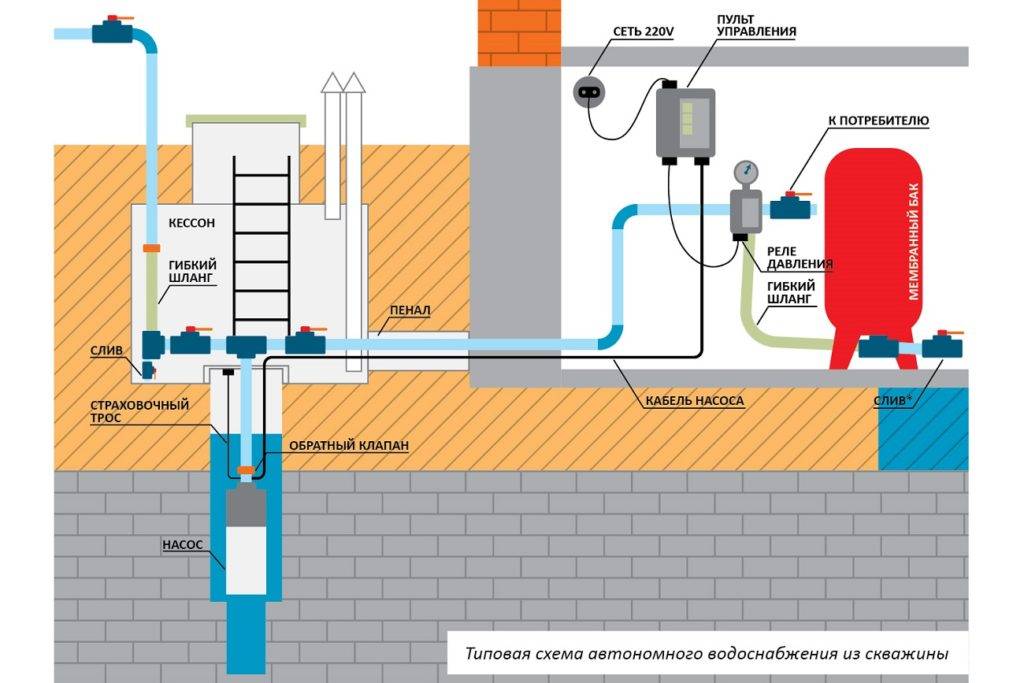
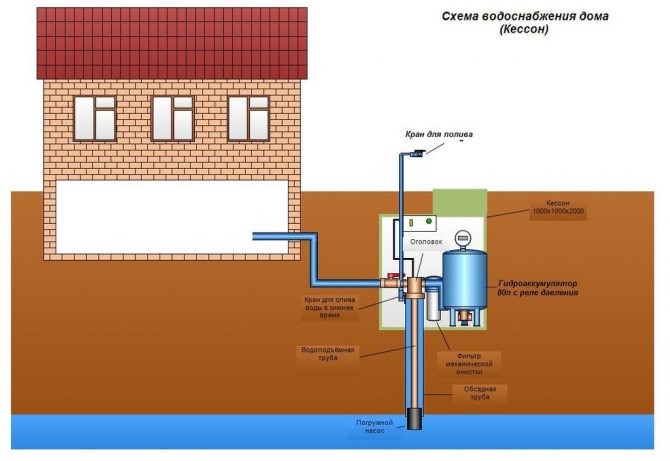
Scheme of automatic water supply of a private house
This diagram demonstrates the operation of a completely autonomous water supply system for a private house. Water is supplied to the system and to the user using a system of components.
It is about her that we will talk in more detail.
You can implement a completely autonomous water supply of a private house on your own by implementing one of the schemes. There are several device options to choose from:
1. Water from open sources
Important! Water from most open sources is not suitable for drinking. It can only be used for irrigation or other technical needs. Obtaining water from an open source requires the creation of sanitary protection of water intake points and is regulated by the provisions of SanPiN 2.1.4.027-9 "Zones of sanitary protection of water supply sources and drinking water pipelines"
Obtaining water from an open source requires the creation of sanitary protection of water intake points and is regulated by the provisions of SanPiN 2.1.4.027-9 "Zones of sanitary protection of water supply sources and water pipes for domestic and drinking purposes."
Device
Not all pipes on the building materials market are suitable for creating an autonomous water supply system. Therefore, when choosing them, first of all, you need to look at the markings. Water pipes have approximately the following designations - PPR-All-PN20, where
- "PPR" is an abbreviation, an abbreviated name for the material of the product, in the example it is polypropylene.
- "All" - an inner aluminum layer that protects the pipe structure from deformation.
- "PN20" is the wall thickness, it determines the maximum working pressure of the system, measured in MPa.
The choice of pipe diameter is based not so much on the diameter of the threaded inlet on the pump and the automated pressure control system, but on the expected volume of water consumption. For small private houses and cottages, pipes 25 mm in diameter are used as standard.
When selecting a pump, the following points should be considered:
If water from a well is used, a vibration unit cannot be used, it will damage the casing and filter element. Only a centrifugal pump is suitable.
The quality of the water from the well must meet the requirements of the pump. With a well “on the sand”, grains of sand will come across in the water, which will quickly lead to a breakdown of the unit
In this case, it is important to choose the right filter.
Dry run automatic. When choosing a pump, if the choice fell on a model without built-in protection against "dry running", you must additionally purchase automation for the appropriate purpose
Otherwise, in the absence of water that performs a cooling function for the motor, the pump will overheat and become unusable.
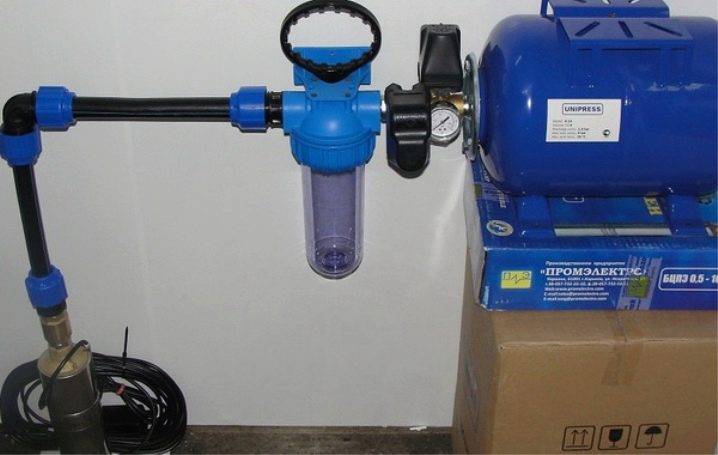
The next step is drilling a well. Due to the complexity and high labor intensity, this stage is best performed with the help of a specialized team with the necessary drilling equipment. Depending on the depth of water and the specifics of the soil, various types of drilling are used:
- auger;
- rotary;
- core.
The well is drilled until the aquifer is reached. Further, the process continues until a water-resistant rock is found. After that, it is inserted into the opening casing pipe with filter at the end. It should be made of stainless steel and have a small cell. The cavity between the pipe and the bottom of the well is filled with fine gravel. The next step is to flush the well. Most often, this procedure is performed using a hand pump or submersible, lowered into the casing. Without this, the action of clean water can not be expected.
The caisson serves as protection for a well, and for the equipment lowered into it. The life of the water supply system, as well as the convenience in servicing units immersed in the well, directly depend on its presence.
The caisson, depending on the material used, may be as follows:
- metal;
- cast from concrete;
- lined with concrete rings with a diameter of at least 1 meter;
- finished plastic.
The cast caisson has the most optimal qualities, the creation of which can take into account all the existing specifics of the well. Plastic caisson has low strength and needs to be reinforced. The metal look is subject to corrosion processes. Concrete rings are not very spacious and maintenance or repair work in such a caisson is very difficult. The depth of this structure is determined by the level of soil freezing in winter and the type of pumping equipment used.
For clarity, consider an example. If the depth of soil freezing is 1.2 meters, then the depth of the pipelines leading to the house is approximately 1.5 meters. Given that the location of the well head relative to the bottom of the caisson is from 20 to 30 cm, it is necessary to pour concrete about 100 mm thick with about 200 mm crushed stone. Thus, we can calculate the depth of the pit for the caisson: 1.5 + 0.3 + 0.3 = 2.1 meters. If a pumping station or automation is used, the caisson cannot be less than 2.4 meters deep. When arranging it, it is worth remembering that the upper part of the caisson should rise above ground level by at least 0.3 meters. In addition, a natural ventilation system is needed to prevent the accumulation of condensate in summer and frost in winter.
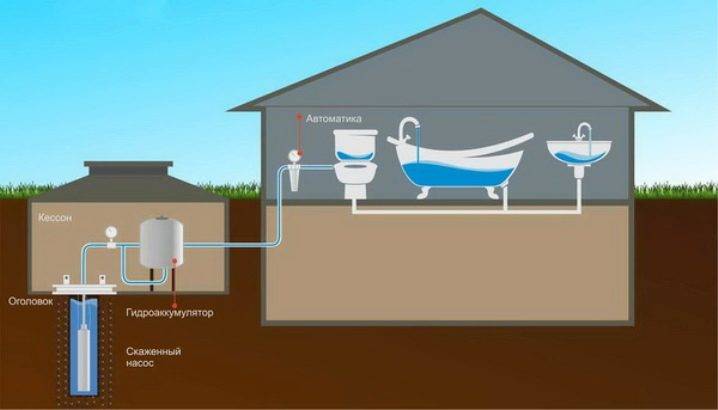
The principle of operation of an autonomous water supply system
The water supply system is one of the most important elements in home improvement.The essence of its work lies in the automated supply of the required volume of water, for which the user now only needs to start the equipment, and then simply control it periodically.
An autonomous network independent of the central water supply must be correctly designed and calculated in order for the house to be fully supplied with water according to the needs of the owners. It is necessary to organize the system so that water flows freely to all water intake points.
For normal operation, the water supply system is equipped with devices and technical devices that provide automatic or partially automatic operation.
To automate the process, a hydraulic accumulator is used. It is used as a buffer tank for water supply and as a device to maintain a stable pressure.
The membrane tank has two compartments - for air and water, separated by a rubber membrane. When the container is filled with water, the air chamber is compressed more and more, which increases the pressure.
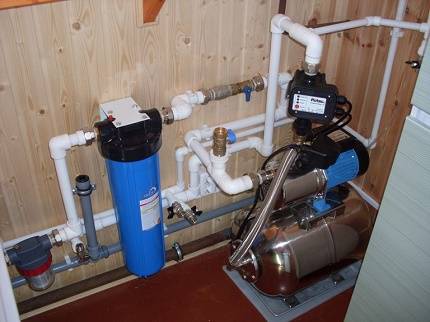
Autonomous water supply systems consist of internal and external parts. Includes pipeline branches of the same name laid from the water source to points of water intake, fittings, plumbing, pump, storage tank or hydraulic accumulator
Reacting to the increase in pressure, the electric switch turns off the pump. As soon as one of the owners opens the tap, the pressure in the system begins to drop. The relay again reacts to a decrease in pressure and turns on the pump unit to replenish the used water.
The use of a hydraulic accumulator in a water supply organization scheme allows not only to automate the process of water intake and ensure its supply.Significantly extends the life of pumping equipment due to the reduction of on / off cycles.
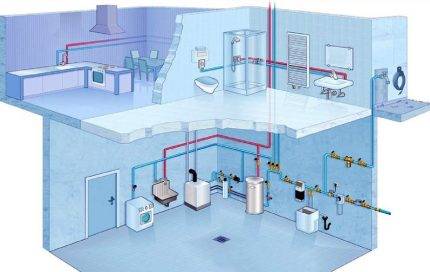 Water supply is the life support of the house. It depends on him how comfortable a person will live in his home.
To choose the right system parameters, you must:
- Formulate requirements for the intensity and regularity of water supply. It is possible that in a small country house you can get by with a system with a conventional storage tank and a minimum of plumbing fixtures.
- Determine possible sources, the feasibility and cost of their construction, water quality.
- Select equipment and calculate options for laying engineering networks.
A well-designed system requires professional installation and the use of quality components.
Well water supply
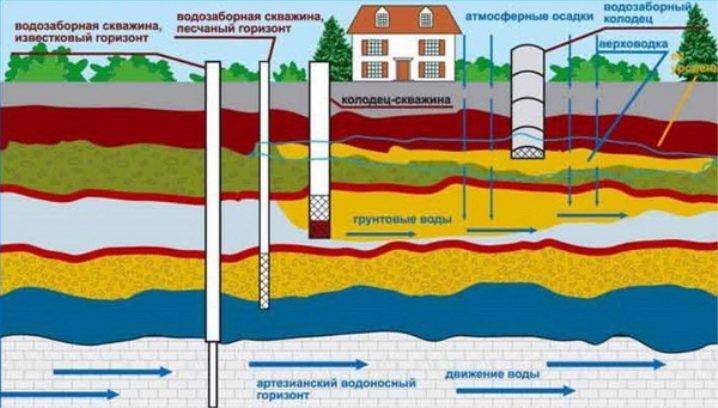
Wells "on the sand" are so called due to the fact that during the device they dig the upper layers of sandy soil, following the layer of loam, which serves as an excellent filter for groundwater. The depth of such a well reaches 50 meters. If, when drilling a source, 15 meters fall into the bed of an underwater river, this is considered a great success. After all, now the filters and pipes will not clog with sand due to the fact that this layer consists exclusively of pebbles.




Drilling takes place in the following ways:
-
By hand, you can drill a well up to 10 meters deep;
-
Percussion drilling;
-
Mechanized method of well clogging;
-
Percussion-rotary drilling;
-
hydrodynamic method.
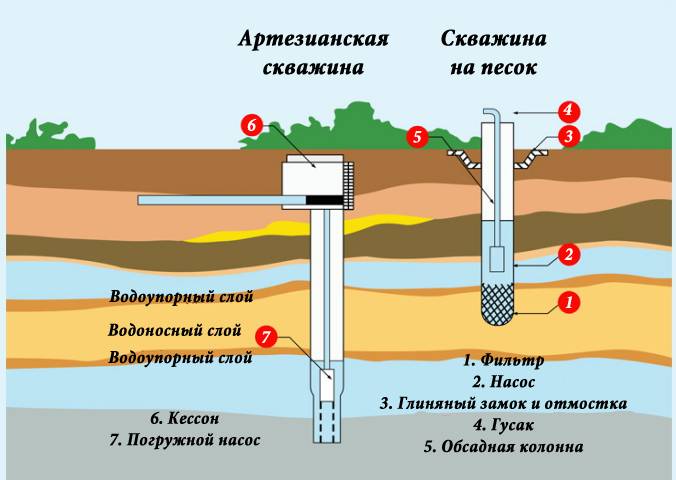
Scheme and difference between two types of wells
After drilling a well, a metal or plastic pipe is lowered into it, which fits snugly to the ground and prevents it from crumbling. Further, the arrangement of water supply based on a sand well is being carried out.The service life of such sources is about 10 years.
It will be much more difficult to supply water to a private house using an artesian well than in previous cases. However, such a source will last up to 50 years. In addition, an artesian well does not depend on climatic conditions and always has a consistently high debit. Any natural and technological pollution does not penetrate into artesian water, as the layer of impervious clay is a reliable natural filter. Such a source can be drilled in any part of a country house, unlike a sandy well. Choosing an artesian well as a source of water supply in a private house, it is necessary to ensure free passage of the drilling machine to the head.
General requirements for the area for drilling an artesian well:
-
Availability of free territory for drilling with a size of 4 × 12 m;
-
Ensuring a free height of 10 meters (no tree branches and electrical wires);
-
Absence in the next 50-100 meters of sewage, landfills, toilets;
-
Gates in the yard must be at least three meters wide.
Several main advantages of water supply of a country house with the help of an artesian well: high debit - from 500 to 1000 liters per hour, uninterrupted supply of high quality water, long-term operation of the source. Among the shortcomings can be identified the high cost of drilling. But it all depends on the season (drilling is cheaper in winter) and the depth of the selected equipment.